Sermon: “What now?” (John 1:1-14)

postcard

Back in my sophomore year of high school, when everyone in my grade suddenly started agonizing over their grades on each and every test and paper, it did not take me long to get caught up in the whole thing.

Like most people, I was more interested in some things than others, and I joyfully put in extra time in some areas without even realizing it, while in other areas it did not work that way.

I would read ahead for English class, even when I nearly missed dinner because of it. But each and every second I spent on Algebra II felt like a piece of my fleeting youth I would never be able to recover.

I could recite the 23rd Psalm in French because learning that was fun; however, when my Biology teacher tested us on a book he had assigned called “To Know A Fly,” I’d read the book so inattentively on the airplane back from Christmas vacation that I not only failed the test, but my teacher felt obligated to observe, “Mr. Grant, not only do you not know the fly, I’m not sure you ever even met the fly.”

(Teachers could say that sort of thing back then.)

Nevertheless, in sophomore year, with everyone around me talking constantly about how the stakes had suddenly gotten higher for us all, it seemed suddenly as if the subjects I loved and worked hard at weren’t good enough, while the ones I didn’t like and avoided were actually going worse than I thought.

And so came the day just before the end of the marking period, when in back to back classes, I got back an English paper I’d been proud to turn in the week before, and then a math test I’d stayed up long past curfew to prepare for.

And it turned out, unfortunately, that I hadn’t done very well on either one. Which is to say, I got a B+ on the English paper, and a C-/D+ on the math test.

I was beside myself. Beside myself.

I was convinced that my future was suddenly in severe jeopardy.

Crying was distinctly frowned upon for boys at my school, unless we’d just lost the Andover game, or something.

But I managed to sob myself to the classroom of my favorite teacher, Ms. Oakes, who sat me down and let me explain and handed me Kleenex, and all those things that teachers like that do.

And finally, after I was calming down, she smiled and said, “Max, let me ask you a question. And be honest. Do you truly think that you’ll still be upset about this a year from now?”

And this is the part of the story where I just want to say that teachers are scandalously underpaid in this great nation. If you’re a teacher, whatever we are paying you, we should double it tomorrow.

Because like so many other sophomores in the world, when Ms. Oakes asked me if I thought that in a year, I would still be upset about my two disappointing grades, I looked her right in the eye, and I said, with a big helping of how-could-you, “Ms. O., this is the worst day of my life. I will never forget this day.”

Well, eventually the crisis passed. My friends and I settled into sophomore year, and most of the time, the future seemed pretty much as far away as ever.

That spring, I decided to apply to a year-long school program in France for my junior year, and I got in, and off I went, and that was great.

And one day, when I was over there, I went to my mailbox , and there was a postcard with a picture of the Academy Building of my school on it.

It was a postcard. From Ms. Oakes.

It said, “Hi Max, Just wondering how you’re doing about that math grade from Algebra II. It’s cold here. See you soon!”

And friends, it’s then that I realized that there is nothing more beautiful in this world than the long game.

Yes, indeed, there are other games. Diversions, amusements, challenges, surely. But there is nothing that compares to the long game.

II.

I think about this during this time of year.

I try to remember about the long game.

January, as you may know, takes its name from the Roman God Janus, who had two faces—one that looked forward and the other backward.

So many of us do just that, ourselves, during these days—we remember the year just past and look to the year ahead. But it’s more of a short-game thing for us…anyway, it is for me.

Last year at this time, I was very certain that I was going to be very serious about losing some weight. I didn’t, though, and so, as I’m looking into 2016, I’m trying to imagine how I will go about it differently this time.

Within this world of what-will-you-remember-one-year-later, I guess that’s one thing that I do remember.

But yesterday, I was trying to remember what my New Year’s resolutions were for 2014, and I don’t remember any of them.

Which is just what my teacher, Ms. O., was saying, right?

Whatever it was that seemed in such great need of changing has either become so chronic that I’ve just decided to live with it, or somehow, it managed to resolve itself all on its own, without my help.

But there are other things I very much do remember.

Because by contrast, what I really do remember are those moments when I got to be with people—when I got to pray with them, or for them, when I was let in on some piece of important news that they were digesting, when I got to be a witness to the unvarnished truth about their life.

I remember moments with my kids and with Liz and with my parents.

I’m not sure we really acknowledge the spiritual significance of that kind of remembering.

But what it tells me is this: It tells me–reminds me–that what’s deeper than any resolution are the moments when we feel as if we truly know and are known by those we love.

If there’s anything this side of a miracle that has the capacity to change us, it’s not our resolutions—it’s that love.

I’m very sure of that.

III.

That, for me, lies very much at the heart of John’s gospel.

Our reading this morning was from the opening words from John—“In the beginning was the Word, and the Word was with God, and the Word was God.”

If it reminds you of the opening words of Genesis, which also begins with the words “In the beginning,” well, that’s on purpose.

The Book of Genesis imagines how it was that all things were called into being.

First God makes the light, then the heavens, then the seas and the land, and the things that grow, and the stars in the sky, and the moon and the sun, and the fish, and the birds, and the cattle, and then humans, and finally the Sabbath itself.

John’s account is simpler. It’s more of an annotation than a rival account, as such.

Because what John wants to say is that before all that creating, before this world we know so very well came into being, before God had reached over to press play on the great CD player of the world, there was Jesus.

There was Jesus. Watching. Waiting. Counting the minutes until he could join us—so great, so eager, so delighted and concerned for us, so fascinated by who he knows we really are, was he.

John writes: “What has come into being in him was life, and the life was the light of all people” (v. 3-4).

And he might just as well have that “what has come into being in him was love, and the love was the light of all people.”

Because it’s clear that what John wants us to know about Creation is not simply that it happened, or that there was order or purpose at the start of it all.

John is saying that God is playing the long game with the world—that he’s not content merely to create it, but that he loves it—he loves us—and what God wants is for us to know how deeply we are loved.

That God’s love is the light for all people if we would only know it. If we would only listen to it. If we would only follow it.

If we would only join the wisdom of the long game, and open ourselves up to the transformation that God wants so much for us.

What if this year, we resolved to love one another as Christ loved us?

There’s a resolution for us.


IV.

Friends, we spend too much of our time and energy worrying about things that won’t matter to us, even a year from now.

We focus our will on projects and plans and visions of ourselves that we probably won’t even remember.

What we will remember is the love we were able to give and to receive.

What we will remember is the new beginnings we find in each and every day that come with knowing we are loved.

What shapes our future is the love we are able to share today, however tentatively, however uncertainly, however inadequately.

The only thing really worth practicing and getting better at is love.

And John proclaims that for all that changes in our lives over the course of a year, or over many years, what matters most is what was true all the way back at the beginning: that abiding in us and in our world is the deep and wondrous love of God.

So often, it seems as if our lives leave us beside ourselves.

John reminds us that through all that comes, we are under the care of the God who always stands beside us.

“And the Word became flesh and lived among us, and we have seen his glory, the glory as of a father’s only son, full of grace and truth” (v. 14).

May this year be a year full of grace and truth for all of us.

Amen.

Christmas Sermon 2015: “Deep Darkness, Great Light”

storewindow

Last week, just after dark, I walked up Greenwich Avenue from the train station and got my first glimpse of the store windows this year.

I always enjoy that, especially in the evening.

The twinkle-lit trees are illuminated, and the restaurants are in full swing, and the commuters are trudging uphill with their briefcases and backpacks toward Maher Avenue or Mason Street.

As you know, the stores along the Avenue put some attention into their windows, and if you look closely enough, it’s almost as if a story unfolds—or as if you’re looking in on scenes from a world.

In one window, the mannequin with the cravat and the double-breasted blazer seems frozen in the middle of a joke with the mannequin in the red boiled wool jacket.

Maybe their next stop is the fancy dinner taking place two windows up, at Betteridge, where the table is set with an enormous Victorian silver gravy boat, shaped like Santa’s sleigh.

Or perhaps they are going down the Avenue, to the Classic Car shop to pick up their lovingly restored Triumph motorcar with the enormous red bow on it.

Christmas on the Avenue is elegant in a way that my own Christmas is not.

But it’s still fun to look, even if I can’t really imagine ever actually needing the particular accoutrements they have on offer.

I mean, have you ever noticed that there are always a lot of enormous leather steamer trunks in the windows along the Avenue this time of year?

This is not exactly about needing.

Admittedly, those windows are better at depicting the broadly aspirational than the strictly necessary.

They whisper to us about imaginary worlds that are just the merest swipe of a card away.

And so, indeed, there is something of us in those windows….

There is something we actually do need, in a different sort of way.

Because there’s something in them of our hunger for beauty and sophistication, for friendship or festivity, and maybe for a life without rushing: a life with time for actual conversation rather than texted reminders or “last chance” emails.

I always think we feel the rumble of that hunger more at Christmas.

There’s no denying that Christmas can be a particular focus for that longing.

If fact, if you look at those windows closely, maybe they have less to say about what elegance looks like than about what a life in balance looks like­—a life that’s more connected with people and places and to the joy of living.

At Christmas, the windows seem to speak to that dream of balance.

II.

Of course, the Christmas story as Luke’s gospel tells it is far from a celebration of lives in balance.

If there is one thing that was true for all the characters assembled around the manger, it is that after stopping in Bethlehem, their lives would never be the same.

Whatever balance they had come to know and rely on would turn out to be gone for good.

God’s supreme act of “disruptive innovation” would change everything.

In the Old Testament, the prophet Isaiah had written, “The people who walked in darkness have seen a great light; those who lived in a land of deep darkness—on them light has shined” (9:2).

I’ve always wondered if they thought of that—I wonder if all those various travelers on the roads to Bethlehem that night were thinking about darkness and light.

Think of all the old paintings of Joseph leading the donkey bearing Mary along the starlit road from Nazareth.

The scene always looks so quiet. They both look so lost in thought.

What were they thinking?

Everything and nothing, I suppose.

But I like to think that as the miles wore on, they were remembering the voice of Isaiah….deep darkness…great light…

Maybe the shepherds were thinking of Isaiah too, as they hunkered down on the edge of town. Shepherds were largely forgotten people, people mostly just hoping to pass through without causing attention.

They knew about deep darkness. They were living it.

So were the magi, wearing the exotic silks of royal courts, coming from Jerusalem on their camels, following the great star they had seen so far away, and so many weeks before.

They knew about darkness. They saw the look on Herod’s face when they told him about the star. They knew it wasn’t just a star, somehow.

Make no mistake: the darkness Isaiah was talking about went a lot deeper than the inky mantle of night.

The King James Version is exceedingly direct on this point, translating Isaiah’s words as: “The people that walked in darkness have seen a great light: they that dwell in the land of the shadow of death, upon them hath the light shined.”

Isaiah was talking about a world that needed saving—a world weighed down by the shadow of death itself.

So what Isaiah seeks to name, and what the Christmas story seeks to name, is first of all, the fact of that darkness—the darkness that is in the world, and the darkness that we find in ourselves….

We know it well.

It’s a darkness we encounter in the news, and in our homes and offices.

It’s the darkness we encounter in the comments section of any Internet story, no matter how seemingly uncontroversial.

It’s the darkness of a world where so many are fighting for their lives in so many different ways.

So much in our world is so ugly. The shadow of death is not far from us. We know it.

But that’s not all that Isaiah has to say.

He talks about darkness, but that’s not where Isaiah leaves things.

When Isaiah talks about light, about the great light, he’s trying to imagine what it will be like when the God who had seemed silent for so long will once again make His presence known.

The Gospel of Luke picks up on that.

For Luke, the promise of the story is that the coming of Jesus, the coming of the light, can rekindle the light within us.

Luke promises that, in Jesus, the light will be bright enough for us to see by, once again.

In fact, he promises that it will be bright enough for others to see, and that in time, they will come to follow it, too.

III.

Rekindling the light is slow work, even for the best of us.

That’s why we need to hold on to this story and to keep telling it. That’s why we need to pass it on to our children.

Christmas reminds us that the world needs our help, and that we need God’s help.

Yes, it is hard to wait—we’ve already been waiting so long.

But remember: the promise of the story is that, in fact, the waiting is over.

The story promises us—reminds us—reassures us that the work of redemption has already begun.

The light is already shining in the darkness, urging us forward.

Tonight we affirm again that in Jesus of Nazareth, the babe in the manger, God sent his only son to be with us and to share our life, so that in time, all people might come to share in God’s life.

It has already begun.

That’s what the story promises.

That said, what it does not promise is balance.

So many people seem to love Christmas because it calls us to be a little kinder, a little more generous, a little more patient.

There’s that song that goes, “We need a little Christmas, just this very minute….”

So many love Christmas because it calls us to put things in perspective. In balance.

But when push comes to shove, a lot of people don’t actually want a lot of Christmas. They only want a little. And they don’t want it in the fullness of God’s time. They want it now. Just this very minute. On their terms. In ways that fit in neatly to the lives they’re busy living.

They don’t want surgery: they just want to get a little work done.

And yet, that’s not what the story promises at all.

The story says that to live in the light of this story is to see our lives not just tweaked, but transformed.

To live in the light of this story is to see God’s claim on the world that He has made, and it is to see the world gradually waking up to that claim.
The story is about following the call to serve the love and purposes of God, wherever they may lead.

There’s nothing little about it, except for the little baby in the manger—that baby who is already growing into the mature person he will become.

Its enormous promise is that in him, even you and I might grow into maturity, too.

But only if we undertake the journey. Only if we are willing to walk the light of that one star.

IV.

 What is it we’re longing for this Christmas, you and I?

Lives somehow different than they are? Relationships, prospects, comforts, diversions somehow different than they are? A world somehow different than it is?

That’s not what’s on offer down Greenwich Avenue.

The real Christmas we seek is not on display in a store window.

Tonight we remember that the window that matters most of all is the window into God’s heart.

That’s what Christmas is. It’s a window into God’s heart.

And it shows us a world where the darkness is banished, and the way forward is clear, and whoever we might be and by whatever road it is we travel, there is a place for each of us around that manger. There is a place for you.

“The people who walked in darkness have seen a great light; those who lived in a land of deep darkness, on them light has shined.”

For it is by that light, that finally we come to see.

Merry Christmas. God bless us, every one.

Sermon: “The Surprise of Christmas” (Micah 4:1-5, 5:1-5)

surprise

When the prophet Micah wrote, sometime around 750 BC, King David had been gone for nearly 250 years, and the slow decline of Israel from its glory days was about to start moving faster.

When Micah writes, the Assyrians are putting Jerusalem under prolonged siege.

And so the first reading we heard this morning is a dream of peace—a dream where those who are coming to Jerusalem from all around the world are not nations coming to make war, but rather people of all backgrounds coming to Jerusalem to worship God.

Micah writes during days when the sight of figures coming over the horizon had grown ominous, indeed, but he dreams of a different day, when figures on the horizon will be a welcome sight—weary pilgrims rather than angry warriors—nothing to be afraid of, and even cause for celebration.

The second reading gives us a look at the actual scene.

He records God’s own words, saying, “Now you are walled around with a wall; siege is laid against us; with a rod they shall strike the ruler of Israel upon the cheek” (5:1).

There is a hunkered down quality to it—and he talks about the wall in a funny way, leaving it decidedly unclear if the people of Jerusalem are keeping the enemy walled out, or if it’s more accurate to say that the enemy has them walled in.

But here again, Micah speaks words of comfort. Surprising words, really, because he begins to speak to Bethlehem, saying, “…from you shall come forth…one is to rule in Israel, whose origin is from of old, from ancient days” (v. 2).

That is, help will come, the stalemate at the walls of Jerusalem will end, but surprisingly, not because the beleaguered people of the city will somehow think of something they hadn’t thought of before.

And not because they will think up some new military tactic or construct some new potent weapon of mass destruction.

The stalemate will end because God will raise up a leader from somewhere outside the walls, outside the expected channels or the obvious answers, and in that leader, the promise of God’s people that had been slowly slipping away since the days of David, will be reclaimed.

II.

It’s not very Christmasy, is it?

And yet it’s the little passage about Bethlehem that Matthew will quote in his version of first Christmas.

You’ll remember that one.

The magi come to Jerusalem from the east and ask Herod, “Where is the one who has been born king of the Jews? We saw his star in the east and have come to worship him.”(Matthew 2:2)

And Herod calls in every religious expert he can find in the city and asks them where the tradition says that the Messiah is to be born, and they respond, “In Bethlehem in Judea…for this is what the prophet has written: ‘But you, Bethlehem, the land of Judah, are by no means least among the rulers of Judah; for out of you will come a ruler who will be the shepherd of my people Israel” (v. 6).

Of course, the prophet they are mostly quoting there is Micah.

And so there is something in this passage that’s worth pausing over.

The prophet’s words would have been 750 years old by the time Herod heard them—I mean, no wonder he needed his lawyers and his theologians to look them up.

The siege about which Micah wrote was long over by then. The walls of Jerusalem had been reinforced and destroyed and rebuilt and then rebuilt again.

Such antiquity, notwithstanding, Herod, as we know, was not one to take chances with prophecies, and particularly prophecies about future kings of the Jews. As the present King of the Jews, he cared immensely about such things.

That sets a whole series of things in motion for Jesus and his parents.

But I think Micah was actually making a larger point, and Herod in his literalism misses that point. And the story, in its eagerness to show Jesus as the one who had been predicted in ancient prophecy, which is its own kind of literalism, almost misses it, too.

But I think it’s very important.

Because I think what Micah was trying to say is that there is something fundamentally unpredictable about God.

Remember what Micah says. He says that rescue is not going to come from inside the walls of the city, but from outside—from some unknown figure raised up by God outside the predictable channels, and outside the parade of the usual suspects, and from outside the ones we are accustomed to look toward for answers and for help.

It’s ironic, of course, that this will become the basis of a prophecy, because it confounds the notion of predicting in such a fundamental way.

III.

And yet what would it be like–how might our sense of Christmas be different–if what we celebrated on Christmas Day was the God whose love can strike as abruptly and powerfully and randomly as a bolt of summer lightning?

What if Christmas were more explicitly about God’s infinite capacity to surprise us?

That’s not all that far away from Christmas as we tell it.

Because after all, what is Scrooge if he’s not surprised? What is the Grinch if not surprised?

The shepherds were surprised.

Luke tells us that when they arrive at the manger, “…they spread the word concerning what they had been told about this child, and all who heard it were amazed at what the shepherds told them” (Luke 2:17-18).

Even Mary, who got the word first and has been closest to it in every way all along, is said to have “treasured up all these things and pondered them in her heart” (v. 19).

This cloud of witnesses around the manger has astonished her.

These people are all surprised.

Don’t get me wrong: I look to this season to remind and reaffirm a lot for me.

love Christmas and its traditions.

The other morning I came into the sanctuary and lit the Christmas trees myself and made a point of letting it soak in. I try to do that every year. I say “try” because believe it or not, even though I work only about 100 steps away from this spot, it can be hard to get here.

But it’s my experience that if I do, and if I give that kind of moment long enough, I’ll think of it when you need it down the line.

I’ll think of it when I’m waiting for Easter. I’ll think of it on those busy days at the end of another school year. I’ll think of it in July when the air-conditioning in my car isn’t working, and I need to drive somewhere in Friday 95 traffic.

Likewise, I look forward to visiting the inflatables on the Mead House lawn every night with the girls, who have particular cloaks they have appropriated for December. And every fall as the weather turns cooler I think to myself that it won’t be long now, and that lifts me.

Those parts of Christmas lift a lot of us.

IV.

 But a little bit, I worry.

I worry that all our anticipation, all our relying on that kind of lift, can turn Christmas into a festival for a God who comes on cue.

I worry that it makes Christmas about a God who comes at the stroke of midnight on December 25th, and with all the familiar trappings: as steady and reliable and surely worth visiting as Old Faithful.

But as Micah reminds us, the wondrous thing about this God, about our God, is that God doesn’t necessarily come on cue at all.

The thing about His love is that it constantly surprises us. It catches off guard. It breaks into the world. That’s how it grabs us…how it gets our attention.

Have you ever gone downstairs in the middle of the night for a drink of water or something, or maybe to turn down the thermostat, and realized that somehow somebody left your front door wide open?

There’s a reason that the angel always has to say, “Fear not!” when it appears.

Because the love of God surprises us like that. It makes us suddenly aware of our own vulnerability. Sensitive to the vulnerability of every living thing.

It’s a little fearsome, especially at first. But quickly enough, it warms us, too. And it teaches us to look for God in the situations when and where we least expect.

That’s what Micah tells us. That’s what the Christmas story tells us.

It’s not that “God is everywhere” in some general, pleasant sort of way. It’s that God could be anywhere, at work in anyone, in a way that changes everything.

God could even be at work in you or me.

When was the last time God surprised you?

If it was not so long ago, then you know. You remember.

If it’s been awhile, or if it’s never really seemed to work like that for you, then Christmas has one message for you: hang on to your hat.

God says, “Now you are walled around with a wall; siege is laid against us; with a rod they strike the ruler of Israel upon the cheek. But you, O Bethlehem of Ephrathah, who are one of the little clans of Judah, from you shall come forth for me one who is to rule in Israel, whose origin is from old, from ancient days….And he shall stand and feed his flock in the strength of the Lord, in the majesty of the name of the Lord his God. And they shall live secure, for now he shall be great to the ends of the earth, and he shall be the one of peace” (Micah 5:1-2, 4-5).

May Christmas always remind us of God’s power to surprise.

With all that lifts us in these days, may we remember that it is surprise that truly gives us our wings.

Amen.

From the Newsletter: “The Homecoming of Christmas”

rockefellertree

I have a friend from the old days in Brooklyn who has since left the City as part of a successful academic career. He’s one of the fortunate ones—he’s been invited to teach at wonderful places and has done well at each one. Like many displaced New Yorkers, he grouses about the lack of “decent” bagels anywhere west of the Hudson and doesn’t always know what to make of the instinctive politeness he routinely encounters in other parts of the country, but overall, he has been happy with his life and at home in the tidy, cultural communities where he’s been invited to live.

But every year at Christmas, he turns in his first semester grades, throws a duffel bag of laundry into the backseat of his now-legendary, almost “classic” Mercury Sable, and points the car back home. And happy as he is, successful as he is, he drives home to Brooklyn with the urgency of a diver trying to rise to the surface before his air runs out.

“God, I need New York,” he posted on Facebook a few days ago. “Won’t be long now.”

I’ve never asked him, but I’m guessing this goes deeper than the bit about the decent bagel. For many New Yorkers, it’s about the energy of the place—the feel of the streets, the little, familiar interactions between strangers, the sensory overload—these are all part of the unique rhythms of the City, and if they are part of your own rhythms, then there really is no other place where they seem to come together in just the right way.

Maybe that’s true of home for each of us, no matter where our home happens to be.

But what I’m especially thinking about these days is that urgency—that need for a place.

There is a similar kind of longing at the heart of the Christmas story.

It’s not longing for a place, per se, unless maybe it’s for a place that hasn’t quite existed, yet. Nevertheless, that sense of needing to be elsewhere is alive in the gospels. Both Matthew and Luke set the stage for the arrival of Jesus in a world that needs to be different than it is. And in their own ways, all of the characters, be they shepherds, magi, or member of the holy family, know what it is to have the rhythms of the heart feel out of kilter with the rhythms of the world.

The Christmas story begins with a world that needs to change: a world that both needs God and cannot seem to find God. The coming of Jesus is about God’s wanting to help us find our way at last, and to make a world where the rhythms of the heart feel truly at home.

That’s why we need this story all over again, each and every year. For all the great moments we know throughout the living of our days, there is still that sense that things are not as they were meant to be, and that we are not as we are meant to be. We are still searching for the place where everyone belongs, where all possibilities come together.

That’s why we need Christmas. Christmas names our hope for such a place, and God’s promise that in the fullness of time, He will lead us there.

Christmas is how we begin to imagine what such a place will be like.

So grab your duffel bag and get ready to hit the road. It won’t be long now.
See you in church,

Sermon: “Sparking Joy” (Isaiah 12:2-6; Philippians 4:4-7)

spark

Our texts this morning are two readings about joy.

From the Old Testament, the Prophet Isaiah, in the midst of a series of stern warnings about the impending future of Israel, interrupts himself to offer a vision of comfort and restoration.

“You will say on that day: ‘I thank you, Lord. Though you were angry with me, your anger turned away and you comforted me.’”

And he promises the people: “You will draw water with joy from the springs of salvation…shout and sing for joy, city of Zion, because the Holy One of Israel is great among you.” (12:1, 3, 6)

It is a vision of life and restoration for a world into which the Messiah will have finally come.

Then we heard from the Apostle Paul, writing much later, after the life and death and resurrection of Jesus.

It is another brief passage from Paul’s great love letter to the church he had founded at Philippi: “Rejoice in the Lord always!” he urges. “Again, I say rejoice! Let your gentleness show in your treatment of all people. The Lord is near.” (4:4-5)

Those are certainly nice words. But the sense of an impending future hangs over them, too.

At that time, he days that were ahead for the Christian communities were not going to be easy, and that was already clear…already very much happening, as Rome began to take notice of this strange new religion that was sprouting throughout the Empire.

Paul knew that firsthand, himself. It helps to know that, in fact, he writes these words about joy from prison, in what was likely his final incarceration in Rome, during which he died…probably by execution.

So this is not a holiday candy gram sent from Canyon Ranch or Aspen.

Paul talks about “the peace that passeth all understanding,” and if he makes such a point of talking about joy, then these words are very much an expression of that peace, and of the joy that flows from that peace.

And so if Paul and Isaiah can talk about joy within the context of their particular circumstances, then we are invited to do the same. We’re invited to speak about joy within the context of our particular circumstances.

II.

What can we possibly say?

I suspect that the general consensus is that joy is not having a particularly great year in 2015.

So let’s not start on joy just yet. Let’s talk about something else.

Instead, let’s start by talking about de-cluttering.

Many of you may know about de-cluttering—the art and science of organizing the spaces where we live and work.

Some of you are probably David Allen fans—he’s the guy who wrote that book called “The Art of Getting Things Done”.

Some of you may follow Heloise with her helpful hints. She’s good, although in my experience, for Heloise, every solution to every problem somehow seems to involve diluted white vinegar. I don’t get that.

Or maybe like me, you’re married to someone who loves the Container Store. I’m told that some people love it so much that, given the choice between a week in Acapulco without children or four hours without children at the Container Store….

So anyway, my point is here is that I am told that de-cluttering is a little bit of all of those things.

And so for those who study its mysteries, 2015 will be long remembered as the year of Marie Kondo, the author of “The Life-Changing Mage of Tidying Up: The Japanese Art of De-cluttering.”

You see, Marie Kondo approaches the practice of de-cluttering with Zen-like simplicity.

And she says that the way to de-clutter is not an elaborate system to be created. Rather, it is to ask one question of each and every thing we own.

She tells us to take each thing in our hands, look at it carefully, and ask: “Does this spark joy?”

That’s it.

If something sparks joy, keep it. If it doesn’t, give it away or throw it away, but it needs to go away. Pretty much now.

Fundamental as the question is, and easy to ask, it turns out that this is harder than you might think.

So often, we seem to hold onto things. Things that should spark joy. Things that used to spark joy. Things that might one day spark joy. Things that someone we’re not thinking of, or someone we may not have met yet will one day see and say, “Hey! That sparks joy! I’m so glad you have that!”

Well, that’s not good enough, says Marie Kondo. Don’t overthink it, she says. Just at a gut level, today, does what you’re holding in your hand spark joy?

Because, as one of her disciples explains, the reality is that we don’t hold onto things, per se—what we hang on to are the emotions attached to those things.

And emotions can be so hard to let go of.


III.

I don’t know about you, but I find that helpful to remember in this time before Christmas.

For so many of us, Christmas is a season of emotional over-eating and emotional over-spending and emotional over-load in general.

But when was the last time you looked at a Big Mac grabbed on the run on the way back from the mall after some Christmas shopping and asked, “Does this spark joy?”

When was the last time you that you held another invitation for another December party and asked, “Does this spark joy?”

When was the last time you held a gift for someone else in your hands and knew that it was destined to spark joy, both in the giving and the receiving?

Sometimes, we really need to ask ourselves what it is that we’re trying so hard to hold onto.

If you think about it, I think you’ll see, that these aren’t just the questions of de-cluttering. They are the questions of Advent.

Advent is, likewise, a time of personal inventory, and not only of our things, and of our relationships, but also of ourselves.

Sometimes, the thing we’re holding onto most tightly of all is some cherished image of who we are. What our lives should be like, or should be like again.  We have an image of the company someone like us ought to be keeping. The impact we should be making.

Our lives are cluttered with the false notion that the world belongs to us, and that what happens to us is the most important thing in the world.

And the fact is, that makes it awfully hard to be joyful.


But if we go back to Isaiah, writing in a time of great peril for God’s people—a time when so many had lost sight of what was most important, and lost sight of nothing less than what it meant to be faithful—he’s talking about joy.

What is this joy that he’s talking about?

He says, “You will draw water with joy from the springs of salvation.”

He says that because for him, joy and water are the sources of life. But they’re sources that flow from an even greater source, which is the love and faithfulness of God.

It’s a vision not just of individual salvation, but of a people redeemed and reoriented toward what really matters.

It’s a vision of a life lives with and for others, and lived with and for God.

In the same vein, if we go back to Paul’s letter to the Philippians, he says, “Rejoice in the Lord always! I say rejoice!” And he can say that, even from prison, even in the face of stern days ahead, because he has learned that the thing that sparks joy in him is learning to be true to the God, come what may.

He sees this as the answer for him, and for us all.

In Paul’s case, this is all the more remarkable, because he is a great thinker, a great reasoned, a passionate arguer—and yet in this moment, he’s not making a thoughtful, reasoned argument to his friends. He’s telling them not to be anxious, that a peace that passes all understanding—a peace that passes all reasons, all arguments—will keep their hearts and minds on Christ Jesus. No matter what may come.

What’s that about?

For Paul, it’s about knowing that the Lord is near.

It’s about the clarity that comes with knowing that the Lord will return, and so the only things there’s time for now are the things that give us joy. Not the happiness and diversion of the moment — Paul has no time for those. But the things that offer joy. The things that point to the love of God.

He and Isaiah are reminding us of what Advent is all about. The rest, they suggest, is just clutter. They’re right.

IV.

It says in the old hymn, “Joyful, joyful we adore thee, God of heaven, Lord of love. Hearts unfold like flowers before thee, opening to the sun above.”

And that is what we’re called to ponder. What is it that makes our hearts unfold—not what used to, not what’s supposed to, not what’s going to—what is it that makes our hearts unfold…today…now?

The church’s view is that if you look carefully enough, God is to be found in that unfolding.

And the message of Advent is that as the Lord draws near, there is no time for anything else. The time to listen and the time to act are now.

As we said before, in 2015, joy is not having a particularly great year.

Fear is rampant. Anger is rampant. Despair is rampant.

These are hard times.

But I would suggest to you that the Christian voice that the world needs to hear is not the voice of Christian fear, or Christian anger, or Christian despair.

What the world needs now is voice of our hope. The voice of our love. The voice of our peace. And the voice of our joy.

The world needs to hear from each of us now. That’s how we begin.

That makes the questions of Advent that much more urgent: What is it that sparks joy in you and me? What is it that makes our hearts unfold?

And how can we find a way to share it? How might our reaching out make other hearts unfold? How might our new-found love for one another teach us to move forward together?

That is what Advent challenges us to ask and what it is that God seeks to answer.

That is what the world is crying out to know.

Because the rest is clutter. Advent reminds us that it’s time to let it go.

“And the peace that passes all understanding, will keep your hearts and minds safe in Christ Jesus,” says Paul.

Let every heart prepare him room.


Amen.

Newsletter: “Waiting…and waiting”

Waiting

Dear Friends of Second Church,

A friend of mine, Rev. Quinn Caldwell, wrote a wonderful Advent reflection last year that begins: “There’s waiting and then there’s waiting.”

He means that there’s a difference between the waiting we associate with busy-ness and hassle, and the waiting that is part of our deepest hopes or hurts.

I don’t think I’ve ever really made that distinction before. Of course, waiting for a parking spot at the mall and waiting for an estranged sibling to call are very different kinds of waiting. So are waiting for a package to arrive (even an important one!) and waiting to see what a new relationship becomes.

It isn’t even that waiting for “good things” is different than waiting for “bad” ones, although that’s surely true. Nor is it that some things take longer than others, although we all know that’s true, too.

Curiously, “gratification,” “gratitude” and “grace” share the same Latin root—they all point to a sense of thankfulness, favor, esteem or good will. To me, this gets at the question of waiting…because what a world of difference there is between them. Our thankfulness to whom and for what says a lot about our priorities and focus. What are we truly waiting for? The momentary gratification when the cashier opens a new register (and I get to be at the front of a much shorter line) is not the same as the gratitude I feel for being out on a Sunday afternoon, buying our family Christmas tree…and neither compares to the grace of loving and being loved by those with whom I’ll share that tree, or ultimately, the grace of what their love teaches me about the grace of God, which is grace in all its fullness.

What are we waiting for? This is what the modern Christmas so often misunderstands. So much of it seems about gratification. Yet what we are truly waiting for must be closer to gratitude or grace.

These waiting of weeks before Christmas is a chance to consider what it is that we’re thankful for, and to whom we offer that thanks. It’s a time to consider what it is in ourselves, our relationships, and our world that remains unfinished, unresolved, or in need of repair. So often, it’s that finishing, that resolution, or that healing that we’re really waiting for—and the gratitude we feel, and the grace we encounter is about a sense of deeper connection to others and to God.

That’s what Christmas is really about.

As Quinn Caldwell says, “There’s waiting and then there’s waiting.” May we all make time to address that deeper waiting in these coming weeks.
See you in church,

Thanksgiving Stories

Dear Friends of Second Church,

I don’t know whether you’re staying or going this Thanksgiving.

Liz, the girls and I always “go”– first to my parents’ house for Thanksgiving (and overnight with their dog Henry, whom the girls adore), then on Friday to my in-laws in the City for Second Thanksgiving.

It helps that the matriarchs are both wonderful cooks.

But we’re very blessed to have all four grandparents near to hand and mostly spry, and we know that.

I remember my great-grandfather when he was a few years older than my dad, though I don’t remember much other than his supervising late season yard-work on the day after Thanksgiving.

When it came to children, he was pretty much a member of the “seen but not heard” school. In his view, yard work was for boys, dishes were for girls, and sitting quietly was for anyone under 30, except active military.

The idea of having a kid read him a book, or explain about which character in the movie is Kristoff and which one is Sven, or ask to hold the dog’s leash during a walk, or go on “Very Important Errands” with him to CVS–well, these things hadn’t been discovered yet.

So aside from the yardwork, and the one year I whined my way into getting my cousin Charlie to take me with him to the Madison-Guilford Thanksgiving Day football game, what I remember over all those Thanksgivings was a lot of sitting and listening to the grown-ups talk.

I didn’t look forward to it, although now, of course, I would give anything to sit there quietly and listen.

Because honestly, what talkers they were.

My Great-Uncle Tom, who was drafted at 19 and had hidden wine bottles all over the woods of France “just in case they ever retreated” en route to Berlin.

His wife, Aunt Alice, who had been the “Shoreline correspondent” for the New Haven Register, and one of the first people in town to own a television, and a political junkie since the 40s.

My grandmother, talking about the time she skated with Sonja Henie in “The Nutcracker” in New Haven, playing a rat who had to chase the cheese.

My father, who then as now, has always gotten on a roll when he’s around his siblings, and loves to get them bickering over what happened to the cat in 1953, or who convinced Brucie Barber to stick his tongue on the guardrail while they were waiting for the school bus one frigid February morning in 1948.

So many stories.

And so, while I’m glad that our girls will have warm memories of all kinds of adventures with their grandparents, and will remember how everyone was so interested in their world from the very first, I’m a little sad that they won’t have quite the same experience of hearing the stories year after year, of being initiated into the family lore (whether or not they want to be), of learning to listen not because they’re interested, but so that they might become interested.

They’re young. There’s still time.

But Thanksgiving reminds us of how importance it is to take hold of these moments, and that, while it takes years to pass on a legacy, we need to take the moments seriously–and see them for the opportunity they are.

Teaching our children what it is we believe in, how it is we understood ourselves to have been seen through challenges, what it is we think we owe, and where we come from are all vitally important things for us to pass on.

It’s part of how they understand not only that blessing is real, but that blessing takes particular forms within our lives, and that our legacies are shaped by those blessings.

Your family may not tell stories that refer to God or “faith” or “prayer” or even “blessing.” Most of mine does not. But in learning who their people are, for good or for ill, in ways comic and tragic, our children learn a lot about the way that love unfolds across the generations. They learn about who it is they are being invited to become. And they learn about the power of testimony in ways that will never let them go.

I feel God’s presence in that.  And I give thanks.

See you in church,

The Claims of Abundance (1 Thessalonians 5:12-24)

Ragamuffin

The next few days are precious ones for us Congregationalists.

These are that precious handful of days when people think about Pilgrims, Plymouth Rock, and the Mayflower—when stores and schools and all night diners all over the country are decorated with the autumnal colors and the cultural symbols of New England Puritanism.

Now there are those who cringe at the papier mache pilgrim hats and the little white bonnets for women and girls. Not me.

It’s kitschy, I admit it. But as a Congregationalist, I still love it. Because what form of tribute could be more American than that? In America, if you’ve been turned into a Pez dispenser or a party costume, your place in the culture is forever secure.

Now there are questions we might ask about just what place we Congregationalists seem to have secured.

If you go to Party City in search of Pilgrim hats or one of those fetching white Pilgrim bonnets, you’ll see that they have them on sale, which is entirely right and proper.

However, right next to them, you will also find the ready-to-wear, adult-sized, gobble-to-claw turkey outfit, because what Thanksgiving could ever be complete without somebody’s brother saying “I say boy…..” over and over and over again.

I’m not sure what that says about the place of Thanksgiving in the collective imagination these days. Or about the cauldron of emotions it seems to stir whenever we return to our families of origin—who wears a turkey outfit?

Still, as a Congregationalist, I delight. If some of our legacy is to sponsor an annual conversation about where it is that people call home, and why, or about how traditions shape us, for good or ill, I am delighted.

That said, it’s interesting to me to note how a day whose beginnings were found in gratitude simply for having survived at all after a long and difficult year has softened quite a bit since 1621.

That first year at Plymouth was a hard, hard year, indeed. Many of the Mayflower settlers didn’t make it through the first winter. None of them would have without the pity of the local Wampanoag Nation—and the providential discovery of some food buried in a nearby abandoned native town.

But when we celebrate Thanksgiving, that’s not really what we celebrate, is it?

The day isn’t about eke-ing out an existence in a strange and physically punishing environment. It’s become a celebration of abundance. If it’s about anything, anymore, it’s about remembering how our forefathers once had to eke, and about how, comparatively speaking, now many of us don’t have to eke—and, well, thanks be to God for that.

And so, for all the conversations that Thanksgiving seems to generate, I don’t think it generates the right one, at least as far as abundance is concerned.

II.

Actually, it used to do better.

Before the Macy’s Thanksgiving Day Parade, in fact, there was a tradition of what were called “Ragamuffin Parades”—particularly in New York City, but also in other places.

Ragamuffin Parades were for children, especially working-class children, who would go into wealthier neighborhoods on the day before Thanksgiving, wearing elaborate costumes and going door to door, asking “Anything for Thanksgiving?”

If it sounds distinctly like Halloween to you, you’re absolutely right. It was.

Yet I would suggest that the Ragamuffin Parade was trying to make a different point.

Unlike Halloween, the Ragamuffin Parade was about abundance. About not forgetting our neighbors, and especially about not forgetting our children. It was about social divisions, yes, but also about how good will and kindness could help to bridge those divisions. It was about reminding the successful that the left behind were not far away.

At a time when so much of the popular rhetoric was about how to ensure that fellow Christians and other were transformed into reliable Americans, the Ragamuffin Parades were a reminder from fellow Americans and others about becoming reliable Christians.

It would not have been entirely cutesy. The line between “The Little Rascals” and “The Gangs of New York” was thinner than you might think.

But the point would have been hard to miss.

With the pies for Thanksgiving already in the oven, and the smells of plenty filling the house, the Ragamuffin Parade came by, and who was who and what was what would hang there for a moment, and the descendants of those first Pilgrims would lock eyes with someone trying to eke out his existence in a strange and physically punishing environment. Someone who was seven.

Imagine if we still had it.

Because what would it be like if, on the day before Thanksgiving—which is always a day when the grownups are cooking or cleaning or trying to load the car so we can beat the traffic—what would it be like, if a parade of ragamuffins suddenly showed up, to remind us of our abundance?

Because, yes, sure, you’re trying to make it to LaGuardia and you don’t need to apologize to anyone for the fact that if some yahoo gets in the EZ Pass lane by mistake, that means you can miss your flight, and good luck to you if that happens. But then the parade comes and you remember: you’re blessed.

Or maybe it’s the day before Thanksgiving and you’re chastising a houseful of kids: “Guys you cannot make a fort out of pillows in the living room right now because Uncle Fred’s new wife is like Martha Stewart on Steroids and I really don’t have time to get chocolate finger schmears off of the sofa.” But then the parade comes and you remember: you’re blessed.

Or maybe nobody’s planning on coming by and you’re sitting at home, debating about whether to go to Boston Market for the half-chicken special, or just not bothering at all this year. But then the parade comes and you remember: you’re blessed.

Abundance takes many forms. Nevertheless, with all the challenges of the living of our days, it can be easy to forget the many ways that we are blessed. And it’s become all too easy to forget the enduring claim of our neighbors upon us.

III.

We don’t talk about that much as part of Thanksgiving, now.

But the fundamental understanding of the Pilgrims long ago was that unless you understand that, then you don’t understand much of anything.

They had a sense—a deep, abiding sense—that ultimately, all things come to us as gifts, that the world does not belong to us, but that it belongs to God.

They believed that there is a wisdom at work in our lives, even in adversity. They believed that wisdom is bringing the Universe together in ways that we can and in ways we cannot see, and they thought it was absolutely essential that we learn to trust that wisdom.


But they also recognized that this wisdom made claims on each of us along the way, and that loving God without loving our neighbors wasn’t really loving God much at all, because you can’t love God fully without coming to love what God loves.

Abundance was a grace, indeed, but it was never intended as a cloistered grace. It was a way to serve the Kingdom of God. They saw that, and tried to live it.

They were imperfect people, to be sure.

And yet their sense of thanksgiving was deeper and more challenging than ours typically is, and a lot more faithful.

But they understood that Thanksgiving had power in it. The power to make us much better Christians.

IV.

The Apostle Paul would have agreed.

Our reading this morning comes from his first letter to the Thessalonians, and he gives a series of moral exhortations.

“Encourage the fainthearted,” he says. “Help the weak. Be patient with all of them. See that none of you repays evil for evil, but always seek to do good to one another and to all” (v. 15).

But then he brings it home, saying: “Rejoice always, pray without ceasing, give thanks in all circumstances, for this is the will of God in Christ Jesus for you. Do not quench the Spirit. Do not despise the words of the prophets, but test everything; hold fast to what is good; abstain from every form of evil” (vs. 17-22).

To me, the part that is really important is when he says “Rejoice always…give thanks in all circumstances.”

Because remember: Paul is writing to a church that’s very different than ours. He’s writing to what will soon become a fugitive church—a church that will choose to meet in graveyards and catacombs because even Roman soldiers wouldn’t go there after dark.

Paul is writing to a church that even already is seeing the beginning of dark times.

And in that context, what he’s saying is remarkable.

Because what he’s saying is that it’s not enough to believe that the Gospel is true. It’s not enough to believe that Jesus was the Son of God. It’s not enough even to be ready to see those beliefs through to the end…whatever that end might be…and whatever bravery we might have to summon.

Instead, what matters according to Paul is to be so immersed in the love and purposes of God that we learn to “rejoice always,” and “to give thanks in all circumstances.”

What matters is to remember just how very blessed we are.

That’s not to say our lives are easy. That’s not to say it’s wrong to ask God to heal what needs healing in our lives or in our world.

It’s saying that despite how things may seem, it is still right to trust the wisdom at the heart of it all.

It’s saying that whatever darkness we may find ourselves in, it is still right to believe in the power of light.

It’s saying that no matter what may come, God’s people are called to remember the words of the doxology: “Praise God from whom all blessings flow.”

Because the blessings do flow. And God is the source of all our blessings.

So I hope you are proud to be identified with Thanksgiving, this particularly Congregationalist holiday.

You may not choose to wear the costume.

I don’t know that a Ragamuffin Parade will pass by your house on Wednesday to remind you of your abundance, and of the enduring claim of our neighbors upon our love and care.

But I hope you will recall the many blessings that have brought you to the place you are, and sustained you in the great challenges of life, and given you hope for what may yet come.

I hope in these days that you will be mindful of those blessings, and give thanks for the abundant life we find in God through Jesus Christ in the Holy Spirit, the giver of all good gifts. And feel God’s urgent call to share them with a world so much in need.

Amen.

The Urgency of Thankfulness

Prayer Book

Dear Friends of Second Church,

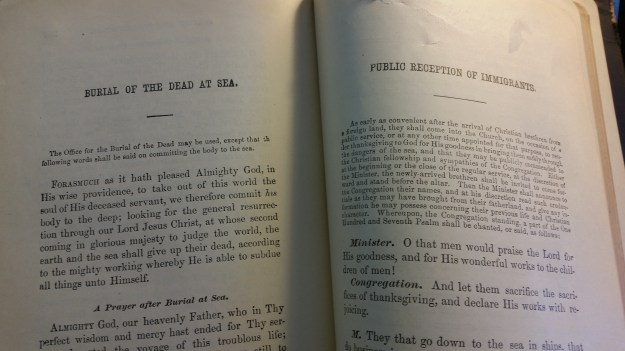
One of the gems in our church library is a 1901 Order of Worship book for the Reformed Church in the United States.

I don’t know how we came to have it. It’s not particularly rare or valuable. It’s a slender black book with a pebbled leather cover and gilt-edged pages, and looks a little like a daily diary, or like the sort of curio that a pastor buys at a yard sale.

Yet so much within it is familiar. Prayer books always have sections for different services, and there is always an appendix with the Psalms. This one is no exception. But books like these are also products of their times. For example, the Episcopal Church’s now not-so-recent revision of its Book of Common Prayer includes a prayer for astronauts and a few references to “interstellar space”…that was “cutting edge” when it first appeared.

With that in mind, when you look through a prayer book from 1901, it’s a glimpse into the hopes and fears of a new century, now itself past.

For example, it is telling that there is a whole section of “Prayers and Thanksgivings for Special Occasions at Sea.” It takes a moment to remember that, well, of course, they had those back then.

In fact, it’s next to that section, just between “Burial of the Dead at Sea” and “Laying of a Cornerstone for a New Church” that you will find a service for “Public Reception of Immigrants.”

The fine print at the top explains: “As early as convenient after the arrival of Christian brethren from a foreign land, they shall come into the Church, on the occasion of a public service, or at any other time appointed for that purpose, to render thanksgiving to God for His goodness in bringing them safely through the dangers of the sea, and that they may be publicly commended to the Christian fellowship and sympathies of the congregation…The Minister shall announce to the Congregation their names, and at his discretion read such credentials as they may have brought from their fatherland, and give any information he may possess concerning their previous life and Christian character.”

It’s telling that before offering the “fellowship and sympathies of the congregation,” and even before the announcement of their names and “such credentials as they may have brought,” it was assumed that the most urgent need of arriving brethren would be “to render thanksgiving to God for his goodness….”

I’m moved by that urgency.

In our own era, we can be so quick to introduce ourselves and so slow to remember to say thank you—to anyone, much less to God. We have lost some of that sense of having been brought “safely through the dangers of the sea” or any other place, and so often consider ourselves lucky (randomly) to have made it to a safer, better place, for however long we get to be there. We have lost the habit of seeing, and naming that sense of deeper forces and purposes at work in our lives, and don’t seem to feel as if we owe those forces much of anything.

Our forebears knew better.

That’s why Thanksgiving is such an important holiday.

It may not be on any Christian calendar—it’s not an “official” church holiday, of course.

But to me, it’s one of the most important holidays of all.

It’s a day we have a chance to feel that sense of God’s claim on our lives, and God’s claim on the history that brought us to this place. It’s a day when we remember that giving thanks isn’t supposed to be the last thing we do, but rather the first thing we do—just as Sunday, the Sabbath day, isn’t the last day of the week, but the first—it’s the act of devotion and the day of recollection from which all other acts and days may then begin.

Like the Sabbath, Thanksgiving is a day to remember that there is a world of difference between being “lucky” and being blessed—and that we have been blessed, and with much that God expects to follow from that blessing.

To me, this little prayer book gets it right. We have escaped the “Burial at Sea”—the sea of troubles we constantly navigate, whatever they might be. What lies ahead is the “Laying of a Cornerstone,” not only for a new church, but for a new world—a place that reflects our commitment to justice and peace, freedom and love, however we may be called to work for such a world.

What lies between is the urgent need for us to name God’s claim upon us. What lies between is the urgent praise of grateful hearts that know God hasn’t brought us this far to leave us. What lies between is the urgency of giving thanks.

Happy Thanksgiving.
See you in church,

Sermon: “Two Copper Coins and a Holy Trust” (Mark 12:38-44)

widowsmite

n the last couple of days, some of you may have seen news reports of a recent study of children and altruism, published in the academic journal Current Biology.

Apparently, researchers were looking to find differences in empathy or sharing in different cultures around the world.

And they were interested not in generosity, but in altruism, which is to say, they were not looking at how children gave when the giving was easy, but rather at what they could learn about how children gave to others when there was some sort of cost to themselves.

The results were surprising.

The children were asked to play a game in which they were given a limited number of stickers. They were told they could keep as many as they wanted. But then they were asked how many they would be willing to give away to an anonymous child in their school with their same demographic background. A kind of basic set-up to get at their abstract willingness to share.

It turns out that, actually, children who grow up in religious households (and particularly Christian, Jewish, and Muslim ones) are not more inclined to give sacrificially. That was the result that everyone was expecting. Actually, they may be somewhat less inclined to give sacrificially.

In fact, it turns out that the older the children were, the less generous they became, suggesting to the researchers that (as Forbes magazine put it) “longer exposure to religion leads to less altruism.”

Do you ever read something in the newspaper and think to yourself, “This is the article that is going to launch ten thousand blog posts?”

I feel a little that way.

And I’m not going to take our sermon time this morning to offer you my own attempt at a full response.

But I was interested to learn that this phenomenon, which we religious folks find so surprising, is less surprising to psychologists. It turns out that their work points to one possible answer for why religious children are perhaps less generous.

They refer to a phenomenon called “moral licensing.” Moral licensing is about how sometimes when we do good things, we may actually give ourselves a little more internal permission to do questionable things. It is as if we have proven to ourselves that we are good people, that our hearts are in the right place, so…what’s a little fudging on other things here and there?

Ironically enough, for some of us, attending church, or taking time for prayer, or reading Scripture privately in the morning before work, may actually make us a little more open to bending the rules in our own situation.

It reminds me of a story I’ve heard that surely cannot be true, about a church that was trying to attract people with a more edgy kind of message. So one day the head of the Church Council was driving by the church and she saw the pastor putting a banner over the front door that said, “Welcome Sinners!”

Of course, she immediately zoomed into the parking lot and ran over and said, “You can’t say that! I mean, people will get the wrong idea about who we are, and who we think they are…this is a disaster!”

And the pastor immediately backed down and said, “O.k., I get it. No problem. I’ll change it right away.” He hops back on the ladder and starts taking down the banner.

The next Sunday, she drives up to church and there, over the front door, is a brand new banner, and it says, “Welcome Pharisees!”

I doubt that pastor lasted much longer.

But if this whole idea of moral licensing is correct, I think we need to acknowledge that working through our own temptation to be Pharisees is an important and ongoing part of our faith journey.

II.

To put it another way, we may find the whole idea of moral licensing to be troubling, and maybe even astonishing.

But it seems clear that in his own time and place, Jesus saw such behavior all around him.

It did not seem to astonish him.

And I want to suggest that this morning’s story from Mark’s gospel about the widow’s mite, the widow who gives all that she has to the Temple, even though it is just two copper coins, is finally more about the danger of moral licensing than it is about the faithfulness of the widow.

We don’t tend to read it that way. For obvious reasons, we tend to read it in the context of stewardship.

We usually hear it as a call to giving—as a reminder that it is not the size of the gift but the size of the heart that gives it that matters—and I admit that I have preached that sermon. I’ve preached it more than once. It’s a good sermon.

The scene lends itself to that.

Because what we tend to forget is that in this scene, the widow is giving everything she has—everything including what she needs to live on—and while her faith is great, when push comes to shove, she’s putting her faith in an institution that doesn’t deserve it.

She’s putting her faith in an institution that caters to the scribes and has all but forgotten her.

She’s putting her faith in an institution that by the time Mark writes his gospel will already be physically destroyed, and the scribes who are there one-upping each other and strutting around won’t be there anymore. After unsuccessfully fighting against Rome, the Temple will be a smoldering ruin, and the scribes who ran it will have been almost entirely wiped out.

The point of the story is not that the woman is faithful. It’s that she’s taken her two copper coins and purchased herself a steerage ticket on the Titanic.

And if faith comes down to what the Temple does, then faith is sunk.

Jesus wants us to recognize that the faith that the Temple embodies is no longer a kind of life-giving connection to the purpose and presence of a living, loving God.

It’s become a spiritual DMV, offering the moral license lets people do what they want under a veneer of respectable religion.

III.

Church, this is a tough passage.

We want to think of ourselves as the widow, of course.

But I think Jesus’s word to us this morning is that, actually, we need to see ourselves as the scribes.

Jesus is pushing us to see that it’s their challenge that may well be closest to our own.

Because it’s easy enough to tell people to put their faith in God. That’s not wrong, by any means.

But remember: People also put their faith in us.

As they are learning what it is to put their faith in God for the first time….or as they are learning how to find God again when life has thrown them a curve ball…they can’t always see God.

But they can see us. They can listen to us. They can learn from us. And so, we have a holy trust to keep.

And so if we say “have faith because God is good”…if we say “With God, all things are possible”…if we say “All things work together for those who love God,” we must remember that it isn’t simply that they believe these things because they’re true, although indeed, they are true.

Before they ever get to that, though, they believe these things to no small extent because we say that we believe them.

They do these things because we say, this is the way to find God.

And so they do them. They put in their two copper coins and hope to God that what we’ve promised them is true.

We have a holy trust to keep.

The people in our lives who are like that widow—the people we encounter who are the most vulnerable, the most adrift, the most confused, the most precarious among us—the people we encounter who need God the most—they may not have

the spiritual wherewithal to know that God loves them, to know that the Universe isn’t out to get them, or to imagine a different future.

Instead, what they have is a spoonful of hope, and then the power of our example.

What they have is the gift of God’s love, and the humility we are willing to share about our own journey toward a more faithful life, with all its ups and downs.

We have a holy trust to keep.

And the remarkable thing is that if we keep it, this trust is enough. It’s enough to get started. It’s enough to feel included. It’s enough to get you feeling human again when you don’t. It’s enough to show you that grace is real, and that grace can be just as amazing as the song says it’s supposed to be.

It’s also why we must never give in to the temptation of moral licensing, with the little permissions we give ourselves to do what we will because the external trappings of our faithfulness mean we’ve already crossed God off of our “to-do” list for the day.

For just as surely as there is always need for kindness, for honesty, for justice, for peacemaking, so indeed there is always time for kindness, for honesty, for justice, and for peacemaking.

If only we will see the need. If only we will make the time. If only we will keep the trust.

The story of the widow’s mite isn’t a story of the power of generosity. It’s a call to be a church that’s worthy of her hopes, and listens to her need.

The need is real. But the grace is amazing. And it saves a wretch like you and a wretch like me, not just once, but time and time again.

May we learn to keep its trust through all our days.

Amen.