2CC Sermon: “The grace of being an old bag” (Romans 5:1-5; John 16: 12-15)

old bag

So, two weeks ago, I had the strange experience of taking delivery for two big ticket items in my world.

I got a new briefcase, and I got a new laptop.

The first one was a birthday present from my parents. The second one was for work, which means that it was from Gordon Ng. (Thank you, Gordon.)

I am getting used to both.

Both of them look brand-spanking new. Out of the packaging new.

Of course, in a laptop, that’s considered a quality.

Not that looks are everything, mind you. I’d guess that when it comes to a computer, speed and weight and memory are everything.

But there’s a connection there. We’re all used to the idea that, the newer a laptop looks, the safer it is to assume that it’s as fast and as light and as capacious as they could make it then.

I bet there are people who are into technology and can look at a laptop and say, “Ohhhh. A MacBook Pro early 2015 model. Man, you know, back in its day, that was a great computer….”

It reminds me a little of my dad, who is one of those people who can see an old car in a movie on t.v. and tell you the exact year that car was made because of the shape of the tail-fins or the chrome grille on the front.

Americans have always had a real appreciation for the new thing.

But it is part of the challenge of life today that there is so much that feels so new, so quickly.

Do you ever feel that way?

It is hard to keep up.

Speaking of which: it’s probably also true that in a world that seems determined to go entirely paperless, buying a new briefcase is kind of an old-school move.

Who’s going to need one of those?

Well, I do, and I will.

But here’s the thing that struck me.

In a laptop, being brand-spanking new is considered a quality.

In a briefcase, that’s not necessarily so.

Forget the nylon Land’s End jobbies that were popular in the 80s as a sign of high fashion, like wallets with velcro. I’m not talking about those.

In a briefcase, it’s all about the wear and tear. It’s all about the weathering…the gradual breaking in that comes out of being used—that comes out of being caught in the rain, or left out in the sun, being bungee-corded to the back of bike or scrunched under the seat of an airplane.

Something like that is more than just a tool for taking things from one place to another.

If that’s all you see, you’re missing it.

Because the point is that, over time, a briefcase starts to take on a kind of character.

The more beaten up it is, the more of a treasure it becomes.

If it’s stained, and curled at the edges, and all that, it is all the more highly prized.

It represents the idea that life can be hard on us, day in and day out, but this doesn’t wreck us—far from it. Somehow, that daily wear and tear brings out the patina, the true beauty that lies within us.

I’ve been thinking about that this week, as I’ve been carrying the words of the Apostle Paul in Romans back and forth in my new briefcase.

Do you see where I’m heading?

Because Paul says, “…we boast in our sufferings, knowing that suffering produces endurance, and endurance produces character, and character produces hope” (Romans 5:3-4).

The King James Version puts it nicely too, saying, “…we glory in tribulations also; knowing that tribulation worketh patience; and patience, experience; and experience, hope” (5:3-4).

Jesus himself had been somewhat reluctant to speak so directly.

We heard just a little bit from John’s Gospel of his final speech before the disciples at the Last Supper.

And the part that caught my attention was when Jesus said: “I still have many things to say to you, but you cannot bear them now. When the Spirit of truth comes, he will guide you into all the truth…” (John 16:12-13).

He knew hard days were ahead.

I don’t know about you, but if I’d been there, I would have wanted Jesus to tell it to me straight—whatever it was about him or me, or what was going to happen.

And here’s where Paul’s words come back in.

Paul wasn’t a guest at that particular party. But when his time came, he would know all too well what it was like to suffer. He knew what it was like to be a disciple in the hard days. He was there in the thick of it.

And what he wants to ask is how we get from the suffering of now to something like the promised future that we’ve just heard Jesus talking about in John’s Gospel.

And what he wants to affirm is that, yes, life can be hard on us, day in and day out, but even so, this doesn’t wreck us—far from it. Somehow, that daily wear and tear brings out the patina, the true beauty that lies within us.

If Jesus speaks to his disciples about the power of truths they cannot yet bear, it’s Paul who says that those truths—those hopes—come only in our sufferings, in our losses, in the painful lessons we are called to learn.

Some have said over the years that Paul is a glutton for punishment, and I admit that sometimes, he can sound like one.

But there’s a deeper point.

I don’t think Paul is telling us to go seek out the chance to suffer.

Paul’s point is to tell us not to be afraid of suffering. Not to be afraid of life’s challenges and setbacks. Even the big ones. He’s telling us not to let them stop us.

Certainly, yes, they won’t last. They will not be the final word. That is comforting to hear.

Paul’s point is more nuanced: he’s saying that it’s through suffering—through the strength that it can teach us—through the “tribulation that worketh patience” that we develop the strength to become the kind of hopeful people Christ calls us to become.

For Paul, it’s not that we should be hopeful despite our challenges—it’s that we can scarcely hope to become truly hopeful people without them.

To put it in the church’s language: for Paul, it’s only life’s wear and tear that brings out the patina of the character we form in Christ through the patient teaching of the Holy Spirit.

Unless we learn from life in its hardness, we will scarcely know how to stand for life in its goodness.

It’s important to remember that.

It’s especially important to remember it now.

In so many ways, we live in a laptop kind of world—a time when all around us, many feel the deep attraction to what is newest, what is fastest, what is lightest, what is easiest.

Americans have always had an appreciation for the new thing.

And there’s no question that the benefits of the new are many.

But as Christians we are called to live in a certain amount of tension with that kind of world, and to view it with a fair bit of suspicion.

As faithful people, we’re called to see the beauty, and the character, and the hope that all come with learning to keep going, despite what life throws at us.

We’re called to rejoice in how we’ve learned to be tough, old birds when it comes to serving, and loving, and working for the good.

Part of it is seeing through the false promise that life can be painless, or effortless, or easy.

We’re also called to remember that it’s those who pretend otherwise who often end up doing the most damage.

Instead, Paul calls us to remember that the only the way we will work to make the world as it should be is for God’s people to find the strength to endure the world as it is, and to keep going.

More remarkable still, the way he sees it, this isn’t just a tough job that somebody has to do.

For him it’s a joy. It’s a blessing. It’s an honor.

It’s a life we should look forward to living.

That’s not the way that most people talk about their hopes for the future in a laptop world.

But this morning, Paul reminds us that for Christians, as for a new briefcase, it is the daily wear and tear brings out the patina, the true beauty that lies within.

With God’s help, each one of us is on our way to becoming an old bag.

May it be so.


Amen.

From the Newsletter: “Shoemaking”

shoemaking

Dear Friends of Second Church,

Knocking around my Facebook feed yesterday was a quotation, supposedly from Martin Luther: “The Christian shoemaker does his duty not by putting little crosses on the shoes, but by making good shoes.”

I’d never heard that one, but it struck a chord with me, and I reposted it.

It didn’t take long for my friend, Tim, a professor of theology in Boston (and a Lutheran pastor), to inform me that, sadly, the quotation is of dubious attribution to Luther.

Now, you may not know it, but Luther said a lot of other really memorable things. In fact, if you go on the Internet, you can probably track down an eyebrow-raising, NSFW (but carefully footnoted) list of actual insults that appear in Luther’s collected works. (Take it from me: Luther would have loved Twitter.)

That said, Tim assured me that while the quotation I’d found was probably too good to be true, it was still a good approximation of Luther’s actual theology of work.

But even so, he felt very strongly that it wasn’t–isn’t–right to tell people Luther said it.

So consider yourselves told.

Because more to the point, whoever did say it was right on the money, as far as I’m concerned.

In my own line of work, of course, I get to talk about faith a lot—mine and maybe even yours, for starters.

In preaching, imagining almost anyone’s faith is considered fair game, and almost anything can turn into an object lesson coming to a sermon near you.

We preachers have our reasons–actually, most of them good. For if you believe, as I do, that God is active in the world all the time, and that the message of the God’s love and forgiveness is not just good news, but urgent news…well, you spend a lot of time agonizing over how to get the word out about that, and properly so.

It’s important to talk about faith.

Yet even I would have to agree that the most powerful forms of witness to faith might well be found elsewhere. It might just be found in acts such as making good shoes, rather than in taking every opportunity to work in a little witnessing wherever we can, say, by being the shoemaker who tacks little crosses on those shoes, or by providing a free sermon with each purchase of a new pair. It’s really our lives that are the best and most persuasive sermons of all. Just ask our children.

I’m saddened that so many people have those stories of being trapped on a plane next to a self-appointed missionary. Or of going to the dog park only to have a stranger start quoting Scripture—then go home to find out that the stranger has managed to track down their email and send word that she’s worried for them because they don’t attend a “Bible-based” church. (Which actually happens.)

It isn’t just that such approaches rarely work, although that’s true.

Experiences like those can actually make it harder for so many to hear the voice of God—whatever such a person’s intentions, their voices, their agendas, their obvious baggage crowds God right out.

By contrast, the most faithful people I know are irresistible in a very different kind of way. Something about them seems to radiate from within, and they seem to act and speak from that place. It seems to touch almost everything they touch. They don’t need to work things around to God-talk—their lives just have a holiness to them to which words can scarcely do justice. That’s what it is to have your heart warmed by God.

How do we become those people?

I think a lot about that, too.  One thing I can say for sure is that it takes a lot of practice. Church, and prayer, and reading Scripture, are part of it, of course.

But part of it comes down to making good shoes, and making them one pair at a time.

If someone asks, be sure to tell them Luther told you so.
See you in church.

Sermon: Pentecost 2016 (John 14)

mayflower

It’s really too bad, but nobody thought to take any pictures with their cell phones when the Pilgrims landed at Plymouth Rock.

If you go to Plymouth, you can still see the actual rock…or in any case, you can see what people in Plymouth at the end of the nineteenth century had heard from somebody’s uncle was the actual rock.

Of course, nobody could really say why he was so sure.

Maybe it didn’t matter.

But in any case, because there are no pictures, nobody can really say. And because there are no pictures, nobody can really offer much by way of proof for what it was like there in Plymouth during those early days.

But that doesn’t mean that people haven’t tried.

You can go to Plimouth Plantation Museum, for example, which as imagining the Pilgrims goes, has to be the gold medal winner, hands down. It’s a whole recreation of the Plimoth settlement, and they’ve even gone so far as to reverse bioengineer livestock, so that the oxen look like seventeenth century oxen, in case you were wondering about that.

I highly recommend a visit.

But when it comes to imagining the life of the Pilgrims, a more typical approach has been through paintings—recreating scenes from their lives.

Every Thanksgiving, my Facebook feed fills up with those. They’re right next to all the snarky posts by fed-up historians, reminding us not to believe our eyes.

Do we really think that Chief Massasoit showed up with a big smile and a casserole dish full of corn? Come on.

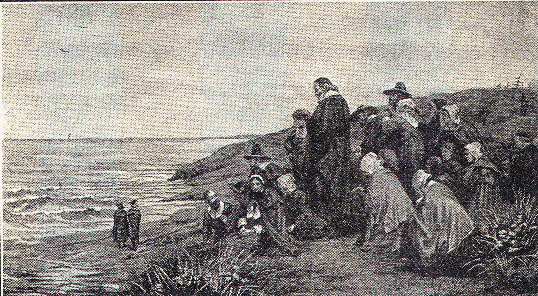
Yet over the years, there is one painting in particular that I’ve come to think might really be getting it right.

It’s an odd sort of artifact.

You see, most of the great oil paintings about the Pilgrims came from after the Civil War, which is before people were really asking too many questions about what Plymouth was or wasn’t.

What mattered is that this was how America had started, and we were for the most part glad that it had, and so thank you for that…please pass the stuffing.

But this one picture I’ve never forgotten imagines a different chapter of the story.

It imagines what it was like for the Pilgrims on the day when the Mayflower finally weighed anchor and set sail for home, leaving them to it. Leaving them to this New World. Leaving them to get working on that city on the hill. Or in any case, leaving.

After wintering-over impatiently there in Cape Cod Bay, having lost many of his sailors to the same diseases ravaging the Pilgrims, it was early April, and the captain decided it was time to cut bait and get back to civilization.

And this particular painting imagines what it was like for the Pilgrims on that day, as they saw the Mayflower sailing away toward the horizon.

Some of them have gone down to the shore, to watch their ship get smaller and smaller.

A few are waving.

But if you pause for a moment and really look, you’ll see that one person is not exactly waving.

Her hand is outstretched, almost like it’s waving, but her face full of grief, as if to hold the receding ship in her hand until the last moment…as if, should someone somehow manage to throw her a line, she would grab on and let herself be taken back to the world she once knew.

I don’t know if any of you have seen “The Martian” or read the book. But I think that the Pilgrims would get the many emotions of that story—they would get its textured understanding of what it is to be left behind, training or no training. Mission or no mission.

The Pilgrims knew they had a mission. But even so.

And that’s something I find even more remarkable in this morning’s Gospel from John—this account of Jesus at the Last Supper, when he tells his disciples about how he is going to leave them behind, but that he is not leaving them destitute, because he’s going to send them what he calls an advocate, a holy comforter, to be with them, going forward.

What I find remarkable about that is that Jesus is telling his disciples that they will have a mission. He’s making it clear that they’re much more than just a cheering section or people who were lucky enough to score tickets for his show. He’s making it clear that, going forward, he has work for them to do.

He’s telling them about their mission.

But he’s also saying that he won’t be with them in the ways they’ve gotten used to.

He won’t be there, teaching and healing among them, going back and forth across the Sea of Galilee or ducking in and out of Jerusalem. There won’t be any more confrontations with the Pharisees—and that’s too bad, because who among them hadn’t come to enjoy a good confrontation with the Pharisees?

Well, no more.

That said, in a deeper way, he promises that he will still be with them.

This is where the holy comforter comes in.

The Greek word for that is “pantokrator,” and it means “one who comes alongside.”

So what he means is that, even as he departs, God will still be the one who comes alongside the disciples.

What they would come to see in time, of course, is that God would come alongside them, especially in those moments when they came alongside others who were hurting. Others who were in distress. Others who needed love and care, a sense of belonging, and someone who would speak up for them in ways large and small.

If you think about it, so much of what it is to be faithful is learning to come alongside—and in learning to see God when and wherever that happens.

Coming alongside. That’s what the Holy Comforter does.

And yet—can anyone really blame the woman in that painting of the departing Mayflower, reaching out her hand in a gesture that is half “farewell” and half “Oh God, please take me with you”?

I’ve been thinking about that.

And I think my answer is, well, it depends.

It depends on whom you’re left with.

We don’t have a companion picture for this. But it would be telling if right next to the picture of the Mayflower sailing off, with the eyes of the Pilgrims straining to watch it go, there were another picture.

The picture of when everyone turned around and faced the New World once again.

The picture of when they turned around and saw each other standing there.

What are the looks that would be on their faces then?

There’s a big difference between seeing ourselves as marooned, and seeing ourselves as building a world, isn’t there?

There’s a big difference between fighting to survive and creating a life, isn’t there?

There’s a big difference between trying to find shelter, and trying to build a home, isn’t there?

I’m reminded of the African proverb that says, “If you want to go quickly, travel alone. If you want to go far, travel together.”

This morning I would just say, simply, that this is what Pentecost is. It is a call to travel together. A call to see that this is God’s will for God’s people. A call to find the God who comes alongside us, particularly as we come alongside others.

That’s what all this is.

If you’ve attended a baptism here, then you know that there’s a moment when the child is led around the congregation, and I introduce a few of you in the pews by name. By name and with a little mention of something about you.

I’ll be honest: it’s kind of working without a net because I’m always afraid I’m going to blank on someone’s name—you know: “This is….uh…Liz Perry….she’s a…uh….a teacher…..”

Sometimes, I probably run the risk of naming an attribute that isn’t someone’s particular favorite about themselves.

I apologize if that’s actually truer than I realize and I’ve done that.

But the purpose behind it is important.

Because what I’m trying to affirm, by way of a few specifics, is that each one of us is someone you can count on.

Each one of us has something really important to bring to the table.

We each have ways that we are taking part in building that shining city on a hill that the Pilgrims only got to start.

That’s who we are. That’s what this is.

And I, for one, have come to believe that the world depends on it.

For those of you who are part of our Youth Choir, and especially for those of you who will hang up your red robes for the last time today, I have just this to say.

I think you know in your hearts what this has been.

Even if from here on out you are called to new pursuits, I think you know.

It was never about the music.

It was about the world you made, Wednesday by Wednesday by Wednesday.

It was about the people you were free to become here, especially if there was no other place where you knew that freedom.

It was about the ways you learned to come alongside one another, in good times and bad.

It was about learning how to offer hope, and energy, and joy together, even when any one of you might not have been feeling especially hopeful, energetic, or joyful on any given day. In fact, maybe especially then.

And I guess I would just say that, for all its flaws, for all its imperfections, for all the wrong notes it seems to hit, the church is the community—the commonwealth—where all that happens.

For wherever that happens, we in the church would say that something holy has come alongside, giving a deeper meaning to what is happening.

Lastly, our hope for you in your time here has been that you would start to see that each of you has something very important to bring to the table of the world’s becoming.

Each of you has a role to play in building the city on the hill.

Knowing you even just a bit, as I do, I have to say, what a wonderful city it will be.

And may this little city that dwells on this particular hill always be a home to you.

For those of us who remain, the work continues.

The invitation to come alongside still beckons.

Each one of us has a part to play, and much to offer.

The mission of loving and serving the world is still our mission.

On Pentecost, this call to travel together reminds that, for all its challenges, our mission also the source of our deepest joy.


Amen.

Mother’s Day 2016 (1 Samuel 1:1-20)

Hannah

I don’t know if you heard this, but last week a man in Haifa, Israel went to court in order to take out a restraining order against God.

According to the UK news organization, The Independent, David Shoshan of Haifa went to court because God, as he said, has been treating him “harshly and not nicely” for a period of time.

Mr. Shoshan did not go into detail.

However, he did apparently go into detail about how he has called the police to his home on at least ten different occasions to make a complaint about how God has treated him, only to be told by the police that they were powerless to help him and, finally, after squad car with sirens visit number ten, that if he thought God had some sort of grudge against him, he should go ahead and seek a restraining order, which is what he was there in court to do.

This is one of those stories where I feel like I just have so many questions. Right?

Well, to no avail, I’m afraid, because the case did not last long enough to get into any of that.

As far as the restraining order went, the judge did not agree…and he told him so-o-o-o. He called Shoshan “delusional” and threw the case out.

The punch line for much of the coverage, if you haven’t already guessed, is that, unfortunately, God could not be contacted for comment.

And while I don’t know for sure, I can’t help but think that this—God’s unavailability for comment—is probably not far from the root of Mr. Shoshan’s complaint, whatever the roots complaint actually actually be.

Think about it.

In those times when life is difficult, when it seems as if the power of the Universe is tilted against you, the lines can get murky.

Because God is, after all, well, God…it makes sense that we’re the ones who are supposed to be doing the changing. If the Universe seems particularly harsh and unyielding, surely the solution is to seek God’s instructions for how to get back on track.

But as we said, the lines get murky fast.

Because of course, God is not available for comment.

And because God is not available for comment, it can be incredibly hard to parse out.

Is it that God thinks we are somehow not doing our job?

What if we think we were? What if we were giving it everything we’ve got?

Because if we think we were doing our job, it doesn’t take long to wonder if actually, God is somehow not doing God’s job.

I can’t say I agree with that. But I understand the logic of it…or the temptation of that logic.

I wonder if that’s where Mr. Shoshan is coming from. That for some reason, God has decided to treat him like the supervisor from Hell.

Because if that’s what you think, it makes sense that the best thing for all concerned might be to take out a restraining order against God.

I get that.

II.

I think Hannah from this morning’s Scripture might be quick to say she gets it, too.

She doesn’t take out a restraining order against God, of course. Quite the opposite.

Her despair at thinking the Universe is tilted against her is what pushes her toward God.

If she went to court, instead of a restraining order, Hannah would be looking for a writ of habeas corpus for God.

But she knows what it’s like to be bewildered by what life, what fate, what God seem to have thrown at her.

And like Mr. Shoshan, Hannah wants answers, but answers turn out to be in short supply.

In addition, it turns out that empathy for her situation is in short supply, too.

Thus, whatever its source, in her deep, abiding ache to be a mother, Hannah discerns that only God can really get it.

Only God can understand where she is, emotionally and spiritually.

Hannah’s husband, Elkanah is sweet and loving and prosperous, a good enough man for the most part, but maybe, truth be told, a little clueless.

Elkanah sees his beloved wife in her distress and his instinct is to try to make it better, to say some sort of nice thing.

You know, there are a lot of us out there who just can’t handle it when a woman starts to cry. Elkanah is like that.

There they are on their annual trip to Shiloh, off to give thanks to God for all the good things with which they have been blessed, and there in the hotel dining room, one of the other wives can’t resist the opportunity…she can’t resist the opportunity to dandle her new baby on her knee, and let the toddler fish through her purse for crayons, while the boys are making the Tower of Babel out of the packets of Equal and Sweet and Low.

And maybe in a moment when Elkanah is otherwise occupied, maybe studying the menu, maybe over at the bar getting everyone’s drinks, the other wife looks over at Hannah, who is just barely holding it together, and the other wife catches her eye, and shoots her a long, cruel, knowing smile. She’s just one of those people who is like that.

So yes, we’re really talking about Hannah here, but for what it’s worth, poor Elkanah too.

When Hannah runs off from the dinner table there at the hotel in Shiloh, and he finds her back in their room, stretched across the bed sobbing, poor Elkanah can’t stand it.

And that’s when he says the stupid thing that he means to be nice.

Has anyone ever tried to say something nice and ended up making things worse?

Well, that’s Elkanah.

Because he sits on the edge of the bed, there in that hotel room with all the lights turned out and his wife just completely beside herself, and he says, “Hannah, why are you crying? Why don’t you eat? Why are you downhearted? Don’t I mean more to you than ten sons?

And I think it’s an important moment in this story because it’s at that moment that it just becomes so clear to Hannah that even the man who loves her most in the world doesn’t get it. He doesn’t see. Doesn’t understand.

Unfortunately, this turns out to be a theme.

In the next part of the story, she kind of pulls herself together, washes her face and goes alone to the Temple at Shiloh—a woman, alone—to pray.

And the priest of the Temple, Eli, sees her there all alone, and he sees her lips moving in prayer, and he assumes she must be drunk.

That is to say, he takes one look at her and assumes she must be some loose woman—that she’s there in God’s house, making a mockery of everything religion is supposed to stand for.

The point of that little detail is very simple: even the religious guy doesn’t get it.

Only God gets it.

But like Mr. Shoshan, our friend from the courtroom in Haifa, Hannah is desperately seeking a remedy for the ways in which life has been treating her “harshly and not nicely.”

And I bet when she Eli comes and tries to shoo her away, thinking she’s just some nasty hootchie-mama, Hannah is about ready to spit nails.

What she says is, “Not so my Lord. I am a woman who is deeply troubled. I have not been drinking wine or beer; I was pouring out my soul to the Lord. Do not take your servant for a wicked woman; I have been praying here out of my great anguish and grief” (1 Sam 1:15-16).

And with this, something changes.

Maybe he’s another one who can’t stand to see a woman cry.

But in any case, the old priest of Shiloh, who is cynical and world-weary and surely not a credit to my profession, takes a second look.

This time, thankfully, Eli sees something in Hannah that moves him—her humanity, her heart, her soul—and he offers her a blessing.

All of sudden, it isn’t just God that gets it. Now he gets it too.

He answers her: “Go in peace, and may the God of Israel grant you what you have asked.” And the story reports, “She went her way and ate something, and her face was no longer downcast” (v. 17-18).

Something changes.

III.

Here’s why I think this story is important.

Because this story is talking about events that took place more than 1000 years before the birth of Jesus.

When this story happened, King David was still two generations from being born.

It’s an old story. But it’s not an unfamiliar story, by any means.

Because I’ll guarantee you, there’s not a woman in this room who doesn’t know what it is like to be treated as if she is invisible.

There’s not a woman in this room who doesn’t know what it’s like to live confined by somebody else’s story of who she is, and what she can offer, and what she should want, or have any right to expect swirling around her all the time.

There’s not a woman here who doesn’t know what it’s like to feel like nobody gets it, that nobody seems to care enough to try.

Even today, we know Hannah’s story all too well.

Now as it happens, Hannah doesn’t want anything radical for her life.

What she wants is to be a mom.

In fact, that was the expected path.

In wanting that path for herself, Hannah is not out there trying to blaze trails or crack glass ceilings or be a medical miracle or anything of the kind.

But in fighting for her chance to live an essentially conventional life, Hannah finds her voice.

She finds her voice before God and man.

And that proves to be transformational—not only for her, and for her family, but ultimately for the entire nation.

It turns out that her son, Samuel will play a significant part in Israel’s history.

But all that only happens, in a very real way, because Hannah decides that she has standing before God.

She decides that her heart has words that God needs to hear.

Most remarkably of all, she is brave enough to believe, brave enough to have faith that God is willing to hear those words, to receive her anguish.

She trusts somehow in her heart that God will not remain unavailable for comment.

That’s not anything that she would likely have been taught by the religion in which she was raised.

It’s not something she would have heard from the religion she expected to live out through all her days.

But nevertheless, she finds the courage to speak. And God hears her loud and clear.

So, the great power of her story is not simply that she does, in fact, become a mother—though of course, that is central to the story.

Rather, the key point is that the love and longing in Hannah’s heart are just too great for her to keep silent any longer.

She knocks at the door until God opens it.

IV.

That’s why I think it’s also important to remember her and honor her on Mother’s Day.

Because Hannah stands at the beginning of a long line of women, down through the ages—a long line of our foremothers in faith, who noticed people that other people did not see, who understood people that others did not bother to understand, and who stood up for a world where nobody has to live confined by someone else’s comfort zone.

She’s an early member of a long line of women who knew what that was like, but who refused to let the story just end there, and who changed the story for all of us.

That’s what this day is all about.

Mother’s Day calls us to remember the women who encountered a world that in so many ways, continues treat so many people harshly and not nicely, as Mr. Shoshan put it.

But in the face of so much harshness, rather than prompting us to seek a restraining order against the hand of God, it was the wisdom of Hannah, and the wisdom of our foremothers, that what we need to do is to find our voices.

What we need is an unrestraining order.

We need to claim the freedom of the Gospel. The freedom of life in the light of God.

We need to push back against the powers that be, in order to secure the good that must come.

The love and longing that are in our hearts must be trusted and must be spoken, even if at first, there is only God to hear it.

That is the wisdom of our foremothers. That is the wisdom of Hannah.

And it is the wisdom of a faith that moves mountains.

May we honor it and honor them not only today, but always.


Amen.

Sermon: “Worry and Doubt” (Matthew 6:25-34)

taco bell

So here’s a question for you: who is it in your life that taught how how to worry?

Do you know who it was?

Show of hands: how many of you would say it was your mom? What about dad?

How many of you have a kind of informally-designated worrier-in-chief in your extended family?

Raise your hand if it’s you.

For myself, I’d say that my parents taught me what to worry about, and thankfully, even more about what not to worry about.

But they were not the ones who taught me how.

I seem to have picked that up in my own.

You see, my parents were not the ones who taught me about Taco Bell burritos, and when it comes to how I, Max Grant, worry, I have learned that Taco Bell is a big part of my response.

So is prayer.

But let’s start with Taco Bell.

I confess that Taco Bell is part of my response, but hear me, church—this is not to say that Taco Bell offers much by way of a solution.

It is just part of how I initially respond.

And that’s the thing, right?

Because somehow, how I have learned—how I’ve taught myself—to worry begins with a period where my instinct is not so much to start solving whatever it is that’s on my mind.

My first instinct is to dwell in it. My first instinct is to turn my worrying about something into my own little fiesta-for-one.

The great challenge for me with worry is not to let myself linger there.

II.

That’s where prayer comes in.

And actually, I can tell you who taught me that.

It was Martin Luther.

You see, at some point in my late twenties, I found my way back to church.

That happened, not because I had started to feel what I’d describe as faith. Not at the start, anyway.

But what I felt was just this deep, deep longing for God that wouldn’t go away and that I wasn’t really sure what to do with.

I had a lot I was trying to figure out, and trying to juggle as best I could with the tools I had.

And anyway, it’s then that I encountered this story about Martin Luther.

Luther was a tremendously busy man in the early days of the Reformation—actively participating in the church and politics of his day, translating the Bible into German for the first time, at times having to go into hiding because there was more or less a price on his head.

He was the leader of a spiritual revolution. But like all revolutions, and as every revolutionary from George Washington to Fidel Castro can tell you, there are lots of things to worry about, and only so much that lends itself to one person’s control.

So think about that for a second.

And that’s what makes this little anecdote so interesting.

Because apparently, Luther was once asked what his plans were for the following day.

He responded: “Work, work, from early until late. In fact, I have so much to do that I shall spend the first three hours in prayer.”

And to me at that time, what that seemed to point to was that, for Luther, prayer was not just a rote formula or a momentary break to hear a word from our sponsor.

Prayer was looser than that, but far more vital.

It was about staying grounded in our relationship with the Eternal.

It was about listening deeply to what the Eternal had to say to us, here in the realm of the temporary and imperfect.

Without that, Luther recognized nothing worth doing would ever get done.

That was incredibly important for me.

It was incredibly important because it taught me that, without a doubt, there are some things that still clearly matter in the light of Eternity.

There are things that seem to rise even to that level.

And there is much that does not.

Not so long ago, I told the story of my teacher who sent me a postcard reminding me of how inconsolable I’d been about a bad grade the year before—I talked about what an eye opener that was.

Well, I’m afraid that’s a lesson that I’ve had to learn more than once.

But you know, Linda Hartig put it so well for me this last week at Bible Study, when she observed that some worry is important for us to do and some worry is important for us not to.

Worry that gets us moving, that expresses care in a way we can do something about—well, that’s one thing.

Worry for its own sake is something quite different.

And that’s right.

There is worry that God places on our heart—a sense of concern and relationship that we are called to do something about.

And then…well…there’s Taco Bell.

Because it’s there that I don’t worry about the things I actually can control. It’s where I let myself dwell in the things that I can’t.

Luther taught me better than that.

III.

And of course, so does Jesus.

Matthew’s Gospel puts it this way: “Can any of you by worrying add a single hour to your span of life? And why do you worry about clothing? Consider the lilies of the field, how they grow; they neither toil nor spin, yet I tell you, even Solomon in all his glory was not clothed like one of these” (Matthew 6:27-29)

And he continues, “Therefore do not worry, saying ‘what will we eat? Or ‘what will we drink? Or ‘what will we wear’…But strive first for the kingdom of God and his righteousness, and all these things will be given to you as well” (v. 31, 33).

There is a kind of language almost of “reward” when he says that, and there have been those who have understood this idea that “these things will be given to you as well” in that kind of light.

The bigger question of how God provides for us does come up here.

Jesus asks his disciples, “If God so clothes the grass of the field, which is alive today and tomorrow is thrown into the oven, will he not much more clothe you—you of little faith?” (v. 30).

But I would say that his point is not about the depth of our faith as it is about the spiritually precarious distraction of our worry.

Matthew’s word for “worry” is helpful on this point.

Because the word he uses is the Greek word merimnao (merim-NA-oh), which is itself a blend of two other words: the word merizo, for divide, and the word nous, which means mind.

To be worried, then, is to be one with a divided mind.

It’s the same word Jesus uses when he speaks to Martha in the Mary and Martha story, when he says, “Martha, Martha, you are anxious and troubled about many things; one thing is needful. Mary has chosen the good portion, which shall not be taken away from her” (Luke 10: 41-42).

It’s the same word Paul uses to the church at Phillippi when he counsels them: “Have no anxiety about anything, but in everything by prayer and supplication with thanksgiving let your requests be made known to God. And the peace of God, which passes all understanding, will keep your hearts and your minds in Christ Jesus” (Philippians 4:6-7).

Do not let your mind become divided.

So much of worry does that—it divides our mind.

And if we’re not careful, it divides our heart and maybe even our loyalty, too.

Because worry challenges us to remain grounded in what is most important—what it is that rises to the level of the Eternal.

And it can be so strangely tempting to dwell among the things that do not matter all that much rather than seek a way forward in the name of the things that matter most.

We may not quite realize that we’re doing it—but this is precisely why we need to find a way to see ourselves for what we are, and to glimpse the Eternal for what it is.

As Jesus tells Mary, to glimpse the Eternal is to choose “the good portion.” As Paul says, it is to claim “the peace of God, which passes all understanding.”

For the last couple of weeks, we have considered some of ways that doubt and faith are related.

I’ve tried to make a case that doubt is very much a part of the life of faith—that perhaps Thomas was not so much doubtful as he was a person who could only know things in his own particular way, as indeed, we all must do.

Last week, I suggested that as our faith evolves, we outgrow some of the answers that had been so important and so nurturing for us before, but now no longer quite fit—and that the time betwixt and between can be a difficult one, but that new answers do come.

By way of conclusion, I would just say that of all the things we go through in the living of our days, worry can push so many questions on us.

Worry casts doubt on so many things—not only the bad things, but the good ones, as well—whether it is only for a season or more permanently.

To worry is to live with a mind divided. It is to be so distracted that we can begin lose sight of where our love and loyalties truly lie.

Our great task, with God’s help, is to keep those things in view–to push past our initial response and to seek the source of what truly sustains us, that source without which nothing worth doing would ever get done.

It is to look to Jesus, in whom, as Paul said, “all things hold together…For in him all the fullness of God was pleased to dwell, and through him God was pleased to reconcile to himself all things, whether on earth or in heaven….” (Colossians 1:17, 19-20).

The rest, my friends, is Taco Bell.


Amen.

Sermon: “Who, Then, Is This?” (Luke 8:22-25)

stormy sea

On my very first day of divinity school, at my very first morning chapel service, we did something that seemed curious, even a little gimmicky, at the time.

I don’t know what I arrived at the service expecting—I suppose a lot of singing and earnest praying, and I’m sure the service definitely had plenty of both, too.

But near the end of the service, the dean of the chapel came forward and said:

“Friends, now we are going to offer you a few minutes to compose a letter to yourself about your hopes and prayers and worries for this coming year—or if you prefer, for this whole journey of divinity school.”

“We will also offer you an envelope. Once you have written your letter, if you wish, you may put your name on the envelope and seal it, and we will keep it in this box and keep it here in the chapel until the morning of your graduation. Then you may have it back.”

Well, I’d heard about stuff like this. Truth be told, it did not seem like something that would be my thing. But you know, it was the very first day, and I understood that new experiences were part of the deal, so I did as I was told.

I wrote a lot about my worries, and in writing about them, I realized I had quite a few.

Was I really cut out to be a pastor? Was going back to school at the ripe old age of 34 somehow “too late”? Everyone seemed so earnest and kind and Midwestern—what would happen when they found out I was from Brooklyn?

But there were deeper questions, too.

First among those was what this new venture would mean for my marriage – my first marriage – which was already quickly crumbling at the time.

In fact, unbeknownst to me, it would end just a few weeks later, on Columbus Day weekend.

The other question, though it wasn’t exactly a question, was just the feeling that I had in those days that, somehow, I hadn’t heard from God in awhile.

This wasn’t what I had been expecting.

In the lead up to my initial decision to go to divinity school, I had felt God’s presence in all kinds of situations and through all kinds of people.

High school teachers can see a great deal of triumph and tragedy in the course of a normal day. Seeing God in all that is not hard to do—frankly, I think you have to work harder not to see God.

But then summer comes, and life is not so intense, and people don’t need you with the same kind of urgency—and most of us look forward to that and recharge in those weeks, but I hadn’t, at least not that year.

Truth be known, I’d had a long, dry summer, when God did not seem to be in any of the places that I had grown used to seeing Him, and I felt betwixt and between.

My prayer life wasn’t what it had been. My marriage was filled with silences. And I felt adrift—not just from God, but somehow from myself.

That was new. And not so welcome.

So, excited as I was to be starting divinity school, this all weighed on me heavily.

II.

Maybe you know what such seasons in our lives can be like.

Many of us have been through seasons that are even harder—seasons when something that had seemed so very clear before suddenly grows murky, or even dark.

Many of us know what it’s like when the answers we’ve relied upon seem abruptly full of holes—when our hardest-won answers now seem subject to questions we’ve never seemed to notice before.

The English Bible translator J.B. Phillips once wrote a short devotional book titled, “Your God Is Too Small,” and for faithful people, that is how such seasons in our lives can often feel—as if even God, at least as we’ve understood Him, is no longer big enough to make sense within the world as we now understand it to be.

It is a rude awakening, to put it mildly.

And it’s then that I think we encounter the real depth of Jesus’ question in this morning’s Scripture, when he asks the disciples, “Where is your faith?

Now let’s remember at the outset that the circumstances are a little more dire than mine were.

Being caught in an open boat in the middle of a sudden storm is a particularly vulnerable kind of moment.

This isn’t just them being nervous nellies, either—many of them were fisherman, of course, and not the kind of people who fasten their seatbelts at the first sign of turbulence, before the captain even bothers to turn on the sign.

Luke confirms their worst fears, saying that the boat is, indeed, taking on water and that they are in danger.

So surely the disciples were to be forgiven if they were terrified and suddenly wondering where God was in the middle of this storm.

When the boat you’re in starts feeling awfully small, it isn’t long before the God you worship can start to feel awfully small, too.

And how baffling it must have been, then, to see Jesus there, in the middle of it all, sleeping peacefully in the stern, not a care in the world.

In all the crashing and banging and chaos of that moment, amid all the fear that would paralyze anyone who let themselves go there, I can’t say for certain if the disciples are calling on Jesus as a way of calling on God, or if they’re just calling for all hands on deck.

III.

But whomever it is that they’re calling, it’s God who answers.

It’s God who rebukes the storm.

And of course, it’s God who asks this immensely important question—which is actually the only line of dialogue that Luke bothers to record from Jesus in this whole story.

Jesus asks them, simply, “Where is your faith?” (8:25a).

It is, to be sure, another kind of rebuke. First, Jesus rebukes the storm, and then he rebukes the disciples.

There is a distinctly, “Guys, how could you?” quality to this moment.

Of course, it’s not really “Guys, how could you wake me up?”

It’s “Guys, how could your faith in God’s presence and care—how could your faith in my presence and careturn out to be so flimsy?”

But this leads to the key moment.

Luke ends his story without further ado by saying, “And they were afraid, and they marveled, saying to one another, ‘Who then is this, that he commands the wind and water, and they obey him?” (8:25b).

That’s the key: “Who then is this?

Because it’s then that they begin to realize that their God has been too small.

It’s then that they begin to realize that something very deep inside each one of them is being called to shift.

God’s world turns out to work in ways that they hadn’t quite understood as well as they had thought.

“Who then is this?”

Who then is God?

And I guess I would just say, this doesn’t strike me as a question of doubt.

It’s the question of a faith that is changing. Changing, and just as clearly, growing.

It is an unsettling fact that for us, growth so often feels like doubt. It can be bewildering, in some circumstances, terrifying, and in many more, just terribly lonely.

Or perhaps it is more accurate to say that if faith is more complicated than we sometimes think, well, so is doubt.

But clearly, when the truth as we’ve understood it no longer seems to fit, and we begin to doubt it, it isn’t that nothing is true. It’s that how we are grasped by the power of a new insight, a new recognition of the truth, has not yet taken hold.

“Who then is this?”

To be a disciple is to trust that there is always a “then” – always a new perspective that will come into focus.

But we cannot get there until the old answers begin to lose their grip.

And so there must be room for doubt. Doubt is one of God’s preferred ways of reaching us.

IV.

I think that was a lesson I learned on my last morning of divinity school, when the dean of the chapel processed in to our final worship service, carrying a large box full of the letters that my classmates and I had written on that first day.

It was not simply that my grief and worry had turned to joy, though that was also true.

It was that I realized how close God had been in those early days, that when He had seemed so very absent, it was that God was calling me, reluctant though I was, into a new and far more hopeful future.

Something much more powerful and beautiful had been set in motion, and the love of God was way bigger and more wonderful than I could possibly have understood.

“Who then is this?” the disciples asked.

It is our doubts that remind us that the answer is always a surprise.


Amen.


From the Newsletter: “Caring and Covenant”

covenant

Dear Friends of Second Church,

David Brooks had a wonderful column in yesterday’s New York Times, titled “How Covenants Make Us.”

The key observation is that there’s a difference between a contract, which is a legal concept, and a covenant, which is a theological one.

As Brooks explains: “When we go out and do a deal, we make a contract. When we are situated within something it is because we have made a covenant. A contract protects interests…but a covenant protects relationships. A covenant exists between people who understand they are a part of one another. It involves a vow to serve the relationship that is sealed by love: Where you go, I will go. Where you stay, I will stay. Your people shall be my people.”

Let me finish his understated quotation there at the end, which comes from the Book of Ruth. The final line properly reads: “Your people shall be your people…and your God, my God.”

If you know the story of Ruth and Naomi, it’s easy to see why Brooks goes there. It’s a powerful example of covenant.

But even if you don’t know the story, it probably won’t surprise you to learn that, historically speaking, the Congregational churches of New England have had a rich tradition of covenant. Our tradition teaches us very clearly that a life, properly lived, is not about each person doing his or her own thing. It argues that our freedom is the freedom that comes only in and through loving. It says that, paradoxically perhaps, we can only finally become who we are called to be only by living our days with a profound sense of “the ties that bind” (to quote an old Congregationalist hymn). To this way of thinking, a proper life—in fact, the only kind of proper life—is the “bound” one, a life of close relationship to God and neighbor.

More generally, covenant reminds us that, whether it’s getting married or establishing a colony in the New World, it is relationships that are most in need of protecting. The opposite is a false, even diabolical option. If all we’re out for is to protect our interests, we are living life far too narrowly, and far below the vision that God has for us and for Creation. Covenants teach us to make commitments and to cherish them.

In a small way, our own church continues to live out this history today at every Annual Meeting, where we recite the “Salem Covenant” of 1629.

But I’m sure you’ll see that, if our only connection to covenant is a short prayer we say once a year, we are in deep trouble.

These weeks after Easter offer a particularly important time to think and pray about the covenants we’ve made, and to ask ourselves how we are protecting and nurturing our relationships. Let me be clear: we’re called to look, not our interests within those relationships, but to the relationships themselves—to how “well bound” we feel to those we love, and to the broader community of those among whom we live.

After all, it was in the days following Easter that the disciples felt the call, not only to remain together, but to grow into something bigger and new, which they called the church. They continued to follow Jesus after his death, not because they were jockeying for their own interests, but because they felt his ongoing presence, and they continued to feel bound by his call to go and make disciples of all nations. They were living out a sense of covenant to him and to each other, and this meant attending to a circle that was ever-expanding, even as the ties that bound them strained at times.

This is what it is to be the church. But it is also what it is to be a good spouse, a good parent, a good sibling, volunteer, coworker, or neighbor. We are called to care for our relationships, even as they make new claims upon us or take us into uncharted territory.

God’s promise is that, with the guidance of the Spirit, that uncharted territory will be a place where we encounter Him.
See you in church,

Sermon: “Witness for the Resurrection” (John 20:19-31)

doubting thomas

One of the really interesting things about being a pastor is seeing how people respond when they find out what you do for a living.

I imagine every profession has its own stories about this.

I had a friend who was once at a party and told someone he had just started med school, and the person he had just met suddenly rolled up his sleeve and said, “Oh, that’s so great because for the last couple of weeks I’ve had this really strange rash all over my arms….”

Well, as you might imagine pastors encounter a little bit of that, too.

There are many who say, “Wow, that’s great!” and others who say, “…Oh, that’s nice…”

But one of the responses that I receive always leaves me curious and rarely satisfied.

Because it would amaze you to know the number of people who say, “Oh, you’re a pastor? Well, I went to Catholic school.”

Sometimes they’ll even shudder as they tell you that before smiling nervously and saying, “The nuns didn’t like me there. I asked too many questions.”

More than once. I’m telling you.

And with that, they often look off over my shoulder for a moment and then mumble something about going to freshen their beverage before beating a hasty retreat.

It’s not just Catholic school alums, either, of course. Not by a long shot.

Many people will talk about a childhood in church as a strange experience of great love, great care, and great limits.

It can be painful to grow up in churches or in faithful families, and become aware of the difference between the way we talk about God as Christians, or about the importance of our faith, and then how we talk about the world, or about particular groups within the world.

It can be painful to grow up in churches or in faithful families, and become aware of the questions we have about those moments in life when the explanations, the answers, the truths that we affirm don’t seem to cover all the issues…and yet to see, or just know without being told, that our questions are not welcome.

Sometimes that grandmother who is so wonderful to us will come out with words that we’ll never forget—words that burn and bewilder us decades later—but which there was no way to ask about then, and for which there is no way to ask about now.

As I said: great love, great care, and great limits.

II.

 Then you add on top of that that each of us knows and recognizes God, or the Holy, or the meaningful, in our own particular ways.

Not only are our questions different, but what feels like a genuine answer may be different, too.

That makes sense, right?

I mean, for those among us who have been married, how did you know—really know—for the first time when your spouse loved you?

Some would say it was when she stopped rooting for Wisconsin and started rooting for Notre Dame.

Maybe it was when he agreed to give up being Methodist and to become Congregationalist instead.

Whatever the specifics of it were, surely, it was some moment when you felt listened to, or seen, or cared about in a way that you never quite had been before.

That’s what love is like.

On the surface of it, why that was the specific thing that made you feel truly loved may seem to make no sense at all. But to you, it makes all the sense in the world.

How it is we know the things we know – how it is that we know what’s true – is something that is probably unique to each of us.

That’s true of our spouses, or about so many parts of our lives that we discover we have fallen in love with.

And it reminds us of the fact that, when it comes to God, we know God’s presence…we recognize God’s character…we feel God’s love for us…each in our own particular ways.

III.

That’s also why the story of “Doubting Thomas” from John’s Gospel is such an important story.

Now let’s admit that John himself might not agree with this reminder that God speaks to us in all our particularity–much less our doubt.

John tells this story because he has some profound concerns about doubt. Some doubts about doubt.

He tells us the story to commend those who come after the disciples, as he did, and as his first audience did.

He wants to commend the faith of those can believe in Jesus without being able to touch him, the way that Thomas did.

He’s saying that at a certain point, you have to trust, and that is absolutely true.

In the King James Version, Jesus tells Thomas, “Reach hither thy finger, and behold my hands; and reach hither thy hand, and thrust it into my side; and be not faithless, but believing” (20:27).

“Be not faithless, but believing.”

You can almost imagine a million churches with that carved in stone right over the front door.

(Actually, I’m surprised to say that I haven’t actually seen that before.)

But let’s admit that what the churches seem to mean by that may well be different than what Jesus meant.

Because certainly, Jesus understood that to believe is no simple thing.

Certainly, Jesus understood that doubts and questions are part of what it is to be faithful.

Let’s remember that among the very last words of Jesus on the cross were the words we have come to call his “cry of dereliction”—which is when he says, “O God, my God, why have you forsaken me?”

Jesus understands doubt. He doesn’t just know about doubt. He knows doubt first-hand.

IV.

And so what if…what if…the point of this story is not to somehow condemn the reality of doubt in the life of Thomas or in the life of anyone else?

To me, the story’s deeper significance is in pushing us to think about how it is we know the things we know.

Is Jesus someone that we know about? Or is he someone we know?

How would you and I each tell the story of how it is that we first encountered him? And how would we say that we encounter him now?

What Thomas gets, in a way and perhaps, to a degree that is unique among all the disciples, is that to be a Christian is not simply to believe in an incarnational God.

To be a Christian is to be part of the love of God for God’s world in specifically incarnational ways.

The language he speaks of touching Jesus is not gentle, truth be told.

Our text this morning has Thomas say, “Unless I see the mark of the nails in his hands, and put my finger in the mark of the nails and my hand in his side, I will not believe.”

The original Greek makes it clear that he isn’t talking about gentle caresses, or some other form of loving touch as we would typically imagine it.

The King James is closer when it translates it as “Except I…thrust my hand into his side, I will not believe.”

His language is intense, actually almost violent in character.

But what it means is that Thomas is willing, almost uniquely among the disciples, to get into the blood and guts of what it is to believe.

So say what you want about his questions.

If the way he talks sounds skeptical and scandalous to you, as it has to so many, you are more than welcome to that opinion.

But recognize that those questions lead Thomas into places that nobody else had thought or dared to go.

And that’s what an incarnational faith is all about.

Thomas reminds us that, however it is that we know, we are called as Christians to get into the blood and guts of the world.

If that is where our questions lead us, then they are not simply our questions. They may well be God’s questions.

In a world of great love, great care, and great limits, so often it is our questions–it is the ways that God reaches out particularly to each of us–that bring us back to God and send us back to work.

It is our questions that thrust us into a love without limits. A love that will not let us go.

That is what Thomas encountered in his doubting.

Go thou and do likewise.

From the Newsletter: God in the Aisles

cvs

Dear Friends of Second Church,

This afternoon I was quicker than the pediatrician’s office and went to pick up a prescription at CVS, only to find myself there (“It’ll be ready in about fifteen minutes, Mr. Grant…”) with a little more time to kill than usual.

I suppose I could have just fallen into my smartphone and left it at that.

But a place like CVS always reminds me that I’ve been meaning to resupply the medicine cabinet, and so I started wandering the store, looking for what I thought I might remember needing if I just saw it one more time.

I was good at recalling the stuff that had dwindled over the winter—cough drops, NyQuil, and whatnot. But the other stuff didn’t come back to me so quickly, and my wandering slowed…Wait, which one is Liz’s toothpaste, again? Did I get a big thing of Q-Tips in my stocking at Christmas this year, or was it last year? Wow, what was it someone told me about “compression socks”? That I should have some or that I shouldn’t?

After a few slow trips up and down the aisles, I was almost ready just to buy one of everything and call it a day.

Fortunately, they called out my prescription and I made it outside with what I had come for, plus a pair of kiddie sunglasses with Elsa from “Frozen” on the frames (no you can’t borrow them).

Yet it also makes me think about all the other things in life we might remember needing if we just saw them one more time.

It might be strange to put it this way, but life, in general, can so easily come to feel like a slow, uncertain trip up and down the aisles of the world.

These days, there are so many people who seem to be searching.

What it is they’re looking for? They can’t quite say. How will they know when they’ve found it? Well, they’re hoping they just will, somehow.

If only they could see “it” again, they’d surely recognize it…whatever it is.

Are they looking for something they truly need, or just, well, restocking the medicine cabinet–replenishing their supplies of whatever it is that helps them get through for now?

It’s easy to enough to see how that happens.

To me, so many of the challenges of our lives are fundamentally spiritual ones, and yet the solutions that come most quickly to us—and the ones that our friends are most likely to offer—so rarely are.

“Just try this,” says one.

“You know, what you need is…” suggests someone else.

Part of my hope for Easter every year is that searching people will find their way to churches like ours, and suddenly remember that, in the end, God is what they have been looking for.

So many important feelings point in God’s direction. A sense of being loved by the Universe. A call to a higher purpose. Gratitude. The feeling of being deeply alive. The power to forgive.

It won’t sell much in the aisles of CVS to say so, but these are the feelings we most dream of having again—the feelings that life’s challenges and disappointments seem to drain out of us, at least for a time.

We need to feel them constantly–to refresh our supplies when they get low.

More to the point, settling for anything else is just treating the symptoms of our maladies, rather than getting to the cause, much less the cure.

Easter is a reminder of what it is to be made whole again.

Think about it. Look around. Maybe you didn’t consider yourself actively in the market for Easter hope, for new life in God, for the wholeness and health represented by the Hebrew word shalom…but isn’t it what you’ve been looking for?

Isn’t that really what you came in search of, after all? Don’t you remember?
See you in church,

Easter Sermon: “The Burning Heart” (Luke 24:13-35)

Emmaus Road

I.

I’d like to begin with a story this morning. It’s known as “The Rabbi’s Gift.”

It’s about a Russian monastery that, truth be told, had seen better days.

Although the monastery had once been vast, now, there were only four or five monks left.

The grounds of the monastery had gotten hard to keep up, and had started to grow wild. Many of the buildings were no longer habitable.

The Daily Office of prayers and hymns in the chapel had a distinctly half-hearted feel. There were just too few voices joining in now. You couldn’t cover the gloom.

It was a hard time.

The abbot of the monastery, who was a wise and devoted monk, prayed fervently on all this, but even he could see the handwriting on the wall, and tried to resign himself to what seemed to be the will of God—that the monastery would have to close.

But then one day, an old woman who still occasionally came to visit mentioned the local rabbi, who led a tiny community in the nearby town. She talked about how the rabbi was respected for his great humility and wisdom. The abbot decided to go seek his advice.

He walked into town and knocked on the rabbi’s door. The rabbi was, of course, surprised to see a monk standing there, but he invited him in, and the two men sat down.

The abbot poured out his heart, as the rabbi listened. Then the rabbi poured out his own heart, talking about the challenges of life in his congregation, as the abbot listened.   At the end, the two men realized how much they had in common, and they wept together and embraced.

But as the abbot began to leave, the rabbi said, “Friend, I do not know the answer to your challenges, any more than I know the answer to my own. However, I do know this. Even now, somewhere, the Messiah is among you and your brothers. “

With these words, the two men parted.

As the abbot walked back to the monastery, he thought about what the rabbi had said.

It seemed very clear that the Messiah couldn’t be among the brothers of the monastery. He was the abbot, after all, and he knew his brothers better than anyone.

He thought about his brothers. Well, he thought, it certainly couldn’t be Father Peter.

Peter was so bookish and awkward and looked past you when you tried to talk to him. He couldn’t be the Messiah. But then the abbot thought: well, that’s all true, and yet, even after all these years as a monk, whenever they read the Gospels during the divine service, Father Peter’s eyes still filled with tears.

Maybe he was the Messiah.

Well, in any case, the abbot thought, it couldn’t be Father Vladimir.

Vladimir was a novice master who hadn’t had any novices to train in twenty years. Vladimir kept talking about the old days and was known to wander sadly through the empty dormitory where the monks had once lived, like a man looking for something precious he had lost. He was a sad figure among them. Maybe the saddest of all.

But then the abbot thought: well, there was that day last year when a family with two small children had shown up unannounced, and Vladimir had taken such great delight in the children and made them laugh all afternoon.

Maybe he was the Messiah.

The abbot thought of each of the monks at the monastery, in turn, and while each one had his shortcomings, to his surprise, even so, he could make a case for each one of them as the Messiah.

That night, he told the other monks what the rabbi had said, and they all laughed at once, laughing together for the first time in years.

They knew it wasn’t true.

And yet, in the days that followed, something did change among them.

A new kindness seemed to have crept into their life together. They each seemed to have a new resolve to make their community more worthy of the Messiah, just in case he was there, whichever of them he was.

The monks began to tend the grounds of the monastery more carefully again. They began to repair the old buildings. They prayed more deeply, cared for one another more sincerely—and it was clear that once again, they were truly starting to feel and act like brothers.

And to their surprise, after a period of time, families began to arrive to walk the grounds on a Sunday. Some stayed for services in the chapel and said how moved they were by the singing of the monks. A local woman wrote seeking spiritual guidance for a challenging situation. One day, a young man arrived, asking if they thought he might be suited for the life of a monk.

And slowly, the monastery came alive again.

The monks in the folktale never told anyone what the rabbi had said about the Messiah.

If you ask me, that’s probably just as well. Was one of them the Messiah? Well, probably not.

But in a deeper sense, it’s clear that they did feel the presence of the Messiah among them once again. Their eyes were opened, and they recognized him.

This transformed everything.

II.

And you know, it still transforms everything.

To me, that’s what makes this an Easter story.

Because I think we can draw a line from those monks all the way back to those two followers of Jesus who encountered the living reality of God as they walked on the road to Emmaus on the afternoon of that first Easter.

The two disciples didn’t recognize Jesus at first. Actually, they didn’t recognize Jesus for a good long while.

But when they finally did—when Jesus broke the bread and blessed it and their eyes were opened and they recognized him—when that happened, they realized that, of course, of course it was Jesus who had been with them.

They should have known.

It was almost like in the story, when the rabbi said, “Even now, the Messiah is among you.”

He was.

They should have known it by the way their hearts were set aglow…by the way their hearts burned within them as he spoke.

And that’s important.

Because that’s what it is to encounter God as a living reality. That’s what it is to encounter the Christ of Easter.

It is to have your heart set aglow, to have your heart start burning within you.

And the reason that the Church celebrates Easter is not simply because this encounter happened once, miraculous though that was.

The Church celebrates Easter because a line can be drawn from the two men on that dusty road straight to you and me.

We can draw that line from their hearts to ours.

It’s something that happens again and again—it’s the quiet heartbeat of all Creation.

We hear that heartbeat in all kinds of places – places far less likely even than the road to Emmaus.

Given the heartbreak of Good Friday; given the way that evil seemed to triumph over good; given the way that at the foot of the cross, hope seemed to fall short yet again—given all that, it’s understandable—even smart—that the first instinct of the two disciples was to run away from Jerusalem and from the other followers of Jesus as fast as possible.

We all know what it is to look around and feel like we can see the writing on the wall.

But on the road to Emmaus, the disciples encounter a new reality. They encounter the fact that the rules have changed. That God has changed the rules.

And so it is even now that when we hear—when we see—when we touch the love of God…when we sense the presence of the Jesus…in our own lives…we encounter that new reality for ourselves.

Our priorities shift, our attention focuses.

We begin to see beyond the horizon of our own needs, beyond our inclination to play it safe, beyond the temptation to settle for the obvious answers.

Our own capacity for love becomes intertwined with the living reality of God’s love.

That changes everything.

III.

Many of you know that two weeks ago, Liz and our girls and I went to visit family.

It was also our first opportunity to meet some new relatives.

My cousin P. and her husband K. have begun the adoption process for three siblings, truly lovely, joyful kids but with a wide spread in their ages and very different kinds of needs that flow from that.
It’s never easy to be a new parent, even for one new addition.

Imagine three.

Now imagine being the new parent of a near teen, a second grader, and a preschooler, all with the stroke of a pen and the purchase of a minivan.

Well, there’s actually a little more to the story.

Because two months into life as a new family, my cousin P.’s husband, K., became gravely ill. It came out of nowhere, and it’s been slow to resolve. It is the kind of illness that would have up-ended their old life. But you can imagine what it means now.

For my cousin, it means long days, and a tremendous burden that is hers to carry.

The kind of burden that all the help in the world can only ease but so much.

There are so many days that have been hard for her – harder than she ever thought possible

P. worries that she’s not cut out for this—that she just isn’t able to do everything the way she wants to, which is to say, she is frustrated that she cannot do everything perfectly.

But you know, perfection is not called for.

Because the heart that burns within her is so very clear.

Because seeing her with her new children, in all the chaos, confusion and complexity, you can hear it.

You can hear quiet heartbeat of Creation.

What was so clearly present in our time with our new family was not just the tremendous strength and courage of my cousin.

Somehow in it all, you could feel the love and presence of God.

Something sacred is happening. Jesus is there.

And as a pastor, I can tell you, there are so many people who can tell stories just like that.

IV.

The word “resurrection” comes from the Latin resurgere, from which we also get the word “resurgent.” But at its root the word resurrection means “to rise again.”

And so it is the Christian claim that, because Christ has risen again, his all-seeing faithfulness, his all-powerful love, and his ever-present hope are resurgent, even in the face of death.

And so it is in him that you and I and all Creation can find the power to rise again.

That’s what made those hearts burn on the road to Emmaus, on the late afternoon of that first Easter.

That’s what those monks rediscovered in that Russian monastery.

And I am here to testify that in so many places and so many ways, it’s what makes our hearts burn within us today.

Even within this dark and profoundly unsettled time, there are those who live in the light of a new reality.

Jesus is risen. But that’s not to say he’s far—it is to say that the Messiah is among us, even now.

He’s among us in the breaking of bread, in the breaking of all oppression, in the repair of the world.

Wherever life triumphs over death and diminishment. Jesus is there. Jesus is here.

He died, not so that he might enter heaven, but so that he might enter every human heart.

It’s happening even now. Even here.

Easter reminds us to open our eyes and recognize him.


Alleluia.