Category Archives: Uncategorized

Sermon: “The Shepherd’s Language” (John 10: 11-18)

You’ve heard the old saying about how Eskimos have 36 different words for snow.

Well, apparently, Arabic has about that many different words for sheep.

There are words to distinguish sheep by gender, breeding ability, and age.

And others, depending on the season in which they were born.  And there are at least twelve words to describe color—not only black or white: in Arabic, there’s even a word for sheep with a brown-and-white-spotted face.

And then, if your sheep gets sick, there are apparently even more words, based on whatever it is that it’s got, and then how bad a case it seems to be of whatever it is.

That’s a lot of words.

It also means that where some of us may only see a herd of sheep…  know your Arabic, what you see is different.

Because for those with the right words, and then the right eyes, a herd isn’t just some sort of random jumble of hooves and fur.

Not at all.

Instead, it’s a whole collection of unique faces and bodies—it’s a vision of Creation in all its startling diversity and particularity.

And that changes everything if you’re a shepherd.

Because then each one comes to have a story of its own.

If an animal gets its leg stuck, you aren’t just rescuing one of the sheep—to you, the rescuer, it’s that little kid born at the springtime with the brown and white spotted face, who’s gone and done it again.

I find that helpful to remember as we think about this morning’s Gospel passage from John, in which Jesus speaks of himself as the good shepherd.

Because I think what Jesus is saying is that God’s love sees us—God’s love knows us—God’s love calls us—with just that kind of appreciation for the particular.

God sees each of us as a special case.

I spent some time this week pondering what it is in my life that I try to see with that kind of particularity….what it is that I have thirty six words for.

I asked Liz and she said: “the only thing you have thirty six words for are books you want on Amazon.

(That wasn’t kind of you, Liz.)

But maybe I am just sort of challenged in this way.

My roommate in college was a trumpet player, and he once satme down in our living room because he wanted me to learn how to appreciate the subtleties in three different recordings of Herbie Hancock’s “Cantaloupe Island.”

I have no idea why that was so important.  Maybe it’s no surprise, then, when I admit that I failed miserably.

We didn’t end up connecting over that.

Similarly, when my parents left Brooklyn and were moving into their new house, my mother asked me to compare the five different shades of off-white that she was considering for the living room walls.

Looking at that little book of paint strips, I couldn’t even see five different shades of white on what she handed me.

I was no help whatsoever.

We miss out when someone tries to share his—her passion with us, and we can’t find our way into it.

Learning someone else’s language—learning their 36 words for whatever it is that’s most important to them…whether it’s snow or sheep or the names of sails on a frigate—whatever it may be: learning someone else’s language is how the strongest human bonds are forged.

That’s how we let someone know we have entered his—her world.

But as a pastor, I’ve come to see how rare that actually is.

As a pastor, what I encounter much more often is the great pain of people who feel as if the ones they love no longer see them, or no longer appreciate the lengths they go to…the effort they make and the courage they show.

The pain of losing that sense of being known, of being seen, of knowing we are loved is one of the hardest things our souls can go through.

It’s a cliché, but it’s nevertheless true, that the person who is living a life that’s constantly behind the eight ball, but who still feels noticed and cared about, is in a totally different place than the person who is doing well but feels invisible in his own home.

It’s not that we lose sight of one another’s special passions that is so crushing, but the way that we lose sight of one another’s daily struggles and triumphs.

One of the greatest gifts we can offer is attention to each other’s daily particularities, to what happened at work, or how the sciatica feels, or what Christian said that Ellie did after she got that text from Molly about Lisbeth.

Whatever those particularities might be.

Because it’s in those moments that we live out our days, and slowly become the people we become, and the character we bring to our tasks emerges for all to see…if they only would.

And so the message of this morning’s Gospel is simple.

It’s saying that God sees.

The late nights and the red-eye flights and the dutiful driving to all the recitals—God sees.

The mother who’s grown old worrying about an adult child who is in trouble—God sees.

The sick husband who is trying to be so brave—God sees.

The third time or the umpteenth time you’re a finalist for a position and come up short—God sees.

When your college plan or your promposal doesn’t work out the way you’d hoped—God sees.

In the face of all the challenging particularities that we encounter—God sees.

God knows us.

Each one of us is a special case.  And the God we serve is a God who speaks our language, whatever it may be.

Now I know this is hard for some people to accept.

In this morning’s Gospel, when Jesus is talking about being the gate and being the shepherd, his audience isn’t just the people who know they’ve lost their way—he’s also talking to the Pharisees, who have been listening to his teaching with arms folded and eyebrows raised, waiting for something they can jump on.

When Jesus is talking about the good shepherd, he’s also talking about bad shepherds too, and he’s channeling the words of the prophet Ezekiel, who had called out the false leaders of Israel many years before, saying:

“Ho, shepherds of Israel who have been feeding yourselves!…You eat the fat, you clothe yourselves with the wool…but you do not feed the sheep.  The weak you have not strengthened, the sick you have not healed, the crippled you have not bound up, the strayed you have not brought back, the lost you have not sought, and with force and harshness you have ruled them.” (Ezekiel 34:2-3)

He’s calling them out, and they know it.

And even now, we know we have to be on guard from anyone who suggests that God’s love is limited or conditional, or intended only for a select few.

Or who suggests that we ourselves aren’t lovable, whether it be to God to or anyone else.

We are all far from perfect and have a ways to go. That’s true.

But we must never forget that God doesn’t love some sort of plain vanilla sameness.  God doesn’t make saints with a cookie cutter.

God loves us in all our uniqueness. And for all the ways we give of ourselves as only we quite can.

God loves us for the uniqueness of each face before him.

And he calls us to love one another as he has loved us.

So may we learn to see one another’s face, and to speak one another’s language.

For it is in loving the sheep that we show our great love for our Good Shepherd, and work for the day when at last, we shall all be one flock.

Amen.

Newsletter: “Wild Thing…You Make My Heart Sing”

IMG_5055

Dear Friends of Second Church,

Last week we learned that our campus has a temporary sojourner visiting with her family: a mother fox with two cubs moved under one of the sheds behind the church.

We know, of course, that she cannot stay, and we are looking into humane ways of relocating her and the cubs in the next few days. I am glad to report that she appears to be entirely healthy. (Anybody want a pet fox? She’s free!)

But while she appears to be entirely healthy, she’s not entirely shy—she has been spotted by many people on the Mead House lawn, and last Saturday, she walked right by me in the driveway, took a right on Maple Avenue and proceeded down toward the statue of the Union soldier across the street. If you do see her, you’ll have time to take out your camera and snap a few pictures—she doesn’t bolt away at the first sign of a human.

I suppose they are the one visiting family we should hope doesn’t get too comfortable here.

And yet, I find myself rooting for them. Especially the mom.

Their being here reminds me that, much as we draw our property lines and set our campus speed limits, worry about how the garden is doing or if the flowers in the planters are getting the right amount of water, it only takes the presence of a small, wild thing to show how arbitrary that all is. Creatureliness has a logic all its own—makes homes where it can and must, not only where it “ought to.”

Much as we may know that a wild thing does not belong here, we’re only sort of right.  Because its presence reminds us that “belonging” is much bigger than the ways we understand and live out our own notions of that term.  For while we may be well within our rights to remove any trespassers, the fact remains: other creatures make claims on us.  On our space. Our time.  And on our care.  We may not choose to acknowledge it, but we belong to each other and to God.

The notion that we can draw the borders where we choose and manage the interactions on our own terms is a foolish notion–one we must hope we do not fool ourselves into believing.

The story that is the center of our common life begins with a baby who had nowhere to lay his head—born in a shed because there was no room for his family in the inn, no place where they belonged, no welcome according to the arbitrary rules that governed their world.

So much of Jesus’ ministry was a call to a deeper understanding of what it is to belong, to understand ourselves as creatures, created and sustained by God, and to find a deeper community among all living things, in his name.

I’m rooting for our campus foxes–hoping they will find a good, safe place where they can stay.   But I am grateful for their beauty and their wildness, and how it reminds us of how we are all wild, beautiful creatures in our own way.

See you in church,

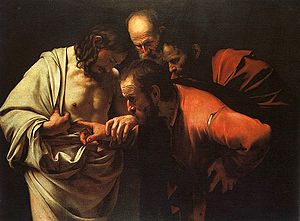
Sermon: “Prove It” (John 20: 19-29)

Saint_Thomas

I saw a photograph this week that someone had snapped in the course of her travels—it was a huge Walgreen’s sign that read “Easter…50% Off.”

I guess that’s better than “Easter’s Over: Going Out of Business.”

But it seems hard to deny that the world seems to take Easter at a little bit of a discount.

Just compare it to Christmas.

Christmas manages to be more of a season…more of a culmination. The world goes quiet in that week after Christmas in ways that seem reverently hushed.

People have always said things like, “’Tis pity that Christmas comes but once a year.”

For whatever reason, joyous as it is, Easter is not like that.

The fact is, even for many in the clergy, there are years when it just seems to come and go, like an Easter Bunny hopping from one side of the stage to the other.

So maybe that sign that said “Easter 50% Off” is just telling it like it is.

II.

 And if that’s what we’re doing…if we’re telling it like it is…maybe it makes sense that the Sunday after Easter is the day when the Church reads the story of “Doubting Thomas.”

There used to be a show on MTV that began with the words, “This is the true story of of seven strangers… picked to live in a house…work together and have their lives taped… to find out what happens… when people stop being polite… and start getting real….”

In that spirit, there is this sense that the politeness of Easter is no longer required…that now we can all be real.

It’s too bad that for many people, “being real” seems to mean “sleeping in.”

Because if Easter represents faith at its most triumphant, the Sunday after Easter represents faith, maybe at its most honest.

And I would argue that we need that faithful, real-world, here and now honesty as much as we need that hope-filled Easter Morning glimpse into God’s glorious future for Creation.

In fact, if it were up to me, The Sunday after Easter, Doubting Thomas Sunday, would be as much a part of the story as Palm Sunday and Holy Week.

Because it’s more important than many of us ever give it credit for.

Because without it, so many of those who need Easter the most can miss the Easter message entirely.

Because, remember, church….remember: so many people join us for Easter Sunday and they think that actually, we have forgotten…that we who are inside have forgotten what it feels like to be on the outside of the church and looking in.

They think we have forgotten what it is to live, not quite sure about what you believe.

And not quite sure how to get your life together.

And not quite sure if other people can tell that, some days, you’re hanging on by your fingernails, just hoping to get through.

Those pilgrims come, and they think we’ve gotten it mostly figured out. That each day is Easter Sunday, and that we’re all just here to say thanks be to God.

They think we’ve probably forgotten life on the outside looking in.

If that’s your situation, and you come to a church on Easter, it can be so easy to leave that Easter service, convinced that everyone else in the sanctuary was born singing the “Hallelujah Chorus,” and that you’d better keep your own searching reeeal quiet, because the only people who ought to be calling themselves Christian are the ones who have already found Jesus, and not the ones who are looking for him.

And so we read the story of Doubting Thomas today, in order to name that the searching matters, and to name that the searching continues, and we read the story in order to name that the answers are not simple for any of us.

III.

The story itself is not long to tell.

On the evening of the first Easter, the disciples have retreated back to their hiding place—that room where they had been holed up for days, waiting for Passover to end and for the Romans to march back out of town, leaving the coast clear.

And the story goes that Jesus comes to them there, ghost enough to pass through a locked door, but human enough to touch, and wounded enough to prove that he is the one and only Jesus.

He is among them again. It is truly him. In spirit and in flesh. Somehow—who knows how?—only God knows how—but there he is.

The story does not tell us what they said to one another after he left again. It doesn’t tell us how they wrapped their heads around it.

Instead, it tells us only that one of their number, Thomas, was not there when it happened.

And when Thomas arrives, he is unprepared to accept their testimony about this new, strange appearance of Jesus among his friends, and he says, “Unless I see in his hands the print of his nails, and place my finger in the mark of the nails, and place my hand in his side, I will not believe” (v.25).

“I can’t know Jesus like this second-hand,” he says. “I’d love to believe it. But I need to see it for myself. I need to know it in my own way. Prove it.”

I love him for that.

I love him for listening to his own heart and his own head, and for trusting the prompting of his own soul to tell him when he had found what he was searching for.

Some would say that’s disrespectful, or even faithless, but I don’t think so.

In my book, he’s one of the strongest disciples that the Church has ever known—the conscience of them all.

He won’t go along to get along; he doesn’t know how to win friends and influence people; he won’t let some other piper call the tune.

He has no patience for believing someone else’s beliefs, or kneeling before someone else’s truth—even among his friends.

And so he pushes back.

To me, that makes Thomas the patron saint of all seekers.

To me, he is a friend to all those who find easy answers to deep questions unacceptable.

To me, what matters is not that Thomas refuses to accept the truth, but that he refuses to accept even a beautiful truth…even a truth that sounds great…he refuses to accept even a truth that he wants to believe in more than anything, until God reaches out to claim him with that truth.

He will only stand up for what he knows.

I love him for that. And so does Jesus.

Clearly, there is a place for him among the disciples, and in the Kingdom of God.

IV.

The Church throughout its history has told people of all kinds – people of all backgrounds and classes and races and genders that there is a place for them in God’s heart, and in God’s church.

God doesn’t expect us to have all the answers, or to imagine that we’ve finished our growth into who it is He needs us to become.

I believe God wants us to seek, and to keep on seeking all our days.

We cannot expect all the answers to line up before us—part of this journey that we’re on means that seeking knowledge, and seeking to serve God always pushes toward the horizon, taking us further into the unknown.

But our world is forever growing. And our hearts are forever expanding.

And in time, with God’s help, we come to understand that we must push beyond the world we know, and beyond the facts we can hold in our hands, and journey on into the places where only faith and trust can direct us.

Today’s Scripture reminds us that without doubt, there is no seeking. And seeking is precious to God.

Without seeking, Easter is a story that simply comes and goes.

But for those who seek, for those who push, for those willing to undertake the journey, it is a foretaste of the heavenly banquet that is to come.

It was for Thomas.

May it be so for you and for me.

Newsletter: What if I didn’t believe?

Dear Friends of Second Church,

Every year between Good Friday and Easter Sunday, an Episcopal priest I know uses his prayer time for a particular spiritual discipline: he tries to imagine an atheist version of himself.

That is, he tries to consider just how his life would be different if he didn’t believe in God.

So: there are some obvious things, of course. He would be in a different line of work. He would dress differently. He would be doing a very different kind of writing—maybe not doing much writing at all. His Sunday mornings would probably involve tai-chi and the crossword puzzle on a more regular basis.

But those are a handful of superficial things.

The deeper question, of course, is what he might be inclined to believe in, instead.

Without a sense of living under the sight of God, and a hope to live in a way that is pleasing to God, whose looking would he be most aware of? Whom would he be hoping to please?

What larger story about the world and how it works would he use to explain his daily experience?

Because, religious or not, everybody has some larger story they lean on. Over time, our lives come to be shaped by that story in important ways—and we come to understand what’s important and what isn’t, who’s important and who isn’t, and to live our lives accordingly.

Maybe it means something wifty, like “never date a Scorpio” because the truth is in the stars. Or analytically precise, like using cost/benefit analysis for every decision, because the truth is in the numbers. Or wondering what everyone’s therapist would say about why they are acting the way that they are, because the truth is in mind’s unconscious.

More ominously, those larger stories also teach us to see other people in particular ways, too—they determine whom we notice and what we notice about them. Sadly, so often that turns out to be less than who they are in their full complexity, not to mention beauty.

We can’t help but gravitate toward some approaches more than others. Yet each one has its blind spots.

For my friend, imagining himself as an atheist is a little bit like visiting a city, far from home, and recognizing that you could see yourself living there—that you like the weather there, that its scale and pace appeal to you, that its people seem like your kind of people—and yet, despite all that, knowing that it isn’t your home.

And yet, it shows you a lot about what your home is and is not.

Easter is a glimpse of our true home, and of what faith in its fullness promises to be.

But the light of Easter also reveals the places where God’s work in us is not yet complete, where our blind spots remain, where we remain too easily taken in by other ways of seeing the world—and even where our limited understanding of faith may distort more than it reveals.

Easter is not the joyful conclusion to the story, but the joyful beginning of a new and grander story for each one of us.

May you have a sense of God’s deep love and abiding peace as you set out on the journey.
See you in church,

Newsletter: Easter and New Life

emptytomb

Dear Friends of Second Church,

“And very early on the first day of the week they went to the tomb when the sun had risen.”
Mark 16:2

Whenever I get up just before dawn, I think of the women on that first Easter, rising to play their role in what seemed like the end of the story.

Many people forget the surprising detail that, in Mark’s telling, the women are greeted at the tomb by an angel, and that they don’t react with wonder and joy: in fact, they run away terrified and tell no one what they have seen.

I love them for that. It’s so human. And if we’re honest, we know that when new life beckons us, we don’t always respond at first with wonder and joy, either.

God’s purposes can have a way of over-ruling a lot more than we expect or hope, and sometimes it takes a while to adjust to God’s new reality for us, even when it’s grace-filled.

The women at the tomb that morning were only the first to experience something that Christians have had to learn time and time again.

If you think about it, Easter should be a lot to adjust to.

And not just that first one, way back when: every Easter ought to take something out of us, because it was on this day more than any other that God reached down to put something into us: a new heart, a new destiny, a new life in Christ that meant a new life of love and service we would be expected to grow into. Living into that takes everything we have to give and more.

But it gives us more than we could ever ask or imagine.

I still have a lot of growing to do. And yet, every year on Easter, I am reminded of the joy I find along the way, and my gratitude for finding the new things God is asking me to become a part of, and to help as best I can.

Wherever you will be this Sunday, I hope you will find your heart warmed by the presence of those you love, and lifted by the vision of the God who makes all things new.

Happy Easter,

Newsletter: “The strange gift of vulnerability”

guyeyepain

Dear Friends of Second Church,

On Monday, I had to be in the city for a short medical procedure on my right eye. It went fine—I was in, I was out, I was on the subway and back in a comfortable chair in no time.

But after an hour or so, I started to feel some discomfort—not pain, exactly, just that “this doesn’t feel like I remember it felt the last time” sort of feeling—and I began to wonder if this was one of those things you just wait through, as we do so much of the time, or if this was something I was supposed to be tending to right away.

I thought about calling the doctor to check. Or calling Liz to see what she thought I should do. I wondered if I should call someone to drive me home rather than taking the train. And it was then that my discomfort really began, because I realized, all of a sudden, that I couldn’t call anyone at all. I had left my cell phone back in Greenwich.

I also realized that: my parents were in New York City; my in-laws were in New York City; the doctor I had seen that morning was in New York City; half of my friends from college were in New York City; many from our congregation were at work in New York City. If you ever need help in New York City, call me: I can get someone there in ten minutes. Or, actually, that’s something I can do… if I have my phone.

Well, I decided to wait the situation through for a while. But as I did, I had a new sense of my own vulnerability.

Of course, we all deal with the unexpected on a regular basis—that’s what life is. However, what makes us vulnerable is when our strategies for dealing with the unexpected break down—when the cell phone isn’t in its customary place, when the phone number you need isn’t one you remember, when the people you rely on for help cannot be contacted.

Or maybe it’s when the parents you’ve always called for advice, or a little support, are no longer available to offer it. Or when your health takes a turn, and things you once did easily and without any thought now require tremendous care and concentration. Vulnerability comes in many forms.

What do we do when we encounter it? Are the things we rely on truly seeing us through, or are they just propping us up?

My time of vulnerability did not last long—after resolutely/foolishly getting myself home on the train, I was back in the world of the familiar, and well on the mend by dinnertime. But what if that hadn’t been an option?

It’s worth thinking about this week because so much of the story leading up to Easter Sunday is about the courage and faith of Jesus, even in the face of his own vulnerability. In no small part, the story of Easter is God’s affirmation that he remains with us in our most vulnerable moments, for he knows first hand what it is to see strategies break down, and to see the way forward plunge into confusion.

But most of all, it is to affirm that confusion never has the final word.

To walk the way of Easter is to believe in the power of forces we cannot quite see, and to trust in answers we may not entirely understand, remembering that it is often when our own familiar solutions run out that God’s most miraculous and unexpected solutions emerge. Christians affirm that “new life” does not simply mean “more life” — it means a life that is transformed, led in different ways and lived on different terms than the life that was before. For us, that can only mean a life that is grounded in love of God and neighbor—which is the only truly solid ground there is.

Even so, many hear that affirmation and are essentially unmoved. But for those who believe, and for those who have found in their own vulnerability a path they might never have known otherwise, they are nothing less than words of life.

May God grant you and those you love words of life to sustain and guide you this Easter, and always.
See you in church

Newsletter: “Don’t Miss Out”

Dear Friends of Second Church,

Two Thanksgivings ago, Liz and I hosted a large group of my family, including pretty much the whole California contingent, for several days of dinners, guitar recitals, political discussions, and an outing to “Frozen” (which had just come out).

As I think I’ve mentioned before, for the occasion, we ordered a special, “artisanal” turkey…designed to taste like turkeys did way back when. I remember liking it…though what looms larger in my memory is the elaborate dry-ice packaging in which it arrived on the Tuesday before Thanksgiving. Taking it out of the styrofoam was like being in a Harry Potter movie—a turkey coming out of a box, like some sort of magically-conjured delicacy, complete with mysterious, wispy smoke, emerging from the cauldron. Trust me, once you’ve had that experience, the taste of the turkey itself is just sort of an additional feature.

I’m thinking of it today because, as you might imagine, the artisanal turkey people have been contacting me a lot lately. They are extremely concerned that I haven’t yet placed my order for an Easter/Passover lamb—time is running out! Orders are flying in! Even now, the dry ice is being prepared! Don’t miss out!

Sometimes, it seems as if we have a very strange notion of what’s authentic, these days. We hate the very idea that we might be missing out on something deeper, truer, or more real, somehow—and in spiritual terms, that longing is important to listen to. The church has always thought so: St. Augustine has famous prayer in which he writes, “our hearts are restless until they rest in thee.” Clearly, there is no doubt that our longings, understood at their deepest, point to many of the questions that faith hopes to answer.

But when it comes to the answer to our longing, we seem to end up focusing on the externals all too easily.

Consider: is that longing answered by what’s on the table–an artisanal lamb or a turkey–or by the act of gathering with those we love? Is it about the magic of artful presentation, or the unmatched napkin because an extra guest has been squeezed in? Is the point of preparing old recipes really about showing that we got them just right, or is it about remembering the hands that once prepared them so devotedly?

I’m not so worried over missing out on the authentic taste of artisanal lamb. By contrast, being too harried to enjoy three generations around the table together worries me exceedingly. Forgetting that Easter may be Easter, but kids are still kids, and they love us but still want to go watch t.v. before everyone has finished—I’m thinking about that. And especially: losing touch with the day as the celebration of God’s utterly selfless love for his imperfect, searching, distracted, impatient people? I need to make sure that doesn’t happen.

What is the recipe for an “authentic” Easter?

While it is still a few weeks away, I think that’s something we all need to think about. Time is running out. Don’t miss it!
See you in church,

Max

Sermon: “Good Housekeeping” (John 2:18-25)

If you read all four gospels carefully, you begin to see that they tell the story of Jesus in similar, but distinct ways. 

Some stories appear in one gospel but not another.  And we’re not just talking minor things: the gospel of Mark does not even include much of a resurrection story.  In Mark, the women go to the tomb of Jesus, see it’s empty, and run away terrified. The end. 

But this morning’s story about turning over the tables of the money changers in the Temple occurs in all four gospels. 

Clearly, this was an important story for the early church–a story that told them something very important about Jesus. 

Most of them connect it closely to the final week of Jesus’ life.  In fact, most suggest that his angry denunciation of the moneychangers in the Temple is the very first thing Jesus does after arriving in Jerusalem on Palm Sunday–his first stop on his last journey. 

And that has the ring of truth, of course.  Because if it’s true, then no wonder…no wonder that the Temple authorities and the Romans would have been looking for a way to arrest and silence him.  Such public displays of defiance were not to be tolerated, particularly at Passover, when the city was full of pilgrims, and the underlying theme of the religious holiday itself was about God’s liberation from cruel, foreign oppression. 

It didn’t take a genius to see that when the Jewish people were celebrating liberation from slavery in Egypt, they were dreaming of liberation from Rome. 

So you can see why, in the eyes of the Romans, some rabble-rousing preacher from Galilee was trouble–and that if he started to win over the crowd, maybe even big trouble.  

According to the brutal hand of Roman imperial justice, no wonder that the hands that flipped over the tables in the temple were nailed to the cross just five days later.  

It makes a great deal of sense to tell the story in that way. 

So it’s interesting to note that John’s gospel, which is the one we’ve heard this morning, puts the story in a very different place. 

According to John, the scene of Jesus and the moneychangers in the Temple occurs at the very beginning–in Chapter 2 of the story, just after Jesus performs his first miracle, changing water into wine at a wedding in Cana. 

To hear John tell it, it’s almost as if Jesus catches a late ride back to a friend’s house, then is up early again the next morning for a quick trip into the city, where he does this peculiar, and seemingly out-of-the-blue thing at the Temple.

As John describes it, It’s a full two years before the arrest and death of Jesus. 

And maybe part of the point was simply that the handwriting was always on the wall…that what was to come should have been obvious for anyone who was paying attention. 

But I am just struck by the idea that the first two acts of public ministry Jesus performs are a joyful miracle at a wedding and an angry demonstration at the heart of the capital.

Because I get the joy.  I suspect most of us do.  When the churches fill at Christmas and Easter, it’s because people are so hungry for it. 

They’re right to come looking for it in the churches all over the world.

The je ne sais quoi of Christian joy that people experience in our great festival services is impossible to explain, yet impossible to deny.

Those who come may not believe a word of what we say. They may not know the tunes of what may be the most familiar hymns we sing all year.  But even if it’s only for an hour twice a year, they do come, and they feel…something…even if they can’t quite say what it is. 

Maybe they believe, or maybe they don’t…but they most certainly believe that we believe, because they feel the joy of those occasions so deeply, and if you only come now and again, it must seem as if that’s what it’s like if you really believe: that for those who believe, every day is like Easter Sunday, or Christmas…except maybe there’s better parking. 

And so they come and they go, perhaps resolving that once they’ve learned to feel the way that we all so clearly do, each and every day, then they can come back on some other kind of day and apply for membership. 

A place that is clearly such a haven for saints could not possibly serve as a hospital for sinners…or guide post for seekers. 

And that’s why the mission of the Church is more than just teaching people to look upward to heaven, with folded hands and mysterious, Mona Lisa smiles on our faces.

It isn’t just about looking up.  It’s also about looking around. 

And it’s not just about cultivating joy and serenity.  It’s also about living out a passionate engagement with the world, and a deep honesty about the challenges of being alive, even for we who believe.   

That can run to extremes of its own, of course. 

Imagine the person who came to church only on the Sunday after Easter, when we typically tell the story of doubting Thomas, or on the Sunday when we tell the story of the man who comes to Jesus and says, “Lord, I believe. Forgive my unbelief.” 

Or if they came only on those days when Scripture offers marching orders to go out and fix things in the name of God. Any student of history can tell you that the line between righteousness and self-righteousness can be dangerously hard to draw.

That’s why I think John tells this story so early in his gospel, and glues it next to the story about the wedding at Cana. It’s because he wants us to understand that Jesus is about them both. 

Joy is wonderful but can be a little passive; anger can be consuming but, wow, it gets things moving. 

And so Christians are called to look upward, and we are called to look around, too, and the life we are invited to pursue as faithful people is a life in which those two things remain in tension. 

Looking around this morning, I have little doubt that, God willing and the creek don’t rise, I will see you on Easter.  And next Christmas.  

But why are you here today? 

I think you’re here because you are trying to live into the tension presented by John: as Christians, we are on the lookout for water into wine miracles, but we also know that Jesus calls us to overturn some tables. Christianity lived fully is about celebrating God’s unexpected work in our lives–and also going out and doing some of the tough work ourselves. And that in fact, in doing that work, we are doing God’s work. Even if we get into some trouble with the Roman authorities. 

It isn’t inherently noble to be forever joyful, any more than it is inherently more noble to live perpetually on the edge of righteous outrage.

We need to seek the fullness of faith–and that is a well-balanced diet.

Throughout the pulpits of America this morning, I’m absolutely sure that there are any number of preachers with sermons titled “Spring Cleaning.” 

As I think about it, I think I’ve preached that sermon before, myself. 

It’s a natural connection to make, because the story of Jesus and the moneylenders is all about that kind of starting fresh, about reestablishing the right order of things, about putting away what needs putting away and making space for what is needed now. 

But to me, John is making a deeper point about what it is to engage in “good housekeeping.” 

And he’s suggesting that it’s a lot more nuanced than some sort of “out with the old; in with the new” kind of approach.

Because Jesus is inviting us to something deeper.  

To the person who runs and runs and runs, he asks is standing still a luxury you just can’t afford, or an emptiness you just can’t acknowledge?

To the person who feels cruelly misunderstood, he asks what it might be about others in their own situations that needs understanding. 

To the person who thinks heaven is the goal of a spiritual life, he asks what it might be to work for the Kingdom of God breaking forth in our midst.

To the speechifiers, he asks what it might be to listen.

To the righteous, he asks what it might be to befriend the imperfect, and to learn to love them for who they are already, and not for who it is you hope that they will learn to become. 

To the brokenhearted, he asks if there are joys in life that might yet be found, and claimed, and a life rebuilt around them. 

To the joyful, he asks if we know and love the world around us enough to let it break our hearts from time to time.  

This morning, Jesus models a faith that turns the tables on each one of us. 

He invites us to seek out that undiscovered country in our faith, and in our lives, confident in his purposes, and knowing that it may be especially there that he waits to be found. 

Amen.

Newsletter: “The Loser Edit”

Yesterday’s Times had a thoughtful column called “The Loser Edit,” by the novelist Colson Whitehead. (You can read it here: http://www.nytimes.com/2015/03/08/magazine/the-loser-edit-that-awaits-us-all.html?_r=0)

Just briefly, a “loser edit” is a particularly merciless expression from reality television, referring to how those shows take hours and hours and hours of footage and edit and condense them into coherent story lines, fit for an hour long program, with people playing particular characters—heroes and villains, golden boys and golden girls or chumps, brains or brawn, etc.

As Whitehead puts it, “if you have ever watched a reality TV show and said, ‘He’s going home tonight,’ you know what the ‘loser edit’ is.”

It can be a rather willful process, of course—a person might just as well be presented as a kind, considerate hero, or a lovable, harmless schlub, as a dark, selfish snake. It all depends on who does the editing, and what the story seems to require.

This has me thinking about Lent.

Some people push back against the self-reflection and conscious self-denial of a penitential season. At one extreme, some grew up in religious households where “pride” was a particularly grievous label that covered a multitude of situations, some sinful and some perhaps not. They grew familiar with a God was, above all, a Righteous Judge who saw all things, for whom squirming seemed almost more important than redemption.

Sad to say, Lent can remind them of that time, and of trying to live in the light of what seemed like a grace-less God, in painful ways that are long in healing, even many years later.

But they are not the only ones who struggle with Lent.

Many are put off by it, because Lent seems like a season when the Church asks us to construct our own “loser edit” about ourselves — to retell the story of our own lives in terms of our every moment of weakness or selfishness, our every moment of hesitation before doing the right thing, our every angry and impatient word, our every extra helping of bacon or snuck cigarette.

Life is hard enough without dwelling on the negative—how can seeing our story as the saga of our unfolding flaws help anything at all?

Let’s be clear: I’m quite sure that it cannot.

And yet, how often is it that we create the time and space to think deeply about our lives? What kind of story do our lives seem to tell? How often do we step back from the living of our days, and seek to trace the coherent story lines, the slow unfolding of who it is we have become, or the likely destination toward which we’re tending?

On any given day, each one of us is, of course, any number of characters: a kind, considerate hero; a lovable, harmless schlub; and even a dark, selfish snake. But in time, the story emerges, and the plot becomes clear.

In Lent, we are reminded that God is the ultimate author of our story, and that the story of his love for all that he has made is the grand narrative within which our little stories find their place.

The disciplines of the season are not meant to punish us, or to show us the “loser edit” of our lives. They are meant to invite us into a sense of that larger story, and to live our lives more fully as a part of it.
See you in church,

Sermon: “The Faith We May Not Want At All” (Mark 8:27-38)

frownyface

This morning’s reading from the Gospel of Mark represents the first time, at least in Mark’s telling, that Jesus predicts his death and resurrection.

It goes over like a lead balloon.

Mark doesn’t much pause to draw the scene for us – we know that Jesus is on the road with his disciples, and that just before the moment when he announces what is in store for him, he has asked the disciples a momentous question—namely, he asks them: “Who do people say that I am?”

There’s a great deal to be said about that all by itself.

But for our purposes this morning, it gives us a window into the scene right there, because it turns out that the question uncovers so many of the hopes that people have been harboring about Jesus…so many of the possibilities for what’s been happening that they have been trying to sort through.

So before we get to the lead balloon, we need to have the larger scene in mind.

Because imagine what it’s been up to now for the disciples.

Imagine what it would have been like, traveling along the way with Jesus, seeing all the healings, and hearing all the preaching, and feeling a part of a whole new way of living in the world.

The call stories of the disciples always make it seem like Jesus was just irresistible for a certain kind of person–that when he showed up out of the blue and called you, you stood up, untied your apron, tossed it on the back of a kitchen chair and left right then and there.

And they never look back.

As the journey goes along, if you think about it, there is a remarkable lack of grumbling from the disciples.

For all the disciples lack of understanding at any given moment, and all their little agendas about getting in the inner circle of the inner circle, Mark never mentions any “Are we there yet?” kind of whining.

The roads of Galilee may be dusty and the Pharisees may be unkind, but you never hear Peter turn to Andrew and say, “Wow…right now I sure wish we were back home fishing.”

Even now, so many years later, you can feel the energy and excitement of this movement still coming right off the page.

And yet they do have questions—given everything they’ve heard and witnessed, how could they not have questions?

But the way Mark tells it, that kind of questioning hasn’t been something to do out loud.

My United Church of Christ colleague, Rev. Martin Copenhaver, came out with a book last year called Jesus is the Question: The 307 Questions Jesus Asked and the 3 He Answered.

It’s a good book. But I can just see the disciples rolling their eyes and saying, “Right. Tell me about it.”

It seems likely that if you travelled with Jesus, you had to get used to the fact that he was the one who was asking the questions.

And so how appropriate, really, that on the particular morning that Mark is telling us about, out there on the road to Caesarea Philippi, Jesus opens with one of his questions, asking: “Who do people say that I am?”

But this one opens the floodgates.

All their grand theories and their minor hunches, their sense of connecting the dots with Scripture, or just their cosmic attunement to the general vibe of this whole thing comes spilling out.

And it is Peter, for once, who comes up with the right answer, looking Jesus right in the eye and saying, “You are the Messiah.”

Unfortunately, the glow does not last long.

This is where the “lead balloon” comes in.

Because yes, the long-awaited messiah has arrived.

But whatever they’ve been taught that means, whatever they’ve been taught to expect will happen once the Messiah comes, whatever answers that arrival is supposed to yield…Jesus flat out says that it’s not going to be like that.

What lies ahead is not triumph – at least, not in the ways that they’ve been taught to imagine it, and instructed to work for it.

Whatever faith it is that has gotten them this far, Jesus makes it sound as if the faith that they’ll need for the road ahead could turn out to be an entirely different, entirely new, entirely foreign kind of faith.

And I think what’s hovering in the air out there on the road to Caesarea Philippi is that the faith they will need may not turn out to be a faith they even want.

What lies ahead is not a path leading ever-upward, with triumph after triumph to look forward to.

What lies ahead are suffering, and sacrifice, and sadness, and only then, triumph.

No wonder, then, that Peter rebukes him, and vice versa—that a shouting match ensues between the Master and the one who had just shown himself to be the star-pupil.

“After all we’ve been through together, Jesus, how could you do this to us?”

It’s telling that Mark describes this, specifically as “rebuking.”

It’s telling because, though you would not know it, that’s almost a term of art in Mark’s gospel.

“Rebuking” is commonly part of an exorcism—often the opening salvo that seems to render the spirits powerless, or alternatively, which silences them as they depart.

So in this moment when the pupil rebukes the Master, and the Master then rebukes the pupil, it isn’t just two friends fighting.

What we’re witnessing is more like a form of spiritual warfare.

It’s a battle between the faith that Peter wants — prefers — to believe in, versus the only truth that can set him free.

And that’s why it’s so important for us to hear it, too.

Because like Peter, we also contend with the temptation to serve only the gods we want, under the terms we want.

We turn away from the call of God to go into the places we do not wish to go, and to shine sunlight onto forms of brokenness within ourselves that we’d just as soon keep hidden.

But if Jesus teaches us anything, whether it’s in this morning’s gospel passage or in any other you might find, he teaches us that the way of safety – the path of least resistance – is not the way of God, or the way to God.

And if Jesus promises us anything, he promises a way to live that isn’t a strategy around suffering, but courageously through it, because some things are more important – more important than how we feel, or how we look, or even whether or not we are confident about succeeding.

What matters is being faithful to claims of God and neighbor, no matter how much those claims may scare us.

Let’s acknowledge that this is a hard word.

It’s a hard word, especially for anyone who already feels weighed down by the claims of a busy and demanding world—which is to say, it’s a hard word for all of us.

With everything life asks of us, could it really be God’s will that there should be more to do, more to offer, more plates to keep spinning?

Lent reminds us that God calls us to give up the things that do not truly matter in the name of offering greater attention and faithfulness to the things that truly do.

Lent is a chance at least to name some of our own demons, if not rebuke them.

For in our hearts, we know that life is not a journey going ever-upward, with only triumph after triumph to look forward to.

That makes it all the more important to recognize Lent’s invitation to seek a strength that is greater than our own strength, and a courage that is greater than our own courage, and to place our lives in service of a future that is greater than any that we might devise.

For Jesus, what lies ahead are suffering, and sacrifice, and sadness, and only then, triumph.

What lies ahead is life, lived faithfully, and ultimately, transformation.

In this morning’s reading, Peter does not see it, but that is what Jesus offers Peter.

And this morning, and in this season, he offers it to you and me.

The way of the cross may not be the way we want.

But for those who understand, it is the way, the truth, and the life, and the sign of the strength that moves our feet toward freedom.

Amen.

It is the way of the truth that sets us free.