Category Archives: Uncategorized

From the Newsletter: “Buried Treasure?”

nefertiti

Dear Friends of Second Church,

Maybe you have read about the possible discovery of the Tomb of the Ancient Egyptian Queen Nefertiti, which was announced recently by an archaeologist based at the University of Arizona.

If the discovery turns out to be true, it will be the most significant archaeological find since King Tut’s tomb in 1922.

And it’s important to mention King Tut (really, the Pharaoh Tutankhamen) right here for two reasons: first, Queen Nefertiti was his mother. Second, guess where (they believe) they found her tomb?

That’s right: using new scanning technology, archaeologists have identified a hitherto undiscovered, sealed doorway…in King Tut’s tomb.

Apparently, Egyptologists have always found it strange how small the tomb is…more like an antechamber than a full tomb. And Nefertiti’s final resting place was always a mystery, lost somewhere in the Valley of the Kings.

Now, for all the splendors of King Tut’s tomb, it may, indeed, turn out to have been just an antechamber all along, with even greater splendors hidden on the other side of that sealed door.

It reminds me of archaeologist Howard Carter’s first discovery of Tut’s tomb in 1922. It is said that after the very first swing of the pickaxe to open the tomb, Carter jumped to the hole with a lamp, eager to be the first to peer into the darkness with a lamp.

“What do you see?” asked one of the other explorers as a hush fell over the team.

“Marvels…” said Carter, his voice trailing off. “I see marvels.”

Perhaps those marvels are just the beginning—we will see.

It should remind us, also, that just when we might think that the people and places we know so well have no surprises left to spring, no mysteries remaining to uncover, no further treasures buried to unearth, well…guess what? They just might.

In fact, the same is true for you and me. Just when we think there is nothing that could possibly surprise us about ourselves—when it feels as if we must be beyond astonishment at the plusses and minuses that make up who we are—it turns out that there are undiscovered chambers that have yet to be opened. If only all of them held beautiful things!

And yet, wisdom comes in learning to see and know things as they are, not merely as we might wish they were. That’s especially true of our hearts, and of our messy, messy lives.

Maybe faith comes as we learn to offer them to God—to let God show us how even the seemingly unbeautiful, long-hidden things within us might be healed, or even prove useful in healing someone else, and therefore a strange but vital gift bequeathed to us, or a way that God works through us.

As summer trundles on, and the office is half-empty, and the neighbors are off to the Cape, and the nights offer their gentle, quiet moments for reflection, may we seek to open the sealed doors within ourselves and find a way to offer what is in them to God and to each other.

That would be marvelous, indeed.

See you in church

Sermon: “Drawn By God” (John 6:41-51)

This morning’s reading from the Gospel of John follows directly from last week’s section. It’s an extended teaching section by Jesus that is centered around the image of Jesus as the bread of life.  

“Whoever eats this bread will live forever,” Jesus says. “This bread is my flesh, which I will give for the life of the world.” 

There is a powerful combination of ideas here. He is evoking at once images of sustenance and salvation, and also of incarnation and sacrifice. 

Last week, I know Liz reflected on how Jesus seems to be asking us what we’re truly hungry for, and his thinking seems to be that the deepest hunger is, in the end, more spiritual than physical. 

That was an especially powerful statement among people who would have known physical hunger, even starvation, all too well.  

But this is what he does.  

This week we have the further layer of this argument with some of his hearers that he seems to be having. “Stop your grumbling,” he says, when he sees them murmuring. They bristle at this audacious claim that not only is there bread of life, to begin with, but that he is that very bread.

They’ve known him way too long to go for that. They’ve known him from way back. They know his father, his mother, his family. If you need a new ladder or a plow or maybe even a loom, sure, talk to Jesus. But this? 

Come on, man. 

It’s elsewhere in Scripture that Jesus says, “A prophet is not without honor, except in his own country,” but nevertheless, the same idea seems to float over this particular moment in John’s Gospel.   

That’s part of the thing about prophets, isn’t it? 

Because it isn’t only the messages they bring us that are so strange, so challenging, so hard to swallow. 

It’s the messengers themselves who can be so strange, so challenging.

When God’s Word touches down…when Word becomes flesh…it is so rarely through the proper channels, or from among the usual suspects.

Maybe that’s because it actually takes more faith to believe that way. It pushes us commit on a whole new level. Sometimes it seems like that’s how God works. Always looking for that leap we’ll have to make…that horizon over which we’ll have to travel in order to get wherever it is we’re supposed to go. 

Sometimes, I think that if someone ever approached me and said that they were a prophet, sent by God with an important message, I could look them up and down and call it right there. That I’d say “Speak for your servant is listening,” or “You know what? I’m sorry but you can’t be a prophet: you’re just not weird enough.” 

Prophets are often a little bit weird.

Last week, Liz and I saw a terrific one-man play in the city called “The Absolute Brightness of Leonard Pelkey,” and I suppose I’m thinking about it because, while we never meet Leonard, the one thing everyone seems to agree on about him is that he was weird. 

The play opens with a detective receiving a missing persons report for a boy in his early teens. Leonard. Who was sent to live with his aunt and cousin in a small town on the Jersey shore, where he stood out like a sore thumb–flamboyant, theatrical, seemingly close to nobody, insistent on wearing fairy wings in a local play and rainbow platform sneakers that he made himself out of a pair of high-tops and a pile of flip-flops and a massive amount of glue.

He is so different from the world around him that the atmosphere quickly grows ominous. 

And yet, as the play goes on, and the search for Leonard deepens, it becomes clear that, surprisingly enough, he has touched many lives. Because there is something about his absolute brightness, his improbable spirit, that inspires all kinds of people.  

Young as he is, isolated as he is, Leonard is alive. He’s alive in ways that a Jersey shore town in the winter, full of people whose best days seem to be behind them, just can’t help but find hope and comfort in. 

That proves to be his legacy, and mostly, it’s a good one. 

I recommend the play. 

But more to the point, I think it says something about prophets and about incarnation.  

Because there are people like that, right? 

There are people who seem almost sent to teach us that something in our lives or in our world is being called to change. To respond to some new vision. To be ourselves bravely in some new and deeper way.  

Some of the great figures in history were clearly like that.

But I don’t think we’re only talking about setting the bar that high.

More to point, the kind of person we’re talking about might be someone like Leonard, a random kid in a Jersey shore town. Or a headhunter who calls out of the blue, right at the moment when you’re open to a change–I know a little about that one, because a call like that brought me here. Or maybe it’s a neighbor who hears about your recent diagnosis and says, “I don’t know if you know this, but I’m a survivor, too….” 

Prophets come in all shapes and sizes.  

Let’s say also that the message they bring isn’t always religious.  

Many years ago, an Anglican bishop caused quite a stir when he suggested that, perhaps, God might not be particularly interested in religion, among everything else that seemed to be going on.  

He meant that maybe it’s the human, in general, the Creation, in general, wherever life is to be found, and not just the practice of piety in one or two particular communities that was most interesting to God. 

Well, this was big news for a Bishop to say. But it shouldn’t be.  

Prophets come in all shapes and sizes, and the message they bring isn’t always religious. 

But it is holy — it is, somehow, a message from beyond us. A message that calls us even beyond the very selves we know. 

Indeed, in our becoming, sometimes it turns out that we’re just about the last person to know. The last to see. The last to hear God’s deep truth for us.

For any number of reasons, we cannot hear the call until the prophet appears.

In our Gospel passage, Jesus tells the doubters in the crowd that it’s God who draws us when a message is received.  

They are hung up in what is, for them, the sheer temerity of Jesus calling himself the bread of heaven. I’m not aware of that as an old image at the time of Jesus–it’s more like, bread or no bread, if he’s saying that he came down from Heaven, then they’re against it.

They can’t help but hear the message in the terms they know, when the point of a message like that is that it speaks something new, quite possibly in terms we don’t quite know.       

And Jesus responds by talking about the God who draws us, who says things that seem improbable via people that seem improbable, and yet, whose call to us is undeniable.  

To be religious, he suggests, to be conventionally observant, is far less important than our faithfulness in following God’s call whenever and however it might come.  

Our Gospel this morning is not simply about the calling of Jesus. It’s about the ways in which God calls and touches each one of us.  

May we see with God’s help to hear that call, however it may come, and find the courage to follow wherever it may lead. 

From the Newsletter: “Diving In”

diving

Dear Friends of Second Church,

Back when I was in high school, the school’s “Religion requirement” (two semesters at any point during your four years) was broadly considered a throwback to a different era—say, the Early Federal era, when the school’s mission had been the training of pastors for tiny northern New England churches, the curriculum required years of Greek and Hebrew, and the only tuition was a “candle tax” to defray the cost of so much homework after dark.

Two centuries later, “Religion” was still a small part of our education, but even so, the courses were of a different cast: the course on Buddhism was always hard to get into, and you could always spot a “deep” kid because he or she would sign up for Existentialism as a senior during spring semester—willingly reading Camus when all the other seniors were out playing frisbee on the library lawn. (Ahem…I should also add that it one of the best courses I’ve ever taken.)

But the hottest ticket of all was Religion 425, “The Religious Journey,” which was a course in comparative religion. It was the course that the upperclassmen told you about in your first year—full of personal writing, reading by Hermann Hesse and Jack Kerouac.

Not to knock comparative religion, but Religion 425 was also considered the easiest ‘A’ in the school. After all, God was hard to pin down, and religious journeys involved so much self-discovery.

In practical terms, that meant you could “discover” some things about yourself and talk a bit about “The Mystery,” and the Rev would pretty much let the rest slide.

When I got in, as a first semester Sophomore, I was considered one of the lucky few.

But things have a way of happening, and on the night before first day of class, at the dining hall salad bar, I overheard the school’s Assistant Chaplain talking with someone about the course she would be teaching: Introduction to the New Testament.

From the sound of it, New Testament was clearly not going to be a walk in the park. The first month sounded like they would be reading the Gospel of Mark with a microscope—the assignments were going to be things like “read six verses…write a two page reflection for class.”

Yikes.

The student she was talking to wasn’t convinced this was really for her. Wouldn’t you know it, she was taking Chemistry this year.

“We’ll get into the Greek roots for words like ‘salvation’ and ‘the end times’” said the chaplain. “It’s great stuff.”

Well, the budding chemist didn’t appear for class the next morning during C block. Which I happen to know because I did. I let my precious spot in Religion 425 go to someone else, like a seat in the lifeboat off this strange old curricular requirement, and I dove directly into the water.

For the life of me, I can’t say why. 

Maybe it was the slightly forlorn hope in the chaplain’s voice? The seriousness of the study? Because I’d already read Kerouac? Or because sometimes, you just know. Sometimes it’s the water that you want, and somehow you know that you’ll be able to float once you get in it. 

I just knew. And thank God I did. 
As Vacation Bible School starts on our campus next week, I suppose we can’t promise that each and every student will experience what it is to dive into the water for the first time, much less float.

But if we can teach our campers to dream of swimming, and trust to God’s sense of timing, we won’t just be telling them what others have said about religious journeys—we’ll be inviting them to see their own. One tentative splash at a time.

See you in church,

From the Newsletter: The Cigar Lounge Next Door

cigar

Dear Friends of Second Church,

Maybe you need to be a regular Putnam Avenue pedestrian to have noticed the cigar lounge that has opened just next to the neighborhood diner. From the website, it looks like a classy place — dark walls, leather couches, dark-shaded lamps that define the space with pools of golden light, big tumblers with artisanal ice and the merest suggestion of a heavy-handed pour — it’s almost the memory few of us actually have of the smoking car of an old train, hurtling west across the nighttime prairie, with conversations between strangers unfolding over hundreds of miles.

It was said that the notorious nineteenth century atheist, Robert Ingersoll, perfected his arguments in the smoking cars of the first transcontinental passenger trains. It’s also true that Lew Wallace, the author of Ben-Hur (the runaway bestseller of Christmas 1880), decided to write his novel bringing the story of Jesus vividly to life, having listened to Ingersoll in a smoking car somewhere between New York and Chicago. Wallace heard that perfected speech and knew right then and there that something had to be done, and so do it he would.

I can’t say if that’s the level of what’s happening today in the Cigar Lounge next to the diner. Wouldn’t it be pretty to think so?

But even if it isn’t, the lounge must be the right place for a particular kind of person, or maybe a particular kind of occasion, and the word on the street is that it’s doing o.k. so far. People in search of such a place are finding it there.

Meanwhile, just two doors down, the Smoothie and Fresh Pressed Vegetable Juice place (“Try Our New Kale Detox Cleansing Smoothie!”… “10 Day Juice Regimen Gift Packs Available!”) managed to live about as long as the average mayfly.

I’m not exactly sure what that says about our town or our times.

Could part of it be that we’ve started to have enough, not of health, but of convenience? That our food has finally gotten fast enough, that the debit-swipe-bag-it-and-go ethos of a bedroom community may get us what we want when we want it, but leaves us wanting something else entirely? That audiobooks in the car are better than no new stories or ideas or images, at all…but ultimately, not better enough? That we’re sick unto death of all the rushing?

If so, then maybe the cigar isn’t just a cigar. Maybe it’s about slowing down…about conversation…about encounter…about all those things that communities are supposed to be about and now seem to offer all too rarely. Maybe it points to the deep need we all have to know and to be known, to let connections develop over time, and to find ways to agree and disagree but still feel bound together somehow as we travel on this journey.

Likewise, surely we all know that there’s more to a church than simply “being a community.” We’re called to be a certain kind of community—a community shaped by its commitment to the Gospel, and to living it, as well as sharing it. Yet it’s important to remember that we’re never allowed to let ourselves be less than a community. After all, a spiritual filling station that’s only truly open an hour a week isn’t the kind of community we’re called to be. We need to be about slowing down, conversation, encounter, knowing and being known.

Is it convenient? Not on your life. But we understand God’s Spirit to be lurking in the details, the messiness, and the inconvenient truths we encounter in our common life. Thus, we bless and give thanks for it.

And our work and our prayer must always be that, like the cigar lounge down the street, people in search of such a place will find it…here among us.

Sermon: Jesus Comes Home (Mark 6:1-13) 

  
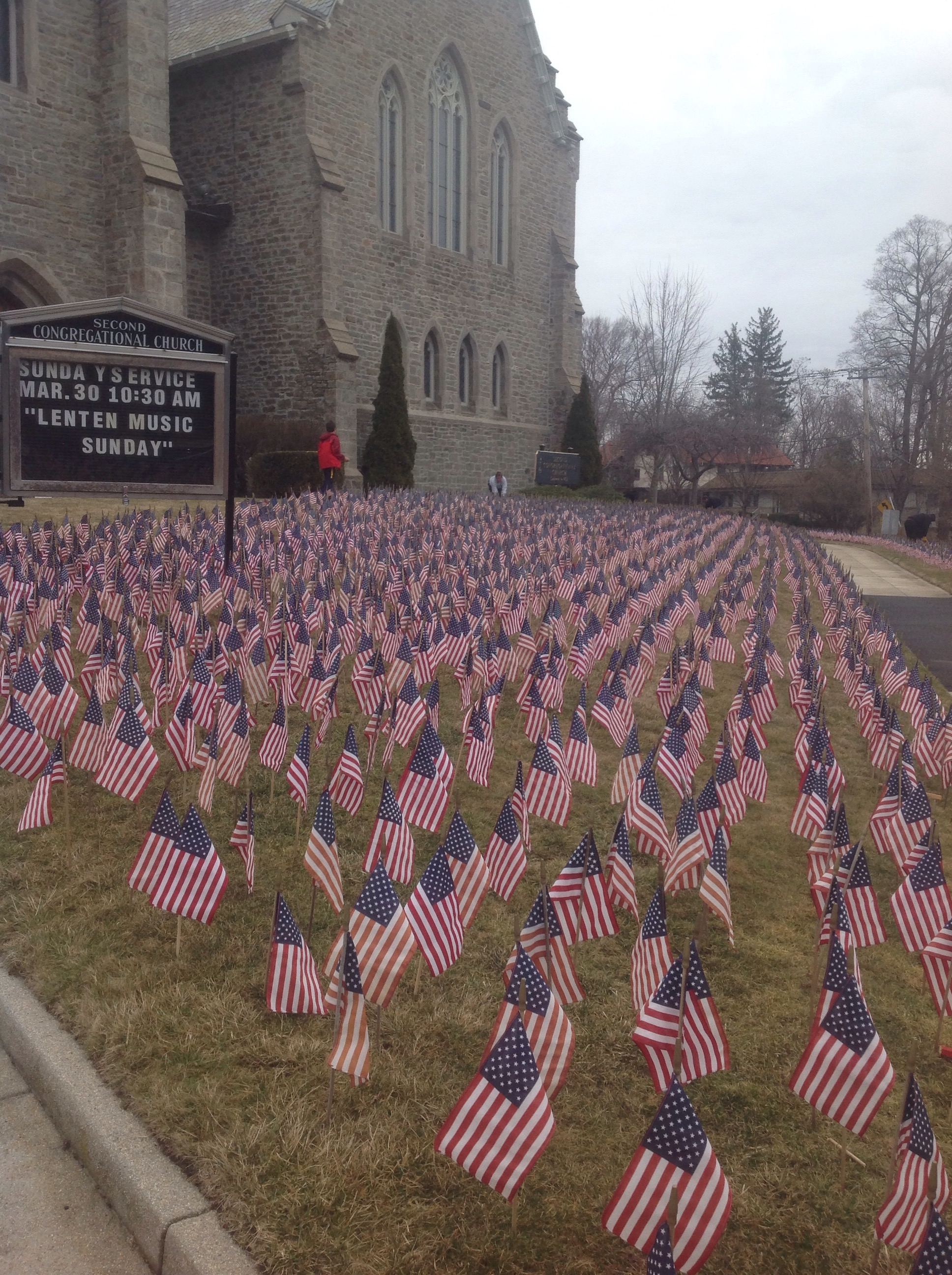
Every year around Fourth of July, my father gets out the kitchen step ladder to hang the American flag from the eaves of their front porch.  

If that conjures a kind of Norman Rockwell image for you, then you’re picturing it correctly. Old house, white picket fence, yard, dog, just down from the post office in a pretty Connecticut shoreline town…the kind of place where the hardware store is as close as they come to a men’s club. 

My dad hangs the flag vertically, which is a subtle form of showing off because there are rules about where the blue field with stars should be, which he has looked up, and while has never said so, I suspect that he keeps hoping that someone will challenge his placement and allow him to show them the relevant pages on flag ettiquette in our family copy of Chapman’s Piloting.

That nobody has, in fact, ever challenged this is, for him, a sign of national decay.  

The fact that in their particular town it is not unreasonable to imagine that each and every family might well have its own copy of Chapman’s Piloting, and therefore know that he is following the directives of the Department of the Navy and the U.S. Power Squadron…well, that has not really occurred to Dad. 

You see my dad is not just a member of the Old School. He is like the Headmaster of the Old School. 

I meant that. 

And so the things about that flag on their front porch that is remarkable is not simply that it’s hung according to regulations. That’s basic. 

The thing that’s actually worth noticing about it is that the stars seem off–their rows are staggered in a funny way, almost zigzagging back and forth along the left edge, as if Betsy Ross needed new glasses.

But that’s not it. Or I should say, you come realize that that’s not it when you actually make the effort to count the stars. Because it’s them that you realize: it’s a 49 star flag.

I told you he was old school. It may be the only piece of Eisenhower memorabilia my family owns. Certainly, it is the only one our family displays.

And let me just say, flying an older version of “Old Glory” is not some form of protest on my father’s part. Let me affirm, especially with our friend Jeffrey Mead back in town for a visit, that we Grants love Hawaii as much as anyone.

So part of it is nostalgia. But only part. There’s more to it than that. Because if I’ve learned anything from my father, it’s that like that flag, America is unfinished. The work of securing a more perfect union is unfinished. The responsibility of this country to stand for liberty and justice for all is unfinished.   

So many have done so much as a part of that work. Yet it continues, even now. As recent events have reminded us all, I’m sure. we’re not at the end of that work. We’re very much in the middle of that work.  

And as the last two weeks have shown, that work is not easy.  

Our congregation is like so many, in that there are a wide range of experiences and perspectives that come together here. I can’t say with any certainty where many of you may be on the symbolism of flags, the proper role of government, or how to define marriage.   

But I’m reminded of two things Benjamin Franklin said in the days when the Founding Fathers were meeting in Philadelphia.  

The first was early on, when the outcome of the Revolution was by no means assured. 

Speaking to members of the Continental Congress, Franklin observed, “We must all hang together…or most assuredly, gentlemen, we will all hang separately.”

The second moment was just after the Constitution Convention finished drafting the Constitution. One evening, as he returned home, a woman leaned her window and said, “Well Mr. Franklin, what kind of government is it to be?” And he tipped his hat to her and said, “Madam, a republic…if we can keep it.”

The challenges of hanging together, and of keeping what was imagined for us remain hard work. 

Wherever you are today, however it seems personally to you that things are going right now, I hope you’ll decide to remain committed to that work.  

In whatever ways you feel called upon to do it…whatever it seems to you the work we need is, even if it’s just talking to a neighbor or telling a grandchild about what it is to serve our country, I hope you’ll do it. 

Seeking and serving the greater good needs all of us. 

In this morning’s gospel, we get a brief look at a community that seems as if it has forgotten that.  

It is Jesus’ own home community of Nazareth, to which he has returned. His ministry has begun–it is beginning to hit its stride. The disciples have appeared. The healings have begun. He’s been baptized in the Jordan, tempted in the desert, started to talk in parables, and even the wind and sea obey him….and in Mark’s gospel, that’s just the first five chapters. 

And then he comes home.  

Is it nostalgia for the small town ways he’d known and lived so long that brings him back? Was it like driving by your old exit on 95 when you’re headed somewhere else, and deciding to take the Post Road through town just for old time’s sake?  

When he sees all the familiar cars parked in front of the synagogue, does he look at his watch and say, “well…why not?” 

He slips in just after the first hymn. Bob Willett hands him a bulletin and points to his family’s pew, which maybe one of his sisters or their kids is holding down solo, and there he is, back.  

And we don’t know how long he’s been gone, but you know that you don’t need to be away from home long to come back and see it with new eyes, the way you do when you come home for Christmas after your first semester in college…the way you do when you’ve finished Basic and you’re home before shipping out…the way you do your first Sunday back after the baby’s been born or your divorce becomes final or you met with the doctor to go over your results.  

And your world is bigger. Bigger and a whole lot more complicated than it was the last time you were here. It’s all changing and you’re just like…whoa.  

Do you ever have Sundays when you kind of dread coffee hour after church because you know that someone’s going to ask you what’s up, what’s new, or how you’re doing…and you don’t want to lay something heavy on them but…big things are happening? 

I wonder if that’s how it was for Jesus.  

And so maybe by getting up to read the Torah, maybe by getting up to do this impromptu sermon, Jesus wasn’t exactly meaning to proclaim the coming Kingdom of God to them.

Maybe he was just trying to head off all the questions by talking about how the Kingdom of God had come to him. Because they always tell you to start that kind of thing with an “I” statement, right? Maybe that’s what’s going on here. 

But he sees the whispering. The frowning. The people sitting in the pew texting the others who aren’t…OMG Jesus back. Not good. Ttyl. 

Or whatever it is they wrote. 

Standing there in the pulpit, Jesus sees all that. 

He sees it and he knows that in some fundamental way, he is “of Nazareth” no longer. That these people — his people — are no longer the ones with a claim on him. 

You see, they can’t imagine that unfamiliar truths might come from a familiar face. They can’t imagine that their world could be called to stretch, and their minds could be called to change, and their hearts to grow. They can’t imagine that God might have anything new to say.

What they see instead, or what they think they see, is the impertinence of Jesus, rather than his radical invitation to join him and become part of the Kingdom of God. 

Whatever the reason, they are willing to listen, but they are not ready to hear. 

What he says is just too different, and it frightens them. 

“This is Nazareth, Jesus. Remember your place. This is heritage, son. Not hate.” 

Like so many communities, Nazareth seems to see its very survival on people knowing their place and staying in it. 

And Jesus returns to invite them into a world where we’re forever changing places, giving up our seats for others and finding ways to make more places available. 

He’s saying that in the Kingdom of God, everyone has a place…and until we’re all together, the work remains unfinished.  

If we are honest with ourselves, we know that they’re right to be afraid. Because living the way that Jesus was inviting them to live was an invitation change everything–starting with themselves, starting with the very security and comfort that they had worked so hard to achieve and were so understandably jealous to preserve.   

They were right to be afraid.  

So should we. Because all these years later, this is still true. He still asks the same thing.   

On July 4th weekend, we remember that as Americans. we are called to “form a more perfect union.”

As Christians, we are called to remember that there is only one union that is truly, finally perfect, and that is a world united in God through Jesus Christ. 

There is much to do on both fronts.  

The good people of Nazareth–and I don’t for a minute doubt that they were good people–could not see their way clear to God’s glorious future. 

And it is so hard when our children return from out there in the world with a message about yet some other change that we are supposed to embrace, or be called a throwback or a dinosaur or part of the problem.  

That’s why listening–hearing–seeking to understand is so important…such an act of faith. 

God is not simply a force for change. If you read your Bible, you’ll know that God is not One who seeks changes for change’s sake. 

But time and time again, the force of goodness, and the force of justice, and the force of love are harnessed in the force of change, and God’s hand is in it. 

We know that about God. And so we are called to listen, and hear, and to seek to understand where God is in the world as it changes. And we are especially called to do that in times like these, when the world seems to change before our very eyes. 

In gratitude for the many who sacrificed their lives for our freedom, and in gratitude for the one who sacrificed his life that all might be free, may we rededicate our lives to a more perfect world for all people. .  

The people of Nazareth chose to stay put. But we must not. That’s not the Jesus way. And our neighbors and our souls need us to move forward, however it is that we can.  

We’re still very much in the middle of the work.    

May there always be room for another voice, another point of view, another friend, and another star.  

AMEN.


From the Newsletter: “Seeing the Sights…or Visiting the Gift Shop?”

giftshop

When I was a kid, we visited a lot of museums.

As a New Yorker, there were a lot of good ones to see, although the Natural History Museum was and is probably my favorite, and particularly the room with the enormous whale on the ceiling.

But there were others.

The catacombs in Paris. The catacombs in Rome. Churchill’s underground war rooms in London (which I recommend). The Jack the Ripper Tour of Whitechapel (not for the faint of heart). The John Knox House in Edinburgh (you can wear a goofy Reformation style hat and snap a picture with your phone) . The Musee de Faience in Quimper (that was a lot plates. A lot.) The Museum of the American Confederacy in Bermuda. (Yes. Yes, there is.)

I bailed on the Museum of Lace in Bruges, and stayed outside for an hour, feeding a croissant to the ducks (Rest assured, I would never waste a croissant like that now).

As you might expect, some of them were great, while others weren’t. Yet the quality of the museum never seemed to dim my enthusiasm for one room above all others: the museum gift shop. Of those, I am a true connoisseur—so much so that, sadly, too much of what I remember from some of the wonderful places I’ve been is the haunting ache for some thing that I wanted to acquire there, but didn’t. Hologram cufflinks. A subway token key chain. A tri-corner hat.

More often than I’d like to admit, the gift shop has been the heart of the whole experience.

I confess that to you now because tomorrow, I’m off to General Synod, the United Church of Christ’s national meeting, currently held in a different American city every other summer. Yes, there are a lot of nice museums in Cleveland, and maybe I’ll have time for one or two. More to the point, though, there is a lot of important work that goes on—creative worship experiences, thoughtful presentations about how to invite underserved people in our communities to our churches, passionate debates about social and moral challenges for our nation and the proper role of the church in those challenges. Missionaries giving reports of phenomenal work all around the world. There’s a new General Minister and President to elect. I have friends to see. From the deeply uplifting to the small and quirky, there will be a lot going on, and it’s all worth knowing about. Some of what will be there is sure to be great, and some may not be. Yet it is sure to be, as always, a remarkable window into the heart and life of our church, and of the way of being Christian that our denomination seeks to offer.

But ohhhhh, my friends, the gift shop. The glorious, glorious gift shop.

How utterly Congregationalist to let temptation itself lurk at the very door of the meeting. How Congregationalist that temptation should come in the form of books and baseball caps and t-shirts for causes of all kinds. That said, I know it is not them. It’s me.

The choice of whether or not to dive deeply into the experience or to stay at the edge of the pool is finally only mine to make.

Of course, none of us can choose what we’ll remember or what it is that we’ll one day come to regret. But in a world where it is so easy to collect badges of our experiences instead of actually having the experiences, we need to commit to new sights, new sounds, new places, and new friendships with renewed vigor.

May these weeks of summer be a time when all of us do just that. I look forward to telling you more about Synod when I get back.
See you in church,

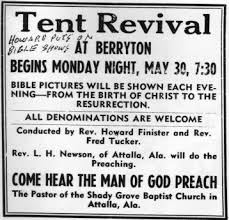
Sermon: Tent Sunday–or, The God of Small Things (Mark 4)

tent

The Hebrew Bible tells us that before there was the Temple, there was a tent.

Before there was a nation of Ancient Israel with a capital in Jerusalem, there was the Hebrew people, and there was the covenant with God that they made out in the wilderness, under the shadow of a great mountain.

Before there was even a sighting of the Promised Land, over on the other side of the Jordan River, there was the promise, and a 40 year journey through an unforgiving country to see that promise to fruition.

Jesus also knew what it was to be outside.

So much of his ministry was a ministry of the road, a ministry of journey—so much so that it’s taught us to see the spiritual life in general as a kind of journey—a highly personal pilgrimage for each soul, with the community that matters not the community of our birth, or our outward circumstances, but the community of hope that we encounter along the way.

And perhaps it is no accident that, according to Scripture, the Apostle Paul had a day job…and his day job was to work as a tent-maker.

City person though he was, Paul knew what it was to journey, and what it was to need shelter—and he knew it in every way.

So to be outside and under the tent again this morning is a change of pace, and an embrace of summer, a time to welcome back some of our prodigals and to commission some of our fellow disciples as they go on to new adventures, but it is also a way to lift up something that is buried deep within us.

It’s a way to get our hands around something that lies very close to the heart of what our tradition says that faith is all about.

Because if faith is about finding our home, and making a home, and about coming home, well, faith is also about leaving home—about leaving the safety and the security and the familiarity of the great stone walls that are there to keep the danger out.

Faith is also about the deep truth that sometimes, it is only when we risk the danger around us that we find the life within us.

And so we come to the tent to reclaim a little bit of that pilgrim spirit that has always been the beating heart of God’s people… the people who got us here…the people who found the strength to do bold things…who were not afraid to seek new life, and new meaning in old promises, and to begin new chapters in their own lives, and in the life of God’s people.

The best thing and the worst thing about a church is how safe it makes us feel. A tent reminds us to love God, and not simply that sense of safety.

II.

If you listen carefully, you may here something of that spirit in this morning’s reading from the Gospel of Mark.

Jesus makes a parable by calling our attention to the mustard seed—the lowliest, the smallest, the least likely to succeed of all seeds.

But it’s a strange parable, in part because it lives in the shadow of a more famous statement that Jesus makes about mustard seeds.

You probably know that one. In the words of Matthew’s Gospel, Jesus says, “Truly, I tell you, if you have faith as small as a mustard seed, you can say to this mountain, ‘Move from here to there,’ and it will move. Nothing will be impossible for you” (Matthew 17:20).

So when we talk about faith that moves mountains, we are talking about something that may begin as small as a mustard seed.

And there are times in life when we desperately need to hear just that…when the promise of that is a life preserver in the middle of an angry sea.

It’s a way of saying that something small can still be great, not because it is not small, but because God is great. And God is good. And so great, good things are possible for those who believe.

It calls us to summon our faith.

But this morning, Jesus uses the mustard seed to make a different point.

Because what he’s talking about today is the Kingdom of God.

What he’s talking about today is that idea…that force…that hope…that odd but steady pull that time and time again taken ahold of God’s people and led us out—beyond the great stone walls, beyond the safety of well made fence, beyond the known…and into the wilderness where anything might happen.

Because the thing about a mustard plant is not that it starts small. The thing about a mustard plant is that it’s wild.

We’re not talking about a plant that begins the size of a pin and in time, grows to be a mighty sequoia.

We’re talking about a plant that barges in and takes over everything.

It’s not a plant that grows tall—it’s a plant that spreads wide.

It’s not a plant that turns out to be beautiful or majestic—it’s a plant that is commonplace, durable, and impossible to contain.

And so what’s Jesus saying?

He’s saying that hope is like that. Life is like that. Love is like that.

The Kingdom of God is not some impressive thing, like the Temple in Jerusalem was in his day, or perhaps like the Vatican is in ours. And when it comes to Greenwich, Connecticut, lets admit that nobody scrapes the sky like we do, and we’re proud of that.

But the Kingdom of God is not that.

The Kingdom of God is wild is ways we cannot hope to contain, which is why the Kingdom of God is worthy to contain our hopes.

It’s strong, not in all the ways we can predict, but in all the ways we can’t, which is part of why it still gives living water when everything else has gone dry.

It doesn’t look like success by any other definition, and its excellence is not excellence in the ways that much of life teaches us to reach for.

It’s where a different kind of hope lives, and new visions take shape, and we plot our journey into places for which there are no maps.
That’s what the Kingdom of God is.

Even as the world can seem so very tired and so very familiar, the Kingdom of God remains just outside the door, eager to call us into the open, eager to take over the whole garden, and show us a life that is made new again and full of surprise upon surprise.

III.

And so today we come outside.

The matinee is over and we emerge from the cool, dark movie theater, blinking in the sun and feeling the air of the season, and remembering what it is to be alive, and unscheduled, and grabbed by what today might be.

Might it be for God?

In Egypt, they said yes. In Galilee they said yes. In Ephesus and Corinth and Athens and Rome and in so many other places, they said yes. At Plymouth Rock, and in so many moments of great danger and great courage, they said yes.

So now we come, not out of duty, but out of hope, and not because we are perfect or complete, but because we seek God healing, and a sense of God’s vision for our lives.

Won’t you say yes?

Our God of small things invites us into the greatness of the life he dreams for us.

Let’s pack up our tents and go.

Confirmation Sunday (Mark 3:20-35)

I.

 Do you remember the first time you liked something that your parents did not?

For me, it was about “The Flintstones.” I was five.

Now, as rebellions go, it was not much of one. The stakes were low. Even at the age of five, I could see that watching “The Flintstones” was not a hill to go die on, and if I’d truly had to give it up, I would have given it up without much protest.

And yet, on the level of big ideas—of broader principles—that was my entry into a much more basic truth: namely, the truth that my parents and I did not always see the world in the same way.

For some, that can be a much harder thing to find out than it was for me.

Many of us here may have stories to tell about that—stories about bringing home a friend from the wrong side of town, or about trying to talk about war and peace at the family dinner table.

A friend of mine who went into the Roman Catholic priesthood says that to tell his very Catholic mother that he was going to give his life to God did not turn out to be a moment of joy, at least at first. For his mother, a woman quietly gearing up to be a grandmother, it was an atom bomb.

Maybe some of you know a young girl who had to tell her parents that she had decided to go to college and look for a job, when they wanted her to marry her nice high school boyfriend and stay local.

Or maybe you know someone who had to break the news to his parents that he had decided to marry a Methodist.

Whatever the story may be, we all know what it can mean when we start to see the world in our own way.

It can be hard on our parents.

II.

This morning, Mark’s Gospel tells us about a time like that in the life of Jesus.

It is early in his ministry—and it feels as if he has not been at it very long.

The crowds have come to hear him—“again,” says Mark. So the crowds have begun to find something in what Jesus has to say, and the word has spread, and now more and more have come to hear. Things have begun to take off. The air is electric.

But he’s only made it down Putnam Avenue as far as Port Chester, and his mother and his brothers and sisters have heard about it, too. They are not happy.

The other folks in Nazareth are abuzz, and not in a good way.

As Mark reports, Jesus’ family “went out to restrain him, for people were saying, ‘He has gone out of his mind’” (v. 21).

And so they go to collect him and bring him home, to save him from himself.

They do not get it, at least right at this moment.

Of course, in time, they will come to get it, but this morning’s Gospel shows us that when it all starts, that is not where they are.

For his part, Jesus does not take kindly to their arrival. When the word gets passed along to Jesus that they are waiting for him outside, he is harsh.

Someone tells him, “Your mother and brothers and sisters are outside, asking for you.”

And he says, “Who are my mother and my brothers?” He pauses and looks around. Finally, he says, “Here are my mother and brothers! Whoever does the will of God is my brother and sister and mother” (v. 33-35).

From here on out, “family” will mean a new thing for him, and for those who follow him.

Much as he loves his mom and his brothers, Jesus has begun to see the world in his own way. The faith by which he will seek to live will now be between him and God alone, and not just kept to what his family teaches now and has from the start.

His faith is his in a whole new way, now.

His new family, his true family, will be made up of those who feel called to live with him on those terms.

III.

 That’s good to keep in mind on a day such as this one, when we confirm three of our young people in their faith.

We have been meeting for the last nine months, and they have been coming to church regularly, and making a point of watching and listening to the service with new focus.

They have written thoughtful essays about who Jesus is for them and what it means to say that something is holy, and what is hard for them.

And the point of all of that, of course, is that like Jesus in this morning’s gospel, the faith will be their own in a whole new way, now.

The answers with which their elders have tried to coach them will now be something, at least in the eyes of the church, for them to take under advisement.

It’s a big day.

But it’s a great day, just as that day when Jesus talked about a new family was, of course, a great day. Today, these young people are joining that new family that Jesus talked about.

The promises that others made for them at their baptism are now theirs to fulfill.

In fact, traditionally, it was held that as of today, as of Confirmation, a godparent’s term of service was understood to be complete.

IV.

But with that said, I hope our confirmands will let me offer a few quick pieces of advice.

You guys can take them under advisement.

Because what today means is not that you are thought to be “fully formed” as Christians. What today means is that we think you are now ready to take charge of your own formation.

So my first piece of advice is: take charge of your own formation.

Don’t settle into a passive kind of faith that just kind of coasts from Sunday to Sunday, or from Christmas to Easter to Christmas. Especially don’t do that now, when there is still so much to learn about the history of our faith and the ways it has shaped the lives of so many women and men who came before us.   Find a way to engage that.

Second, find spiritual friends.

Now, take note: that’s not the same thing as saying, “hang out with religiously observant people.”

There is a place for people who are religiously observant, or faithful in a public way, and I hope you’ll give them a hearing…especially since I am one of those people.

Unfortunately, all too often, we end up being like Jesus’ birth family in this morning’s gospel. We see life’s questions and try to supply faith’s ready answers. To fit you into our boxes.

But spiritual friends can walk with you among the questions, the doubts, the times of great awe and wonder. They can do that, but not be too quick to say what you should think or feel or say or do, or where God is in all of it. And yet, they wait with you as people who believe that God’s answers will appear—when you’re at the end of your rope, they’re ready to keep doing the trusting for you, if need be.

Third, find a way to pray.

There is more than one. Some people never hear that, so I am telling you that now: there is more than one way to pray. Whether it’s on your knees with your hands before you, or walking the dog, or cleaning your room. Whether it is with words carefully chosen, or by picturing something that you want to lift up, or by letting your mind just run on its own.

Some people need to write. I am one of those. God is much more than what words say, and I know that. But words have been a path to God for me – and a path to me for God, the way he reaches me.

That may or may not be true for you. Find your way.

Fourth, look for God beyond the four walls of a church.

What we do here on Sundays is good, and we do it out of love for God, and because it gives us strength, and because we love the other people here, and a little bit because, well, it’s a habit.
It’s a good thing to do, and I hope you do it.

But even if every church in the world were full like Easter Sunday each and every week, I would still say that we need to look for God beyond the four walls of a church.

In the years ahead, you’ll find that the God moments, the holy times, the cosmic flashes when the hair on the back of your neck will rise almost all happen out there.

The reason Jesus is my Lord and Savior is because he says that those moments – those flashes – come most of all when we reach out to those who suffer, those who mourn, those who the world seems not to see, those who do not have the power to fix what is broken in their lives.

Jesus is my Lord and Savior because he says that places such as those are where God is to be found, and time and time again, I have found that to be true.

Seek out such places. Seek out such moments.

Finally, my last point is this.

Yes, God is out there.

Even so, learn the stories and music of the church.

Come on Sunday often enough; read your Bible or go to a museum and look at pictures enough; download versions of sacred music when you encounter it and grabs you enough…so that the wisdom of faith can get to work on you.

Some may say that faith is about understanding the right doctrines. Surely doctrines and creeds have their place.

But as life goes on, I think you’ll find that faith is more often found in the words from an old hymn that suddenly come to us, as if from out of the blue. Or that we hear again for the first time in a while.

Faith is found in that moment on Christmas Eve when we pastors get to stand up say, “And in those days, a decree went out from Caesar Augustus, that all the world should be enrolled.”

Faith is found when you sing “Joyful, Joyful We Adore Thee” at your wedding, and at the baptisms of your children, just as you did at your grandmother’s funeral, and on so many Sundays along the way.

If you learn them well enough, the music and the stories of the church won’t be things you need to seek out – you’ll find that they seek you out, which is to say, that they will be part of how God seeks you out.

I hope in these next few years you will clear the ground and plant the seeds for that to happen.

V.

There is, of course, a whole lot more to say.

We’re not even going to try to say it this morning. After all, the point of this morning is that our words can only take you so far, anyway.

But on this day, we celebrate the faith that is now yours in a whole new way.

The promises made for you in baptism are now yours to fulfill.

Knowing you as I do, I am excited to see how you will fulfill them.

The future of the church is yours to work out.

God bless you in the working.

Amen.

Amen.

Ferris Bueller’s Day Off…An Elegy

ferris

The PBS Newshour reports that today is the 30th anniversary of Ferris Bueller’s actual day off.

Something to do with if-you-closely-analyze-the-baseball-game etc. etc. etc.

The inevitable “oh no it isn’t” posts won’t be along for another five minutes, so I’m using this interval to think about Ferris and to wonder what he’s up to.

He’s closing in on the age his dad was back then. The dorky dad-boogie up in the office while Ferris gleefully twists and shouts at the center of the parade on the street below?

That’s Ferris now.

Heaven help us, that’s us now. Or some of us, anyway.

Not long ago, seeing the movie for the first time in ages reminded me of a conversation I had with a friend of mine back in 1985, around the same time that “Ferris Bueller’s Day Off” was released.

“I never want to have a job where I can’t wear sneakers,” he said.

It felt deep at the time. Sadly, that was often about as close as our imaginations could get to Sticking It To The Man. (If you’re from the 80s, you’ll remember that a lot of us struggled with that.)

Remembering it made me wonder where he is now, and if he’s still holding onto the sneakers thing, and if so, why.

Predictably, perhaps, the older me hopes he pushed through it.

But we didn’t have it all wrong back then, and so my deeper hope is that he’s out there, somewhere, doing something edgy and brilliant and fearless—which is how I remember him back then, and where I thought all of us, or at least many of us, were headed.  Which is what wearing sneakers at work seemed to symbolize.

If I’m honest, it’s also what I suspect I wanted Ferris to be pointing to, although, of course, he wasn’t.

Today we would be less inclined celebrate him uncritically just for being a free spirit, more likely to be troubled by his celebration of petty entitlement, and far less charmed with his sheer élan.

Too bad. We’ve forgotten that he was admittedly sneaky but never smarmy, and that his goal, if he had one, was not simply enjoying the petty entitlements of youth, but was really about working around the petty tyrannies of adulthood.

He had a point there.

Moreover, when it came to my that, I can’t help but remember that back then, there was for me the implicit message of “Ferris Bueller’s Day Off” was about the possibility that nice kids could be rebels, too.
By contrast to so much of the world around me then, the movie suggested that there were options–that being a stoner or one of those perpetually angry, oppositional adult-hating teens weren’t the only ways to say “no thanks” to the often ridiculous rules of the world, which the adults seemed to find as confining as we were all starting to, even if they seemed to feel no obligation to change those rules.

In fact, if “Ferris Bueller’s Day Off” was to be believed, most of the adult day seemed wasted on maintaining those rules, because…because….yeah.

That’s what made Ferris so great.  Because for that one day, at least, he wasn’t having any of it.

Wistfully, then, let me admit that there was something genuinely liberating about that. In its own way, the movie managed to make a point that nobody else was making, and to suggest a path nobody else was suggesting.

Back then, I really wanted and needed that path.

Thirty years later, I’ve come to know that genuine freedom turns out to be a lot harder to come by. Most of us, even the really angry ones, have settled down, and settled in, and settled for the rules, after all.

It turns out that to live by different ones is the kind of project most of us didn’t have the strength or focus to sustain.

So today, I wonder about Ferris.

Did his fundamentally good nature and decidedly PG love of shenanigans mean that after college and Sigma Chi, he settled down, went to B school, and after a few years with an apartment in the city, remortgaged his childhood home and started living the life?

God, do he and Mr. Rooney run into each other in the prepared foods aisle and…you know…chat?

Or did Ferris find a way to blaze his own trail, for real?

Was it all just about the exuberance of being young? Or did it actually hint at what it might be like to be gifted with a special kind of fire?

Please let it be the fire.

From the Newsletter: “The Haircut”

barber

Dear Friends of Second Church,

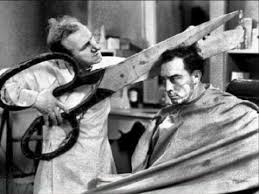
Do you ever have weeks when you need a haircut, but you can’t quite make it to the barber?

Liz tells me that this is pretty much a “guy problem” — apparently, she makes an appointment for that sort of thing…has someone she goes to…whom looks forward to seeing…who’s been in her life longer than I have….

I find that too confining. And since I have had the same hairstyle since fourth grade, there’s a level of expertise my personal chirotonsorial needs simply do not require.

But I realized it was time for a haircut when I came downstairs in the morning, and Emily roared with laughter and said, “Poppy, you’re so silly.” Apparently, my hair looked like I had messed it up on purpose, which I had not.

That was a week ago.

I suppose I’m thinking about it now, not only because I still need a haircut, but because it also reminds me about how I seem to find it so hard to make it to the gym. Or to change the oil in the minivan. Or to do any number of other tasks.

Why is it that the things that can happen “anytime” seem to take so much longer to accomplish?

Recently, I was at a wedding reception, and someone told me how they’d keep meaning to read the Bible, but…you know…. It was on their list for when they retire. Which seemed like a good idea, except that they looked to be about 40.

In a similar vein, people often tell me how much they’d like to get more serious about prayer, finding a church, or talking to their children about Big Spiritual Things….but….

To be fair, these things take time. For a lot of us, time is far and away the most precious currency we have. Do any of us need a new thing to be half-attending to, like the podcast that runs aimlessly through your headphones while you check your email?

Surely not.

Indeed, time is something we make, not something we find — so clearly, it’s better to wait until we’re willing to make the time. Why fool ourselves…right? Right?!

That’s where I’m not so sure.

And this is where haircuts, gym visits, and oil changes have so much to teach us.

Because learning to balance the daily little “shoulds” helps to strengthen us for the work of undertaking the bigger ones—the slower, deeper practices that come to shape our souls. In learning to find time whenever we can, we learn to make something with it. And God finds a way to make something more of us.

Would we do more if we only had more time? Surely yes.

But if we begin where we can and keep at it, faithfully, it’s amazing to see how far we can get—and amazing how the time just seems to open up to go even further.

See you in church,