Category Archives: Uncategorized

The Claims of Abundance (1 Thessalonians 5:12-24)

Ragamuffin

The next few days are precious ones for us Congregationalists.

These are that precious handful of days when people think about Pilgrims, Plymouth Rock, and the Mayflower—when stores and schools and all night diners all over the country are decorated with the autumnal colors and the cultural symbols of New England Puritanism.

Now there are those who cringe at the papier mache pilgrim hats and the little white bonnets for women and girls. Not me.

It’s kitschy, I admit it. But as a Congregationalist, I still love it. Because what form of tribute could be more American than that? In America, if you’ve been turned into a Pez dispenser or a party costume, your place in the culture is forever secure.

Now there are questions we might ask about just what place we Congregationalists seem to have secured.

If you go to Party City in search of Pilgrim hats or one of those fetching white Pilgrim bonnets, you’ll see that they have them on sale, which is entirely right and proper.

However, right next to them, you will also find the ready-to-wear, adult-sized, gobble-to-claw turkey outfit, because what Thanksgiving could ever be complete without somebody’s brother saying “I say boy…..” over and over and over again.

I’m not sure what that says about the place of Thanksgiving in the collective imagination these days. Or about the cauldron of emotions it seems to stir whenever we return to our families of origin—who wears a turkey outfit?

Still, as a Congregationalist, I delight. If some of our legacy is to sponsor an annual conversation about where it is that people call home, and why, or about how traditions shape us, for good or ill, I am delighted.

That said, it’s interesting to me to note how a day whose beginnings were found in gratitude simply for having survived at all after a long and difficult year has softened quite a bit since 1621.

That first year at Plymouth was a hard, hard year, indeed. Many of the Mayflower settlers didn’t make it through the first winter. None of them would have without the pity of the local Wampanoag Nation—and the providential discovery of some food buried in a nearby abandoned native town.

But when we celebrate Thanksgiving, that’s not really what we celebrate, is it?

The day isn’t about eke-ing out an existence in a strange and physically punishing environment. It’s become a celebration of abundance. If it’s about anything, anymore, it’s about remembering how our forefathers once had to eke, and about how, comparatively speaking, now many of us don’t have to eke—and, well, thanks be to God for that.

And so, for all the conversations that Thanksgiving seems to generate, I don’t think it generates the right one, at least as far as abundance is concerned.

II.

Actually, it used to do better.

Before the Macy’s Thanksgiving Day Parade, in fact, there was a tradition of what were called “Ragamuffin Parades”—particularly in New York City, but also in other places.

Ragamuffin Parades were for children, especially working-class children, who would go into wealthier neighborhoods on the day before Thanksgiving, wearing elaborate costumes and going door to door, asking “Anything for Thanksgiving?”

If it sounds distinctly like Halloween to you, you’re absolutely right. It was.

Yet I would suggest that the Ragamuffin Parade was trying to make a different point.

Unlike Halloween, the Ragamuffin Parade was about abundance. About not forgetting our neighbors, and especially about not forgetting our children. It was about social divisions, yes, but also about how good will and kindness could help to bridge those divisions. It was about reminding the successful that the left behind were not far away.

At a time when so much of the popular rhetoric was about how to ensure that fellow Christians and other were transformed into reliable Americans, the Ragamuffin Parades were a reminder from fellow Americans and others about becoming reliable Christians.

It would not have been entirely cutesy. The line between “The Little Rascals” and “The Gangs of New York” was thinner than you might think.

But the point would have been hard to miss.

With the pies for Thanksgiving already in the oven, and the smells of plenty filling the house, the Ragamuffin Parade came by, and who was who and what was what would hang there for a moment, and the descendants of those first Pilgrims would lock eyes with someone trying to eke out his existence in a strange and physically punishing environment. Someone who was seven.

Imagine if we still had it.

Because what would it be like if, on the day before Thanksgiving—which is always a day when the grownups are cooking or cleaning or trying to load the car so we can beat the traffic—what would it be like, if a parade of ragamuffins suddenly showed up, to remind us of our abundance?

Because, yes, sure, you’re trying to make it to LaGuardia and you don’t need to apologize to anyone for the fact that if some yahoo gets in the EZ Pass lane by mistake, that means you can miss your flight, and good luck to you if that happens. But then the parade comes and you remember: you’re blessed.

Or maybe it’s the day before Thanksgiving and you’re chastising a houseful of kids: “Guys you cannot make a fort out of pillows in the living room right now because Uncle Fred’s new wife is like Martha Stewart on Steroids and I really don’t have time to get chocolate finger schmears off of the sofa.” But then the parade comes and you remember: you’re blessed.

Or maybe nobody’s planning on coming by and you’re sitting at home, debating about whether to go to Boston Market for the half-chicken special, or just not bothering at all this year. But then the parade comes and you remember: you’re blessed.

Abundance takes many forms. Nevertheless, with all the challenges of the living of our days, it can be easy to forget the many ways that we are blessed. And it’s become all too easy to forget the enduring claim of our neighbors upon us.

III.

We don’t talk about that much as part of Thanksgiving, now.

But the fundamental understanding of the Pilgrims long ago was that unless you understand that, then you don’t understand much of anything.

They had a sense—a deep, abiding sense—that ultimately, all things come to us as gifts, that the world does not belong to us, but that it belongs to God.

They believed that there is a wisdom at work in our lives, even in adversity. They believed that wisdom is bringing the Universe together in ways that we can and in ways we cannot see, and they thought it was absolutely essential that we learn to trust that wisdom.


But they also recognized that this wisdom made claims on each of us along the way, and that loving God without loving our neighbors wasn’t really loving God much at all, because you can’t love God fully without coming to love what God loves.

Abundance was a grace, indeed, but it was never intended as a cloistered grace. It was a way to serve the Kingdom of God. They saw that, and tried to live it.

They were imperfect people, to be sure.

And yet their sense of thanksgiving was deeper and more challenging than ours typically is, and a lot more faithful.

But they understood that Thanksgiving had power in it. The power to make us much better Christians.

IV.

The Apostle Paul would have agreed.

Our reading this morning comes from his first letter to the Thessalonians, and he gives a series of moral exhortations.

“Encourage the fainthearted,” he says. “Help the weak. Be patient with all of them. See that none of you repays evil for evil, but always seek to do good to one another and to all” (v. 15).

But then he brings it home, saying: “Rejoice always, pray without ceasing, give thanks in all circumstances, for this is the will of God in Christ Jesus for you. Do not quench the Spirit. Do not despise the words of the prophets, but test everything; hold fast to what is good; abstain from every form of evil” (vs. 17-22).

To me, the part that is really important is when he says “Rejoice always…give thanks in all circumstances.”

Because remember: Paul is writing to a church that’s very different than ours. He’s writing to what will soon become a fugitive church—a church that will choose to meet in graveyards and catacombs because even Roman soldiers wouldn’t go there after dark.

Paul is writing to a church that even already is seeing the beginning of dark times.

And in that context, what he’s saying is remarkable.

Because what he’s saying is that it’s not enough to believe that the Gospel is true. It’s not enough to believe that Jesus was the Son of God. It’s not enough even to be ready to see those beliefs through to the end…whatever that end might be…and whatever bravery we might have to summon.

Instead, what matters according to Paul is to be so immersed in the love and purposes of God that we learn to “rejoice always,” and “to give thanks in all circumstances.”

What matters is to remember just how very blessed we are.

That’s not to say our lives are easy. That’s not to say it’s wrong to ask God to heal what needs healing in our lives or in our world.

It’s saying that despite how things may seem, it is still right to trust the wisdom at the heart of it all.

It’s saying that whatever darkness we may find ourselves in, it is still right to believe in the power of light.

It’s saying that no matter what may come, God’s people are called to remember the words of the doxology: “Praise God from whom all blessings flow.”

Because the blessings do flow. And God is the source of all our blessings.

So I hope you are proud to be identified with Thanksgiving, this particularly Congregationalist holiday.

You may not choose to wear the costume.

I don’t know that a Ragamuffin Parade will pass by your house on Wednesday to remind you of your abundance, and of the enduring claim of our neighbors upon our love and care.

But I hope you will recall the many blessings that have brought you to the place you are, and sustained you in the great challenges of life, and given you hope for what may yet come.

I hope in these days that you will be mindful of those blessings, and give thanks for the abundant life we find in God through Jesus Christ in the Holy Spirit, the giver of all good gifts. And feel God’s urgent call to share them with a world so much in need.

Amen.
The Urgency of Thankfulness

Prayer Book

Dear Friends of Second Church,

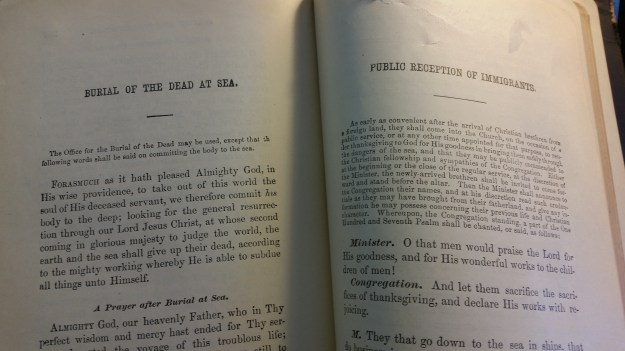
One of the gems in our church library is a 1901 Order of Worship book for the Reformed Church in the United States.

I don’t know how we came to have it. It’s not particularly rare or valuable. It’s a slender black book with a pebbled leather cover and gilt-edged pages, and looks a little like a daily diary, or like the sort of curio that a pastor buys at a yard sale.

Yet so much within it is familiar. Prayer books always have sections for different services, and there is always an appendix with the Psalms. This one is no exception. But books like these are also products of their times. For example, the Episcopal Church’s now not-so-recent revision of its Book of Common Prayer includes a prayer for astronauts and a few references to “interstellar space”…that was “cutting edge” when it first appeared.

With that in mind, when you look through a prayer book from 1901, it’s a glimpse into the hopes and fears of a new century, now itself past.

For example, it is telling that there is a whole section of “Prayers and Thanksgivings for Special Occasions at Sea.” It takes a moment to remember that, well, of course, they had those back then.

In fact, it’s next to that section, just between “Burial of the Dead at Sea” and “Laying of a Cornerstone for a New Church” that you will find a service for “Public Reception of Immigrants.”

The fine print at the top explains: “As early as convenient after the arrival of Christian brethren from a foreign land, they shall come into the Church, on the occasion of a public service, or at any other time appointed for that purpose, to render thanksgiving to God for His goodness in bringing them safely through the dangers of the sea, and that they may be publicly commended to the Christian fellowship and sympathies of the congregation…The Minister shall announce to the Congregation their names, and at his discretion read such credentials as they may have brought from their fatherland, and give any information he may possess concerning their previous life and Christian character.”

It’s telling that before offering the “fellowship and sympathies of the congregation,” and even before the announcement of their names and “such credentials as they may have brought,” it was assumed that the most urgent need of arriving brethren would be “to render thanksgiving to God for his goodness….”

I’m moved by that urgency.

In our own era, we can be so quick to introduce ourselves and so slow to remember to say thank you—to anyone, much less to God. We have lost some of that sense of having been brought “safely through the dangers of the sea” or any other place, and so often consider ourselves lucky (randomly) to have made it to a safer, better place, for however long we get to be there. We have lost the habit of seeing, and naming that sense of deeper forces and purposes at work in our lives, and don’t seem to feel as if we owe those forces much of anything.

Our forebears knew better.

That’s why Thanksgiving is such an important holiday.

It may not be on any Christian calendar—it’s not an “official” church holiday, of course.

But to me, it’s one of the most important holidays of all.

It’s a day we have a chance to feel that sense of God’s claim on our lives, and God’s claim on the history that brought us to this place. It’s a day when we remember that giving thanks isn’t supposed to be the last thing we do, but rather the first thing we do—just as Sunday, the Sabbath day, isn’t the last day of the week, but the first—it’s the act of devotion and the day of recollection from which all other acts and days may then begin.

Like the Sabbath, Thanksgiving is a day to remember that there is a world of difference between being “lucky” and being blessed—and that we have been blessed, and with much that God expects to follow from that blessing.

To me, this little prayer book gets it right. We have escaped the “Burial at Sea”—the sea of troubles we constantly navigate, whatever they might be. What lies ahead is the “Laying of a Cornerstone,” not only for a new church, but for a new world—a place that reflects our commitment to justice and peace, freedom and love, however we may be called to work for such a world.

What lies between is the urgent need for us to name God’s claim upon us. What lies between is the urgent praise of grateful hearts that know God hasn’t brought us this far to leave us. What lies between is the urgency of giving thanks.

Happy Thanksgiving.
See you in church,

Sermon: “Two Copper Coins and a Holy Trust” (Mark 12:38-44)

widowsmite

n the last couple of days, some of you may have seen news reports of a recent study of children and altruism, published in the academic journal Current Biology.

Apparently, researchers were looking to find differences in empathy or sharing in different cultures around the world.

And they were interested not in generosity, but in altruism, which is to say, they were not looking at how children gave when the giving was easy, but rather at what they could learn about how children gave to others when there was some sort of cost to themselves.

The results were surprising.

The children were asked to play a game in which they were given a limited number of stickers. They were told they could keep as many as they wanted. But then they were asked how many they would be willing to give away to an anonymous child in their school with their same demographic background. A kind of basic set-up to get at their abstract willingness to share.

It turns out that, actually, children who grow up in religious households (and particularly Christian, Jewish, and Muslim ones) are not more inclined to give sacrificially. That was the result that everyone was expecting. Actually, they may be somewhat less inclined to give sacrificially.

In fact, it turns out that the older the children were, the less generous they became, suggesting to the researchers that (as Forbes magazine put it) “longer exposure to religion leads to less altruism.”

Do you ever read something in the newspaper and think to yourself, “This is the article that is going to launch ten thousand blog posts?”

I feel a little that way.

And I’m not going to take our sermon time this morning to offer you my own attempt at a full response.

But I was interested to learn that this phenomenon, which we religious folks find so surprising, is less surprising to psychologists. It turns out that their work points to one possible answer for why religious children are perhaps less generous.

They refer to a phenomenon called “moral licensing.” Moral licensing is about how sometimes when we do good things, we may actually give ourselves a little more internal permission to do questionable things. It is as if we have proven to ourselves that we are good people, that our hearts are in the right place, so…what’s a little fudging on other things here and there?

Ironically enough, for some of us, attending church, or taking time for prayer, or reading Scripture privately in the morning before work, may actually make us a little more open to bending the rules in our own situation.

It reminds me of a story I’ve heard that surely cannot be true, about a church that was trying to attract people with a more edgy kind of message. So one day the head of the Church Council was driving by the church and she saw the pastor putting a banner over the front door that said, “Welcome Sinners!”

Of course, she immediately zoomed into the parking lot and ran over and said, “You can’t say that! I mean, people will get the wrong idea about who we are, and who we think they are…this is a disaster!”

And the pastor immediately backed down and said, “O.k., I get it. No problem. I’ll change it right away.” He hops back on the ladder and starts taking down the banner.

The next Sunday, she drives up to church and there, over the front door, is a brand new banner, and it says, “Welcome Pharisees!”

I doubt that pastor lasted much longer.

But if this whole idea of moral licensing is correct, I think we need to acknowledge that working through our own temptation to be Pharisees is an important and ongoing part of our faith journey.

II.

To put it another way, we may find the whole idea of moral licensing to be troubling, and maybe even astonishing.

But it seems clear that in his own time and place, Jesus saw such behavior all around him.

It did not seem to astonish him.

And I want to suggest that this morning’s story from Mark’s gospel about the widow’s mite, the widow who gives all that she has to the Temple, even though it is just two copper coins, is finally more about the danger of moral licensing than it is about the faithfulness of the widow.

We don’t tend to read it that way. For obvious reasons, we tend to read it in the context of stewardship.

We usually hear it as a call to giving—as a reminder that it is not the size of the gift but the size of the heart that gives it that matters—and I admit that I have preached that sermon. I’ve preached it more than once. It’s a good sermon.

The scene lends itself to that.

Because what we tend to forget is that in this scene, the widow is giving everything she has—everything including what she needs to live on—and while her faith is great, when push comes to shove, she’s putting her faith in an institution that doesn’t deserve it.

She’s putting her faith in an institution that caters to the scribes and has all but forgotten her.

She’s putting her faith in an institution that by the time Mark writes his gospel will already be physically destroyed, and the scribes who are there one-upping each other and strutting around won’t be there anymore. After unsuccessfully fighting against Rome, the Temple will be a smoldering ruin, and the scribes who ran it will have been almost entirely wiped out.

The point of the story is not that the woman is faithful. It’s that she’s taken her two copper coins and purchased herself a steerage ticket on the Titanic.

And if faith comes down to what the Temple does, then faith is sunk.

Jesus wants us to recognize that the faith that the Temple embodies is no longer a kind of life-giving connection to the purpose and presence of a living, loving God.

It’s become a spiritual DMV, offering the moral license lets people do what they want under a veneer of respectable religion.

III.

Church, this is a tough passage.

We want to think of ourselves as the widow, of course.

But I think Jesus’s word to us this morning is that, actually, we need to see ourselves as the scribes.

Jesus is pushing us to see that it’s their challenge that may well be closest to our own.

Because it’s easy enough to tell people to put their faith in God. That’s not wrong, by any means.

But remember: People also put their faith in us.

As they are learning what it is to put their faith in God for the first time….or as they are learning how to find God again when life has thrown them a curve ball…they can’t always see God.

But they can see us. They can listen to us. They can learn from us. And so, we have a holy trust to keep.

And so if we say “have faith because God is good”…if we say “With God, all things are possible”…if we say “All things work together for those who love God,” we must remember that it isn’t simply that they believe these things because they’re true, although indeed, they are true.

Before they ever get to that, though, they believe these things to no small extent because we say that we believe them.

They do these things because we say, this is the way to find God.

And so they do them. They put in their two copper coins and hope to God that what we’ve promised them is true.

We have a holy trust to keep.

The people in our lives who are like that widow—the people we encounter who are the most vulnerable, the most adrift, the most confused, the most precarious among us—the people we encounter who need God the most—they may not have

the spiritual wherewithal to know that God loves them, to know that the Universe isn’t out to get them, or to imagine a different future.

Instead, what they have is a spoonful of hope, and then the power of our example.

What they have is the gift of God’s love, and the humility we are willing to share about our own journey toward a more faithful life, with all its ups and downs.

We have a holy trust to keep.

And the remarkable thing is that if we keep it, this trust is enough. It’s enough to get started. It’s enough to feel included. It’s enough to get you feeling human again when you don’t. It’s enough to show you that grace is real, and that grace can be just as amazing as the song says it’s supposed to be.

It’s also why we must never give in to the temptation of moral licensing, with the little permissions we give ourselves to do what we will because the external trappings of our faithfulness mean we’ve already crossed God off of our “to-do” list for the day.

For just as surely as there is always need for kindness, for honesty, for justice, for peacemaking, so indeed there is always time for kindness, for honesty, for justice, and for peacemaking.

If only we will see the need. If only we will make the time. If only we will keep the trust.

The story of the widow’s mite isn’t a story of the power of generosity. It’s a call to be a church that’s worthy of her hopes, and listens to her need.

The need is real. But the grace is amazing. And it saves a wretch like you and a wretch like me, not just once, but time and time again.

May we learn to keep its trust through all our days.

Amen.

“Haunted: A Little Halloween Thought about Churches”

abandonedchurch

Last Saturday night at about 10 p.m., with everyone else in the house asleep, I was sitting on the couch debating with myself about the morality of stealing a Reese’s Peanut Butter Cup from Emily’s Halloween candy (a debate I lost), when I became aware of a tremendous amount of noise on the front lawn of the Parsonage.

It was a group of older kids, though none I knew. They were clearly pausing en route between the Disneyland of Chocolate that is Maher Avenue on Halloween and wherever their next destination was—more houses? A dance? I couldn’t tell.

I stepped onto the porch to shoo them along with my best Mean Old Grouch on the Porch routine, but then I saw they were taking pictures with their phones.

“Wait, wait,” said one. “Freeze right there! Now you look like you’ve just come out of the castle! Everyone else look scared!”

They were taking action shots in their costumes, with the church as a background.

“Awesome!” said the photographer, happily. “That one looks messed up.”

I don’t like to think of the church as a creepy castle (or as looking messed up), although I decided to let the kids go ahead and have their fun.

But it made me think of the ways that churches can come to seem just like that. And I’m not actually talking about the architecture, or about Halloween night, of course.

So often, churches can come across as forlorn and foreboding, as places haunted by the past rather than teeming with new life. There are places where the ghosts are all around: the Ghost of Christmas Past, when the church had to have seven full services to accommodate all the families, and each child thought that getting a fresh orange was the greatest present of all; the Ghost of Budgets Past, when in any given year, the church fathers just made a few calls and…bingo!…they could swing the salary for two more associate pastors and put a new roof on an outbuilding; the Ghost of Pastors Past, when the wisest, kindest, nationally-known preacher with a leonine mane of white hair and Caruso-like singing voice was their leader; the Ghost of Sundays Past, when no athletic coach would so much as dare TOUCH Sunday morning, nobody dared play golf before noon, or needed to sleep in after getting back late from an international flight, and cell phones didn’t call people into work at the last minute.

When a church is haunted by ghosts like those—and those are only a few—it isn’t long before it starts to feel like a creepy castle, all right.

Put that up against a world where people still need loving, wrongs still need righting, the young still need guiding, the bereft still need comforting, life-purposes still need pondering, and friends still need introducing, and you’ll see how tragic it is when a church lets itself give up and just be haunted, instead.

That’s what’s really messed up.

One of the greatest challenges, but also joys of our life together is trying to discern who it is Christ needs us to be in this new time. A church like ours has remained strong because it has found new ways to ask and answer such questions. But more than that, it has found joy in the searching and answering—in seeing a beloved old building as the backdrop for new stories, and the abounding grace in its bringing together new communities, and in its finding new ways to celebrate together.

I hope that’s what you’re finding here. I find it constantly…and not just on my front lawn. Let’s find a way to learn from those experiences and listen for God’s call as we do.

See you in church,

New Sacred » “False Hope, Real Hope, and the Dying Child”

My latest piece on the UCC blog “New Sacred”…What does hope look like at the bedside of dying child? Some thoughts….

Earlier this week, CNN reported the heartbreaking story of five-year-old Julianna Snow, who was born with a rare, incurable neurodegenerative condition called Charcot-Marie-Tooth disease.

Click the link below for the full piece…

Source: New Sacred » “False Hope, Real Hope, and the Dying Child”

From the Newsletter: “‘The Big Broadcast and the Importance of Sabbath”

EdWalker

Dear Friends of Second Church,

Earlier this week, I learned on NPR that Ed Walker, a longtime Washington, D.C. radio man on station WAMU, had died.

Blind since birth, Walker fell in love with radio early…and deeply. The connection may seem obvious; nevertheless, in college, Walker had to convince his academic advisor that his lack of sight did not summarily disqualify him from broadcast work. Ultimately, he did, and his career began…just as television was coming into its own. Maybe it is no surprise, then, that while he enjoyed a successful career, his greatest love was “The Big Broadcast,” a Sunday evening show he hosted, beginning in 1990.

If you never caught it, “The Big Broadcast” was a celebration of the Golden Age of Radio—a four-hour show with music, comedy, and classic serials like “Gunsmoke” and “Dragnet,” many of which Walker remembered hearing as a boy, lying on the living room floor, or with the transistor radio hidden under his pillow as he pretended to be asleep.

His love of those stories, and of radio as a way of storytelling, was obvious, and it helped turn two—maybe even three—new generations into fans.

He always began “The Big Broadcast” with the same signature welcome: “If you have anything that’s bothering you in the coming week, don’t worry about it now. Or any problems that you had in the week just past — forget them too. This is our time in the week — right now. The island between last week and the coming week. So settle back, relax, get yourself a cup of coffee or whatever you want, and get ready to enjoy The Big Broadcast.”

I don’t know if Walker knew it, but the great rabbi and teacher Abraham Joshua Heschel once described the Sabbath in remarkably similar terms, as “an island in time” for humanity to rest and reconnect with those we love, and to reconnect with our Creator.

For Heschel, this wasn’t about “escaping” so much as it was remembering to put our lives in context. Remembering who matters most has a way of helping us stay focused on what matters most, and it has a way of teaching us to use our time more wisely.

Heschel taught that if all that the Sabbath does is patch us up a bit for doing the same old things in the same old way, we have not used it fully according to God’s purposes for it. The Sabbath has the capacity to ground us—crucially so—but also to grow us. That growth is crucial, too: not just for us, but for all those who depend on us, and not only now, but in the future, as those who come after us inherit the world we have built.

That’s how we remember to pay attention to the legacy we will leave, and to find joy in creating it, even though it may only fully blossom well after we have handed it to the next generation. Nevertheless, it matters for the living of our own days, as well as for the living of theirs.

Escaping to the Golden Age, whether it’s the Golden Age of Radio or some other one, is important to do once in a while. It’s always nice to visit the “island in time” between the week past and the week to come, and many of us need to do it a lot more often than we allow ourselves. But Sabbath allows us to find energy and commitment toward creating a better world to come—it teaches us not simply to enjoy rest, but to work for peace.

Ed Walker worked to find new life in old stories. He offered his listeners a measure of escape, yes. More deeply, I think he offered them a way of learning to imagine that was once familiar, but which time and technology have made strange. Those stories gave him a way to see. May they help us, in turn, find new ways to see, and new courage to repair the world.

Rest in peace.

See you in church,

Sermon: Seeing Again (Mark 10:46-52)

BeTheChurch

Let’s begin by conceding that Mark’s point in this morning’s gospel isn’t exactly subtle.

You don’t exactly need to be an English major to figure out that in this story, Bartimaeus isn’t the one who is truly blind here.

It’s also clear that, as far as Mark is concerned, the miraculous healing is hardly the point, because the point is not that Bartimaeus can’t see.

The larger issue is that the world does not seem to see him. For the world, of course, can see. It just chooses not to notice him.

That’s central to Mark’s message for us this morning.

But actually, it goes even deeper than that.

For example, it helps to know that, in stopping at Jericho, Jesus and the disciples have stopped in a major city in the ancient world—a well to do spot on the water where people went to recover from the turmoil of life in the capital.

Jericho was the kind of place where making a big splash could have a major impact. They would have all been feeling that.

Jericho was a historic city—it was where Joshua and the Hebrew people first crossed the Jordan River to enter the Promised Land. As symbols go, it was a profoundly symbolic place…a place where you’d want your messiah to do something big.

But listen again to Mark’s story. This is what he says about this visit to Jericho.

Mark writes: “Then they came to Jericho [period]. As Jesus and his disciples, together with a large crowd, were leaving the city….”

What happened in Jericho? It must have gone well enough: we’re told that a large crowd followed them out of the city. Jesus must have nailed it. There was a debate, and Donald Trump was sick that day, and Jesus nailed it…Iowa, New Hampshire here we come.

But that’s not what Mark says happened in Jericho.

For Mark, what happened in Jericho was that Jesus met this man, Bartimaeus—he met this man that nobody else much cared about. This man who the world didn’t much notice. This man whose endorsement would not have mattered to anyone.

But Bartimaeus mattered to Jesus.

And Bartimaeus should matter to us.

Whatever was wrong with him was, deep down, the least of it…the most fixable thing of all.

The deeper challenge is the kind of spiritual blindness that might see, but decides not to bother.

The implication of Mark’s story is clear: being a Christian is about learning to notice the people that the world does not see.

Being a Christian is about hearing that voice calling from the back of the crowd, asking for help, asking for healing, asking for the grace to join the journey, too.

II.

That day on the Jericho road was a long time ago. Nevertheless, we know that those voices are all around us, too.   All around us, people are hurting and scrounging for any kind of hope they get their hands on.

So many of our neighbors feel left behind by the big party that it seems like life should be. And they don’t know why. And they don’t know what they’re supposed to do about it.

While we’re at it, let’s also acknowledge that Greenwich doesn’t make this particularly easy to figure out.

Here we live in this wonderful place—this town that is a watchword for success, and ambition, and rubbing elbows with glamorous and important public people—and who wouldn’t be fascinated by the things that the people all around us are up to?

And yet we know…and the longer we are here, the better we all know it…that even in this place, this wonderful place, people are hurting. People are searching. People are asking the big questions, and the answers they’re finding are coming up short.

This can be a hard town in which to do your struggling.

So this is the moment when some of you are waiting for the transition to the church and its ministries.

(That’s coming.)

But what some of you are waiting for is for me to now say that when someone in our town is hurting, it’s so important that they have this place to come to.

I do think that.

But as God is my witness, what I want more than that, what I want more than anything in this world, is that when someone in this town finds themselves struggling, what I hope is that they will find one of you.

What I want more than anything else is that when someone out there doesn’t know who else to call, they’ll call you.

Whether they’re Christian or not…whether they will feel led to become Christian or not…if they call you, if you’re the one, then this church will already have been a blessing in their lives.

That’s what we’re here to do.

III.

Because let’s remember that the church is not the building, although the building is so beautiful. The church is not the programs, although the programs here are terrific. The church is not the music, although if you spend any time here, you may find yourself humming “Little Grey Donkey” constantly for about four months out of every year.

These things are wonderful. But the church is not these things. The church is us.

The church is the discipleship of regular people, seeking to follow God’s path for their lives, and journeying along with others as they go forward into the future.

We do so much so well here, and there are so many other things we would love to do to expand our work, to tend our campus, to guarantee life-changing experiences for children regardless of cost, to love and support our seniors, to celebrate creativity in all its forms.

We have wonderful plans—dreams that Joseph even in his amazing Technicolor dreamcoat could scarcely have imagined.

Important stuff. Cool stuff. But let’s be honest: even so, that’s not what the church is.

But it is those things that teach the church. It’s those things that train the church. It’s those things that inspire the church, and shape the church, and sustain the church.

That’s why I give to the church. I’m blessed to be your pastor, and I’m blessed to be paid for the opportunity to do work I love. But I am taught, and trained, and inspired and shaped and sustained by our life together, and by the ministries of this place, and by how I find God with their help.

All these things are teaching me, and all of us, what it means for us to be the church of Jesus Christ, here in Greenwich 06830.

That’s why I give. And that’s why I hope you will join me and my family in giving to the work of this place. So that we can be the church together. So that we can be the church God needs us to be.

In it’s own way, Greenwich might be a little like Jericho. A beautiful place, rich in history and full of fascinating people doing all kinds of amazing things.

Oh, the stories we might tell…if all the anecdotes we have about encountering Diana Ross alone were written down, I suppose that even the whole world would not have room for the books that would be written….

And yet this morning’s Gospel reminds us that the real story is the story of that hurting person, that forgotten person, that ignored person who calls out for healing.

The real story is the one about the person who needs Jesus, and about how his life is transformed by meeting Jesus.

We are the Lord’s church, charged with carrying on his work, and charged with living in the ways he teaches us to live.

In a world where so many are crying out, in the midst of so many who cry out, we are charged to be the ones who notice, and the community of those who are called to respond.

That’s what it is to be the church.

I hope you will feel moved to be a part of it in all the ways you can, and to support and nurture its ministries, so that its ministries will support and nurture you and all those whom you may encounter on the road, wherever it may lead.

Amen.

From the Newsletter: “Giving and the Church”

giving tree

Dear Friends of Second Church,

This Sunday, along with inspiring choral support from our Youth Choir, we will mark the beginning of Stewardship Season.

Beginning with Stewardship Chair, Rick R., and over the next several weeks, we will hear brief testimonies from many different members about what makes Second Church an important part of their lives.

So often, it’s important for a combination of reasons. A welcome sense of peace as the light from the stained glass window shines on the Communion Table. A sermon we’ve never forgotten. The greeting of good friends. The memory of working side by side in mission, near or far. Seeing our children go from Cherub to Youth Choir, then breakout stardom in the Christmas Pageant…then, before you know it, walking down the aisle to start a family of her own. Gratitude for the care of those who dropped off casseroles during a difficult time.

I am always inspired by stories like those, and they make me mindful of my own gratitude, not only for Second Church, but for all the churches that have been my home over the years.

That said, to me, they are much more than just “nice stories about church.” Really, they’re a reminder of what I want the whole world to be like.

Busy as we are, imperfect as we are, we find it harder than ever to practice the ways of caring that we know are best.

By comparison to many of you, or even to my wife, I am blessed to be hyper-local—living literally a few steps away from the office, a pleasant downhill walk to our local school, with a sense of rhythm to my week and to the year, in general.

Living in a connected way should be easier for me than just about anyone, but sometimes, even I feel jangled, confused about which calendar I wrote something down on that I’ve now forgotten, or unsure if I am hungry because I’m nervous about something or because I didn’t eat lunch. There are too many birthday phone calls for my friends and family that even I never quite get to, class reunions where the old roommates call to wonder why I didn’t come, neighbors I meant to get to know but never did quite break the ice with. There are so many years when I start the Christmas season, intending to be more deliberate about making time for prayer and quiet…only to realize on Christmas Day that, once again, I didn’t quite manage it.

Left to our own devices, we struggle to be the kind of neighbors, spouses, and friends we always expected we would be. The world isn’t so easily accommodated.

That’s why the Church is so important: it’s important because, despite all that, it stands for a different, deeper, better way. It’s a place where peace is still possible, and love of neighbor remains important, and service is understood as part of the fabric of life. It’s a place where we have permission to be decidedly imperfect—not “together,” not “over it” (whatever the “it” may be), not flawless…but us as we really are. It’s a place where joys and concerns can be named side by side among us, recognizing that in the lives we lead, joy and concern are so often side by side.

I wish the whole world were already like this. Indeed, the promise of Scripture is that, one day, in the fullness of God’s time, it will be. But as we go about making it so, each in our own way, there is this foretaste of the Kingdom. There is this place to learn the different, deeper, better way God offers us.

I hope in the coming weeks, you’ll think about how God might be calling you to live more deeply into His way. I know that as we do, our community will be blessed, indeed.
See you in church,

Sermon: “The Faith Zone” (Mark 10:35-45)

Screen Shot Oprah

A few days ago, Oprah Winfrey was on “The Late Show with Stephen Colbert,” talking about an upcoming series on her cable network.

The series is called “Belief,” and coming soon, over seven nights, it will explore the origins of different religious faiths, which as a former teacher of 7th Grade World Religions, I am very much in favor of.

Religious illiteracy is a dangerous and all too common thing in our world. I’m glad someone of Oprah’s public standing is taking up the challenge. I hope I can tune in and that many others do, too.

But Oprah’s interview with Stephen Colbert was interesting just in itself.

Colbert is a church-going Christian, and a thoughtful person, and so at one point, he and Oprah were talking about growing up in church, and he asked her what her favorite Bible verse was.

I’m not sure if the question surprised her, or threw her off for a second, because she responded at first by asking him what his favorite Bible verse was.

Without missing a beat, he said, “Mine’s from Matthew. I like it ‘cause Jesus says, ‘So I say to you do not worry, for who among you by worrying could change a hair on his head, or add a cubit to the span of his life?’ What I like about it is that it’s a commandment to not worry, and I’ll go with that.”

Oprah responded warmly, saying, “Mine is Psalms 37:4. ‘Delight thyself’—I love that word ‘delight,’ don’t you? I’m so glad that David knew it.”

“‘Delight thyself in the Lord. He will give you the desires of your heart,’” Oprah said.

She went on to say: “Now what that says to me, Lord has a wide range. What is Lord? Compassion, love, forgiveness, kindness. So you delight yourself in those virtues where the character of the Lord is revealed. Delight thyself in goodness, delight thyself in love, kindness, and compassion, and you will receive the desires of your heart. It says to me, if you focus on being a force for good, good things will come.”

And that’s where it gets a little harder for me. Don’t get me wrong: she is absolutely right that delight is an important part of faith. Where and how we find our delight says a lot about what is most important to us, and it says a lot about the state of our soul.

And yes: compassion, love, forgiveness, and kindness—I am for all of these things. I think all of us are.

But with all due respect to Oprah, that’s also where I find myself resisting.

Surprisingly enough, this morning’s Gospel is part of the reason why.

II.

You may well know the story.

It wasn’t too long ago on this extended road trip they’ve all been on that the disciples were fighting over which of them was the greatest. You’ll remember that this is what provokes Jesus into some of his famous affirmations, including “If anyone wants to be first, he must be the very last, and the servant of all” (Mark 9:35).

And he says, “Whoever welcomes one of these little children in my name welcomes me; and whoever welcomes me does not welcome me, but the one who sent me” (9:37).

It’s the jockeying between the grownups that pushes Jesus to his important words about welcoming children as a way of welcoming him.

Well…it’s a few miles down the road, maybe a few days later, and it seems that the disciples are at it again.

Jesus has gotten mindful about Heaven, and it seems that the disciples have gotten newly mindful of Heaven, too.

But their earlier preoccupation with who among them is the greatest has come roaring back.

If Heaven is where they’re going, fine. Their question is who will be seated in Zone 1.

I’m sorry to say that religious people can really do this.

Religious people, it turns out, may have a particular definition of what Zone 1 may be—it may be very different than flying business class on an international flight—but the old, old impulse to be in Zone 1 still affects us.

I have a dear friend who is a devout Buddhist, and goes on extended meditation retreats at a Buddhist monastery in upstate New York several times a year.

And she once complained that one of the real challenges of going on retreat was watching so many people try to “out-compassion” and “out-kindness” one another.

Even the Buddhists have their version of Zone 1.

So there the disciples are, walking along the road with their rolling bags, and James looks at John and says, “You know what Heaven is going to be like? Heaven is going to be having the overhead compartments all to yourself, and waiting for you at your seat will be a little ramekin full of those warm nuts.”

And John smiles and says, “Right. And the flight’s not too full, and you’ve got your seat on the aisle, and all of the babies are back in Zone 5.”

It’s not that what they say is crazy. It just isn’t the Kingdom. More immediately, it’s not what this journey is going to be like, at all.

So let me flog this metaphor one more time and just say, when the plane hits severe turbulence, it isn’t all that different in one zone versus another.

And what Jesus is talking about is the reality of turbulence, not only for God’s people, but in the end, really for all people.

Jesus asks John and James, “Can you drink the cup I drink or be baptized with the baptism I am baptized with?” (v. 38)

With all the turbulent events that are to come, for Jesus, and for them all, are they really committed to this journey, or not?

III.

So with that in mind, let’s go back to Oprah for a moment, because I think that’s what strikes me as thin in her answer about her favorite Bible verse.

Because who is not “for” compassion and love, or for forgiveness and kindness?

Do good things come of practicing them…do we receive something for practicing?

Of course we do.

Yet how deeply does that go? When our lives get turbulent, are those the values that will still guide us? Is that what people who encounter us will see?

Great when everything turns out our way, I guess. But when our dreams don’t come true, what then?

Because it’s dangerously easy to turn cultivating our virtues into a strategy for receiving, instead of a way of living.

When we don’t receive what we think we have coming to us, the temptation is to find another strategy and just try that, instead.

“Oh, I tried being a Christian for a while…but it just didn’t pay off. Speaking the truth in love, turning the other cheek, going the second mile. Now I’m more into massage and macrobiotics, you know, mind-body.” Or whatever.

More seriously, we all know good and decent people whose lives have been made small and bitter by loss, or illness, or deep disappointment, desperate to find a way forward.

Who can blame us for trying to buy a little good karma just in case?

There’s no getting around that life is hard sometimes.

And there’s no getting around that trying to live it as a Christian can be even harder.

Our faith insulates us from so very little. But as Jesus makes clear in this morning’s gospel, insulating was not the point, and never has been.

The point has always been to transform us.

The point is to give us a strength that we cannot have on our own; to call us to a compassion that may not be natural to us; to push us to forgive when bygones aren’t yet bygones, by any means, and it’s hard, and we have so many questions.

The point is to lead us into ways of kindness that aren’t just fakey-fake niceness, but something that comes from the real us, seeking to do good in the real world.

The point is to change us. To reorient us. So that in some way, we can be part of how God changes and reorients the world.

“Can you drink the cup?” Jesus asks.

The Gospel tells us that we can.

May it be so.

Amen.

From the Newsletter: “Oops.”

forgetful

Dear Friends of Second Church,

I hope you had a wonderful Columbus Day Weekend, enjoying the bright sunshine, the turning of the leaves, and the perfect temperature here in Greenwich, or in so many beautiful places in our part of the world.

As many with young children will admit, three day weekends are not always easy on parents. There is just that little bit more to plan, from meals to group activities to strategies for minimizing “screen time,” with sleepovers and playdates that much harder to coordinate, that many more dishes that need washing, and all those little things that need doing around the house now getting more overdue and urgent.

So when our three and half year old, Emily woke up at 5:30 yesterday morning and broke into a hearty rendition of “Frosty the Snowman,” her current favorite, and Liz rolled over and murmured, “your turn,” I knew I was in for a long day.

And truth be told, it was.

By 9 a.m., we were two loads of laundry and one grudging guitar practice down, and mid way through our second time watching “Frozen,” and I was starting to make cup of coffee number four before I just thought to myself, “Max, don’t do this. This is just a bad idea. Really, really, what does this solve, after all?”

Truth be told, good coffee solves a lot for me, but I knew that this time, it wasn’t the answer.

I gazed out the kitchen window for a moment. I thought I might pray.

I didn’t get that far, though, because it was at that exact moment when I saw Emily’s Pre School class come out into the playground for recess. Emily didn’t have the day off. Pre School was in session. There had been some sort of miscommunication.

I called to Emily, to see if she wanted to jump into her clothes and go to school, after all.

She was quiet. I asked again.

She gave me a long look. “Is Mommy coming to my school today?” she finally asked.

So much for that, I thought. She ran off.

Just then the phone rang.

“Hi, this is Julian Curtiss School,” said a pleasant voice. “Is Grace sick today? We don’t have any note saying she will be absent.”

At that point, Grace (also still in her pajamas) wandered into the kitchen to get herself some Cheerios, then wandered out again.

“Oh, I’m sorry,” I improvised to the woman on the phone, “we must have forgotten to put the note in her folder last Friday…..”

Well, so much for my sense of paternal selflessness and the quiet toll of patient, dignified suffering.

Reminded of the difference between life’s little martyrdoms and the speed of my own impulse toward self-pity, I decided that I’d better have that fourth cup of coffee, after all, and get on with it, which is what I did.

Sometimes, blowing it completely can be so clarifying.

There is an old chestnut that “the church is a hospital for sinners, not a museum for saints.” We are called as the Church to be a collection of imperfect people who remember that we are loved, even as we make mistakes. Even if those mistakes are far graver than forgetting to look at a school calendar. No matter what, God’s love and forgiveness, and the joy of one another, are what we come seeking, and so often find. Perfection is not ours to claim, and never will be.

That said, the strength, vision, and hope to do better can be ours, and can be found among all those whose lives have been touched by God. Among all the other imperfect, hopeful people we call our friends and God calls His Church.

Hope to see you there this Sunday. Don’t worry: I’ll make myself a post-it note so I remember.

See you in church