Category Archives: Uncategorized

2CC Sermon: “Resolve to Pay Attention” (Luke 2: 22-40)

Presentation

I’ve been giving some thought to my New Year’s resolutions over the last few days.

Those of you in the business world are probably aware of the acronym SMART, S-M-A-R-T when it comes to goals. The idea that goals should be specific, measurable, achievable, relevant, and time-bound.

So I guess I will need to revise the resolution I wrote that was “Get closer to fluent in Church Latin.”

It may be “smart,” but it’s not all that SMART.

A lot of my goals start out sounding that way.

“Walk more” seems like it’s on the list every year, and it sounds that way.

“Train the dog” is another.

In fact, at one point a couple of days ago, it occurred to me that when it came to my resolutions, maybe I was actually the wrong person to ask.

The fact that my goals weren’t SMART ones was only part of it.

So I asked Liz.

She rolled her eyes. “Where do I begin?” she said.

I instantly regretted asking and had to walk that back. But I felt like my instinct there was a good one.

Because there is a kind of romance to New Year’s resolutions.

Whether we resolve to work toward a particular personal milestone or to develop some sort of new habit — a new way of living — there is a little bit of a love affair in it.

A love affair between us and our dream of whom we still just might become.

That makes resolutions a kind of flirting with the future, and if it is, so be it.

So be it, except that probably not all the matches between 2017 me and 2018 me are particularly good ones. A Max who speaks fluent Church Latin is likely not much of an enhancement.

Maybe if we treated resolutions in the spirit of arranged marriages, set up by people who loved us but were able to be more objective about our little quirks, the whole thing would go better.

Other people probably have a better sense of the working capacity of our willpower, and isn’t that what resolutions are really all about, after all?

So let them decide how many pounds it should be between now and Easter, or how to get organized about getting organized, or what tops the list of the things we’re supposed to learn to say “no” to.

There is no question that the power of our will is enormous. We have a remarkable capacity to grow when we resolve to pay close attention to something and then learn to do so, whether it is something specific and measurable and all the rest, or even something broader.

For example, when we learn to pay close attention to our children, when we enter their worlds as learners, it is amazing what they will show us….it is amazing how they blossom.

But what deserves our attention? We may not actually know.

II.

To me, that’s part of the backstory of this morning’s gospel — the story of the Presentation of Jesus at the Temple, which we get from Luke.

Luke likely meant the story to emphasize the careful and commendable religiousness of Jesus’ parents. They have dutifully brought their first born to the Temple and have arranged for two turtledoves to be sacrificed in thanksgiving to God, which may or may not have been an actual expectation for families at the time of Jesus.

But it does get right a deeper idea within Judaism, which is that all of life is meant to be lived with an awareness of God. The Temple as the heart of Jewish life was a place to bring your gratitude as well as your shortcomings, and so even if this particular child was from the very first recognized as more than just a child…if what the angel had told the shepherds back on Christmas night was true…well, that did not change the fact that his parents were drawn to the Temple not out of some particular pride, but out of a humble awareness of God. (No word about the partridge in the pear tree.)

Yet the particularity of this child is never far away.

In the story, Luke also means to place Jesus in the arms of two figures who he particularly associated with the Temple — a prophet and a prophetess, Simeon and Anna — two older people of great faithfulness.

Simeon and Anna pick up the refrain from the stable in Bethlehem on the first Christmas, greeting him the infant Jesus much like the shepherds had, with delight and wonder, recognizing the baby — the baby — as the Messiah for whom they have been waiting.

And it’s here that I want to pause and wonder about the backstory to this moment.

Because I think it’s a story that, in its own way, is about attention.

Familiar as we are with the story, well-versed in the poetry of Christmas as we are, we might well forget how strange it would have been to hear someone claim that God had arrived in the form of a baby.

For seven hundred years, the people of Israel had been lifting their eyes to the hills, overwhelmed by the politics of the ancient world into being a perpetually occupied territory, and they had come expect, to wait for the day when they’d look up and see George S. Patton at the top of the ridge.

Have you ever been in a movie theater watching a movie where it seems all is lost, when suddenly the hero shows up, and the audience all around you just erupts?

Well, all the people in the Temple that day when the baby Jesus was brought by his parents would have loved seeing a movie like that. They were itching to erupt with just that kind of joy.

“What’s that Quirinius? Not so fast.”

Dirty Harry would have had them lining the streets for a look.

This little baby didn’t get so much as a second glance.

All those people in the Temple that day did not know it, but somehow, within all their suffering, all their longing, many had come to invest their hopes in the kind of Messiah they wanted, and not in the Messiah the prophets had told them to look for.

Their faith was grounded in a kind of faithful living that remembered God from the moment of waking to the moment of sleeping, and in a thousand other places in between.

Its whole logic was about learning to pay attention.

Nevertheless, it turned out that one could be extremely religious and yet oblivious.

Surely that should not shock us.

Luke’s point is just the opposite, though. What he wants us to see is that there in the Temple on that day, there were two who were not oblivious.

There were two, anyway, who had learned what it was to pay attention, who were not distracted by worry, waiting, or just wanting the Messiah of their own dreams to arrive.

Simeon and Anna, these two dear old souls, these old and faithful prophets, received the miracle they had been waiting and longing for.

III.

What is it you and I are waiting and longing for?

Even if we’re not all that into introspection, it’s the time of year when we ask that question.

What path are we on?

As we think about our resolutions for the year ahead, are we strategizing in the shallow water of what we simply want…what we want, well, because we want it?

Or are we truly learning to pay attention to the world, to see its beauty and its pain, to listen for the unspoken truths that the people who love us most are longing so very much to tell us, but don’t know how to tell us?

Do we feel the Spirit tugging on us in the gentle but persistent way she has, tugging us to know God in new ways, and to find new life as we drink, even just sip, from new springs?

God is resolved that the world will become a place of love and life and hope for all people — how are we keeping our focus on that?

Begin there.

I cannot promise that, in the end, your goals will turn out to be SMART ones.

God has a way of broadening our commitments once we get started.

They may not turn out to be SMART.

More importantly, they’ll be wise. And good. And full of heart.

And somewhere, Simeon and Anna will be watching, and smiling down upon you.

Amen.

Christmas Eve 2017

star

A couple of weeks ago, our daughter Grace performed in her first school concert, as a member of the Julian Curtiss Choraleers.

I’m a bit embarrassed to admit my surprise at how good they actually were.

It is amazing what they do — the harmonies they find — with just 45 minutes on Friday afternoons in which to find them.

And though Grace is not in the school band, the band also performed, and I decided that there must be a special place in heaven for Elementary School band teachers, these good souls who believe so deeply in the power of music to make good people.

Only a special kind of person can hear a wrong note blare out of a trombone played with gusto, and warmly praise the gusto.

God bless them for that.

And so there we all were in the school gym, on a Thursday evening in December, with little brothers or sisters on someone’s lap, with some coloring in their “Frozen” coloring books, and others bribed into stillness by the chance to play “Angry Birds” on someone’s iPhone — all so that we grown-ups could have a few moments just to take it in.

Just yesterday, that sweet little kindergartener with the brand new backpack was holding your hand all the way to school, and today she’s one of the big kids, up there singing the harmony to “Dona Nobis Pacem,” or maybe she’s one of the kids sitting in the band, the one in the front row, playing the trombone with gusto.

It didn’t matter which it was.

Because, as happens from time to time in life, the world in all its complexity paused, and there was just this moment of deep tenderness and love.

Christmas is about pausing, too.

It always has been.

To say that the early church was a place of constant squabbling actually understates the anger of its disagreements. The disagreements within the early church were fierce. This was particularly true of the debates around just what was supposed to be meant by the idea of Jesus as both God and human, the understanding of Jesus as God’s Incarnate Word.

But nobody ever disagreed about the mystery and power of that pause on the first Christmas.

The stillness of the nativity scene seems to point to a quiet that blankets — that embraces — all Creation.

It’s a very particular kind of silence if you think about it.

We tend to think of silence as an absence of noise.

And yet this silence is not that.

When we talk about the silence of that night, that moment when all was calm and all was bright, what we’re talking about is not absence but fullness — we’re talking about a fullness that speaks in a way that even words cannot.

It’s about the fullness of people’s hearts, maybe even the fullness of all Creation’s heart.

The silence of Christmas is the kind of silence that descends when the conductor picks up her baton — it is the silence of love, of hope and expectation.

So tonight, also, once again, the discordant groans of each individual instrument as it seeks to come into tune do finally pause, and on the other side of that pause they are transformed into an orchestra that plays with one voice.

The world can be so out of tune. Each one of us can be so out of tune.

So much is broken in the world and in us.

But tonight, we remember that love has picked up the baton, and as we pause again, in hope and expectation, we remember…we remember that even with our sins, even in our brokenness, we are invited to join the symphony, just the same.

II.

Is that what they all understood to be happening away in that manger, so long ago?

Mary, the young girl wise beyond her years, seems to have known.

The magi, the tenured court astronomers from far away, with nothing worldly to gain from being there, seem to have known.

But the others seem more simply to have found themselves there, shaken out of the darkness by the apparition of this strange comet, a word which (as I learned this week) turns out to mean “long-haired star.”

I also learned that comets come from the far side of Neptune, many of them shaken out of Neptune’s orbit by fluctuations in gravity caused by passing stars and galactic collisions, which is worth knowing only because, although the shepherds were not astronomers, they would have known a thing or two about what it was to be shaken out of orbit, and to have your life set in motion by titanic collisions.

To be a shepherd then was to live a precarious existence in the countryside around Jerusalem.

When it came down to it, the world’s ever-present capacity for disruption and heartbreak would have been familiar to them, indeed.

Yet on this particular night, the comet that began in the shaking of orbits and the crashing of galaxies came not, in turn, to scatter them.

It came to call them home.

And so it is that, just as it was that first Christmas night, women and men with their orbits shaken are invited home.

For all those with their orbits shaken by loss and loneliness, injustice and indifference, violence and vitriol — to all these powers that would shake us — the Lord said “Stop! Enough!” just as the angel looked down and said to the children of earth “Be not afraid!”

Be not afraid…because God has proclaimed a new beginning.

Be not afraid…though the conductor has raised the baton, and you scarcely feel ready to begin.

Be not afraid…for love is not simply the destination. Love is also the way…it is also the road…and as we take our steps along that way…as we learn to walk that road, we travel always with the one who first came to join us on this very night, and who loves us more than we can fathom.

III.

Do you come tonight with a heart already lifted in expectation of God’s new dawn?

Young people, newly in love, often find themselves full of love and hope for everyone and everything because loving and being loved has changed the way they see.

The expectant silence of Christmas is the delighted pause of that kind of love, finally made complete.

Or do you come tonight as a pilgrim, as a shepherd, finding yourself on the move because something has knocked you out of your orbit, and you aren’t entirely sure just where you will come down?

Christmas is the promise that anything that is wrong with us can still turn toward redemption and that anything that is wrong for us can stretch out its hands for healing and for justice.

Sometimes we feel as if the world is not our home.

But no matter what, we have a home in God.

There may be no room at the inn. But there’s room at the manger.

Love still has a place for us.

Christ came to free our “stifled longing” (Soelle) for a different kind of world, or if that seems too much, then first for a different you and me, by way of getting started on that different kind of world.

Tonight, if we listen closely enough we can hear it — can’t you hear it? — the murmur of the angels, come to tell all Creation that in the baby born in Bethlehem, we are finally and forever free.

Freed to love, at last.

Merry Christmas.

From the Newsletter: “Great Expectations”

expectations

Dear Friends of Second Church,

I am in that part of the Christmas season where my best intentions for the season are starting to come undone.

Each year, I resolve to get started early with my wrapping, make time for quiet and prayer, listen to more music (Annie Lennox’s Christmas CD remains my favorite, at least in principle), and let myself really settle into the festivity.

I also have this vision that I’ll have found the perfect gift for each person, and secured it, months ago, leaving me little to do in December except watch “It’s a Wonderful Life” and drink hot chocolate.

Well, once again I’m not quite there yet.

Advent, the season before Christmas, is often described as one of “waiting and expectation.”

But in our world, “expectations” have come to mean something different than they once did. When we talk about “expectations,” we’re often referring to measurement and evaluation in some way. I shudder to think of the offices where Monday morning post-mortems of Christmas will unfold: “So did Christmas meet or exceed your expectations this year?”

If I’m honest, I know that my intentions for the season are, in their own way, about that sort of expectations, too — was I organized enough about the tasks of Christmas this year? Was I tracking who-likes-what closely enough that I was “ready to go” ahead of the predictable bottlenecks?

If I’m not careful, that kind of “expectation” can turn Christmas into little more than an exercise in clearing my desk before a vacation.

Advent is supposed to take us outside of all that — to remind us about a bigger sort of hope and imagination. It’s about Expectation with a capital “E.”

It’s less about practicalities (important as those are) and more about remembering what it feels like to dream.

This seems to have gotten harder for us, and is all the more important for just that reason.

Our gathering, our exchanging gifts, our effort at getting lights on a tree and remembering to water it — all “the things” of Christmas aren’t just another to-do list to get through. They’re invitations to dream again. To say how much we love and feel grateful for one another. To practice caring.

Because the expectations that matter most are not the little performance measures we can come to live by all too easily. The expectations that matter are the ones that give us life and hope — the expectation of an even greater love that is to come, for us and for all people.


May we all find our spirits brightened by that kind of expectations in these coming weeks.


See you in church,

From the Newsletter: “A Reformation Faith”

luther

Dear Friends of Second Church,

This coming Sunday, we will mark Reformation Sunday at our 10:30 Worship Service — which will include a musical celebration with harpsichord, brass, strings, a boy soloist…in short, the works.

It is sure to be a great tribute on a day close to the 500th anniversary of when it is said that Martin Luther nailed the 95 Theses to the cathedral door in Wittenberg, Saxony (the actual day is October 31st).

There are those who wonder if it happened exactly that way, with all the drama of Spielberg movie, and I admit that I don’t know.

But it’s clear that a very different way of “being the Church” emerged as a result.

Luther focused and then broadened a conversation about how we encounter God, how we understand God’s will for us, and what the world should look like in light of our faith.

Over the last 500 years, that conversation has continued, and what’s proven to be its most enduring feature are its perennial questions, rather than many of its specific answers. Those often turn out to be the testimonies of a particular place and time, with much to teach us, but also much we must respectfully, but courageously reinterpret.

To do as Luther did has proven more important for us than to think precisely as Luther thought.

The composer Gustav Mahler once said, “Tradition is not guarding the ashes, but fanning the flames.”

Along those lines, the thing about a Reformation faith is that each generation — and in a very real sense each person — is challenged to remake it anew. We have to fan those flames once again. We have to look for God in our midst and ask what God is doing now, in this place.

What are the urgent concerns of this moment, and how is it that the light of the Gospel and the love of God in Jesus Christ can transform them? What does God need the Church to see, which the world, in its brokenness, cannot? And what does that ask of us in the Church, and of all of us as the Church?

There is not one simple answer. How could there be?

Truly, it is no surprise that passionate debate has always been a part of Reformation faith.

Yet clearly, it’s not a passive way of being faithful. It never has been.

Moreover, it must not be.

That’s one of the Reformation’s most important and enduring insights.

Passivity creeps in all too easily.

The great sociologist Max Weber talked about “the routinization of charisma,” his phrase for how the great energy and insight of a movement’s founder gets translated into (and slowly depleted by) the often mundane work of maintaining an institution.

Even the Church.  Even the Reformers’ churches.

The Reformers and those who came afterwards loved building institutions.

Indeed, those institutions have given us a lot to be thankful for.

The challenge of wrestling with God’s Word demanded that the first Reformers push for Bibles that people could read in their own languages. Then they saw the need to push for the broad, basic literacy that ensured the people could read for themselves. In this country, you can trace the migration of the Puritans and their descendants by following the founding of colleges across the American West.

But at a deeper level, those achievements came back to that fundamental commitment to wrestling.

Much has changed over the last 500 years. Some even say that we are at the very beginning of the next Great Reformation in Christian history, as the institution of the Church changes yet again to meet life circumstances and new social expectations that have shifted dramatically, especially in the last 50 years.

That commitment to wrestling has not changed.

From where I sit, the most vibrantly faithful, joyful, and committed of our own members today are those who live out that commitment, and the people who visit us and end up staying are those who are seeking a nurturing place to do that, too.

This tells me that, whatever the next 500 years will bring, the women and men whose lives are shaped by a Reformation faith across the generations will always share something much more fundamental than anything that might divide them.

I hope you’ll join us this Sunday to celebrate the last 500 years, and the next 500 years, and to engage for yourself in the deep wrestling that is the enduring heart of our faith.


See you in church,

From the Newsletter: “#MeToo and our Faithful Response”

For the last week or so, my Facebook feed has offered testimony after testimony from women under the hashtag #metoo, sharing their experiences of unwanted sexual advances from men with positions of power in their lives — elite music camp “star teachers,” coaches, dissertation advisors, bosses, pastors — men of all kinds, sometimes drawing on even the slenderest forms of “leverage” to coerce women into doing what they wanted.

For the first couple of days, I was truly shocked.

Then I got embarrassed that I was so shocked.

In so many cases, the stories were not accounts of a single time, or a single creep.

They were matter-of-fact lists of men named only by role, encountered through the years and in many different places.

Part of the point is that the details of any given one scarcely matter, because in some sense, of course, they are all the same story, told over and over again by women of all backgrounds, and often multiple times within the life of even one woman.

The details don’t matter because we might be too easily tempted to use them as a way to parse these stories, to identify some sort of behavior in the teller, some sort of mixed signal, some part of the context that meant that it was “all an unfortunate misunderstanding.”

We’d like so much to think so.

There are mixed signals and unfortunate misunderstandings, to be sure.

We can always look for those if we so choose.

Or we can seek to learn from the vast experience of all those for whom these are not isolated incidents, but rather all-too-predictable patterns of living and working alongside men.

Maybe an isolated story has the power to shock us.

But a fact of life that stands in plain view, testified to by countless family members, friends and coworkers, can only reveal how willful our blindness and astonishment truly are.

That should embarrass us — and challenge us, too.

The Church at its best has always been grounded in the understanding that all people are created in the image of God, and are precious to God.

That means they are never to be seen as objects for someone’s particular use or purposes, or as the means to an end. All are worthy in themselves, and always to be seen in light of the fact that God did not consider Creation complete without each of us — and not for some to serve as “helpmeets” for others, but for all to serve together as coworkers in the vineyard.

This is never to be taken lightly. Particularly by those in a position to give particular help or hindrance, to do good or harm, to enact justice or injustice for others, or to act on behalf of neighbor or of self.

Sin should not shock us. But it must motivate us.

Jesus believed there was joy to be found in working together in service to the Kingdom.

May we work for a day when it is the stories of such joy that speak of our common lot, and not the heartbreak and shame of bearing someone else’s inhumanity.


See you in church,

On Love and Bakeries: A Reflection

granola

Today’s Washington Post reports that last Tuesday, the Food and Drug Administration sent a formal letter of warning to a Massachusetts bakery, regarding a series of violations, one of which was with regard to the labeling of the bakery’s famous granola.

It seems that the Nashoba Brook Bakery in Concord is proud of its granola.

I’m glad.

It’s one of those artisanal bakeries where they aren’t just in the bread and cookie business, but understand themselves as part of the community in a deep way, as a place that takes care of its people, etc., all of which is also surely commendable.

People love the bakery. It has a following, and a bit of a sense of humor.

Keep that in mind, because apparently, if you look at the ingredients listed in their granola, in addition to oats and almonds and brown sugar and stuff, the folks at the bakery have also listed “love” as an ingredient.

According to the Post, “the ‘ingredient’ was a nod to the passion bakers put into their product and a wink to the fans of the snack.”

Well, that was all a little to cute to the FDA, which has regulations about such things, and so on Tuesday, they warned the bakery that “love” was considered “intervening material” on a list of ingredients, and needs to go.

From now on, if “love” is going to be an ingredient, it’s going to have to be a secret one.

What is it with love and bakeries, right now?

You’ve probably heard that in its current term, the US Supreme Court has agreed to hear Masterpiece Cakeshop v. Colorado Civil Rights Commission, a case that is also, in its own way, about love–specifically, the right of a bakery to deny a customer service for religious reasons, namely, the baker’s faith-based objections to same-sex marriage.

The baker argues that his cakes are a form of expression, and that therefore he cannot be forced to use his creativity for something in which he does not believe. (See Robert Barnes, “In Major Supreme Court Case, Justice Department Sides With Baker…”, Washington Post 7 September 2017.)

In some sense, he’s claiming that the couple’s love represents a challenge and an affront to his own–his love of craft and right to self-expression through that craft, which is such that he feels it must be desecrated by being placed in service to an unworthy recipient, namely, a same-sex couple getting married.

Notionally, I wonder how far he takes this.

When former clients end up divorcing, does he go after some sort of marriage-means-forever security deposit? Make people return any uneaten portions of the cake they might still have in the back of the freezer?

What does the cake actually mean?

Kind of a lot. For everybody.

For many same-sex couples, there is the abiding awareness of having to keep their love secret — the all-too-familiar-reality that love as they felt and lived it was a “secret ingredient” in so many lives, almost everywhere, and among almost everyone.

That this is no longer the case in more communities (though even now, far from all) is very recent history — which explains some of the power of being able to proclaim it openly at this particular moment — as if love and the liberation of loving and being loved were not already worthy of being proclaimed and celebrated all by themselves. Which for almost everyone else, they are.

People claiming their right to love and be loved are making a powerful public act.

So is refusing to make them a cake when they do.

But it’s a fundamentally despicable one.

The Book of Leviticus declares: “No man among your descendants for all time who has any physical defect is to come and present the food of his God” for sacrifice.

“No man with a defect is to come,” it says, “whether a blind man, or a lame man, a man stunted or overgrown, a man deformed in foot or hand, or with misshapen brows or a film over his eye or a discharge from it….” (Leviticus 21:21).

The list goes on, a sobering reminder that the Bible is, indeed, often entirely comfortable with notions of second-class citizenship.

Even today, a baker who considered it essentially “un-Biblical” to bake for a blind person or someone in a wheelchair could claim solid Scriptural footing.

But the Bible also tells us about heroines like Ruth and Esther, who loved across boundaries and, in so doing, both saved themselves and became foremothers of the entire people.

In the Bible, love liberates.

The strength of the faithful and their success as a people waxes and wanes as they learn forget, and remember that central idea.

It’s the key ingredient in everything.

On that, everyone involved in the court case surely ought to agree.

That only some do tells you just about everything you need to know.

“To Have and To Hold: Theological Perspectives on Personal Gun Ownership in the United States”

going-to-the-church

Many thanks to all those who expressed interest in taking a look at my M.Litt. thesis for the University of St Andrews, which was accepted last week.

Theological perspectives on gun ownership tend to emphasize “idolatry,” and while I have great respect for that approach, my own thinking has tried to open up some different lines of inquiry, and has tried to engage more directly with arguments by and on behalf of gun owners, in the hope of offering a fuller picture of the ethical issues involved.

Below is a link to a .pdf of the whole thing.

The document is about 65 pages–please read as much as you care to, with my gratitude.

I would love to know what you think.

Here’s the link:

MGrantMLitt

Sermon: “Freedom From, Freedom For” (Galatians 5:1, 13-25)

fieldofdreams

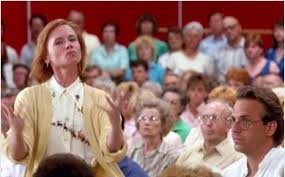
There is a wonderful moment in the movie “Field of Dreams” when the Iowa farm family that is at its center attends a PTA meeting because someone in their community wants to have a particular book banned by the local school.

The woman behind the proposed ban is acting out of a misplaced Christian impulse, and what quickly comes into the picture when she speaks is a whole slough of harsh invective about morality that is meant in the movie to be more or less a parody.

Well, getting increasingly agitated as the woman speaks is Annie, the wife of Ray, the main character. She is a now settled down mom. But she was a flower child in her youth, and she has a decidedly different opinion of the book that the other woman wants to see banned—perhaps even burned.

Annie loved that book. But maybe more than that, Annie has a different opinion about the idea of banning books, in general, whether or not she agrees with them.

And the two women get into a furious argument there in the school gym, which the other parents watch go back and forth like a tennis match.

Ultimately, it is Annie who prevails, after an impassioned speech about love, understanding, and peace—good values to be sure, which, personally speaking, she doesn’t happen to embody very effectively at that particular moment.
Of course, nor does the other woman seem very much like a disciple of Jesus in that particular moment.

I say this just to note that, in our reading from Galatians this morning, if it sounded to you like the Apostle Paul was one of those people from the 80s, standing in front of a school board, talking angrily and judgmentally about moral turpitude (they actually expressions like that back then)…well, you are to be forgiven.

It is a little bit of a blast from the past.

And as someone who loves Paul—as someone who gets a lot of important sustenance for the journey from Paul—I have to tell you that the mean church lady misinterpretations and misuses of Paul are still a cause for great sadness in my life.

Because there is so much there, and it’s so beautiful, and so important.

But even today, it’s easily obscured by the use and abuse of a kind of “thou shalt not” version of Christianity that still speaks with a megaphone in so many places.

Sometimes it is hard not to wonder if we Christians are more inclined to shout down Jesus rather than listen for his voice.

I worry that we might be.

This week, I’ve wondered if maybe Paul didn’t worry about that in his own day, too, truth be told.

That’s why it’s important to read Paul closely here.

When you do, what you notice is something interesting.

You see, Paul isn’t simply signing off on the danger of the vices he names.

Don’t get him wrong. He still sees them as dangerous, to be sure.

You don’t need to be particularly faithful to see that licentiousness—doing what you want when you want how you want as much as you want with whomever you want—is a precarious and often destructive way to live.

But Paul’s deeper point is that if avoiding the bad is all our faith is, well, then we have missed the mark.

Because for Paul, what it means to have a new life in Christ is not simply that we find the strength or summon the shame to avoid the bad.

For Paul, what faith really is comes down to a newfound power to choose the good.

It’s not simply the power to walk the narrow path of righteousness. That’s not what faith is, for Paul. That’s important, but it’s only the beginning of what faith is.

It’s not that we are perfect, either.

It’s that because of faith, somehow, in what we do, in who we are, a brighter light shines through.

And when you put it that way, I think what Paul is saying is actually meant as a criticism of much of the religion in his day—and perhaps in ours, too.

Because important as it is to seek freedom from sin, the deeper point of faith is to give us the freedom for love, the freedom for good, the freedom for the hard work of building and sustaining the whole human family.

In the early days of the Protestant Reformation, Martin Luther would speak of what he called “the bondage of the will,” his sense that our shortcomings make it impossible for us to live faithfully without God’s help.

Luther believed that our wills themselves are bound by sin.

But he also believed that when our wills are finally freed—freed by the light of God that shines through even in the darkest of places—then at last, a different path is possible.

When that happens, he argued, we are freed for a very different kind of life.

Paul would have understood that.

Unlike Paul’s list of vices, his list of virtues gives us much more to aspire to.

Paul talks about love, joy, peace, patience, kindness, generosity, faithfulness, gentleness, and self-control.

And that’s what life looks like when we are finally freed. When faith finally takes hold and begins to grow.

It’s not that we are freed from the snares of sin. It’s that we’re freed for the joy and challenge of a very different, deeper kind of life.

I remember when I was seventeen, I was studying for a year in France, and some friends of mine and I decided we would take an Easter trip to Italy for just over a week.

And it was certainly a wonderful trip.

But at one point, I remember, I realized something that I’d never thought of before.

I realized that for the very first time in my life, I was entirely without adult supervision of any kind.

For the very first time in my life, there was nobody waiting up for me. Nobody worrying where I’d been.

I was completely, totally free.

I celebrated this by having a triple serving of pistachio gelato, which is something my parents would never have permitted.

Italy, schmitaly. No way.

Now, I know that others respond to their first taste of freedom from parental constraint in other ways. I’m not here to point fingers.

But if all that trip had been was a scrupulous avoidance of the things I’d been taught to avoid, it would not have been much of a trip.

I mean, yes, except for the gelato, indeed, I did avoid all those things.

But the point of the trip was not that.

The point of the trip was to see new things. The point of the trip was to have new experiences and to build bonds with new people.

And the reason I still remember that trip so fondly all these years later is because I was able to do those things.

It was not only my first taste of freedom. More importantly, it was a small glimpse into what freedom for can be like, as opposed to freedom from something.

All by itself, freedom from is a kind of settling.

And what Paul wants for the Galatians, and what he wants for us, is the freedom for a life that never feels as if it’s settling for anything.

Friends, these are days when our fears may focus our attention on freedom from any number of dangers, toils and snares.

These are difficult days.

But the promise of life in Jesus is a promise of healing and wholeness even in the midst of the world and its brokenness.

It is a freedom for lives of peace and hope, no matter what the world might bring.

The love of God shines through.
And wherever it does, God’s people are transformed, and mobilized.

Where the love of God shines through, everyone else may see a minefield.

God’s people see a field of dreams.

Amen.

From the Newsletter: “New buds”

snowtopia

Dear Friends of Second Church,

Each spring, I am all promises when it comes to the hanging plants in our backyard.

Liz focuses on getting the girls to grow a few vegetables in the sunny corner by the gate, and on selecting plants that are pretty but hearty. She knows that these are probably not the years when Greenwich magazine will come calling, looking to do a full color spread on the parsonage garden. She plans accordingly.

But I can’t go to a plant nursery without feeling like the biggest morning glory basket—I like the ones with the mossy exteriors—needs to be ours…mine.

While Liz and Grace are dutifully waiting in line to buy tomato seeds, I take Emily off to the hoop houses and ask her which plant she thinks is the prettiest one. Then as a loving father, I feel duty-bound to get it.

After four years, she’s finally started to figure out what I like, which is gratifying.

Unfortunately, I am not as good at watering as I am at purchasing, so there are years when my joy at the garden is short-lived.

This year looked like one of those.

I’ve been very faithful to watering the lobelia. Love that blue. It’s losing its elegant shape but remains electric.

But last week, I realized on Monday evening that I hadn’t attended to the snowtopia…since the Friday before.

The snowtopia wasn’t happy about it. I sheepishly applied water. But to no avail. After a few days, except for one improbable, bright, cheery blossom, such flowers as were left looked like the color of old newspapers. The elegant trailing stems were more like brown shoelaces. The water seemed to run right through the hanging basket without stopping.

I kept watering it, anyway, mostly out of guilt. I tried debudding the shriveled buds. I told it I was sorry. Nothing.

Then yesterday, I noticed the beginning of new buds. At first, it seemed like only a few. But as I looked more closely, I saw that all of the stems had perked back up. Every tendril seemed to have new buds preparing to blossom.

The snowtopia is coming back.

As summer begins, I think a lot of people feel as if they’re dragging: that they’ve been cut off too long from whatever it is that sustains them: rest, affection, inspiration, peace of mind, a sense of grace. Maybe it’s because we’ve forgotten to water—to care for ourselves and for others who depend on us. Maybe someone else has not been faithful to the task of our nurturing.

But life being what it is, a power beyond all our imagining, it emerges again and again, even in the most delicate forms and in the most hostile places.

No matter who’s to blame or what we’re up against, new life breaks forth, even under the care of the weakest of hands and nourished by the thinnest of streams.

Beauty remains ready to blossom.

May we all find some of the beauty in ourselves in these coming weeks, and give thanks to the Creator who placed it there to flower in due season.
See you in church,

Father’s Day 2016

baseballdad

About ten years before I became a father, myself, I got a window onto fatherhood that got me thinking about the kind of dad I hoped I would be when the time came.

Many of the dads here will probably agree with me that the most important training we get in that department is from our own fathers.

That is certainly the case with me.

But I don’t think I had given that much thought, particularly.

Until one day.

It was spring, and the JV baseball team at the school where I was teaching was having a lackluster season.

But the catcher of the team was in my C block English 10 class, and he’d been trying to get me to come all season, and I felt guilty for not having gone, so, on this particular May afternoon, there I was, with a handful of other parents out to see the game…and an away game, no less.

It was a lovely, spring afternoon in Wilmington, with the trees in full flower and the sky impossibly blue.

Or, I should say, it was a lovely afternoon until the bottom of the fourth, when one of the parents from the other team playing started loudly complaining about umpire.

Now, I have to say, speaking for myself, I don’t particularly notice that kind of thing right away.

I’m from Brooklyn. People from Brooklyn talk back. Most of the games I’ve been to involve seats so far away from the field that you get nosebleeds up there. In seats like that, you can say whatever you want, and that’s kind of part of the fun.

But this was different. We were all right there. And so it wasn’t long before everyone in our little group was uncomfortably aware of the man in the Titleist visor loudly complaining. And it really wasn’t fun.

“Oh come on, Ump,” he burst out loudly at one point when the umpire called a strike.

Then when that batter went down a few pitches later, he said, “Oh for crying out loud.”

You know that look you sometimes shoot each other? The one that says, “What on earth is going on?” Well, there were a lot of those looks pinging back and forth through our section of the bleachers right then.

And then with the next batter and another couple of pitches, he said, “This guy’s an idiot.”

“Whoa, sir,” said one of the moms on our side loudly at that point.

But it turns out that this was all just the prelude.

It was at the bottom of the next inning when guess who’s son came back up to bat?

“All right, P.J.,” he shouted, “All right!”

Well, poor P.J. whiffed the first pitch.

The man stood up in the bleachers. “Come on, son, come on. DO IT,” he said.

The next pitch game. P.J. swung like he was going to hit that ball straight to New Jersey, whiffing again. Strike two.

“COME ON, SON,” he shouted, “GET IT TOGETHER.”

At that point, the other coach turned around over on his bench. Our parents were about to call DCFS.

Well, thanks to a decent pop and the fumbling from our shortstop, who tripped, P.J. actually made it to first base. The man in the bleachers celebrated with characteristically poor form.

I wondered for a moment if anyone over there was so lame as to actually let him share a high five with them, and was reassured that the answer appeared to be no.

But as happens in baseball, this dad’s joy was short-lived.

Because on the very next pitch, the batter knocked the ball back toward our shortstop, and this time our shortstop didn’t trip. He scooped up the ball and tossed it over to second just in time.

P.J. was tagged out.

You know those moments when everything just seems to sloooooow dowwwwn?

Well this was one of those, because I could see that the dad was leaping off of the bleachers and running onto the field to start shouting at the umpire like Billy Martin in the t.v. baseball of my childhood.

I saw his son’s coach leap up and try get him back to his seat.

But it’s the next moment that I really want to remember.

Because it was then that I saw our coach, like Atticus Finch in the trial scene of To Kill a Mockingbird, slowly, calmly, collectedly, get up from the team bench, and walk over to the home plate umpire with a weary smile.

He waited a moment. Stood just to the side.

The face of the man, the umpire, and the other coach were all various shades of red and purple…and you couldn’t make out the words…well, except for, you know, some….

“Excuse me, sir,” our coach interrupted at least.

“Coach….” said the umpire warily.

“Sir,” he repeated. “I think we’ll take our run now.” He smiled again. And then he went back and sat down.

And it was as if, all of a sudden, something else managed to kick in.

It’s like when you are trying to jump start a car and suddenly the sputtering engine revs like it’s supposed to.

The umpire nodded. Then he turned, faced the bleachers, pointed to our bench and said, “Score one home run. Sanford.” Then he turned to the man, “Sir, you’re ejected from this game. Get off my field. NOW.”

And after another moment, with his son’s coach taking him by the arm, off the man went to sit out the rest of the game in his car.

You see, I don’t know what the rule is here, but in Wilmington, Delaware, when a parent charges onto the field, it’s an automatic home run for the other team.

But I hope that you’ll see that in that moment, it wasn’t about a home run, or winning a baseball game. It was about quietly making sure that something else finally kicked in.

That’s what made it a moment of moral grandeur. It was a moment when somebody finally stood up to say, “Enough.”

It was a reminder in an unimportant game during an undistinguished season that fair play matters. Because fair play always matters. And character always matters.

Actually, those are the things that really matter, whatever the game may be.

And I thought to myself, that when I’m a dad, I want to be like that guy.

Of course, not all fathers out there do.

As we know all too well, P.J.’s dad isn’t the only one who didn’t seem to get the memo, and the children of those Great Santini types often have the baggage to show for it.

Also, it will probably not surprise you to learn that for many people, their relationship with God begins as a kind of extension of the relationship they had with their parents—and in particular, their relationship with their fathers.

So many of the people who decide to reject faith altogether, and who speak of God as angry, judgmental and supremely to be feared are remembering the flaws of human fathers they have known.

I find it hard to blame them.

Imagine, for example, what P.J.’s understanding of God must have looked like.

But the instinct of Scripture is to try to describe God not as angry, or as simply a remote, stern, lawgiver. The instinct of Scripture is not to imagine fatherhood, or God our Father, as the guy who shouts at us from the stands.

If you read the Bible attentively, what you find is a God who is more typically like the father in the parable of the Prodigal Son—a God who worries sick about us when we’re off doing our thing. But who nevertheless gives us the space to do our thing.

The God of the Bible is much more like the God in our reading from Isaiah this morning—a God who calls and calls for us, who reaches out to us, who wants good things for us, who gets exasperated with us, and who winces in those moments when, for whatever reason, it seems as if we can’t get out of our own way.

But God never stops loving us.

There are a lot of people who would be astonished to learn that God’s fatherhood isn’t really about control, or about pushing perfection.

God is more about dusting us off when we fall and sitting us back on the bicycle.

God concern is about teaching us to try. And to keep on trying.

God knows that we aren’t perfect now, and that we never will be.

But that’s not meant to be cause for punishment or shame.

If you read the Garden of Eden story, or Tower of Babel story, or the Noah story, or the David story, I think you’ll conclude that God must have made His peace with that a long time ago.

And God’s definitive response is the Gospel story.

God responds to us at our worst by loving us, anyway, and working even harder to show us the way to the life He promises us in Him.

God works to bring something good out of the worst and darkest things we humans go through. No matter what it takes. No matter how high the price.

That’s the kind of father He is.

That’s the God that people need to hear about.

Especially in these days, I think…these days when we’re remembering Charleston and still mourning Orlando, and watching the news in the meanest political season anyone can remember.

We need to tell people about the love of the father, which does not condemn us, but forever reorients us, and believes in us, and counts on us.

God knows that, despite our imperfections and our undeniable shortcomings, each of us can still be a force for good, a voice of reason, and a source of kindness.

His delight is to see what we do with His gifts.

That is God’s understanding of what it is to be a father.

On Father’s Day, may we be especially grateful for all the men in our lives who heard God’s call to go and do likewise.

Amen.