Monthly Archives: December 2020

Sermon: Christmas Monday

In our reading this morning, you may have caught the mention of the two turtledoves that Joseph and Mary offer at the Temple as a way of dedicating their first-born son.  

If you go by the “Twelve Days of Christmas,” this morning, we are on technically on the third day, which is when our true love is supposed to give us three French hens.  

I’ve never been entirely clear if that means I’m also supposed to be getting two more turtle doves and a third partridge in a pear tree today, or if each day is meant to be its own thing, but no matter.   

Some of you may be aware that since 1984, PNC bank (which I think is in Pittsburgh) has maintained what it calls the “Christmas Price Index,” an economic indicator that graphs the cost of the items listed in the song, cumulatively, through the 364 items to be delivered on the twelfth day. 

Business school graduates, fear not.  

The index takes into account that all the people mentioned are, of course, independent contractors, presumably filing some version of a 1099.   

In fact, along those lines, you will be glad to know that this year, according to the Christmas Price Index, the cost of the twelve days is down an eye-popping 58.5%. 

This is because all the live performances are out – this year, no lords leaping, ladies dancing, pipers piping, drummers drumming, or maids milking (to me, that last one was always more on the performance art side, anyway).

Your true love is going to be saving a bundle. 

And yet, of course, as I suspect the folks at PNC bank know full well, who can really put a price on Christmas? 

The whole point is that it represents something beyond calculation.  

It asks us to see the world in a very different way.  

This is what Ebeneezer Scrooge could never understand before his conversion.  

It’s something we are in danger of forgetting, ourselves.  

For us, just barely on the other side of Christmas, calculation in its various forms is the way of a world that’s poised to come roaring back as early as our first Zoom call tomorrow, like the Red Sea roared back into place as soon as Moses lowered his arms, unaware of whom it would drown.   

It’s the world that roars back every Monday morning. 

II.

If we take the story of Jesus seriously, it seems hard to believe that there is so much detail about his arrival, and then nothing after his dedication in the Temple a short time later.  

There was that star in the sky.  

It set astronomers from foreign lands in motion for months. 

It terrified Herod and all Jerusalem with him, eliciting ancient prophecies about the true king of Israel—even a protracted, armed house to house search for the child through Bethlehem.  

It led shepherds to abandon their flocks and to come into town, bearing accounts of angel choruses bursting into song.  

All these powerful testimonies.  This big deal stuff. 

Then, at least as far as Scripture is concerned, nobody mentions it ever again.  

How could that be? 

The answer is Monday.  Another Monday came.  

Just as it will tomorrow.  

And even with everything that’s happened, the calculating world roars back to life, and though they paused and gazed at that star for a moment, after that moment, most people simply move on.  

One month later, when Joseph and Mary bring the baby Jesus to the Temple for his dedication, you might think that Herod would have the place on high alert, but you’d be wrong. 

To most of the people there, baby Jesus is just another little peanut in a blankie, brought by parents doing their religious duty.  Nothing to notice, one way or the other.  

A savior might be born, but Visa’s still going to be due in a couple of weeks, I can’t work at home and run school at my kitchen table for two kids, and my mom still has no business driving that car.  That’s my focus.  

It’s going to be a while before that savior gets around to saving me. 

Well, we all know Monday.  

III.

Except that some do see. Some hearts are changed.  

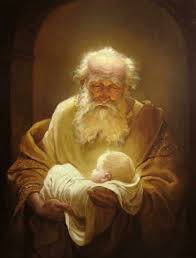
In our story this morning, Simeon and Anna, these old and faithful denizens of the Temple, see that particular peanut come through the gate, and they know immediately.  

For them, waiting for a savior has not been the passive thing it is for most of us.  

It has been the focus of their attention, literally, for years.  

For these two, there is no calculating “Monday world” that always seems to come roaring back—for them, what always roars back is the hope they find in God.  

For them, every day was the day before Christmas. 

And then at long last, Christmas arrives, as they had hoped and dreamed it would for so long.  

The story comes to us from the Gospel of Luke. 

Bear in mind also that Luke wrote his gospel around 85 A.D., in a world that was already very different from the world into which Jesus had been born.  

By the time Luke wrote, Jesus was long gone.  Most of the apostles were long gone.  Certainly, Simeon and Anna were long gone.  Even the Temple itself was gone, and Jerusalem in ruins.  

For Luke’s first listeners, this vision of dedicating a first-born son by bringing him to the Jerusalem Temple was like gazing at a sepia-toned photograph of your great grandmother as a young girl.  

A vision of a world that used to be.  

But those listeners knew about waiting, too. 

Waiting for Jesus to return was already taking so much longer and asking so much more than anyone had ever expected. 

Those things he had said about taking up the cross to follow him were not exaggerations. 

Yet it was possible to wait with joy and hope. 

The Apostle Paul had learned how, as, indeed, Simeon and Anna had learned how while they awaited the Messiah’s first coming. 

They knew how to keep ahold of Christmas.  

IV.

What sustained them into Monday and beyond? 

Some would shrug and remind us that these are the saints, people God chose to love exceptionally well and to grace with exceptional clarity of vision.  

By that logic, of course they’re hopeful.  

They were built that way. 

I don’t think so. 

To me, that makes it sound more like exceptional luck than exceptional faith.  

I believe they understood that love and care, attention and devotion are not things we squeeze in between appointments or save for the weekend.  

I think they understood that holiness, like life itself, is what happens while you’re busy making other plans.  

They were able keep ahold of Christmas because, unlike so many of us, they never stuck it back in a box and took it back down to the basement until next year.  

They didn’t let that happen. 

What price will we put on Christmas? 

The Christmas Price Index is one way to answer the question.  

The love and attention of a lifetime is another. 

May we remember it today, and especially tomorrow, and for all the Mondays to come.

Amen. 

Christmas Eve Sermon

Christmas has a kind of heavy lift to do this year, doesn’t it? 

The church, of course, has a particular understanding of what the Christmas story means, and the rest of the “Santa, Baby” world has a somewhat different one. 

Either way, it’s tricky to navigate what that ought to look like in this particular year.  

If you think about it, there might even be a certain defiance in celebrating. 

Let’s be careful how we talk about defiance, of course. 

Faith reminds us that all truth is ultimately God’s, and this year, some are taking God’s truth as it is known specifically through science and throwing it to the wind. 

Let’s not endorse that.  

I’ve always believed that, though they speak in different voices, true faith and good science are eternally friends.  

So if we acknowledge a certain defiance in celebrating Christmas, let’s be clear that the defiance I’m talking about is of a more private kind.  

Because there is a measure of defiance in decking the halls and all the rest, particularly when the audience for all that festivity…all that effort…might only be one or two people instead of the usual gang.  

As in Camus’ retelling of the myth of Sisyphus, there is something noble in our integrity, whether or not anyone else sees it. 

We may be tired.  We may be down.  We may be in a less-is-more kind of mode in any number of ways this year.  

But Corona cannot steal Christmas.  Not if we refuse to let it.  

That’s what I mean by defiance. 

II.

In some ways, it’s like we’re living in an odd, alternate version of that story about the Grinch.  

You’ll remember that in the original story, “How the Grinch Stole Christmas,” the Grinch sneaks from his lonely mountaintop hideaway down into the little town of Whoville. 

With his own feverish zealotry, which is never a good look, the Grinch steals all the presents, and the decorations, and the contents of every icebox in town, all in a futile effort to keep Christmas from coming.  

Eventually he learns that, in point of fact, he can’t stop Christmas. 

Christmas doesn’t come from a store — because “Christmas, it seems, means a little bit more.” 

Despite all the Grinch’s efforts, the Whos down in Whoville still have one another, which is what matters at Christmas and at every other time. 

Of course, this has been in front of him all along, but it is only when he hears the Whos sing on Christmas morning, lifting their voices even in the midst of loss, that he finally understands. 

His old Grinchy heart finally changes, and as Dr. Seuss tells us, the Grinch’s heart grows three sizes that day. 

Now, I did not see any Grinches earlier this evening, here on the church lawn, when we had our own version of a Wahoo Chorus. 

We gathered, bundled and masked and distanced and with great care, to sing a few Christmas carols together.  

To spend just a little while together.  

I can report that “Silent Night” is still beautiful when sung by the light of battery-operated candles, which looked like winter fireflies hovering in the darkness. 

The children of the church and their families have also put together a lovely on-line service of Lessons and Carols, which you can find on YouTube, and if you have not yet seen it, we hope you will.  

It is good just to have a glimpse of one another, and especially the kids, to help us remember and look forward to different days when it will be safe to gather again. 

But I felt the absences, too.  

Among many other things, Christmas Eve is a wonderful reunion of our church family – kids back from school, people back from other places, people with relatives visiting or with friends they’ve convinced to come along, not to mention others who just find themselves here.

One year, on the spur of the moment, a friend of mine from middle school flagged down a cab in Brooklyn and had it drive her all the way out here to Christmas Eve at 2CC.  

This is not the year for that kind of profligate gesture.  

With that in mind, even if Christmas doesn’t…shouldn’t…come from a store, that doesn’t change the fact that, by God, it needs to come from somewhere.  

Maybe the Grinch was wrong, at least as far as this year’s Christmas is concerned.  

If Amazon can send along the trimmings and the trappings and give us a nudge so that we might sing in the midst of loss, as do the Whos, God bless it.  

Whatever it takes to see to it that our hearts do not shrink has got to be worth it.  

III.

It may be hard to remember right now, but one way or another, this is always the challenge of Christmas. 

It was last year, and the year before that, and the year before that. 

The shrunken-heartedness of the world is the condition for which Christmas has always offered itself as a kind of vaccine. 

And if we come into the season feeling especially vulnerable, in this or any other time, we would do well to remember that we are not alone in being so.  

For starters, let’s remember that the baby in the manger knew a great deal about vulnerability.

Born to a young girl, chased into Egypt by a deranged king, later turned out of the synagogue in his hometown and nearly thrown off a cliff by his own village, to say nothing of Good Friday, it would turn out that the one put in the manger was not immune to much. 

He was vulnerable, first to last.  

In point of fact, that vulnerability was no accident.  

The story is quite clear about this.  

From the very beginning of Luke’s Gospel, it is abundantly clear that Herod’s bluster and deep cruelty, his fixation on violence as a way to hide any sign of weakness, is the opposite of true strength. 

By contrast, this baby who so terrifies Herod empowers his own parents, who are already vulnerable themselves in so many ways.  

By the grace of God, the deep vulnerability of parenthood has made them strong but not hard.  

His mother, especially, has already been through so much.

If you know the story, you know that she has so much more ahead of her.  

But she will not close her eyes to need or her heart to God, even if it costs her dearly.  Nor would Joseph.  

In God, they find the strength to do what is right, even though almost any other course of action would have been far safer. 

The same would be true of the adult Jesus, himself. 

To Jesus, entanglements and obligations weren’t a form of diminishment. 

They weren’t a weakness or something to get over. 

What we owe one another, who was our neighbor, how we might bring forth God’s peace and healing into one another’s lives, where God would call us to mercy – these were the questions that shaped his days.  

His answers were made clear in how he chose to live, and in how we do, as we seek to follow in his footsteps.  

In a world made small by need and greed and fear, Jesus and his family show us what large-heartedness looks like.  

IV.

Tonight, we remember that the shrunken-heartedness of the world at its worst is no match for the large-heartedness of God’s own Son. 

For all the challenges of this past year, that is still true.  

Admittedly, it might not feel especially true.  

For many of us, the lights are not so bright this year. 

Our losses have been many.  

Jesus knew that what gives us the power to sing in the midst of loss isn’t that our losses are not real, but our trust that love is even greater. 

It may seem strange to speak of that on Christmas, which we tend to think of as uncomplicated.  As just sort of happy.  Pleasant.  Merry. 

Some years, it is. 

But speaking otherwise would not have been strange to the Whos down in Whoville, or to Scrooge, or to Rudolph, or Isaiah, or to Malachi, or to Micah, or to Mary or Joseph, and it would not have been strange to Jesus.

They all knew loss, fear and worry, too.

Nevertheless, they defied the power of those emotions and chose to grow where others thought it better to shrink. 

Tonight is a night to lift that up.  

Many years, we sing in the midst of blessings. 

Others, we sing in the midst of loss.

Either way, sing we can and sing we do because of what Jesus teaches us: that love is worth it – worth even the risk and the pain – for nothing can truly defeat love, not an unjust king, nor a terrible, new virus, nor even death itself. 

That is the defiant proclamation of Christmas. 

Tonight, God comes alongside us in love, carrying our burdens in the divine heart, and looking to the day when all that has been lost will be redeemed and all Earth’s people one.  

For all that might divide us, I’m sure that we are all looking to that day. 

Even though so much seems different and diminished this time through, we’re looking to that day.

God came when he did and where he did and as he did to show us once and for all that no place and no person can ever be considered God-forsaken.  

Tonight is the night when we especially remember that God’s love has not changed.  

It never will. 

As the hymn says, “Light and life to all he brings, ris’n with healing in his wings.”

Tonight, may every heart grow three sizes, and may the world rise, healed.Merry Christmas. 

Sermon: “What Mary Knew” (Advent IV)

At no point in my life has a stranger ever told me that I’d be so much more attractive if I just smiled more.

So when I first began hearing that women hear things like this and worse all the time, or that shows like “Mad Men” were not simply describing the way things way back in the Dark Ages, I simply did not believe it.  

Sure, I was certainly raised with the expectation that I would be polite.  

It mattered to be polite.  Nothing wrong with that.  

But the notion of going beyond politeness and conjuring up my own friendliness to please someone else at his request, to perform emotional labor for someone else’s anything, be it his whim or his full-blown agenda, was not expected of me.  

Of course, it wasn’t.  That was beneath the dignity of a man in the world I grew up in.  Even a young man.  

I don’t know I “learned” that – how it was I saw it – which is just to say: nobody ever explained any of that.  

But learn it, I did.  Saw it, I must have.  

It was part of my understanding of what it was to be me. 

I thought it was what life was like for everyone

I don’t really know how my unlearning began. 

Seeing those assumptions when you look in the mirror isn’t one of those Damascus Road kinds of things, where you’re blinded by the light and everything changes in an instant.  

Even now, my unlearning, my turning from error and toward a fuller picture of the truth, is a work in progress.

Yet it is work that the Christmas story itself calls upon us to do.  

II.

This is a key theme in the story’s deep concern with Mary, the mother of Jesus.  

We don’t know where Mary, the mother of Jesus, grew up.  

If you look into it, you’ll see that people have wondered that since the early years of the church. 

Some say Nazareth.  Some say Jerusalem.  

There are legends that Mary grew up in the Temple itself. 

Others say she lived near it and was educated there. 

In fact, an early church and pilgrimage site was built 400 feet from the Temple itself, just outside the walls of Jerusalem, purporting to be where her parents, Joachim and Anna, had lived and were buried.  

Clearly, the Church has always wanted to affirm that there had to be some kind of sanctified backstory that the Gospels themselves did not include. 

That must be true.  What it was, we don’t know.  

Yet there is this sense that Mary had already learned a great deal about who she was by the time she appears in the Gospel.  

Was she a dutiful pleaser — the kind of kid who sat in the front row, got As for deportment and penmanship, memorized the proper answers quickly and got that school was mostly about sticking to those, whether you actually cared about the answers or not?  

Or was she a wisenheimer — a kid who asked questions the teacher didn’t know how to answer, who sat with the out crowd, who laughed and was awkward, who wondered what life was? 

We don’t know.  

Either way, she turns from error to truth, and from social conventions about her place in the world to God’s disruptive role for her in the drama of salvation.  

Whoever she was before, there would have been a lot of things she would have had to unlearn.  

She does just that.  

Around the time when older men in the neighborhood would have been trying to cajole her into smiling for them, when they were warmly or not-so-warmly calling her “kiddo” whenever she spoke up with ideas about things, something happened. 

The unlearning clicked. The line was crossed.  

Somewhere between heaven and her heart, something different and definitive intervened.  

However it might have been before, now Mary was through with pleasing, fully ready to claim her dignity as a person. 

The years of performing for any agenda other than God’s were over.

What are we supposed to make of her encounter with the Angel Gabriel?

I’m not sure the Church has ever given sufficient attention, much less appreciation, to the fact that God’s angel comes asking, not telling, and that the choice is very much Mary’s to make.  

According to the story, she answers immediately. 

To me, that still doesn’t mean that the choice is obvious.  

There is plenty to weigh in choosing the path she does.   

But she knows who she is.  

Clearly, coming into her role in salvation history, she came into her own.  

As Irenaeus of Lyons puts it, “The glory of God is a human being, fully alive.” 

Part of what makes Mary so remarkable is that she’s not afraid to be just that: fully alive.  

As Soren Kierkegaard observes: “There are two ways to be fooled.  One is to believe what isn’t true; the other is to refuse to believe what is true.” 

Whether it’s about what matters in this world, or about who she is, either way, Mary refuses to be fooled.  

She will not be misled by anything that would deny her life in all its fullness. 

III.

And isn’t that the deeper point of Christmas, if we think about it? 

Its rich imagery is trying to tell us that God, “the way, the truth, and the life” has become plain as day.  

In the Christmas story, the counterweight to Mary is King Herod, who is fooled in both senses, not believing things that are true and convinced by things that aren’t, particularly about himself. 

Maybe that’s an occupational hazard if you’re a king.    

It’s a hazard for anyone.  

Yet some are not fooled.  

Mary is not, of course, but she’s not the only one. 

Many of the other people around the manger are not fooled, either, be they holy family, shepherds, or magi.  

Moreover, on this particular night of nights, in this particularly humble place, they realize that to pretend otherwise is simply beneath their dignity. 

Now and forevermore, they know better.  

I can’t say if someone ever told a shepherd or a wiseman that they really ought to smile more.   

But in seeing Jesus, they come to recognize definitively that there is something broken in the world’s ways…something broken in so many of the things we are so told to do…something broken in so many of the things that we are told are true. 

And they have decided that they are done for good with all of that.  

They have unlearned a falsehood, and they’ve started to grasp for the truth.  

It is the holiest of moments.  

Similarly, whenever a person decides that for themselves again today, something of Christ is born anew.  

Life in something more like fullness stretches out before them, and there’s a little bit of God’s glory that shines brighter, radiant like that star hanging in the sky over the manger.  

IV.

The world is full of ideas about the lives we ought to lead.

There are things it wants us to notice and others it would just as soon we did not. 

There are even truths about ourselves we are in danger of missing, and worlds waiting to be born that never will be, if we do not learn to see.  

God would not have us be fooled.  

God’s hope is that we will come to be fully alive – as Mary dared to be – unlearning falsehood and committing to truth, wherever it may take us. 

This morning, we remember how it took Mary to a stable in Bethlehem. 

The Gospel reminds us that took a lot to get there.  It asked so much of her and so many others to get that far.  

This morning we remember God led her to that stable not as a conclusion, but so that her story, and ours, might truly begin.  

May it be according to that word.  

Amen.  

Sermon: The Comfort of Christmas (Isaiah 40:1-9)

Do you remember how last April, all those ring lights and other gizmos to help us look our best on Zoom were just flying off the shelves?  

Don’t just sit there looking like Jabba the Hutt, they said.  Raise your laptop to eye level.  

When you do that, don’t just use some random collection of coffee table books, they said – use a special laptop lifter instead so you can get it juuuust riiiight.  

At one point last spring, you may remember, the New York Times offered expert advice in setting up a good background for a life now lived on screen.  

Want to look thoughtful? Make sure you have a bookcase behind you, they suggested. 

Want to look classy and like you have it together? Go minimalist, they suggested. Have an empty room with a single orchid behind you, or maybe a Japanese print on the wall.  

These seemed like good ideas.  

Unfortunately, these suggestions quickly became minefields all their own.  

It turned out that people cared what the actual books were and pondered what your bookshelves said about you. 

How thoughtful were you, really?  What did your reading reveal to the discerning eye?  

Then people started critiquing the orchid, or your choice of print. 

I’m glad to say that it seems like we’re over a lot of that.  

Books? No books? Fancy ring light? No ring light? Print? No print? Whatever: it’s still Zoom.  Let’s do this.   Life is hard enough already.  

Lately, in particular, it seems as if things are pulling back, and we’re settling in for the long winter’s nap.  

A certain kind of striving is out.  Comfort is in. 

The catalogs have been saying so for months now—telling us that it’s time to stock up on everything fuzzy, wuzzy, cozy, and comfy. 

For the first time, accountants are letting people claim things like plush velvet jogging pants as a legitimate business expense. 

It’s a new world. 

It’s like that moment in the marriage when you stop trying to rush the other person and just try to find somewhere to sit and wait until they’re ready.  

These things take however long they take.  You might as well get comfortable.  

II.

Unfortunately, the Christmas story moves in the opposite direction.  

From start to finish, it is a story of people willing to put up with every imaginable kind of discomfort.

It starts with Jesus’ mother and keeps her constantly in view, but the centrality of discomfort extends well beyond her. 

There are the lowly shepherds terrified by an angel chorus that shows up—boom—out of nowhere. 

There are the mysterious magi who journey thousands of miles to follow a star and understand its meaning.  

The story of Christmas is deeply intertwined with the story of John the Baptist, a man who could have had a cushy life like his father’s – a life of occasional business trips to the capital and great respect all around, as Luke’s Gospel suggests.  

Instead, John opted for the wilderness, finding God, somehow, in that discomfort, with his greatest peace coming finally in a prison cell. 

Then there’s the moment, well into the ministry of Jesus, when one of the Jerusalem scribes seeks out the Lord for a kind of informational interview as he ponders giving it all up and following him.  

Jesus warns the scribe, “The foxes have holes and the birds of the air have nests, but the Son of Man hath not where to lay his head” (Matthew 8:20).  

Jesus seems quite clear that if what you’re after is a comfortable life, then the life of faith may not really be your thing. 

At Christmas, we especially remember that for Jesus, himself this had been true from the very beginning, going all the way back to that manger in Bethlehem.  

Paul reminds us that Christ, “though he was in the form of God, did not count equality with God a thing to be grasped, but emptied himself, taking the form of a servant, being born in the likeness of men.  And being found in human form he humbled himself and because obedient unto death, even death on a cross” (Philippians 2:6-8). 

If Paul’s exalted language is unfamiliar to you, what he means is that, in coming down here struggle and suffer with us, Jesus gives up nothing less than his equality with God, his exalted perch on Heaven’s throne. 

His point is that such is God’s great reservoir or love and hope for us, Jesus is willing to bet the farm that for all our brokenness, we might yet find it in us to be healers, if only someone truly decided to show us how.  

What a vision!

But as the Gospels remind us, it’s a vision that begins with disruption.

How could it be otherwise? Because things are going to be different now, starting with us.  

Believing in Christmas is about believing in change. 

We find it in ourselves to become disrupters of anything and everything that would disrupt God’s abundant vision for Creation. 

III.

This morning, we heard the words recorded by the prophet Isaiah in another moment of profound dislocation—words that God speaks to God’s people in the midst of their captivity in Babylon.  

“Comfort,” says God, “Comfort ye my people.”

It is not entirely clear whom God specifically intends to do the comforting.  

What is more important is that God speaks these words of comfort—the very first expression of the tidings of comfort and joy we would come to sing about at Christmas so many years later.  

It signals God’s intentions at a moment when they seem murkier than ever. 

For some, God had been silent for generations, unwilling or unable to rise to the occasion. 

You can hear them now, and understandably so. 

They held that God was a false hope…a distraction from doing whatever you could to get comfortable, to hole up and hold out in whatever way you could.  

It’s into this moment that at last, God speaks again. 

The comfort God offers has little to do with getting comfortable.  

What God offers instead is the comfort we find in getting ready.  

“Prepare ye the way of the Lord” says the prophet Isaiah.  

Centuries later, by the banks of the Jordan River, John the Baptist would take up Isaiah’s cry, sensing something urgent in it once again. 

Neither Isaiah nor John the Baptist understood waiting on the Lord as an invitation to sit back and relax.  

It was a call to do nothing less than lower the mountains and raise the valleys, to make a highway in the desert for the Messiah, the one who comes in the name of the Lord.  

They wanted us out there with our bucket and our shovel.  

They understood that the very things that offer us true and lasting comfort have little to do with the things that make us comfortable. 

IV.

That’s especially interesting to ponder right now, in this year when every catalog in our mailbox, and many other voices besides, say we should be trying to figure out how to get comfortable. 

There are days when getting comfortable sounds really really good.  

Yesterday, I read that the lines for nice-smelling hand cream at Bath and Body Works are out the door and down the block this year.  

There’s nothing wrong with hand cream. 

But in its own way, Christmas reminds us that we shouldn’t settle for being comfortable when what we actually need is comfort.  

Christmas says: let’s disrupt each other’s pain.  Let’s disrupt each other’s loneliness.  Let’s disrupt each other’s worry. 

The world is busy wringing its hands and trying to find its hand cream. 

Meanwhile, there are people who are still focused, still out there, still making calls, still double checking the numbers on a spreadsheet, still helping a kid with her 3x tables, still worrying about the folks who can’t afford heating oil with winter coming.  Still bringing forth the Kingdom. 

People are taking care of other people – not just the ones that God has particularly placed in their lives, but many others besides. 

We need to be among them.  

So go get your bucket and your shovel, and let’s do this.  

The old Heidelberg Catechism captures it well. 


“What is your only comfort in life and in death?” it asks. 

Its answer is this: 

“That I am not my own,1
but belong—

body and soul,
in life and in death—2

to my faithful Savior, Jesus Christ…3”

I think that’s it.  

Seeking to be comfortable is what happens when we imagine that, in the end, the only possibility is that we belong to ourselves.  

It may well be harmless.  But it’s also pointless. 

By contrast, to be comforted is to remember that, in truth, we all belong to God.  That we always have and always will.  

Comfort is focused on the things that can never be taken away. 

Instead of moving inward, comfort moves outward, seeking to love what God loves, and to disrupt anything that would seek to deny that love.  

So when Isaiah and John the Baptist call us to “prepare the way of the Lord,” this is what they’re talking about.  

That’s what they want for us.  

In the time of Corona, maybe at last we have finally come to the end of appearances and merely seeming. 

There we are on Zoom, watching one another, wondering who it is we really are – what those books on the shelf behind someone might reveal, why we went with that print instead of another one.  

Christmas is calling us to a different, disruptive vision—a very different answer.  

This morning, it beckons to us once again.   

The God who brings a new heaven and a new earth is coming to be born, so that you and I and all the world might be reborn.   

May it be as Isaiah writes: “The glory of the Lord shall be revealed, and all flesh shall see it together, for the mouth of the Lord has spoken it.” (Isaiah 40:5)

May it be soon.  

Amen.