Monthly Archives: April 2015

Newsletter: Mr. Softee

mrsoftee

In the Brooklyn of my childhood, it wasn’t really Spring until the Mr. Softee trucks came out.

It didn’t matter what you were doing…whenever you heard the tingling bells of the Mr. Softee truck, you dropped what you were doing and ran for the street as fast as you could.

I mean this.

One day, my friend, Benji Dorfman was in the middle of washing the family dog, and in true Pavlovian fashion, heard the bells and ran for the street without another thought, leaving the dog to roll the soap suds off on the living room carpet. The white living room carpet.

Douggie Armer used to run for the truck without remembering to get money first—until as a form of tough love, we refused to spot him, and started making him go back and ask his mom.

Oh…the many near misses with speeding cars! Oh…the horror of getting to the street, only to see the truck already turning the corner at the end of the block, which made it officially out of bounds.

But that was Spring.

In fact, I remember my surprise at seeing the Mr. Softee guy riding the Lexington Avenue subway one Saturday during the winter—it was like someone handing you an Easter egg on Halloween.

What are the rites of Spring for you?

Maybe it’s getting the grill or the lawnmower back in working order. Maybe it’s putting your golf clubs back in the trunk, or getting your beds planted. For some of our teachers, it’s navigating how you’ll teach your classes in May with all the disruption of AP exams. And for our snowbirds, maybe it’s packing up the cars and heading back to Greenwich.

Now that I’m older, these are the precious weeks when it’s warm enough to sit outside on the porch, but there aren’t any bugs.

However it is you know for yourself that Spring has sprung, I hope you’re able to find a way to appreciate this gentle season, and to find in it sources of rest, joy, and connection with all living things. In some ways, our lives return endlessly to larger rhythms and cycles, and things are forever coming around again. At the same time, when Mr. Softee rounds the corner, an opportunity slips away.

May you and I make space for the larger rhythms of Creation, and the soft, tinkling music of God’s love in these days.

See you in church,

Sermon: “The Shepherd’s Language” (John 10: 11-18)

You’ve heard the old saying about how Eskimos have 36 different words for snow.

Well, apparently, Arabic has about that many different words for sheep.

There are words to distinguish sheep by gender, breeding ability, and age.

And others, depending on the season in which they were born.  And there are at least twelve words to describe color—not only black or white: in Arabic, there’s even a word for sheep with a brown-and-white-spotted face.

And then, if your sheep gets sick, there are apparently even more words, based on whatever it is that it’s got, and then how bad a case it seems to be of whatever it is.

That’s a lot of words.

It also means that where some of us may only see a herd of sheep…  know your Arabic, what you see is different.

Because for those with the right words, and then the right eyes, a herd isn’t just some sort of random jumble of hooves and fur.

Not at all.

Instead, it’s a whole collection of unique faces and bodies—it’s a vision of Creation in all its startling diversity and particularity.

And that changes everything if you’re a shepherd.

Because then each one comes to have a story of its own.

If an animal gets its leg stuck, you aren’t just rescuing one of the sheep—to you, the rescuer, it’s that little kid born at the springtime with the brown and white spotted face, who’s gone and done it again.

I find that helpful to remember as we think about this morning’s Gospel passage from John, in which Jesus speaks of himself as the good shepherd.

Because I think what Jesus is saying is that God’s love sees us—God’s love knows us—God’s love calls us—with just that kind of appreciation for the particular.

God sees each of us as a special case.

I spent some time this week pondering what it is in my life that I try to see with that kind of particularity….what it is that I have thirty six words for.

I asked Liz and she said: “the only thing you have thirty six words for are books you want on Amazon.

(That wasn’t kind of you, Liz.)

But maybe I am just sort of challenged in this way.

My roommate in college was a trumpet player, and he once satme down in our living room because he wanted me to learn how to appreciate the subtleties in three different recordings of Herbie Hancock’s “Cantaloupe Island.”

I have no idea why that was so important.  Maybe it’s no surprise, then, when I admit that I failed miserably.

We didn’t end up connecting over that.

Similarly, when my parents left Brooklyn and were moving into their new house, my mother asked me to compare the five different shades of off-white that she was considering for the living room walls.

Looking at that little book of paint strips, I couldn’t even see five different shades of white on what she handed me.

I was no help whatsoever.

We miss out when someone tries to share his—her passion with us, and we can’t find our way into it.

Learning someone else’s language—learning their 36 words for whatever it is that’s most important to them…whether it’s snow or sheep or the names of sails on a frigate—whatever it may be: learning someone else’s language is how the strongest human bonds are forged.

That’s how we let someone know we have entered his—her world.

But as a pastor, I’ve come to see how rare that actually is.

As a pastor, what I encounter much more often is the great pain of people who feel as if the ones they love no longer see them, or no longer appreciate the lengths they go to…the effort they make and the courage they show.

The pain of losing that sense of being known, of being seen, of knowing we are loved is one of the hardest things our souls can go through.

It’s a cliché, but it’s nevertheless true, that the person who is living a life that’s constantly behind the eight ball, but who still feels noticed and cared about, is in a totally different place than the person who is doing well but feels invisible in his own home.

It’s not that we lose sight of one another’s special passions that is so crushing, but the way that we lose sight of one another’s daily struggles and triumphs.

One of the greatest gifts we can offer is attention to each other’s daily particularities, to what happened at work, or how the sciatica feels, or what Christian said that Ellie did after she got that text from Molly about Lisbeth.

Whatever those particularities might be.

Because it’s in those moments that we live out our days, and slowly become the people we become, and the character we bring to our tasks emerges for all to see…if they only would.

And so the message of this morning’s Gospel is simple.

It’s saying that God sees.

The late nights and the red-eye flights and the dutiful driving to all the recitals—God sees.

The mother who’s grown old worrying about an adult child who is in trouble—God sees.

The sick husband who is trying to be so brave—God sees.

The third time or the umpteenth time you’re a finalist for a position and come up short—God sees.

When your college plan or your promposal doesn’t work out the way you’d hoped—God sees.

In the face of all the challenging particularities that we encounter—God sees.

God knows us.

Each one of us is a special case.  And the God we serve is a God who speaks our language, whatever it may be.

Now I know this is hard for some people to accept.

In this morning’s Gospel, when Jesus is talking about being the gate and being the shepherd, his audience isn’t just the people who know they’ve lost their way—he’s also talking to the Pharisees, who have been listening to his teaching with arms folded and eyebrows raised, waiting for something they can jump on.

When Jesus is talking about the good shepherd, he’s also talking about bad shepherds too, and he’s channeling the words of the prophet Ezekiel, who had called out the false leaders of Israel many years before, saying:

“Ho, shepherds of Israel who have been feeding yourselves!…You eat the fat, you clothe yourselves with the wool…but you do not feed the sheep.  The weak you have not strengthened, the sick you have not healed, the crippled you have not bound up, the strayed you have not brought back, the lost you have not sought, and with force and harshness you have ruled them.” (Ezekiel 34:2-3)

He’s calling them out, and they know it.

And even now, we know we have to be on guard from anyone who suggests that God’s love is limited or conditional, or intended only for a select few.

Or who suggests that we ourselves aren’t lovable, whether it be to God to or anyone else.

We are all far from perfect and have a ways to go. That’s true.

But we must never forget that God doesn’t love some sort of plain vanilla sameness.  God doesn’t make saints with a cookie cutter.

God loves us in all our uniqueness. And for all the ways we give of ourselves as only we quite can.

God loves us for the uniqueness of each face before him.

And he calls us to love one another as he has loved us.

So may we learn to see one another’s face, and to speak one another’s language.

For it is in loving the sheep that we show our great love for our Good Shepherd, and work for the day when at last, we shall all be one flock.

Amen.

Newsletter: “Wild Thing…You Make My Heart Sing”

IMG_5055

Dear Friends of Second Church,

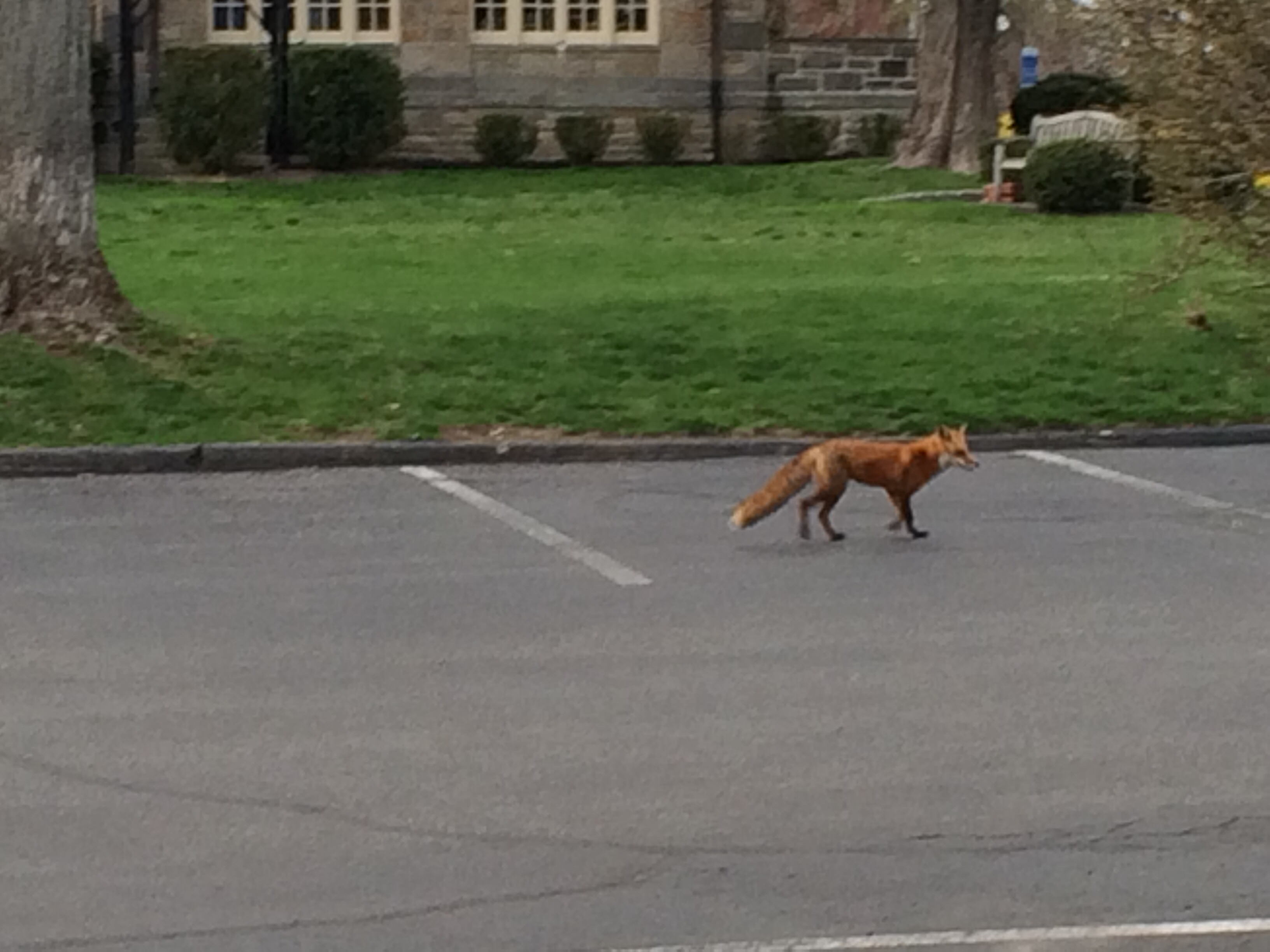
Last week we learned that our campus has a temporary sojourner visiting with her family: a mother fox with two cubs moved under one of the sheds behind the church.

We know, of course, that she cannot stay, and we are looking into humane ways of relocating her and the cubs in the next few days. I am glad to report that she appears to be entirely healthy. (Anybody want a pet fox? She’s free!)

But while she appears to be entirely healthy, she’s not entirely shy—she has been spotted by many people on the Mead House lawn, and last Saturday, she walked right by me in the driveway, took a right on Maple Avenue and proceeded down toward the statue of the Union soldier across the street. If you do see her, you’ll have time to take out your camera and snap a few pictures—she doesn’t bolt away at the first sign of a human.

I suppose they are the one visiting family we should hope doesn’t get too comfortable here.

And yet, I find myself rooting for them. Especially the mom.

Their being here reminds me that, much as we draw our property lines and set our campus speed limits, worry about how the garden is doing or if the flowers in the planters are getting the right amount of water, it only takes the presence of a small, wild thing to show how arbitrary that all is. Creatureliness has a logic all its own—makes homes where it can and must, not only where it “ought to.”

Much as we may know that a wild thing does not belong here, we’re only sort of right.  Because its presence reminds us that “belonging” is much bigger than the ways we understand and live out our own notions of that term.  For while we may be well within our rights to remove any trespassers, the fact remains: other creatures make claims on us.  On our space. Our time.  And on our care.  We may not choose to acknowledge it, but we belong to each other and to God.

The notion that we can draw the borders where we choose and manage the interactions on our own terms is a foolish notion–one we must hope we do not fool ourselves into believing.

The story that is the center of our common life begins with a baby who had nowhere to lay his head—born in a shed because there was no room for his family in the inn, no place where they belonged, no welcome according to the arbitrary rules that governed their world.

So much of Jesus’ ministry was a call to a deeper understanding of what it is to belong, to understand ourselves as creatures, created and sustained by God, and to find a deeper community among all living things, in his name.

I’m rooting for our campus foxes–hoping they will find a good, safe place where they can stay.   But I am grateful for their beauty and their wildness, and how it reminds us of how we are all wild, beautiful creatures in our own way.

See you in church,

Sermon: “Prove It” (John 20: 19-29)

Saint_Thomas

I saw a photograph this week that someone had snapped in the course of her travels—it was a huge Walgreen’s sign that read “Easter…50% Off.”

I guess that’s better than “Easter’s Over: Going Out of Business.”

But it seems hard to deny that the world seems to take Easter at a little bit of a discount.

Just compare it to Christmas.

Christmas manages to be more of a season…more of a culmination. The world goes quiet in that week after Christmas in ways that seem reverently hushed.

People have always said things like, “’Tis pity that Christmas comes but once a year.”

For whatever reason, joyous as it is, Easter is not like that.

The fact is, even for many in the clergy, there are years when it just seems to come and go, like an Easter Bunny hopping from one side of the stage to the other.

So maybe that sign that said “Easter 50% Off” is just telling it like it is.

II.

 And if that’s what we’re doing…if we’re telling it like it is…maybe it makes sense that the Sunday after Easter is the day when the Church reads the story of “Doubting Thomas.”

There used to be a show on MTV that began with the words, “This is the true story of of seven strangers… picked to live in a house…work together and have their lives taped… to find out what happens… when people stop being polite… and start getting real….”

In that spirit, there is this sense that the politeness of Easter is no longer required…that now we can all be real.

It’s too bad that for many people, “being real” seems to mean “sleeping in.”

Because if Easter represents faith at its most triumphant, the Sunday after Easter represents faith, maybe at its most honest.

And I would argue that we need that faithful, real-world, here and now honesty as much as we need that hope-filled Easter Morning glimpse into God’s glorious future for Creation.

In fact, if it were up to me, The Sunday after Easter, Doubting Thomas Sunday, would be as much a part of the story as Palm Sunday and Holy Week.

Because it’s more important than many of us ever give it credit for.

Because without it, so many of those who need Easter the most can miss the Easter message entirely.

Because, remember, church….remember: so many people join us for Easter Sunday and they think that actually, we have forgotten…that we who are inside have forgotten what it feels like to be on the outside of the church and looking in.

They think we have forgotten what it is to live, not quite sure about what you believe.

And not quite sure how to get your life together.

And not quite sure if other people can tell that, some days, you’re hanging on by your fingernails, just hoping to get through.

Those pilgrims come, and they think we’ve gotten it mostly figured out. That each day is Easter Sunday, and that we’re all just here to say thanks be to God.

They think we’ve probably forgotten life on the outside looking in.

If that’s your situation, and you come to a church on Easter, it can be so easy to leave that Easter service, convinced that everyone else in the sanctuary was born singing the “Hallelujah Chorus,” and that you’d better keep your own searching reeeal quiet, because the only people who ought to be calling themselves Christian are the ones who have already found Jesus, and not the ones who are looking for him.

And so we read the story of Doubting Thomas today, in order to name that the searching matters, and to name that the searching continues, and we read the story in order to name that the answers are not simple for any of us.

III.

The story itself is not long to tell.

On the evening of the first Easter, the disciples have retreated back to their hiding place—that room where they had been holed up for days, waiting for Passover to end and for the Romans to march back out of town, leaving the coast clear.

And the story goes that Jesus comes to them there, ghost enough to pass through a locked door, but human enough to touch, and wounded enough to prove that he is the one and only Jesus.

He is among them again. It is truly him. In spirit and in flesh. Somehow—who knows how?—only God knows how—but there he is.

The story does not tell us what they said to one another after he left again. It doesn’t tell us how they wrapped their heads around it.

Instead, it tells us only that one of their number, Thomas, was not there when it happened.

And when Thomas arrives, he is unprepared to accept their testimony about this new, strange appearance of Jesus among his friends, and he says, “Unless I see in his hands the print of his nails, and place my finger in the mark of the nails, and place my hand in his side, I will not believe” (v.25).

“I can’t know Jesus like this second-hand,” he says. “I’d love to believe it. But I need to see it for myself. I need to know it in my own way. Prove it.”

I love him for that.

I love him for listening to his own heart and his own head, and for trusting the prompting of his own soul to tell him when he had found what he was searching for.

Some would say that’s disrespectful, or even faithless, but I don’t think so.

In my book, he’s one of the strongest disciples that the Church has ever known—the conscience of them all.

He won’t go along to get along; he doesn’t know how to win friends and influence people; he won’t let some other piper call the tune.

He has no patience for believing someone else’s beliefs, or kneeling before someone else’s truth—even among his friends.

And so he pushes back.

To me, that makes Thomas the patron saint of all seekers.

To me, he is a friend to all those who find easy answers to deep questions unacceptable.

To me, what matters is not that Thomas refuses to accept the truth, but that he refuses to accept even a beautiful truth…even a truth that sounds great…he refuses to accept even a truth that he wants to believe in more than anything, until God reaches out to claim him with that truth.

He will only stand up for what he knows.

I love him for that. And so does Jesus.

Clearly, there is a place for him among the disciples, and in the Kingdom of God.

IV.

The Church throughout its history has told people of all kinds – people of all backgrounds and classes and races and genders that there is a place for them in God’s heart, and in God’s church.

God doesn’t expect us to have all the answers, or to imagine that we’ve finished our growth into who it is He needs us to become.

I believe God wants us to seek, and to keep on seeking all our days.

We cannot expect all the answers to line up before us—part of this journey that we’re on means that seeking knowledge, and seeking to serve God always pushes toward the horizon, taking us further into the unknown.

But our world is forever growing. And our hearts are forever expanding.

And in time, with God’s help, we come to understand that we must push beyond the world we know, and beyond the facts we can hold in our hands, and journey on into the places where only faith and trust can direct us.

Today’s Scripture reminds us that without doubt, there is no seeking. And seeking is precious to God.

Without seeking, Easter is a story that simply comes and goes.

But for those who seek, for those who push, for those willing to undertake the journey, it is a foretaste of the heavenly banquet that is to come.

It was for Thomas.

May it be so for you and for me.

Newsletter: What if I didn’t believe?

Dear Friends of Second Church,

Every year between Good Friday and Easter Sunday, an Episcopal priest I know uses his prayer time for a particular spiritual discipline: he tries to imagine an atheist version of himself.

That is, he tries to consider just how his life would be different if he didn’t believe in God.

So: there are some obvious things, of course. He would be in a different line of work. He would dress differently. He would be doing a very different kind of writing—maybe not doing much writing at all. His Sunday mornings would probably involve tai-chi and the crossword puzzle on a more regular basis.

But those are a handful of superficial things.

The deeper question, of course, is what he might be inclined to believe in, instead.

Without a sense of living under the sight of God, and a hope to live in a way that is pleasing to God, whose looking would he be most aware of? Whom would he be hoping to please?

What larger story about the world and how it works would he use to explain his daily experience?

Because, religious or not, everybody has some larger story they lean on. Over time, our lives come to be shaped by that story in important ways—and we come to understand what’s important and what isn’t, who’s important and who isn’t, and to live our lives accordingly.

Maybe it means something wifty, like “never date a Scorpio” because the truth is in the stars. Or analytically precise, like using cost/benefit analysis for every decision, because the truth is in the numbers. Or wondering what everyone’s therapist would say about why they are acting the way that they are, because the truth is in mind’s unconscious.

More ominously, those larger stories also teach us to see other people in particular ways, too—they determine whom we notice and what we notice about them. Sadly, so often that turns out to be less than who they are in their full complexity, not to mention beauty.

We can’t help but gravitate toward some approaches more than others. Yet each one has its blind spots.

For my friend, imagining himself as an atheist is a little bit like visiting a city, far from home, and recognizing that you could see yourself living there—that you like the weather there, that its scale and pace appeal to you, that its people seem like your kind of people—and yet, despite all that, knowing that it isn’t your home.

And yet, it shows you a lot about what your home is and is not.

Easter is a glimpse of our true home, and of what faith in its fullness promises to be.

But the light of Easter also reveals the places where God’s work in us is not yet complete, where our blind spots remain, where we remain too easily taken in by other ways of seeing the world—and even where our limited understanding of faith may distort more than it reveals.

Easter is not the joyful conclusion to the story, but the joyful beginning of a new and grander story for each one of us.

May you have a sense of God’s deep love and abiding peace as you set out on the journey.
See you in church,

Newsletter: Easter and New Life

emptytomb

Dear Friends of Second Church,

“And very early on the first day of the week they went to the tomb when the sun had risen.”
Mark 16:2

Whenever I get up just before dawn, I think of the women on that first Easter, rising to play their role in what seemed like the end of the story.

Many people forget the surprising detail that, in Mark’s telling, the women are greeted at the tomb by an angel, and that they don’t react with wonder and joy: in fact, they run away terrified and tell no one what they have seen.

I love them for that. It’s so human. And if we’re honest, we know that when new life beckons us, we don’t always respond at first with wonder and joy, either.

God’s purposes can have a way of over-ruling a lot more than we expect or hope, and sometimes it takes a while to adjust to God’s new reality for us, even when it’s grace-filled.

The women at the tomb that morning were only the first to experience something that Christians have had to learn time and time again.

If you think about it, Easter should be a lot to adjust to.

And not just that first one, way back when: every Easter ought to take something out of us, because it was on this day more than any other that God reached down to put something into us: a new heart, a new destiny, a new life in Christ that meant a new life of love and service we would be expected to grow into. Living into that takes everything we have to give and more.

But it gives us more than we could ever ask or imagine.

I still have a lot of growing to do. And yet, every year on Easter, I am reminded of the joy I find along the way, and my gratitude for finding the new things God is asking me to become a part of, and to help as best I can.

Wherever you will be this Sunday, I hope you will find your heart warmed by the presence of those you love, and lifted by the vision of the God who makes all things new.

Happy Easter,