Tag Archives: christmas

A Christmas Day Sermon (Matthew 2: 13-15)

The journalist Andy Rooney once wrote that “One of the most glorious messes in the world is the mess created in the living room on Christmas.” 

If you and I have left those very messes in order to be here this morning, well, think of the glory that awaits us upon our return! 

Rooney is right, of course. 

When you consider the overabundance of joy that comes into our homes and our lives on Christmas, a little chaos is a small price to pay.  

Where your family may be different than mine is that in my family, Christmas is a day not only for opening new presents, but also for remembering previous ones.  

The opening of presents seems to take us back to other years and other living rooms, with other family, some of whom are gone now or moved away. 

But I don’t want to misrepresent the spirit of our remembering.  

We Grants are not particularly sentimental folk. 

So what you need to understand is that at Christmas, the tales we love most to tell are the ones that recall the Great Duds of Christmas Past.  

There was year my mother got my grandmother, her mother-in-law, a strand of pearls for Christmas…and my grandmother got her a stuffed cat.  

There was the year when my mom got a salad shooter for the second Christmas in a row from the same person, although at least it came in a box the second time around.  (I had insisted on that box.) 

There was the year my grandmother got everyone nutcrackers, each one themed to our hobby at that time—my father’s was an admiral nutcracker.  I got a golf nutcracker.  

This was just your average misfire until my uncle got to his, which was not a carpenter nutcracker in line with his hobby, but was, perplexingly, a shoemakernutcracker, which had nothing to do with anything.  

There is disagreement in our family about what happened next.  

We’re divided about whether he actually put it in the fire that day.  

If you’re interested, the actual disagreement centers on whether our family still used the fireplace at that point, but not whether my uncle was the kind of person who would throw his Christmas present into one.  

Getting into the spirit of the Great Duds of Christmas, one of my daughters never fails to recall the year that we did not achieve “even-steven” on their presents, and she had to sit there watching as the other one worked through one backlog and then another and then another.  Or so she says.  

Of course, there are also the moments when we have managed to get it right.  

Everyone has those, although they may not be quite so fun to tell.  

But you’ll remember those moments when, there amid the glorious mess of the living room, someone receives a gift that is truly wonderful.  

For just a moment, a hush seems to fall over everyone as the recipient takes it in.

I love that hush.  

It’s a respectful silence unlike any other because it recognizes, not that someone has gotten something that they really really wanted, but a much deeper gift: it’s what it’s like to witness a moment when someone feels they have truly been seen.  

We go quiet in the presence of a much holier kind of joy.  

Such moments remind us that, while we may be quick to console one another for a dud gift by saying “well, it’s really the thought that counts,” there are gifts that really do count—moments that take account of us in a particularly powerful way. 

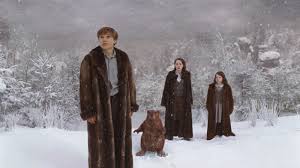
There’s a moment in C.S. Lewis’ novel, The Lion, The Witch, and the Wardrobethat seems to point to this kind of joy. 

You may not particularly remember that when we first see Narnia, the land on the other side of the wardrobe, it is under a witch’s spell. 

The spell is keeping the land in a perpetual, joyless winter which Christmas cannot break through.  

Do you remember the grim joke during the first months of COVID that today’s date was the 97th of March, or what have you? 

That’s more or less what Lewis is imagining as the spell of a perpetual winter.  

But slowly, the witch’s powers begin to weaken, until one day, the characters at the heart of the story hear sleigh bells in the distance—and it turns out that, at last, and for the first time in ages, Father Christmas has been able to come in.  

The moment is described as having a certain surprise.   

“Some of the pictures of Father Christmas in our world make him look only funny and jolly,” the story says. “But now that the children actually stood looking at him they didn’t find it quite like that.  He was so big, and so glad, and so real, that they all became quite still.  They felt very glad, but also solemn…Lucy [she’s one of the children] felt running through her that deep shiver of gladness which you only get if you are being solemn and still.”  

This reminds us of what we sometimes see reflected in the giving of very special gifts: a particular love that shines through the stillness of such moments. 

There’s a lesson in that, too. 

As an anchor point for faithful people, Christmas is trying to talk about God’s love, which arrives for us “so big, and so glad, and so real” that it first evokes that same stillness, and then a “deep shiver of gladness.” 

To look around us, it may not seem that still. 

We celebrate Christmas with tremendous gusto, whether that’s in the form of the glorious mess in the living room, the recitation of the Great Duds of Christmases Past, the biggest tree that could possibly fit in our house, or the loudest sweater we can possibly find to wear for the office party. 

(Someday, I should try to do a sermon about the theology of ugly sweaters.  Come back next year, everybody!) 

Some of you may even have taken part in an informal “Whammageddon!” contest.  

If you don’t know what that is, it’s about trying to avoid the insipid 80s pop song, “Last Christmas,” by the superstar duo, Wham!, whom some of us remember well.  

Anyway, in “Whammageddon,” the last one standing (the last one not hearing the song) is the one who “wins.” 

It’s the “-aggedon” part that interests me – as in Armageddon, from the Book of Revelation. 

It suggests that the Christmas season is an epic battle…a battle that we can only win through some kind of avoidance.  

Certainly, it reminds us of how hard it can be to unplug ourselves from the world’s chatter, even when we really try.  

I’m actually not that gloomy about it. 

I think the real joy, and the real point, is in losing the game. 

Its underlying message is that, like that particular song, Christmas works unrelentingly to find us. 

Whenever and however we manage to get captured are things to be celebrated, and recognized as sources of laughter and community, those two great heralds of God’s kingdom.

God bless the gusto of Christmas – the glorious mess of it.  Even the duds.  

But bless also the stillness of its arrival in our hearts. 

It comes to remind us of how profoundly we’ve been seen, how intimately we are known, and how tenderly we are cared for, not only by those dearest to us, but even more fully by God.

It always takes our breath away and fills our hearts with love. 

Amen.  

Sermon: “Transforming Christmas” (Luke 2:1-14; Isaiah 9:2-7)

candles

It’s always so wonderful to see the sanctuary so blessedly alive as it is on Christmas Eve.

Some people are dedicated, eight o’clock service kind of people, and we expected you, and here you are, and we love that.

Others here are the kind who get everyone motivated and come with a whole pew’s worth of companions, sort of like modern-day shepherds, and of course, we love that, too.

And then some of you are people who managed to slip away from wherever you were and come to church.

At this very moment, back at your house, they still may not even know you’re gone.

We promise we won’t tell.

Sneaky devotion is a much bigger part of the Christian tradition than you’d ever believe, from the catacombs of ancient Rome to the house churches of modern China.

We love knowing that we may be just counter-cultural enough that someone still sees us as a secret to be kept, a people too scandalous to know.

But whether you have been long-planning to come or just find yourself here right now because you were driving by, you’ve come because tonight is the night when we tell the story.

We’ve been building up to it for weeks now—all around the world, we’ve been building up to it.

All around us at this time of year are reminders that Christmas touches us in ways that no other season quite does.

It speaks quite deeply to us to see lights in darkness, and greens indoors, and wreaths with red ribbons on doors—it’s as if the world decided to dress up for the occasion, and to make the kind of effort that is harder and harder to make these days.

We may not do it in other times of the year, but we’ll do it for Christmas.

II.

It’s one of the ways that we show that there is life in us yet—and memory, too.

The memory of Christmases past, maybe, when for so many people, the world seemed to come alive and there was so much celebrating to do—so much cooking and singing and zooming around after this or that.

Is that how you remember it?

So many people will look back and recall that there was just so much that went into it…that you could not help but get caught up in the rhythms of it…that you could not help but be delighted to see so many others you might not otherwise expect get caught up in it, too.

After all, if Ebenezer Scrooge could come around and get into Christmas, how could it be any surprise that others did too: the old lady in the apartment down the hall, who seemed to disapprove of children, making gingerbread men for your family, or a city bus driver, improbably wearing a Santa hat, or your grouchy and impatient great-grandfather, smiling as you brought him egg nog?

That might have been a long time ago, in a world we’ve long-since left.

But almost like veterans, squeezing into an old uniform on the morning of Memorial Day, we remember at Christmas—we remember, and we honor, and we try to be true to the memory of that other, bygone world.

And so, here we are, all these years later.

And if now the blazer has gotten a little snug, or if words were exchanged as you realized you were running a little late—if you discovered that, yet again, your brother-in-law has inattentively blocked in your car—or if your children have come home and were actually telling you about their lives, and in this great moment, out of the corner of your eye, you saw that your husband was discreetly checking his Blackberry and missed the whole thing—well, nevertheless: here we are now.

And may we each, in our way, find some way to connect with those Christmases past, and bring some of their warmth, and their surprise, and their belief in the capacity for deep transformation into our hearts and into our lives, not only tonight, but in the days to come.

Or maybe that’s not how you remember it.

Maybe as you look back, Christmas has always been at the center of a harder season—a time when tensions always used to boil over, or a time when all the things that weren’t right managed to engulf the few that were, and so, even now, even removed from all that, the cheer and the sentimental talk about togetherness gets hard to take.

That’s a Christmas prayer for transformation, too. A prayer to let our pain go, to travel lighter, to find the energy to follow a star rather than stay hunkered down in the darkness.

That’s a different kind prayer for deep transformation. But a prayer just the same.

And I think that has its place at Christmas, too.

III.

Because that’s what the Christmas story is, of course.

It’s a story of deep transformation.

It begins with a world where hope has come to be in short supply and says that God is present in it, and that, therefore, hope should be, too.

It begins with a world where so much is wrong that it seems as if nothing could ever be put right, and says that God insists that, indeed, it can be put right, and if we will but follow Him, it will be put right.

It begins with a world that looks to appearances and to worldly power, and sees them full of selfishness and danger, and says that God is the antithesis of all of that—and yet that it is He who saves and nothing else.

That world, of course, doesn’t sound all that different from our own.

Maybe that gives us pause.

The Christmas story is an old, old story now—and yet it seems as if the world has not particularly changed in its wake, or at least, not as much as predicted.

Last week, I read an editorial that said, “Twenty-five years ago, Christmas was not the burden it is now. There was less haggling and weighing, less quid pro quo, less fatigue of body, less wearing of soul; and most of all, there was less loading up with trash.”

And I thought: RIGHT ON.

And then I looked a little more closely, and realized the editorial was written in 1904.

Our problems are not new.

IV.

And yet, the claim of Christmas is that, even if the problems and shortcomings of the world have not particularly changed, neither has the solution.

The love and presence of God are here for us to claim.

The deep transformation that God offers us, and that God offers the world in Jesus are still before us.

In the eyes of Scripture, Christmas was not simply an event that happened; it was a force that was permanently unleashed.

At the other end of the story, this becomes clear.

After Good Friday and Easter, Luke describes the day of Pentecost, saying: “They were all together, when suddenly there came a sound from heaven like the violent blast of wind, which filled the whole house where they were seated. They saw tongues like flames distributing themselves, one resting on the head of each, and they were all filled with the Holy Spirit…”(Acts 2:1-4).

The story that Luke begins with the sudden pop of the star, appearing in the fields over Bethlehem, announcing the birth of the savior, he continues with sudden wind of the Spirit filling the lungs of God’s people to proclaim and enact the message.

We all know that, at Christmas, Heaven and nature sing; Scripture wants us to understand that they’ve never stopped singing, that at Christmas, something decisive, something permanent came into the world, and it has never left.

A force was permanently unleashed, and that force has never subsided, and while its work is far from finished, its power is beyond anything that human ingenuity could ever control, much less stop in its tracks.

And thank God for that.

V. 

The question for us tonight is, can you and I feel that force?

Veterans of the story that we are, can you and I kneel before the manger…not because we have all the answers…and certainly not because we’re perfect—but precisely because we don’t have all the answers and are still working on being the people we hope to become?

Doesn’t God’s dream for us, and for the world, come alive somehow at Christmas, in ways that we can still feel, that still pull at us—in ways that still push us?

I think it does.

Somehow, in these days, it seems easier to feel how God keeps calling out to us—because the power of the Christmas story still has some sort of claim, some kind of toe-hold on our inmost selves.

So much in our world speaks to our heads, but in our hearts, few of us who gather on a night like this can fully deny that claim.

Because tonight, somehow, we still feel that force—that force, pulsing through this old story, and that force, deeply alive in our hope for a world renewed, redeemed and at finally peace with itself.

Tonight we embody the community of those who live in the light of that story, as surely as the magi lived their lives in the light of that Bethlehem star.

Deep transformation is still possible. For us, for the world—indeed, for every dark corner of the globe and the even darker corners of the human heart, deep transformation and the healing love of God are still possible.

The star still shines, and the wind still blows.

Isaiah puts it this way:

“For unto us a child is born, unto us a son is given: and the government shall be upon his shoulder: and his name shall be called Wonderful, Counselor, The mighty God, the everlasting Father, the Prince of Peace. Of the increase of his government there shall be no end, upon the throne of David, and upon his kingdom, to order it, and to establish it with judgment and with justice from henceforth even for ever” (Isaiah 9:6-7).

And at Christmas, through the grace of God, somehow we know in our bones that it is so.

May we carry the knowledge with us tonight, and all our days.

Merry Christmas, one and all.