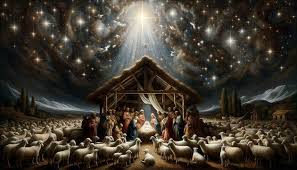
Christmas Eve Sermon: A love beyond predicting (Luke 2)

For a while this month, I was following a discussion on BlueSky by a group of philosophers. 

They were arguing about Christmas movies.  

Now, philosophy may not be your thing. 

Even if it’s not, it probably won’t surprise you to learn that professional philosophers really enjoy arguing.  

So, someone decided to have at it on the subject of Christmas movies.  

And one thing that came up has stayed with me: 

When we call something a “Christmas movie,” are we talking about a movie that happens to occur at Christmas-time, or does Christmas make a difference in a specific way

It’s a good question.  

Predictably, there was much discussion about whether the 80’s action movie, “Die Hard,” should properly be considered a Christmas movie.  

This went on until someone pointed out that “Die Hard” is about a small band of resistance fighters defending a tower against an overwhelming band of corrupt, foreign invaders. 

And when you put it that way, it’s actually a Hannukah movie.  

Make of that what you will. 

Still, if you think about it, a Christmas backdrop doesn’t require much.  

Backdrops rarely do. 

A palm tree, a sporty convertible, and a few people in shades will signal that a story is happening in L.A.

A palm tree, a pastel building, and a guy in shades driving a cigarette boat will signal that a story is happening in Miami. 

New York is all about taxicabs, hotdog stands, and somebody snarling that you should watch where you’re going.  

Similarly, Christmas as a backdrop also has its own shorthand.  

For sure: a string of twinkle lights, a Santa hat, and a ringing bell. 

Often enough: an old red truck driving by with a fresh green tree, someone drinking cocoa, people wearing scarves in an I-don’t-really-mean-it sort of way. 

Any of that and you know: we’re talking about Christmas.  

By contrast, it’s something very different when Christmas is at the heart of the story, acting as the catalyst for someone’s wrestling and change. 

The angel is in the details – the specifics of giving up and claiming; of stumbling, falling and rising up again; of listening to love and not someone else’s expectations – and this because of the language of the carols, the mystery of the candles, the vision of the prayers, the arrival of the child offer someone hope and a way forward.  

There’s a difference between simply existing and truly living.  

When you see it, as Christmas hopes we all will, there really isn’t a shorthand for it.

It’s at Christmas when the church comes closest to saying so outright, because when someone discovers the Christ child for themselves, they always do it in their own way, after their own journey. 

The church knows that there’s no predicting what will prove to be a shelter for any of us, any more than we might say, in theory, what will lift our hearts in gratitude or what we might love so deeply that such love would drop us to our knees. 

Wherever that is and whatever that looks like for us is where we find Christmas for ourselves.  

Who that frees us to become is the start of a new life in God.

That’s why the worst way to tell a Christmas story is to let it be predictable.  

To the church, however it is we get there, each experience of true encounter, reveals something new about God and gives new insight into what life might look like when it is lived as God’s gift. 

This is what we celebrate at Christmas.  

This is what we discover in Jesus.  

One of the great early thinkers of the church, Athanasius of Alexandria, once observed that “God became man so that man might become God.”[1]

But again, this doesn’t mean losing ourselves or getting subsumed by the glory of it all.  

It means that God gets so close to us so that we might – finally – get close to God.  

It means finding our true selves: the person that you and only you could ever be, equipped to do the good that you and only you could ever do, as God intended.  

Christmas says that anything else is less than it should be. 

Now, we may well know a thing about that, too. 

If you think about it, the backdrop for the Bible’s stories of Christmas is all about the weariness of the world.  

There is this pervasive sense of hopelessness about ever getting out from under. 

Under what? 

Unfairness, selfishness, literal and perhaps spiritual poverty, judgment, ignorance: it’s a familiar enough list for us, too.  

But then predictability goes out the window. 

Because it’s in the midst of that weariness that angels come and a star appears, bringing tidings of how the slow and steady grind of life will not have the final word.  

Some go out to meet the new world this opens up. 

So many of Scripture’s own Christmas stories are wrapped up in accounts of various journeys and how they open up new worlds. 

Joseph and Mary and the donkey to Bethlehem.  

The magi meeting on the road, after each had set out from their own corner of world to follow the star.  

The shepherds, who were nomads of a kind, out there on a largely continuous journey with their flocks, who divert to the manger under the direction of the angel.  

Suddenly, something wells up from deep within them that tells them not to settle, not play it safe, not to put limits on what God can do. 

Don’t just exist, it says. 

Truly live.

Whatever that may entail.  

Whatever that may look like as God’s particular gift to you. 

However that might become your contribution to the world.  

And it was kneeling in the manger that it truly dawns on each of them.  

It’s then they understand that God’s love is beyond predicting.  

It’s then they realize that God’s own son has come so that we might live as those who know, and so we might learn to go forth unafraid, in all our glorious complexity.  

Just as it was for them, whenever we realize this now, it is Christmas.   

The child is born, and we are reborn.  

With that in mind, it seems fair to ask what kind of Christmas movie we might be in.  

Tonight, we might ask ourselves just what we’ve been up to for the last few weeks – and maybe even what we’re up to this evening.  

To what extent does Christmas come into how we spend Christmastime? 

The stories themselves attest that God is not content to remain in the backdrop for very long.  

They tell us that God loves us far too eagerly. 

Most of all, they teach us to hope that it may be so.  

Merry Christmas.  


[1] “On the Incarnation” (54:3) 

Christmas as Rescue (Luke 1:39-55)

A few days ago, I read about an urgent exchange on a Reykjavik Facebook page.[1]

It seems that a cygnet – a baby swan – had somehow become frozen to the ice in a local body of water and was dying.  

People were tremendously upset but felt utterly powerless about how to respond. 

Should they risk going out on the ice themselves to rescue the swan, especially if it wasn’t clear how thick the ice was? 

Would the fire department come out for a baby swan? 

What do you use to break up the ice? A hammer and chisel? A rubber mallet? Some sort of saw?  

Did anyone on the thread even have a saw?  

Things went on like this for a while, until finally a naturalist, Kerstin Langenberger, replied, “I am on my way with the necessary equipment.” 

Apparently, by way of equipment, she brought a friend, some thermoses of warm water, and a surfboard, which was there in case the ice broke.  

Then Langenberger slowly thawed and finally freed the cygnet, which promptly flew away, no doubt with a real story to tell the other swans. 

For us, of course, it’s a story about having the right equipment.  

I imagine that, if called upon, anyone on the Reykjavik Facebook page would have been able to lend a thermos and some warm water. 

It’s less obvious to me that somebody in Iceland would have had a surfboard handy.  

But let me not assume. 

You know, I’ll just go ahead ask: if get trapped in the ice somewhere here in town, does anyone have a surfboard they could bring to my rescue? 

In all seriousness, we may or may not have what we need to bring to a rescue.  

We may or may not even know what the right equipment ought to be.  

But most of us know something about feeling trapped, or at least stuck.  

We may not know what it is to be a rescuer, or even rescued (or rescued yet), but we know feelings of the cygnet in the ice. 

We know them all too well.  

And that’s why we hold onto the story of Christmas so dearly, with its deep affirmation of the power and promise of rescue. 

The narratives of Christmas Eve will circle back to the silent night and the fragile baby, practically a cygnet himself, come to join the precarious world with nary a surfboard or thermos in sight.  

But we are to understand that his mother’s peace on Christmas night comes on the other side of knowing.

She had received the angel’s remarkable announcement that this baby – her baby – would be the one bringing rescue…that from then on, nobody would be condemned to be stuck.

She stands on that promise.  

“My soul magnifies the Lord,” she says.  “And my spirit rejoices in God my savior.” (v. 46-47)

“He has shown strength with his arm; he has scattered the proud in the imagination of their hearts,” or, as the Revised English Bible puts it, “he has routed the proud and all their schemes.” v. 51)

She’s putting the schemers on notice, and “scheme-ees” too: help is on the way.  

It’s a message that, for its part, “Rudolph the Red Nosed Reindeer” gets right in its depiction of Christmas Eve, which is all about rescue.  

In particular, you’ll remember right at the end, when in the face of the storm, all the misfit toys living in exile on that island are gathered around another lonely campfire, figuring that Christmas has come, and that once again, they’ve been forgotten.  

And then, quietly in the night sky, they hear the approaching sleighbells, and they realize that their dark night is finally over, that the ice has melted, and that they will love and be loved the way they’d always longed to do.  

Can Christmas really do that? 

It can.

It can if we take its point about remembering the forgotten, or about making room at the table—especially when there seems to be no room at the inn. 

It can if we measure strength in terms of the deep roots that keep us anchored rather than the strong arms that state their business only by swinging. 

It can if we are slow to hate and quick to seek understanding and to work toward settling our differences.  

It can if we are willing to be rescued from all those who would tell us to wise up, hunker down, and cash in unless we want to go out on a limb and find ourselves straight out of luck.  

Christmas reminds us that the world does not have to be the way it still too often is.  

We don’t need to be trapped.  

There is a different way to live, and a different teacher for us to follow—a teacher who speaks with authority from the heart of life itself.  

Each year, in these weeks before Christmas, it seems like something really is thawing our spirits, warming our own hearts, freeing us from the ice in all its forms that nearly manages to freeze the life right out of us. 

But just at the moment when it seems like we might finally succumb, the word goes out, and help is on the way.  

Slowly, the cygnet feels itself unlock and raises its wings to attempt the sky. 

God has lifted up the lowly and has filled the hungry with good things.  

And we remember what it is to soar. 

Amen.  


[1] My own source for this story is the tremendous preacher Marci Auld Glass, who reposted it on her Facebook page.  

Christmas as Joy (Philippians 4: 4-7)

I don’t know who came up with the idea of taking a new liquid dish soap for the kitchen and calling it “Joy,” but I bet they’re someone with a real sense of humor.  

Either that, or they’re someone with very strange ideas about housekeeping.  

As someone once said, “The problem with life is that it’s so daily.”

In that regard, housekeeping is about as ‘daily’ as it gets.  

And yet, some do find joy – a deep, if surprising delight – in its rhythms.  

(At least, so they tell me.)  

The composer Ludwig Von Beethoven had something to say about joy, too, putting a famous poem of his time to music which then found its way into hymn form as the “Ode to Joy.” 

We still sing it.  

If you look at the lyrics closely, it’s not entirely clear if joy leads us to God or if God leads us to joy, but maybe that’s just me being picky.  

Surely the point is that God and joy can tell us a lot about each other.  

And when the hymn says, “hearts unfold like flowers before Thee, opening to the sun above,” we’re back on the power of delight again, and how its rhythms seem to loosen something in us…to open and unfold us in some way. 

That’s why it makes sense to speak of “joy” at Christmas.  

Christmas can feel like our best shot at opening and unfolding after being all wrapped up in ourselves for way too long.  

It’s like the moment on a plane when the captain turns off the seatbelt sign for good, and you finally get to stand up and uncramp yourself, knowing that you’ve arrived at last.  

Can we learn to live that way for good?  

Christmas seems to think we just might.  

That said, the Church has always tried to maintain a distinction between happiness, which we might find in many ways throughout our lives, as opposed to joy, which it understands as more connected to God. 

The Church understands joy as more of a gift.

For that matter, it would go on to name joy as one of those gifts that is beyond our power to make happen, whether for someone else or even simply for ourselves.  

Some argue that, unlike moments of happiness, stories of joy, in fact, begin as just the opposite of where they finally land. 

They emerge out of “disunion, rupture, lack, and suffering.”[1]

And yet somehow, they end in “union, plenitude, and harmony.”  

To a religiously minded person, wherever the shift occurs is where you should look to see the hand of God.  

If you think about it, the story of the first Christmas is just such a story.  

Each person who gathers around the manger is a person already or soon to be under threat, or at least suspicion, and each of them except for the baby knows this all too well.  

Yet when the angel summons them to give up whatever safety they had previously known, and to come and see the beginning of this new thing that God was determined to do, they go for it.  

That’s about joy.  

And yet, if that’s true, then maybe there’s a difference between happy people and joyful people.  

A happy person may be someone who is temperamentally “bright-sided,” and that’s great. 

It’s wonderful that they are.  What a blessing for them and for those with whom they come in contact.  

But if that’s true, then a joyful person must be a little different. 

A joyful person is someone who’s seen some stuff. 

They’re the people who have been out there alone in the rough country, who have driven along some bad road, and run on fumes or even run out of those, too, and found themselves lost. 

They know the other side.  

And because they do…because they have an old life…they don’t take the rhythms of a new one for granted.  

Because the air smells different, and the light looks different to someone who’s been holed up a long time for whatever reason. 

And there are some silences that really are golden when your world has been full of sheer noise for too long.  

You feel a kind of freedom and appreciation that other people can’t quite grasp.  

That’s joy.  

And if so, then maybe joy points to something that is actually tougher and more durable than what we usually think of as happiness.  

Joyful people understand the wonder of the gift they have received and can point to the giver.  

A little while ago, we heard the words of the Apostle Paul to his beloved friends in Philippi.  

“Rejoice in the Lord always,” he writes. But to underline his point, he continues, “Again, I will say, Rejoice.” 

“Let your gentleness be known to everyone. The Lord is near.  Do not be anxious about anything, but in everything by prayer and supplication with thanksgiving let your requests be made known to God.” 

“And the peace of God, which passes all understanding, will guard your hearts and minds in Christ Jesus.”  (Philippians 4:4-7)

His words are beautiful, of course. 

Paul cares about joy because he knows its power to sustain survivors, even if life turns hard again in new and unexpected ways. 

Joy makes and keeps them free in a way that others just can’t quite seem to muster.  

Part of me wonders, though, if he’s telling his friends something that they, as joyful people, already know.  

Paul wants them to make sure they don’t forget, but there’s no danger of that, because there’s no way they’d ever take it for granted.  

By its very nature, joy knows better than that. 

So, I’m always hoping for a happy Christmas and most years, I manage to have a pretty merry Christmas.  

If I do say so myself, I am a pretty merry person. 

But this year, I’m leaving a light on for joy. 

I’m looking for those things that remind me of lives that go from being scattered to gathered, broken to mending, darkness to light.  

And I’m keeping an eye out for God’s hand in those shifts. 

Christmas is about how eager God is to see our hearts unfold, our minds open, and our lives become a triumph song. 

It is God’s eternal call to become people of joy. 

Amen.  


[1] This is from Adam Potkay’s terrific book, The Story of Joy: From The Bible to Late Romanticism.  The quotation is found in the equally terrific book by Angela Wlliams Gorrell, The Gravity of Joy: A Story of Being Lost and Found, 189.  

Sermon: Christmas as Soul (Philippians 1:9-11)

You may have seen that the Cathedral of Notre Dame in Paris is reopening this week, five years after that terrible fire that destroyed so much of it.  

With all the loss, it would be easy to overlook the profound relief and gratitude for what remained.  

The fire burned for nine hours, yet the relics, the walls, the stained glass windows, and the organ all survived, and there were no fatalities. 

In the days after the fire, there was no shortage of ideas for how the reconstruction might offer a chance not only to save Notre Dame, but even improve it.  

For example, one person proposed a swimming pool on the roof.  

They didn’t end up going in that direction, of course.

If that idea had gotten any traction, I’m sure that the Archbishop of Paris would have had a few thoughts about it.  

Still, it is sort of true that Notre Dame doesn’t simply belong to the church alone. Not really.  

It might be in a somewhat different way, but the Cathedral also belongs to France itself, and even the world.  

If there is any lesson to be learned from the fire, it’s that people, religious or not, love Notre Dame. 

They seek and find something there that may be deeper than words. 

On Friday, the New York Times quoted Phillipe Joel, head of the restoration task force, who said, “Each day we have twenty difficulties.  But it’s different when you work on a building that has a soul.  Beauty makes everything easier.”[1]

So many would agree.  

And I hope I’m not being picky in saying that it’s not the beauty that reveals the soul so much as it’s the soul that reveals the beauty.  

I’m going with soul on this.  

When the reporter asked another worker on what the job had meant to her, “she struggled for words, then started to weep.” 

To me, that’s about soul. 

Let me tell you a little more about the building, and you can tell me if you agree.

Because if you’re rebuilding the cathedral and time is of the essence (money, too), why bother replacing the oak roof beams with each new one specifically chosen to match the one it was replacing, much less then carving it by hand to match the original silhouette, much less putting the original medieval carpenter’s mark back on it? 

And all this, for a part of the building that for the next 800 years, only people working on the roof will ever even see? 

What is that? 

Why bother getting things right rather than simply getting them done? 

It’s not just beauty.  

It’s soul.  

It’s feeling yourself in the presence of something that always was and is and ever will be.  

It’s what the opening words of John’s Gospel mean when it says, “In the beginning was the Word, and the word was with God, and the Word was God.  He was in the beginning with God, and all things were made through him, and without him was not anything made that was made.  In him was life, and the life was the light of men.  The light shines in darkness, and the darkness has not overcome it.” (John 1:1-5)

The wording has thrown everybody for ages, and to some extent, it’s slippery on purpose, but at the very least, what John means is that in Jesus, we encounter the promise and the presence of eternity. 

For John, this is something (he calls it the Word) that was present at Creation and that has been in every act of making ever since, from great cathedrals and newborn creatures to a turkey someone draws for you by tracing their hand on a piece of construction paper.  

For John, God didn’t just make a world and leave it at that.  

God gave the world a soul – something in it that points back…that looks up…that sees beyond.  

The soul is what knows the initials of the original craftsman, carved into the beams that hold up the universe.  

That’s what the disciples knew in Jesus, and not only because Jesus told them about it, but because they saw that soul in him. 

Then somewhat more gradually and partially, through his presence and with his help, they saw it in themselves.  

So much of the wonder of Christmas is that it helps us to see the soul of the world and the souls of one another now for ourselves.  

It may still be gradual and remain all too partial.  

But that’s what we’re looking for, and it’s what is so particularly on offer. 

Christmas is here to tell us that the soul is there to be found. 

Admittedly, Paul’s affectionate words to the church at Philippi were not specific to Christmas, but they come from the same spirit. 

“This is my prayer,” he writes, “that your love may overflow more and more with knowledge and full insight to help you determine what really matters, so that in the day of Christ you may be pure and blameless, having produced the harvest of righteousness that comes through Jesus Christ for the glory and praise of God” (Philippians 1:9-11)

These are the days when we collectively seem to reach for what really matters. 

At our best, we seek the knowledge and full insight we need to figure out what that might be.  

Let’s not make that sound too easy, of course. 

As we know, each day may present twenty different difficulties which demand our immediate attention: dressing a toddler, taking a meeting (or the umpteenth zoom), refilling the pill organizer for the coming week, keeping abreast of the news. 

Still, as the man said, the beauty that surrounds us makes everything easier.  

It points to what we’re really after, the people we really are, and most of all, to a love greater than any cathedral that will not let us go. 

Amen.  


[1] https://www.nytimes.com/2024/12/05/style/pantone-color-mocha-mousse-2025.html?searchResultPosition=1

Sermon: Christmas as Close Encounter (Luke 21; Jeremiah 33)

Have you started receiving Christmas cards yet? 

We got the first ones yesterday, unless you count that tire shop in Riverside.  We got theirs just after Halloween.  

If you haven’t gotten many quite yet, you may yet be in store for one of this year’s most surprising Christmas card themes.  

I noticed it when I was shopping for our family Christmas card.  

Suddenly, it seems, there are all these Christmas cards with UFOs in them. 

Don’t believe me?  

Oh good—because I brought examples.  

So, these two are sort of classic, and have the virtue of being mirror images of one another.  

In the one, Santa’s sleigh is a UFO pulled by reindeer. 

In the other, the sleigh is being pulled by a line of UFOs.  

But we’re not done, friends.  Not at all.  

Well, the obvious theme is “beaming up”…though the message seems not so cheery, somehow.  

Fortunately, Santa is on the case…or, well, maybe he isn’t. 

(Is Santa running here?) 

Some seem to imagine that the encounter could be a good thing.  

Maybe it’s just a variation on what Christmas has always been about.  

That’s sort of how it looks here: 

(I think the one on the bottom might be an album cover from the 70s.) 

And here: 

But in the end, maybe the one that sums it up best is this one: 

What do you think? 

Is anybody rushing out to go order one of these before they’re all gone?  

Clearly, if there are so many variations to choose from, this whole concept must be having a moment. 

Still, I’ve been trying to put my finger on just what the moment might be.  

Maybe for a certain kind of ruthless skeptic, there is amusement to be found in a mash up of seemingly outlandish stories.

Alternatively, it may be that the traditional pastoral, northern European imagery of flying reindeer no longer much speaks to us.

By contrast, space fantasy does.  

Those prepared to admit that “Star Wars” is fundamentally a old-style western that just happens to be set in a galaxy far, far away have been saying this, more or less, for years.  

Besides, how would Santa challenge the laws of physics as we know them? 

Ask the aliens – surely, they’ll know.  

Yet at a more basic level, it seems to me that these cards are trying to say something about encounter – close encounter, if you like, but nevertheless: encounter. 

Because what is it, after all, to have something utterly beyond us appear out of nowhere?  

Does the appearance of something that changes everything represent destruction or salvation…or strangely, maybe both at the same time? 

What is it to see with your very eyes that we are not alone…that we have never been alone, and will now forever know that we are not alone? 

And if we don’t know how to answer any of those questions, maybe we should ask someone.

In fact, the Bible has some suggestions for whom we might approach with questions such as these. 

It might point us to Mary, Jesus’ mother, or the shepherds, Mary Magdalene or the disciples on the road to Emmaus, or Paul out there on the road to Damascus.  

Any of them might know.  

Because isn’t the strangeness, but also the certainty of encounter precisely what they have come to understand? 

Whether it’s Christmas or whether it’s Easter or whether it’s some other time entirely, the story the houses of worship keep telling and retelling is this story of encounter.  

It’s a story that runs up against our expectations and our faith in the world as we know it.  

Somehow, it always seems to reemerge just when we shake our heads with exhaustion. 

We all know those moments when it seems like there is nothing new under the sun, whether we’re speaking about the world or, more specifically, about ourselves.  

There are times when we start feeling boxed in, especially by life and its tough choices or, on a grander scale, by fate and its stern decrees. 

But are we really prepared to live differently? 

Christmas is here to press that question.  

Because you can’t encounter God and bumble along, entirely the same as before.  

When Nicholas of Myra, whom we know as St. Nicholas, was walking the nighttime streets of his hometown in 4th century Turkey, he heard a poor man praying through an open window that he would not have to sell his children to pay off his debts.  

Nicholas took it upon himself to answer that prayer by throwing a small purse with gold coins through the window, where it landed in a shoe.  

This was the origin of gift-giving at Christmas. 

Its point was not affection, but liberation. 

It was a moment of encounter between total hopelessness and new life, not just courtesy of Nicholas (though he was part of it), but through the power of the living God.  

The fruits of the spirit that emerge from a life in God remind us of the source from which all good gifts must spring. 

This is wonderful, and when it happens, maybe even a little weird.  

This is what Christmas is trying to say.

If you ask me, it might not be so different to wake up and find gold in your shoes, or a baby in a manger, than it would be to look up and see a spaceship the size of Manhattan hovering in the sky.  

The point is: you can’t go on the way you did before.  

And it strikes me as entirely correct to begin the Christmas season by reaffirming that in every way possible.  

This morning’s Scripture readings are driving toward this same conclusion.  

Luke’s Gospel comes, not from the beginning of his account, but actually from the end, looking to Good Friday. 

Jesus talks frankly about disruption and confusion—even a dark hour to come just before God’s new dawn.  

“Be alert,” he warns, “praying that you may have the strength to escape all these things that will take place, and to stand before the Son of Man.” (Luke 21:36)

By contrast, the Old Testament prophet Jeremiah offers more hopeful words from God:  

“The days are surely coming, says the Lord, when I will fulfill the promise I made to the house of Israel and the house of Judah.  In those days and at that time I will cause a righteous branch to spring up for David…and in those days Judah will be saved, and Jerusalem will live in safety. (Jeremiah 33: 14, 16)

The Gospel presents a kind of agony in waiting for deliverance, anticipating a moment when everything would seem in doubt, even for those who followed Jesus. 

The earlier words from the prophet were more confident, even though they came very much in the midst of agony, at the moment when God’s ultimate deliverance might have seemed most improbable of all. 

But both of them are quite sure that things as they were would not…could not…continue in the same old way. 

Strange as it may sound, they saw this ultimately as a source for hope. 

Because for those who were (who are) willing to live differently, it was (it is) just the beginning.  

So it’s right to hold onto the weirdness of Christmas and to embrace the joy it finds in Godly disruption.  

However we can recapture the enormity of its claims is good, because this may be the only way we can reclaim the something of the enormity of the God we know in Jesus – the impossible grandeur God places, paradoxically, in a tiny baby. 

Christmas is when we remember God’s promise that the world would never be the same again.  

And it’s when we recommit ourselves to making sure it won’t be, starting with ourselves. 

Amen.  

Sermon: Thanksgiving and the Ties that Bind (Mark 3:31-35)

This morning, I want to begin with a confession. 

It’s about Thanksgiving.  

Thanksgiving is probably my favorite holiday.  (That’s not the confession.) 

But there’s one thing I can’t stand about it. 

That thing is cranberry sauce.  

There.  I’ve said it. 

Since I’m confessing, I will also confess that I can’t stand mint jelly on lamb.  

This will be the subject of my 2025 Easter sermon. 

But really, it’s cranberry sauce that I don’t like. 

I like cranberries; I like sauce.  But not the combo. 

I tell you this because it was something that I hid from my family for years.  

You see, my family is one of those families where you don’t just load your plate.  

The person at the head of the table, my dad, serves you. 

Each plate gets passed down.  

And each person, each link in the chain, looks down and kind of feels free to comment on your choices.  

“Wow…that’s a lot of mashed potatoes.” 

“Wait, since when do you like dark meat?”

“You know, I don’t observe a lot of color on this plate.” (That’s my mom.)

The year my cousin Penny came from California and shared that she was vegetarian was something we discussed and adjudicated among ourselves for the next decade. 

The fact that, at some point, my cousin was no longer vegetarian did not moot anything, at least for my grandmother. 

In fact, this coming Thursday, it would not surprise me if the topic came up yet again, even though both my grandmother and my cousin are now gone.  

That being the case, you can see why, even early on, I always made sure to get cranberry sauce, at least a little, on my plate. 

I knew they suspected.  

My grandmother always inspected the plates back in the kitchen before my mom tackled them.  

She would have seen that little schmear untouched. 

But plausible deniability can be an important part of living in families.  

I rode it as best I could, and I rode it for as long as I could.  

Families are so powerful, aren’t they? 

Their ways of marking love and belonging, rewarding loyalty, identifying disappointment, nursing heartbreak, what they’re determined to hold onto and what they’re ultimately able to let go —these all shape us in their way.  

Each one is a community of memory at its most hyper-local. 

At best, the strength of those memories keeps us grounded. 

At worst, it keeps us tethered.  

That grounding and tethering are not always easy to sort out.  

This was a truth that even Jesus knew.  

In our gospel this morning, we’re returning to a story that I may well have preached on earlier this year.  

It is Mark’s account of an early moment in Jesus’ ministry, as he is first beginning to attract real crowds but has not ventured too far afield from his own hometown.  

He is preaching in a house, and the place is full. 

In fact, it’s so full that the crowd has spilled out well into the front yard.  

The disciples have had to give up their own seats. 

They’re outside, doing their best to shush people and keep them from walking all over the flowers—but truth be told, the whole scene is a little chaotic.  

Nobody is quite prepared for the impact that Jesus’ words and his growing reputation already seem to be having. 

And it turns out, the ones who are least prepared for this impact are Jesus’ own family.  

The story doesn’t say so explicitly, but it seems likely that they think he’s in desperate need of help, even a danger to himself and others.  

They come to collect him…to get him back home to Nazareth.

They floor it all the way there to stop this flood of preaching and so-called healing they’ve been hearing about.  

They come out of love.

For all the best reasons, they are trying to do the very thing that the many nay-sayers standing there will ultimately do out of spite: to shut Jesus up.  

But there is no “plausible deniability” for Jesus on this. 

And so, when the disciples pass the word down the chain from the front yard to the living room, like people passing the Thanksgiving plates down an enormous table, Jesus makes a stand.  

Mark writes, “A crowd was sitting around Jesus when word was brought that his mother and brothers were outside asking for him. 

‘Who are my mother and brothers?’ he replies. 

And looking round at those who were sitting in the circle about him, he said, ‘Here are my mother and my brothers. Whoever does the will of God is my brother and sister and mother.’” (Mark 3:31-35)

It’s not a confession.  

It’s not even a declaration of independence, although in some ways it may sound like one. 

We know from Scripture that his mother stays close throughout his ministry straight through Good Friday and Easter, and that his brother James, in particular, would go on to become an early leader of the church after Jesus’ death.  

It’s important to note that this story isn’t marking a moment when he cuts ties with them. 

He doesn’t do that.  

But he’s declaring that he doesn’t belong to them in quite the same way as he did before, because now he knows that first and foremost, he belongs to God…and not for nothing, so do they.  So do we all. 

This will have some consequences for him, and also for them. 

In the short term, it means that his days in the family carpenter’s shop are over.  

More to the point, he is inviting them to give up a way of love that is hyper-local and exclusive for something more expansive, more generous, and infinitely more surprising.  

This isn’t so easy. 

As we know for ourselves, it can be hard for our families when we give up their customs and their loves.  

It can be even harder when we seek release from some of their worst impulses and downright prejudices. 

Loving without lecturing doesn’t always come easily, especially as we are trying to find our own way and doing our best to live as those who are grounded but not tethered. 

Jesus is blessed, indeed, that this seems not to have been so difficult for him. 

So many of those he loves take him up on the invitation to live differently.  

But as we do, we are gathered into a new family—a family not only of common ancestry, but truly of the heart. 

It’s a family that does not shrink by slow attrition, but which is forever expanding, always making new things possible, reminding us how to love one another again and again.  

Rather than binding us, it gives us wings. 

All other loves are, well, relative. 

As we meet one another once again around the table at Thanksgiving, may love prompt us to be patient and generous, but also unafraid to be ourselves.

And may we always know the presence of Jesus there in the midst of us, calling us to the heart’s true home in him. 

Amen.   

Sermon: Out of our silos (Luke 7:1-9)

A long time ago, I attended a church that had one genuine celebrity in it.  

She was an English actress, based mostly in New York, who had a weekend home in the area—a home that became a real refuge for her during what became an extremely salacious, painful, and public divorce.  

Our small town was far from perfect, and like many small places, it ran on gossip the way an airplane runs on jet fuel. 

But when it came down to it, even we were no match for the relentless gaze of the New York Post, and the actress slowly found a lot of healing by being among us.  

And church was very much a part of this.  

She was a faithful person for sure.  

But in her case, church (specifically) and our town (generally) allowed her to be something she didn’t get to be very often, anymore—it was a place where she just got to be a person.  

One among many.  Unremarkable.  

If you were a kid, she was just another mom-aged person who was blocking the cookie table at Coffee Hour.  

And she could not have been more grateful for or in need of just that very thing.  

What a gift it was to be able to be just a person. 

It’s funny because in that same church at that same time was another woman, the unofficial soloist of the church choir.  

If you’re not familiar with small churches in small places, you may not quite have a picture in mind.  

If you know that kind of church, then you probably just had a picture, maybe even from your distant past, snap into your mental Viewmaster.  

Small choirs in small places can be like karaoke at the office Christmas party—there are a few people who are very enthusiastic, but only one or two who can really carry a tune.  

And carry it, they do, indeed. 

This woman was that person for this choir.  

It was incredibly important to her.  

The rest of her week was fairly quiet, even by local standards. 

This meant that, for her, the gift of church was that it was a place to shine.  Theplace.  

I don’t mean it in any selfish way.  

I know this because the church brought out, not her inner diva, but the better angel of her nature.  

For one hour a week, anyway, she radiated joy. 

Now, if this was a Hallmark movie, the next story would be about the duet on Christmas Eve with the famous actress and the small-town soloist. 

Maybe you’ve seen that clip from a few years ago with Kristen Chenoweth and that voice teacher who gets called out of the audience, doing a duet at the Hollywood Bowl?  

I’m sorry to report that, as far as I know, a duet with the actress and the church soloist never happened.

The real point, of course, is that it didn’t need to. 

The point is that they needed different gifts. 

And the point is that somehow, in the endless creativity of God’s abounding love, the church was where each of them received what they needed most. 

Actually, that’s the thing that’s worth remembering.   

Truth be told, I wish more people knew how often that happens, not only in that church, but in any church – and certainly, also in this one.

While we’re at it, I wish more churches remembered how often that actually happens…(and if I may say it with love) including this one.  

It seems to me that it’s so important to remember, especially now, when time and space to gather can be so hard to come by. 

Our world seems so intent on putting us and keeping us in silos that only let us live into one small part of who we are—silos that let us learn only some small portion of what we’d like to know.  

There is so much that seems to be conspiring to keep us strangers, unwilling and unable to see one another’s point of view, eager to have us faithful in rejecting what one another have to say, if we even get together long enough to hear it.  

This is more costly than we know.  

It forgets that some of God’s blessings can only come into being through the work we can only accomplish when we do it together.

It’s a conspiracy that denies the power of God to give us exactly what we need through the miracle of one another, and maybe even work through our very differences.  

We see a moment of that in this morning’s gospel, which comes from Luke. 

It’s the story of a Roman centurion, clearly long-stationed in Capernaum, with some remarkable consequences. 

Because while he’s a centurion, he’s no longer exactly Rome’s man.  

Rome was all about keeping people divided and afraid of one another. 

Rome was all about silos and whatever it took to enforce them.  

Ironically, this man, the centurion would have been one of their enforcers – two of their boots on the ground, as it were. 

But in the endless creativity of God’s abounding love, something has happened to this man. 

Do you think he just showed up at the old synagogue one day? 

They’re all there, at prayer, and suddenly at the door, there’s this 7 foot tall Roman officer, with his bronze helmet and armor and his cape and cudgel…and the room goes completely silent, waiting for him to step forward to arrest someone. 

But he doesn’t.  

Instead, he takes off the helmet and sits in one of the pews in the way back, and he listens as the service picks up again, uncertain at first but slowly getting back into its rhythm.  

And the next sabbath, he’s back.  And the sabbath after that.  

It’s all very careful—and they give him space, and he never pulls rank.

And over time, it becomes clear that it’s here, in the synagogue of all places, that this man just gets to be another person. 

In fact, the gift of this is so precious, that he decides that he’s going to be a blessing to these people – even to the point of building them a new synagogue out of his own pocket, and even though he’s still just sitting in the back, all by himself, a fish out of water, evolving in front of their eyes.   

And so, sometime after that, when his servant is sick, and he asks for Jesus’ help—Jesus’ healing—these are the people who vouch for him. 

Because to them, he’s not just a person.  

He’s a shining light.  

The better angel of his nature has inspired their better angels into trying to bless him back. 

But the real blessing comes from each one of them doing what only each could do, refusing the world’s silos, making space for God’s abundance through the miracle of one another, and building something they can only create together.  

It seems to me that we find ourselves in a similar moment, and that once again, God is calling us to a similar project. 

 Our neighbors need many things.  

If we’re honest, we come with plenty of needs, ourselves. 

Yet in the miracle of God’s abounding love, we all gather to receive and to be transformed in receiving.  

May our eyes be opened, and may we recognize him, especially as strangers become partners, enemies become friends, light shines forth in darkness, and each of us finally gets to be who it is we really are. 

Amen.

From the Newsletter: Making Room for Sainthood

Congregationalism understands “saints” differently than, say, Catholics, Orthodox, and some other Christians do.

In our tradition, when we use the term at all, we look to how the Apostle Paul introduced it in his letters. Following his lead (as we understand it), we see saints in two particular ways: first, not as a way of talking about “super-Christians,” but rather about ordinary folks whose lives have been transformed by God’s extraordinary love; second, we always speak of saints in the plural, collective sense, and not as individuals.

(We also eye with suspicion any notion of praying “to” anything other than God…which is a theological misread that justified a ton of Protestant sanctimony and anti-Catholic bigotry…but that’s a story for a different newsletter.)

Yet, according to us (or, if you prefer, according to Paul as we read him), saints are who we are together, as our church community is genuinely moved to live in the light of God.

Knowing ourselves as well as we do, maybe it’s no wonder that we use the term sparingly, if at all — we’re all too aware of our limitations and hostilities to hazard any claim to sainthood, whatever the definition might be.

For some, saints represent an ideal that can only collapse under the reality of human shortcomings.

But we forget that saints, even by traditional ways of reckoning, don’t need to be perfect (if “perfection” even means never having a grouchy word, or a dark or an impure thought). Certainly, communities can’t claim to be perfect in that way, try as we might.

That misses the point.

Because far from being undone by the reality of imperfection, sainthood is an affirmation of the counter-reality of good.

It names the remarkable fact that, in a world that can be so dark and broken, there are, nevertheless, lives and communities where the light still shines through.

It reminds us that we do not need to be perfect to be kind or for God to use us.

More controversially, perhaps, it goes so far as to suggest that wherever the legacy of the divine presence is remembered and shared, it still offers strength and guidance—God uses it and is present through it once again.

As someone who has never given much thought to saints, I still find that to be true. I find myself remembering people and places where, however improbably, I found light by which to see.

All Saints’ Day reminds me to make sure I find ways to keep passing it on.

I hope you will, too.

See you in church….

Sermon: Halloween and Holiness

A couple of weeks ago, I needed a haircut, and the place I ended up going was next to Sophia’s, the Greenwich community’s costume shop. 

I know from the pictures of the church’s 300th anniversary that some of you have been to Sophia’s. 

If you haven’t, and if you’re in the market for, say, a Victorian-style hoop skirt, it is the place to go. 

Anyway, as I walked by Sophia’s en route to my haircut, there in the window was a mannequin. 

It was dressed in an elaborate gray silk suit with knee breeches, a vest, and a long coat – the kind of attire I think of people wearing in France just before the Revolution. 

It even had a powdered wig.  

It seemed quite authentic.  

You could just imagine Marie Antoinette standing in Versailles, asking this person why all the people in the city without bread didn’t just eat cake.  

The suit was really nice – and you know, if I were 6’4” and 150 pounds, it would be right at the top of my list. 

But it also got me thinking. 

I feel like most of the people I know are so busy right now, it’s hard to imagine them going to a costume party where your costume “game” has to be at that level.  

To be honest, I can’t remember the last time someone told me they went to a costume party, at all.  Even a more basic one.  

Are regular costume parties a feature of your lives that nobody’s telling me about?

What’s harder to admit, of course, is that, even without parties, our daily lives have a certain amount of costume to them.  

Sociologists have long argued that, actually, it goes way beyond that, if you think about it.  

They’d say that, in some ways, we’re all playing characters…that we are assuming the role of ourselves in whatever scenes we happen to wander into, or perhaps create by our arriving.  

This is what makes Halloween so interesting.  

Because it’s the day when our young people have the freedom to think about what side of themselves they want to put on display.  

It’s the day when they script something different for their arrivals and can notice and appreciate the difference between that and the everyday.  

I don’t think you can really enter into it without claiming and proclaiming something you know is inside you. 

Especially for the young, the power of both their dreams and their fears, the shape of their heroes and their villains is on full display.  

If you wanted to, you could even call it “apocalyptic,” in a way – going back to the original meaning of the word “apocalypse,” which does not point to destruction, but actually, to revelation – to a moment when hidden things will be finally uncovered and the truth will reign.  

Satan is the one described by tradition as the “father of lies.”  

The Christian view is that the truth is never something to be afraid of.  

To tell the truth is to stand in the very presence of God, which we know because God makes such a point of using truth to bring healing and liberation. 

As Jesus said to his home synagogue at Nazareth, “The Lord has sent me to proclaim release for the captives, and recovering of sight to the blind, to set at liberty those who are oppressed” (Luke 4:18).  

And whatever our captivity, whatever our blindness, whatever our oppression, the church has known the presence of Jesus and the power of truth wherever the shackles finally fall.  

Apocalypse – revelation – is happening. 

And yet, if you went to Sophia’s Costume Shop and watched one of our neighbors pick out the right costume, I wonder if that’s what you’d see.  

Children find a joy in getting ready for Halloween, in facing their fears or presenting their ideals.  

Often, we don’t enjoy it all that much.  

For us, the trick with finding the right costume is making sure that it doesn’tsurprise anyone or put anything new out there – that whatever it is remains solidly “on brand” for us and keeps our secrets safe with us.  

We’re determined to manage our own revelations, thank you, even when it means muting much of our truth. 

Except that, on Halloween, we are invited to image what it might look like if we didn’t.  

In this respect, Halloween might accomplish more in one night than many churches do in the course of 52 Sundays.  

Because on Halloween, we’re willing to accept the gift of release and the joy of truth which the church faithfully and forever proclaims, but which we may hear only dimly.  

It says two things: first, that lurking beneath our saintly demeanor is a sinner squarely in need of redemption; second, and by contrast, it says that even a monster might yet be a hero, and is, first, foremost and forever, a creature that God loves. 

Halloween leaves us to consider which of those might be the word we most need to hear on any given day.  

Maybe it also makes us think more carefully about the roles we play and the subtle forms of costume we put on to play them, all the better to convince whatever audiences we’re most hoping will believe our performance (so often, an audience of one).

It is a great sadness to me that in some Christian circles, there can be so much focus on the pagan roots of Halloween, and so little recognition of its faith in the power of the truth to make us free. 

As I see it, the Christian thing is to champion and cherish that truth whenever we see it, and all the more so when the speaker and their truth are tender. 

That is not celebrating the darkness.  It’s letting in the light.  

And right now the world stands in dire need of more light, not to mention the truth which is its fundamental source. 

But that’s a sermon for another time. 

For this morning, may we find in God’s presence the courage to be ourselves, and in God’s love, the understanding of how fearfully and wonderfully each one of us is made. 

And may we learn to live in such a way that no matter what our costume may be, the joy of our truth and the truth our joy will always shine through. 

Amen.  

From the Newsletter: Hurricanes and Our Humanity

I’m writing as another hurricane, this one seemingly even larger and graver than Helene, approaches the coast of Florida.

Pat Knight was able to reach the Akels last night and can confirm that they are well away from any potential harm. We will keep reaching out to other beloved members and former members to check on them (and of course, please do pass along any contact you might make with them in the meantime).

But it is hard to watch and wait.

You may have seen the widely replayed clip of South Florida weatherman, John Morales, choking up on air as he described how quickly Hurricane Milton has gained strength. “I apologize,” he finally said. “This is just horrific.”

Maybe it’s only such a reaction (from people who know what they’re looking at far better than the rest of us do) that can truly underscore the seriousness of the situation to those intent on riding it out, as usual.

For many, all the Doppler radar images in the world can’t communicate nearly as well as one momentary sob from a seasoned pro who is not especially prone to emotion, and certainly not on air.

If that’s what breaks through the dangerous self-confidence and bravado of a last few stragglers, I’m all for it.

I’m also enough of a Yankee to know that dry eyes and a steady voice, even when under duress, should not be mistaken for a lack of strong feelings.

Most of the people I grew up with conveyed more through a quiet handshake than any well-intentioned bear-hugger could ever hope to show.

The display could be subtle, but much like the momentary emotion of John Morales the weatherman, what came through was the humanity.

And the humanity could bowl you over.

It could make you feel more seen than you knew what to make of–more seen (or differently) than maybe you were generally inclined to see yourself.

There was such love in it — from those who felt love was something to be demonstrated without ceremony rather than merely spoken. All too often, as they saw it, speech could prove to be a performance without much by way of follow through.

They were forever on the side of follow through and watched anything resembling bravado through narrowed eyes.

Our current moment is a more vocal one, by and large. (I’ll never concede that it is actually more expressive.)

But I know that, however we act out of the depth of feeling that we have for one another, we bring healing and repair. Whenever we show one another that we see each other, particularly in distress, we respond to storms of all kinds with calm and quiet light.

There is such hope in that.

As our neighbors and friends in Florida wait with worry for the storm about to make landfall, may they feel the strength of our love and loyalty, knowing we will be there for them, remembering that God is forever with all his children and hope in him is sure.

See you in church