Sermon: “Beyond Division” (Acts 16: 23-34)

This morning’s Scripture describes an early moment in the church when the Apostle Paul responds to a dire situation, doing so with creativity and love. 

It’s amazing on a lot of levels, but just for starters, I mean it when I say things were dire: the setting is a Roman territorial prison; Paul and his assistant, Silas have been arrested, tried, nearly killed by a mob and badly beaten; then in the middle of the night, there’s a massive earthquake. 

But it turns out to be a funny sort of earthquake.

It’s an earthquake that shakes the foundations of the prison, opens the door of each and every cell, and, as it just so happens, also undoes all of the restraints on each and every prisoner.

That’s the full extent of the damage. 

So maybe it’s not so dire, after all, right?  

Most of the city probably slept right through it.

But for one person, it’s a complete catastrophe. 

That person is the jailer.   

Because the jailer wakes up, sees what has happened, and immediately pulls out his sword, figuring on ending his own life right then and there.

This impulse says a lot, actually. 

What it suggests is that, by his reckoning, suicide is bound to be less awful than whatever punishment his Roman employers will be sure to cook up when they find out.

Back then, when things fell apart, Rome often looked for ways to make an example of you. 

So when it came to a jailer who lost a prison-full of people in the middle of the night after an “earthquake,” it didn’t seem likely that Rome would understand.   

Of course, if you’re Paul or Silas, you actually have a pretty good idea of what had happened.

God was at work. 

But this is where love and creativity come in. 

Because instead of giving each other a high-five and heading off into the night, as they might have done, Paul and Silas stay right where they are. 

What’s more, they convince all the other prisoners to stay right where they are, too.

They could have run, but instead, they choose to stay. 

Nobody says that they’re supposed to save the jailer. 

But Paul and Silas make the choice to respond to this whole sequence of events in a new and unexpected way, and to try loving their enemy and seeing what might happen. 

They try caring when they have every reason not to. 

It isn’t a grand scheme.  It’s just God.

II.

And this is what I want to think about this morning.

Because I read that and I can’t help but think: this is the church that speaks so powerfully to me: the church that stretches to make choices like that. 

So much of the church at its best is to be found when it tries to look beyond our ugly rivalries and sees new possibilities.

It’s the church as we see it in moments like Paul and Silas in Philippi.

It isn’t always like that, of course. 

But let us not forget that there are also moments when the church comes back to itself, hears its own Scriptures anew, feels once again the transforming presence of the Spirit, and sees its work (remembers its work?) with fresh perspective and commitment.

There are moments when we stretch. 

Those moments give us a way to imagine something beyond the same old game—and when they do, it can be amazing to see just how eagerly people step off the merry go round…how grateful they are to step back onto solid ground…more generous and peaceful ground…the kind of world God intended. 

In this morning’s gospel, that’s just what the jailer does.

Acts tells us that he spends the rest of the night bandaging Paul and Silas’ wounds, giving them something to eat, and starting a whole new life right then and there, no longer bound by the rules of the same old game – the very rules it has been his job to enforce. 

He and his whole family become Christians right there under Rome’s nose. 

And maybe they pack up and go do something else…or maybe they just stay and find ways to be Christian in that context. 

Either way, this is Scripture’s first signal that Rome itself will come to be transformed by the love and creativity of God’s people. 

III.

And I have to say, I’m kind of feeling this right now.

I’m ready for the world to be transformed like that again.

I’m ready to be transformed that way, myself. 

I’m hardly one to sing about disruption – to me, most of the time that’s just opening a Pandora’s box.

But I would be thrilled to see the foundations of our old divisions shaken, and what feels like the same old game get disrupted as people reach for something better…as we decide to step off the merry-go round. 

Because I know how earnestly I long. 

I long for a world that’s better than this one sometimes seems as if it even wants to be. 

I long for a world where people can disagree and still keep talking. 

I long for a world where we don’t pretend that all the answers are simple, but where there are also space and grace to figure things out, to not be there yet, to be learning, to have questions, to be stretching. 

It’s something I can scarcely describe and cannot locate, but that my heart knows better than the scent of my mother’s perfume.

You may disagree with me about plenty, but I bet you know exactly how that feels. 

Paul and Silas have come to tell us that it may not be nearly as mysterious and elusive as we think. 

Because as we let God into our lives and let ourselves be drawn into God’s own life, things happen. 

People change. 

We recognize the choices, not that we have to make, but that we get to make between the world as it is and as it might be.

We get our own invitation to live with love and creativity in this moment and make a church that sees beyond one agenda or another, but says everyone needs saving, somehow.

The church is how God embodies the idea that we have it in us to be a force for good, not in some simplistic sense of making everybody Christian – that’s thinking too small – but in the sense of being called to reject any agenda that tries to keep people apart for its own purposes, and to live deeply and joyfully in a very different way. 

This is what I want church to be about now.

This is the work I would love to see us get back to.

In its muddled and most distracted moments, the church can find itself playing the jailer in this story—enforcing someone else’s rules, desperately in need of the very things its gospels try to talk about.

In its greatest moments, the church shows the whole world how to take one big, collective step off the merry go round and back onto solid terrain.  

And the world needs us to do that again. 

The world needs people with this inexplicable call to love even when they have every reason not to…people who see their own cell doors fall open and decide not to leave, but to love right then and there. 

May such people shake the foundations of everything that seems so broken right now, and teach the world to put its swords away, and come live.             

Amen.

Sermon: “History Touches Down” (Acts 16:16-24)

Recently, a famous Associated Press photo from the Vietnam era has been back in the news. 

Known familiarly as “Napalm Girl,” it is an image of a young girl running down a road naked after suffering third degree burns from an air attack.  Her family had been among a group misidentified as enemy soldiers and then engaged by a South Vietnamese pilot. 

It is an unforgettable photograph.

I know many of us can still picture it. 

More joyously, another unforgettable photograph we may well see somewhere on Memorial Day Weekend is Albert Eisenstadt’s iconic Life magazine image of a US Navy sailor kissing a total stranger in Times Square at the news of Japan’s surrender. 

Either photo could be a sermon in itself, I think. 

But this morning, what I want to name is simply that both photos seem to capture moments when history touches down in ordinary lives. 

There is something astonishing and revelatory in that. 

Going about our day to day lives, the stage upon which we do most of our strutting and fretting is not particularly grand, at least most of the time. 

What, with all the laundry and email, we might forget that we are actors in history.

As Will Rogers once said, “We can’t all be heroes because somebody has to sit on the curb and clap as they go by.”

That’s true enough, except that we forget that history doesn’t just happen to heroes, and heroes aren’t the only ones who create history. 

Or: we forget until, somehow, history touches down in ordinary lives—maybe even ours—and we are suddenly aware of the greater questions and grander forces shaping us, and our own role in that shaping. 

II.

It’s too bad that Nick Ut or Alfred Eisenstadt weren’t in Philippi, hovering in the marketplace or following the local women headed down to the river to pray, on the particular morning we just heard about from the Book of Acts. 

If they had been, they might have recorded another moment when history touches down in the lives of ordinary people.

As you’ve heard, Paul and Silas seem to put a much larger story in motion almost by accident.

Up to this point, the church has seemed reasonably successful in its attempts to fly below Rome’s radar. 

Its arguments, if any, have been more with the Temple authorities back in Jerusalem.

But now Paul blunders into something much bigger. 

On one level, the story is a kind of garden variety exorcism. 

A slave girl, possessed by a demon, seems to latch onto Paul and Silas whenever she sees them wandering through the city of Philippi. 

She calls attention to them.  Talks loudly about their foreign god. 

This happens several times, until finally, Paul, who apparently hasn’t had his coffee yet, gets annoyed and calls out the demon from the girl. 

She’s healed.

Unfortunately, though, in doing it, Paul has ended up crossing a line.   

Because it turns out that someone’s making money off this particular girl, parlaying her demonic possession into fortune-telling, which seems particularly callous, sort of like making a street person on crutches dance for a dollar and then taking the dollar. 

So: Paul heals her.  And the girl’s owner raises holy hell. 

The arrest and the trial follow.  Those aren’t great. 

The more immediate issue before that part, though, is the mob that the girl’s owner gathers by shouting his lungs out in the market square, ratcheting everyone up by talking about foreigners among them and their sacred traditions under threat and Roman pride and all the rest.

I know I’m essentially going over a story you just heard. 

My point is just that a lot is happening with this little healing…Paul’s quick flick of the wrist. 

History is touching down.    

Greater questions and grander forces are being revealed.

For a while the whole situation escalates and it gets scary, and yet, oddly enough, the threats don’t seem to project much actual strength. 

If this is what Roman power looks like in practice, it seems strangely hysterical and pathetically desperate.

If this is Roman justice, then it’s no justice at all. 

The whole thing – the mob, the court, the jail – it all gets triggered in order to defend someone’s rights over a particularly vulnerable person who didn’t happen to enjoy the luxury of mattering to anyone but God.  

And when a stranger appears and does something that might make her matter even just a little bit more, or bring her just a little more peace, the response is to throw the book at them. 

To have witnessed it would have been to see a whole broken system laid bare in a way that you could never unsee.

This was no world to want to live in. 

This was no kind of success to aspire to. 

To be there, to see this laid bare would have been the end of something for any clear-eyed person. 

But to the church, it was a new beginning.    

That hole in your heart was like the hole in God’s heart. 

To the church, odd as it may sound, this was cause for rejoicing.

History has touched down. 

God has touched down. 

And now we’re part of it. 

III.

O.k., so it’s a good story, and it provides a little window into the history of the ancient church, but what does it offer us today?

I think it reminds us that we can’t stand outside the larger currents of our own time.

We’re a part of them.

We may prefer to imagine ourselves as sitting on the curb and clapping while the parade goes by, but that’s not actually correct. 

Wherever we might find ourselves, whatever role it seems we have been cast to play…eventually, something happens that we can’t unsee.

It’s like looking at a truly great photograph—an image that doesn’t just show you what happened but rather lifts the veil and offers a fundamental insight into who we are and what we are making of God’s world.

Good or bad.

So there are moments in any life when suddenly, we know that who we are, what we stand for, and what we do have consequences, not just for us, but for everyone. 

We recognize that we are all constantly setting things in motion and responding to how we have been set in motion. 

We are a part of this now.

And what this means is that who we are matters, and that an openness to how God might use us matters

History doesn’t just happen to heroes, and heroes aren’t the only ones who create history. 

God touches down in ordinary lives—maybe even ours—making us suddenly aware of the greater questions and grander forces shaping us, and our own role in that shaping. 

May this new beginning fill our hearts with gratitude as it guides our steps into a new creation. 

Amen. 

Sermon: “Broken Open” (Acts 11:1-18)

When I was in high school, we had a school assembly featuring Commodore Grace Hopper, who at the time was the highest-ranking woman in the United States Navy. 

She was also the second-oldest person still on active duty.

Admiral Rickover, she explained, was sixth months older. 

There’s a lot I still remember about that talk.

What I want to mention today is a piece of advice she gave us right near the end of it. 

In one of her final stories for us, she offered this moral: “Sometimes, it’s easier to apologize after the fact than it is to ask permission.”

I love that. 

I love it, even though I, myself, am more of a “permission” person and always have been.

But we all know it’s true. 

Seeking permission can get you into weird territory pretty quickly, where the lines blur between care and fear, foresight and hindsight, possibility and probability, bridges and walls. 

I suspect Peter knew it, too.

In any case, he had plenty of time to think about it on the ride back home from Joppa.

The black Town Car pulled up to the centurion’s house, and the driver knocked on the door with a note from the main office. 

“We need to see you, Peter. Now.”

And off he went. 

Because you didn’t just go spend the weekend at a centurion’s house. 

You didn’t break bread at the table together—heck, you didn’t even modestly excuse yourself and work off a plate while standing in the kitchen.

When it came to eating faithfully, the guidelines they all knew weren’t just about the ingredients.  They had counsel about the pots, pans, and plates, too. 

And for sure, you didn’t start talking about Jesus. 

You had no idea who these people were.

But this is what Peter had gone and done. 

Had he thought about sending an email or a text before he went?

If he had, it was just as well that he didn’t. 

They would never have gone for it. 

That said, it’s important to note that, while Peter had failed? neglected? refused? to ask permission, he also doesn’t come before the apostles to apologize

Not exactly.

In fact, he comes to preach. 

He comes to tell them about this newest thing that God has done. 

“Who was I, that I could hinder God?” he asks. (v. 17)

And it’s this question that I want to pause over for a bit.

“Who was I, that I could hinder God?”

“Whose permission was I supposed to get?” might be another way to ask it.    

Or “Where am I supposed to send my apology and for what?”

Because the fact is, God has broken him open yet again, and he needs to tell them about it.[1]

He had already seen so much—miracles and healings and appearances behind locked doors and next to a bonfire on the seashore and even Jesus finally ascending into the heavens. 

He’d been there for so much.  They all had. 

In a way, you could see how those experiences might turn anyone into a bit of a hard nut to crack. 

And it’s true that their faith has gotten tougher in a good way, like bare feet do in the summertime, or like a broken bone grows back stronger at the break than it was before. 

But the thing about Jesus was his ability to break you open, not once, but time after time…in face after face, and encounter after encounter. 

Maybe at a certain point, after enough time…enough faces…enough encounters, you’d seen what you needed to see in order to believe. 

You could look up in the sky and think of Jesus up there, sitting on his throne now, looking back down.  [MG: look up with a tentative wave.]

Not Peter. 

For Peter, the real sign that Jesus is alive is that he keeps on breaking people open, and to see it…to be part of it… keeps on breaking Peter open all over again. 

So then, there’s his question: “Who is he, that he could hinder God?”

In his time with Jesus, Peter saw so many broken hearts transformed into hearts broken open.

What he sees now is the Holy Spirit doing that same work of opening, but now it’s not just among the sick and sad or people with not much to lose…people waiting on being saved. 

Now God is breaking open people from different families, different faiths, different nations, different stories – people with no ties to chosenness, at least as any of the apostles had been raised to understand it. 

It’s hard to overstate how important this is. 

Another theologian, James Alison, uses a different metaphor, suggesting that faith is “what enables you to be stretched beyond the familiarity of things.”[2]

Feelings, he suggests, even religious ones, can have the capacity to distract us, for they assure us that what we’re experiencing is not all that different, not really all that challenging after all…not likely to break us. 

But in faith, the God we encounter in the utterly unfamiliar “nudges you into daring to be something rather more than you thought you were.”

This is what is happening to Peter. 

In being broken open, he is nudged into a new sort of daring.

This is especially important for us to remember now.

We also contend with the “cult of the familiar” in our own ways and may feel the steady pull of lives that neither ask permission or demand much apology. 

So many expressions of Christian conviction try to keep us coloring within the lines.

But that’s not how it works when you get broken open or “stretched beyond the familiarity of things.”

You find yourself haunted by an image from a news story about something happening far away. 

You sit with a child who’s made a mistake of some kind and is sinking under the terrible weight of their own shame and embarrassment.

You receive overwhelming gratitude for something not so hard for you to offer and realize how easily you might have done so much earlier. 

Or you learn to love someone else with that kind of love where hearts break and heal and break again and heal again, not out of drama but out of commitment in the face of life, and you wonder how the world might be if everyone got to be loved like that.

This is what it is to be broken open.

And just as surely as Jesus told us to look for him in the breaking of bread, He is to be found alive and at work wherever our lives are broken open. 

Don’t wait for permission to follow him there. 

Don’t apologize for what you learn there.

Dare to be something rather more than you thought you were. 

In a time of walls, may it build a bridge. 

Amen. 


[1] “Broken open” is a phrase also from Jennings’ commentary on Acts. 

[2] James Alison, Jesus The Forgiving Victim: Listening for the Unheard Voice, 220. 

Sermon: Mother’s Day 2025 “Remember the Ladies” (Ruth 1: 15-17)

While there have been many great marital partnerships over the course of American history, one of my favorites is the partnership between John and Abigail Adams.

I am pleased to report that they were Congregationalists and that Abigail was a pastor’s daughter, no less. 

During John and Abigail’s courtship they apparently wooed each other by reciting favorite sections of Milton’s Paradise Lost.

(He was, more or less, a Congregationalist, too.)

But it is really their letters back and forth during the spring of 1776 that indicate their deep bond. 

Mr. Adams, of course, was knee deep in the work of declaring independence—he would come to be a major voice among the framers of the Constitution. 

But as the Continental Congress was initially preparing its formal break with Great Britain, Mrs. Adams wrote him a rather pointed letter. 

“I long to hear that you have declared an independency,” she wrote, “and by the way in the new code of laws which I suppose it will be necessary for you to make I desire you would remember the ladies, and be more generous and favorable to them than your ancestors.  Do not put such unlimited power into the hands of husbands.  Remember all Men would be tyrants if they could.  If particular care and attention is not paid to the ladies we are determined to foment a rebellion, and will not hold ourselves bound by any laws in which we have no voice, or representation.  That your sex are naturally tyrannical is a truth so thoroughly established as to admit of no dispute…”

Mr. Adams responded: “Depend upon it, we know better than to repeal our masculine systems.  Although they are in full force, you know they are little more than theory.  We dare not exert our power in its full latitude. We are obliged to go fair, and softly, and in practice you know we are the subjects.  We have only the name of masters, and rather than give up this, which would completely subject us to the despotism of the petticoat, I hope General Washington and all our brave heroes would fight…”

Mrs. Adams was only somewhat amused.  And pressing her point one more time, she wrote:

“I cannot say I think you very generous to the ladies, for whilst you are proclaiming peace and good will to men, emancipating all nations, you insist on retaining an absolute power over wives.  But you must remember that arbitrary power is like most other things which are very hard, very liable to be broken – and notwithstanding all your wise laws and maxims we have it in our power not only to free ourselves but to subdue our master, and without violence throw both your natural and legal authority at our feet.”[1]

Am I right that they seem well-matched?

I’m not sure if they were flirting while fighting or fighting while flirting, but so what? 

And to me, Abigail Adams’ plea for her husband to “remember the ladies” as independence took legal and political shape is a rallying cry for the ages. 

It didn’t happen in 1776.

By the 1840s, the ladies would grow tired of waiting to be remembered and begin to take the cause of suffrage upon themselves—it was almost an 80 year campaign.

Interestingly, Mother’s Day emerged right at the end of that time, beginning in 1908 and then becoming a federal holiday (although always on a Sunday) in 1914, just six years before women finally won the right to vote. 

And I guess I would simply observe that, in its own way, Mother’s Day is also a kind of prompt to “remember the ladies,” or at least, some of the ladies. 

For Anna Jarvis, the pioneer of American Mother’s Day, the central idea was for each of us to remember only one: our own mother. 

That’s why the apostrophe in Mother’s Day goes where it does. 

But even for all that, I’m not sure that we really make it much of a point to try to see our mothers in any kind of complexity today.

I had a relative who always used to mark his birthday by going and putting flowers on his mother’s grave.


It was in some sense to thank her, I am sure. 

But clearly, it was also to celebrate what he saw as her greatest achievement. 

And there is a part of me that wonders if Mother’s Day might not be a little like that, too. 

Just what is it about the ladies, or just our own moms, that we’re remembering?

For its part, Scripture is willing to remember moments that are remarkably raw in the lives of its heroines.

The lives of women are full of cris de coeur, and in one notable moment, even an outright guffaw in the face of a divine promise that sounds just flat out ridiculous to a woman who thinks she’s seen it all —who thinks promises like that are just the kind of thing a man would say. 

The story of Ruth is remarkable, not only as a study of resilience in the face of tragedy, but because the real love story, the strongest glue between the characters, is not the marriage at the end (although that’s happy, too), but the unbreakable bond between the beautiful, young, foreign widow, Ruth and her wise but weary mother-in-law, Naomi. 

In the opening verses of the story, Naomi urges the newly-widowed Ruth to leave her and find support and a new beginning back among her own family—to remember her fondly, perhaps, but distantly, which is to say, she more or less tells Ruth to move on, to let herself forget.

“See,” she says, “your sister-in-law has gone back to her people and to her gods; return after your sister-in-law.”

But Ruth refuses. 

She would rather remain in a dire situation together than find a way to survive alone. 

“Entreat me not to leave you or to return from following you,” she replies, “for where you go I will go, and where you lodge I will lodge; your people shall be my people, and your God my God; where you die I will die, and there will I be buried.  May the Lord do so to me and more also if even death parts me from you.” (Ruth 1:15-17)

Her words are so beautiful that they are often spoken at weddings, and yet that is exactly not the point. 

In fact, she’s giving voice to a very different kind of love. 

One for which there are no obvious ceremonies or standard words or clearly defined roles. 

And yet, within the messiness of all that, and despite all the chaos that surrounds them, it’s clear that at some point, their love and loyalty for one another start to change things. 

At some point, love and loyalty like theirs become holy

At some point, unlike the mawkish, sentimental emotions and the polite half-truths we so often use to keep one another at arm’s length have fallen away, what comes to exist between this woman and her mother-in-law is raw, real, beautiful, and eternal. 

It is a love that transcends and sustains them both. 

We can have this, too, if we’re willing to go there.

First, though, it brings me back for one more moment to John and Abigail Adams. 

Because for all their wit, their candor, and their obvious affection for one another, their letters back and forth make clear that Mr. Adams, the one who gets to write the rules for a new nation, is mostly just hearing his wife out until she finally lets the matter drop. 

Naomi and Ruth suggest a different possibility. 

They show us what can happen when we truly heed one another and step into an unknown future together, strengthened by the holy bond that love and solidarity have forged between us. 

It’s what life might be when the matter is our lives and dropping it isn’t an option. 

It changes and ennobles both people.

The great virtue of Mother’s Day is its reminder that such bonds are not only possible but are part of why we’re standing here today. 

If that’s not really what we tend to make of today, it should be.

This is what we’re supposed to remember.

Maybe those bonds are with the woman who gave birth to us.

Maybe it’s with a different kind of mother.

But whoever it was, some good person was able to see us in our complexity.

Someone stood up and stood in and walked beside us, like blessed Naomi did.

Someone was generous and open enough to let their life become entangled with ours, sustaining us with the manna of their care and courage when we needed it most.

Today is for them.  And if that was you, it is for you.   

May recognizing their own complexity – their own griefs, their own compromises, their own hopes – a little more clearly now make us more even more grateful for all they gave us.

We remember the ladies, our mothers, offering our thanks to them and to God, the one who is both Mother and Father of us all. 

Amen. 


[1] https://wams.nyhistory.org/building-a-new-nation/navigating-the-new-government/remember-the-ladies/#:~:text=About%20the%20Resources,desires%20in%20the%20Federal%20period.

Sermon: “Undoing Shame” (John 21: 1-19)

If our Scripture this morning sounds familiar, it may be because it revisits a moment that we looked at earlier this year. 

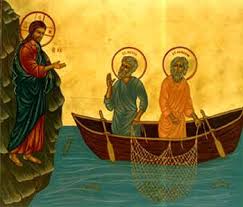
You may remember it from Luke’s gospel, in his account of Jesus calling the disciples to become “fishers of men.”

Once again, there are fishermen.  Once again, they’ve been fishing all night.  Once again, no luck. 

Once again, Jesus appears, tells them to cast their nets on the other side, and suddenly there is a massive haul of fish—enough that the nets almost break. 

Peter is central in both stories, too.

But in Luke’s version, Peter takes one look at those full nets and turns to Jesus, saying “Go Lord, leave me, sinner that I am.” (Luke 5:8)

He says this out of immediate respect rather than anything else.  

John decides to leave those words unspoken.

When the moment occurs is also interesting. 

For Luke, it is almost the very beginning. 

For John, it could almost be the end. 

Their travels are over.  They have snuck back home.  They are back in the boat.  Nothing seems to have worked out the way they thought it would. 

The story is sadder if you remember its arc: they’ve gone from fishermen to fishers of men back to fishermen, and yet, on this night, not even that: tonight, they are fishers of nothing. 

This is especially true for Peter, who had been so central to Jesus’ work.

So when I think of Peter having up and left Jerusalem, and now back on his boat in Galilee, back at his nets and staying up all night, fishing, I think of him lost in thought. 

I see somebody really wrestling.

“Go Lord, leave me, sinner that I am,” he said in Luke’s version.

In John, Peter seems like someone who’s been left.

It wouldn’t surprise me if nobody was speaking a word out there on the water – that Peter’s friends are there, but trying their best to give him some space. 

And yet, I think what Peter feels is not abandonment, but shame. 

He’s wrestling with himself.

In some sense, this might even be long overdue.  

The gospels describe many situations where Peter acts (or reacts) without thinking. 

They also show his tendency toward grand gestures—in one fairly typical example, he hops out of a boat in the middle of a storm to walk with Jesus.

Just as typical is the almost immediate sequel when he suddenly gets scared, starts sinking, and needs rescue.

So much for his grand act of heroism and faith. 

Another one is the night when Jesus is arrested.  

Peter is all about promises of loyalty, come what may – but he doesn’t end up keeping those promises. 

That night, he turns out to be no braver than anyone else. 

But the thing of it is, right up until he messes up yet again, that he thinks he is

His own version of who he is and what he does makes him style himself differently somehow.

Now this is really getting in his way.

The pastoral theologian Lewis Smedes talks about the difference between healthy and unhealthy shame in our lives. 

He notes an important difference between hearing a voice that speaks from our true self as opposed to a voice from our false self.[1] 

This is very important. 

Because there is a voice within us that seeks to call us back when we’ve done wrong or when we’ve somehow acted outside of the person we truly are.

It’s healthy to feel like we have not lived up to ourselves in those moments, and healthy for that to burn.

And there is also a voice within us that shrieks with pain when our superficial identity, a kind of preferred, successful self, undergoes its reversals. 

There is the unhealthy shame of our particular set of wounded vanities, whatever they may be. 

I was reading this week about a person who was adamant about keeping all her college textbooks on display in a particular room in her house, including the ones from classes she had totally detested and otherwise put behind her. 

And then one day, it occurred to her that she needed those books purely as a prop—as a way to prove to herself that she was a smart person. 

To her great sadness, she realized that, her life being what it was, the books in her living room had become more or less the only proof she had. 

Stories like hers remind us of how much we all contend with healthy and unhealthy shame as our true and false selves contend for our attention. 

And this is what Peter is contending with as he sits in that boat, lost in thought. 

There’s the unhealthy shame that surrounds him every time he ends up falling on his face or sinking in the waves.

Intertwined with it is the genuine grief of his true self at not standing up for his friend, at seeing his own love and courage falter. 

This is when Jesus appears and calls to him, offering Peter the chance to speak words of love and affirmation.

In a replay of the night when Peter had denied Jesus, he gets asked the same question answers three times, even to the point that he finds it annoying…even from Jesus. 

He does not recognize that Jesus is offering him a second chance, a way to overwrite his three earlier denials. A chance to start again.

In this, Jesus offers him a way to live, but on somewhat different terms.

Instead of being an impressive, important dispenser of forgiveness and snazzy miracles, the leader of the pack that he had imagined himself to be, Peter is invited to live as someone genuinely forgiven, and therefore truly free. 

The moment lets Peter finally shed the unhealthy shame of a false self.

His wrestling comes to an end. 

Lord knows, we wrestle, too. 

Our hopes and fears, qualities and shortcomings, faith and pessimism, love and betrayal all contend within us, trying to give their distinct versions of the way things are and of how we should respond. 

There are plenty of nights when we’re sitting silently in the boat, or we’re driving mile after mile in the car, lost in thought, unsure of what to do or who we are or what we stand for. 

Jesus comes to offer us a second chance, or maybe a third or a fourth one, a chance to pay attention to the voice of our true self and follow it to freedom.

We’re sure to find Him there.

Amen.


[1] See Lewis Smedes, Shame and Grace: Healing the Shame We Don’t Deserve.

Sermon: Doubt…or Commitment? (John 20: 19-31)

There’s a movie from the early 90s that I saw once and have never been able to bear watching again, although I loved it.

It’s called “The Commitments,” and it’s about a scrappy rock band in Dublin that’s trying to make it and only sort of succeeding, with everyone at each other’s throats as they all chase their dream of being the Next Big Thing – the next U2. 

You don’t have to watch the film to get that “The Commitments” really hits the nail pretty squarely on the head, because what each person is the band is finally committed to, and to what extent, is really the central question of the whole thing. 

So, now let me ruin the movie for you. 

If you’re watching on YouTube and thinking you might want to watch this movie, now is when you should go refresh your cup of coffee. 

If you’re here, maybe you can try putting your fingers in your ears and humming something…maybe something by U2.

O.k., so the band comes together and isn’t bad.

In fact, they’re kind of good. 

They begin to develop a bit of a following, and it’s clear they deserve it.    

But almost as soon as that happens, tensions emerge, and as the movie continues, bit by bit, those tensions start to boil over. 

People take sides. 

Money is very tight. 

Everyone is sort of jockeying to be the break out star if there’s going to be one. 

Of course, there’s a romance between two of the band members that only makes things worse. 

It seems like it’s all unraveling, and they all know it. 

So they decide to take a big gamble. 

They invite a bunch of journalists to a gig, but in order to get them there, one of the band says that he’s inviting his friend, Wilson Pickett, the real life American blues guitarist, to sit in and join them in playing his hit “In the Midnight Hour.”

Word spreads. 

Well…this is why I won’t watch this movie ever again.

Because the journalists show up. 

The fans all come out. 

The band starts playing. 

It’s not bad. 

But as midnight approaches, which is clearly the ideal time to sing a song titled “In The Midnight Hour,” there is no sign of Wilson Pickett. 

The crowd turns on the band. 

The journalists leave, disgusted with this big lie.   

Two of the band get in a huge fistfight.

Another starts to storm off in frustration, saying he’s through. 

Which is when an enormous limousine pulls up, and the driver lowers the window to ask directions to the club. 

It’s Pickett.  He’s there.  He’s arrived.

Unfortunately, it’s too late.   

I think about this as I imagine the story of Doubting Thomas.

Of course, the point is just the opposite, because it’s not too late

And yet the question of Thomas’ commitments is very much in play. 

What the others experience as an overwhelmingly joyful moment of encounter, with Jesus appearing among them, just doesn’t rise to the level of believability for a guy like Thomas. 

Even the delight and relief of his friends does not convince him. 

Clearly, his instincts are not to take things “on faith,”and yet, that’s an interesting observation to pause over.

Because it seems like he’s not pausing to think about what the Scriptures had foretold, or about what Jesus had been teaching them about himself – especially in his final weeks as he was moving toward Jerusalem. 

He’s not taking any of that “on faith,” if by that we mean trusting it long enough to wonder about it now. 

Of course, he’s not taking the direct experience of his closest friends as reliable, either.

It’s not as if he says, “Well, clearly something must have happened,” even if he wants to withhold judgment for a while about what it was. 

This is a story that makes a lot of church going scientists sort of bristle because it sounds as if the gospels are saying that empirical research is fundamentally unfaithful, or even actively disrespectful to God. 

We should never think that. 

Scientists are the ones who have the closest seats to the wonder of Creation and to the boundless creativity of God.

They may know more about what it means to “worship the Lord in the beauty of holiness” than just about anyone.   

So what’s the problem with Thomas? 

It’s not that he questions or wonders or struggles to believe.

Who doesn’t?

His friends have spent most of the day doing that since they all walked back, lost in thought, from the shock of seeing that empty tomb. 

I think the issue is Thomas’ commitments

Because at the end of the day, when we come up against things that we don’t understand, or when exhaustion and grief and worry start to get the better of us, what is it that we have?

What is it that we are supposed to fall back on?

It’s our commitments. 

It’s our trust in what is bigger than the fears and frustrations we may have in the moment. 

In the movie I mentioned, this is precisely what nobody seems to have – a kind of fundamental ability to keep plugging when things go sideways, or a confidence that someone’s not going to promise that Wilson Pickett will be coming when they don’t actually know Wilson Pickett. 

Similarly, part of the reason we need church rather than just a sense of our own personal Jesus is so that we have others to fall back on.

When life gets hard for us, when the fears and frustrations rise like stormy seas, we have each other to remind us of our commitments, to embody God’s presence and guidance and care. 

And we have these promises that God proves over and over again that He is most intent on keeping – that He calls us to keep as a way of keeping us close.

This is what the story is about. 

Because Easter has happened. 

Now it is on us to decide what our commitments are and how we propose to keep them in the times ahead whenever and however life will next prove difficult for us.

But the God who showed up for Thomas is the God who is determined to show up for us. 

We may not get an invitation to put our hands in his side.

Truth be told, even that might not be the answer to the kind of questions we would have.

Yet the love that creates and enfolds us all is eager to find us once again. 

He comes to open the doors of our hearts. 

May we rejoice as we find him once again.

Amen.

Easter Sermon: “Joining the Living” (Luke 24)

The story of Easter begins with the followers of Jesus huddled together and trying to lie low. 

When the women venture out to the tomb to prepare Jesus’ body, we’re told that they go while it was still dark, which is earlier than would have been customary. 

But they’ve been sitting around in that same room since Friday night. Now they’re anxious to get started.

There is also a practical reason to be out before sunrise: the waning darkness offers them a little bit more time in the shadows.

Under the circumstances, the shadows are safer.

There are Roman soldiers and Temple guards and willing collaborators everywhere.

That may be hard for us to conjure now. 

Our Easters are made of light and beauty—serious flowers, a soaring organ, maybe a new outfit to signal a new you – and it’s been our way of marking this day for so long that we might forget that there have been other ways. 

But there were. 

Beyond that very first Easter, the early church would also have known the shadows, and largely for the same reasons. 

For nearly its first four hundred years, the church in many places gravitated to the shadows and made its home there.

In fact, some vestiges of that time remain.   

In Rome, there are extensive catacombs that go back to the third century – it’s a whole underground world where people gathered and worshiped, as well as buried their own, a place where the living and the dead; believers, confessors, and martyrs were close together.

It is easy to imagine those early Christians in the shadows of the ancient city, traveling back and forth between dusk and dawn.

By day, they would have been hiding in plain sight, but wherever they were and whatever the time, they knew they were pledged to a different lord than Caesar and dreamed of a very different world.

Despite the magnificent monuments all around them, each of which was making its own bid for eternity, the early Christians in Rome were brave enough to build their own space and to leave eternity to God alone. 

This rendered them suspect. 

Rome didn’t much care about other gods, per se. 

People deciding to get organized was another matter. 

That needed to be watched closely and nipped in the bud.

So no wonder the early church gravitated to the shadows and stayed long enough to build a world there.    

With this in mind, the walls of the Roman catacombs seem to preach in ways that are surprising. 

Obviously, the possibility of suffering and death were close at hand for anyone who would have been down there.

Accordingly, you might expect to find a lot of images of Jesus’ own suffering and death. 

But not so. 

From what we can tell, there are no depictions of the cross or of the crucifixion until about 100 years after the catacombs were first constructed. 

Instead, before that, space after space was covered in images from the Bible that tell stories of God’s deliverance: tales “of the powerlessness of death and the certainty of the resurrection.”

On the walls of the catacombs, “God delivers his people from the consequences of death situations and gives them life instead. The Old Testament stories of Daniel, the Hebrew young men in the fiery furnace, Abraham and Isaac, Noah, and Jonah were painted hundreds of times.”[1]

Hundreds of times.

So as we listen to the Gospel of Luke describing that first Easter, we need to imagine those first women, venturing out on the dark streets of the pre-dawn city to go to the place where Jesus lay, heading to what we ought to remember as the church’s very first catacomb.

Its particular walls were almost certainly bare. 

And yet, those walls also bore witness to the God who delivers his people from death and gives them life instead.

As dawn arrives, that’s not what the women see—at least, not at first. 

Instead, what gets their attention are the rolled back stone and the absent body, which fill them with horror. 

But soon, it becomes clear that the God who “delivers his people from the consequences of death and gives them life” has acted again—this time, the story becomes one of resurrection.

But it’s important to understand that this means more than just undoing the mechanics of mortality. 

Luke’s gospel signals this right away.

The women are standing there, trying to take in what has happened, and one of the angels suddenly beside them at the door of the tomb asks them a deceptively simple question: “Why do you look for the living among the dead?”

At first, this seems like a roundabout way of announcing that Jesus is alive, that tombs are for dead people and so, of course, he will not be found there. 

Certainly, the message works at that level.

But if you don’t fall for the question’s deceptive simplicity or try to answer it too quickly, it’s a question that grows wings.

It suggests some of what the Christians were able to affirm in places like the catacombs.

Because the story of Jesus is the culmination of that story of deliverance for God’s people.

It’s not only that Christ is risen, but that in him, new life is possible for us, and not just later, but now.

Resurrection doesn’t mean more life later – it means new life, starting now. 

Resurrection means that we have been delivered into the life of God and find our lives in Him.

That’s why we describe it as liberation in its many forms, and as an experience of being “born again,” a term we need to reclaim from those who seem to have forgotten the fullness of its meaning. 

Resurrection, new life in God, liberation, being born again — all mean living as He taught us, challenging ourselves to remain open as He was, risking vulnerability in the name of spiritual strength as He did, resisting humanity’s great talents for hatred and creative cruelty as He insisted that we must.

These are just a few among the many ways that we might rise, and not only to heaven one day, but long before that, as we rise to any occasion or challenge, and invite Him into it. 

This is all part of resurrection…liberation…being born again.

And this means that the angel’s question becomes a much more pointed question—and it’s pointed at us. 

Because where is it that we search for signs of life?

A church that took refuge in a catacomb had clearly moved beyond simplistic answers, but the question renews with each generation and for each of us. 

Where will we take refuge? And in what ways?

So much that claims to be life-giving proves not to be. 

So many attractive roads grow narrow and become dead ends.

At a certain point, the question comes up for us: “Why do you search for the living among the dead?”

It’s God’s invitation to let go of simplistic, dead-end answers and to begin finding our lives within the great complexity, the abundant joy and the overflowing wonder of God’s own life—to see as God sees, serve as God serves, and love as God loves. 

It’s how we begin to claim God’s deliverance for ourselves and know the power of His resurrection. 

This is the promise of Easter.

In the face of emptiness, there is God’s fullness. 

In the face of death, there is the new life in God.     

As we celebrate now in light, in beauty, and in all the outward trappings of a new you and me, may we still find ways to write that promise on our walls and in our hearts.   

Amen.


[1] Gregory S. Athnos, The Art of the Roman Catacombs: Themes of Deliverance in the Age of Persecution (2023), xiv.

Sermon: “The Dream of the Palms” (Revelation 21)

When it comes to being based in Scripture, Palm Sunday may be second only to Christmas in the Christian calendar.

Both holidays remember moments that were long-anticipated— moments that need to be correctly recognized as acts of God, and actually, acts of God that were long-promised – with both of them part of a decisive intervention to fix what was broken in the world. 

Both holidays point beyond the specific biography of Jesus to the figure of the Messiah, and what it would look like when the Messiah finally arrived. 

Connecting Jesus’ biography to long-cherished prophecy is a major task of the gospels. 

Much of the Christmas story: Bethlehem, a virgin who has conceived, no room at the inn, the magi and their specific gifts, those details were all part of how Ancient Israel imagined the signs that would accompany the mysterious liberator God would send. 

Palm Sunday imagines the Messiah’s arrival in Jerusalem, from the donkey to the palms to the shouting of “hosanna,” which means something like “God will save.” Its various elements would have been familiar to those who witnessed it live, especially for those whose concern for the way things were in a dark time had sent them back to Scripture to refresh their hopes. 

By contrast, Easter, as we’ll see next week, mostly breaks new ground – what it describes is God acting in ways that are so unexpected that at first, they don’t even seem understandable, much less wonderful, even for those most desperate to understand them. 

But as I said, more on that next week. 

When the movies depict Palm Sunday, Jesus is often portrayed as the still point in the activity, the eye of the storm, riding the donkey up to Jerusalem with a face that seems lost in thought, while all around him there is all this jubilant tossing of cloaks and palms and branches on the road, an ancient version of rolling out the red carpet for a VIP. 

The contrast is meant to remind us that there is a difference between what the people hope Jesus’ arrival means and what Jesus knows it means—as well as what it will require of him. 

Jerusalem was not that big a city. 

Many of those who are standing along the road cheering his arrival on Sunday would be standing around before happy hour on Friday, cheering his death before happy. 

That irony almost makes Palm Sunday weird to celebrate—a kind of false armistice, a momentous beginning that checks all the boxes, but nevertheless collapses, and does it in spectacular fashion. 

Yet since at least the 4th century, the church has celebrated the day, and not with sadness or repentance, but with joy. 

Some of it may be that the ancients were less surprised by fickle humanity than we are and understood the day as a sign of God’s great faithfulness, particularly in the face of how undependable our love can be. 

God sticks with us even when we don’t stick with him, and that loyalty is all the more striking when we admit that, after the first flush of enthusiasm, many of us don’t seem to stick with much of anything—even God. 

God is not like that.

His ways are not our ways—and so, all the more reason to rejoice on Palm Sunday, grateful for its vivid illustration of what God’s ways are. 

May they teach us a better way as we remake our lives into better reflections of God’s life. 

But this is about a lot more than loyalty. 

And this is where it can be helpful to look beyond the gospel accounts of Palm Sunday and pause over John of Patmos’ vision of God’s ultimate marriage of heaven and earth. 

Most importantly, John reminds us that God’s love for us and for all creation is most beyond human description, and surely beyond all calculation. 

Let’s say what he says again:

Then I saw a new heaven and a new earth. The first heaven and the first earth had disappeared, and there was no sea anymore. And I saw the holy city, the new Jerusalem,[a] coming down out of heaven from God. It was prepared like a bride dressed for her husband. And I heard a loud voice from the throne, saying, “Now God’s presence is with people, and he will live with them, and they will be his people. God himself will be with them and will be their God.[b] He will wipe away every tear from their eyes, and there will be no more death, sadness, crying, or pain, because all the old ways are gone.” (Revelation 21: 1-4)

It’s a description of what Palm Sunday might have been and of what it was supposed to be, as imagined backward from the day when the dream will be realized, at last.  

Like Jesus entering Jerusalem, God arrives in the heart of the world. 

Relationships and possibilities for human life that have been separated by sin and selfishness and injustice (which are, mostly, three ways of saying the same thing) will come back together.

“He will wipe away every tear from their eyes, and there will be no more death, sadness, crying, or pain, because the old ways are gone.” (v. 4)

We could say a lot about it, and over the years, many have. 

John’s words about this later moment of arrival give us a way to understand what was happening on Palm Sunday that none of its first witnesses could quite have known.

But the central ideas are, first, that God will come to be with us so that we can live unseparated from Him. 

Second, a world torn up by turmoil and bearing the scars to prove it will give way to a world of almost unimaginable beauty—a world where the most precious things we know will be worked with skills we do not now possess into dazzling new forms.

Including us.

Including our hearts and our very lives. 

Faith is what urges us to turn toward that promise. 

“Look! I am making everything new!” says The One who sits on the throne (v.5).

It’s a newness that the world glimpsed on Palm Sunday, but did not embrace. 

As a result, for a while, it will seem like the old ways are the only ways.

As we wait, it will seem as if our dream of new ways, our hope for reunion in all its expressions, and our hunger for love in all its dimensions, are all foolish and naïve. 

We’ve been waiting a long time. 

But make no mistake: it’s coming. 

In fact, make no mistake: it’s already appearing. 

Jesus is already in the city, whether we mean the cities of the world or the well-defended cities of our selves. 

The new life has begun. 

And so this has always been a joyful day for the church.

It’s not so much about what it remembers, but about its dreams.

It’s about the God whose Son arrives to enter every trembling heart, and the world that will be possible when, at last, all hearts are one in Him. 

Amen. 

From the Newsletter: Holy Week Approaches

Faith and churchgoing are not the same thing, of course, but as Holy Week approaches (and the opportunities for church going abruptly multiply), it’s probably worth reminding ourselves of this.  

There is a kind of “opt in” structure to so much of our observance, which people can be inclined to bemoan, but which is far from being a “modern” problem if you look into it.   Even the earliest believers had to do a whole lot of juggling to get to services.  

There’s less of an “opt in” for what the observances are trying to affirm—the power of God to bring forth new life, even in the face of death; the experience of Jesus as more than just an inspirational guide, but as an active presence in the world and in our lives; the promise that human brokenness is not the bottom line of human destiny.  

Pondering where we find ourselves on any of that, and on any occasion when the church gathers, is a lot of what we’re doing there.   The quiet reflection before we say the Prayer of Confession? That’s probably the most obvious moment when we open the box for ourselves, although really any hymn, joy or concern, sermonic tidbit, or silent shift in the sunlight coming through the stained glass may find a way to get us in touch with our deepest questions and most heartfelt longing.  

Those are the internal places where we most hope to feel God’s presence.  

This is why I’ve come to love Maundy Thursday and Good Friday, two services that would have been deemed “extra” (and not really “our way”) in the Congregational church of my childhood.  

They tell parts of Jesus’ story that hit hard, and draw on darkness as an element of the worship service itself, which is a rare move for us.   Since the very beginning, our sanctuaries have been built for sunlight, boldly proclaiming that this is who God is—the light of the world, the one whose “life was the light of men.” 

Easter Sunday is surely when we say it most joyously.  

But the purposeful darkness that proceeds it on Thursday and Friday also has its place in our sanctuaries and in our lives, because “where we are” on Easter’s joyful proclamation of our faith’s most central promises needs time to discern.  

We need to remember that the God who is light is, nevertheless, the God who also knows the darkness, whether we mean the darkness of the world, in general, or whatever forms of darkness we may identify in ourselves.  

Maundy Thursday and Good Friday offer us the chance to open the box, with all its questions and longing, and to lift all that into the Easter light.  

These services aren’t just boxes to check in a career of dutiful church-going.  They are places for Jesus to find us and lead us from the empty tomb.  

Hope to see you there. 

See you in church

Sermon: “Final Return” (Psalm 91)

I know I’ve told you before about my year doing temp work in downtown Philadelphia. 

My energy for school had conked out rather unexpectedly just before the start of a new school year, which meant that when September arrived, I turned out not to have any particular plans. 

That was just one way in which my act was (how should I put it?) not together

But the moment I am remembering today happened later on; in fact, it was just about now, in mid-March, in this stretch of weeks when any given day might be spring, might be winter, but even so, there are no leaves, there are no birds. 

There are only the wind and the various exhausted shades of brown wherever you might happen to look. 

My job – as I have mentioned before – was sort of perfect for the season. 

I was filing tax returns for dead people.

If you don’t know, you still owe taxes for whatever part of the year that you’re alive. 

But filing any time after that turns out to be tricky for most people. 

So, there are people who help with that.

My particular piece of it was pretty simple. 

I had a red ink pad and a big, old school librarian sort of stamp, and my job was to stamp the words FINAL RETURN on the front page and then get it ready to be mailed out. 

This sounds easy enough, and it was.

Except now is when I mention that I was working for Fidelity Investments. 

Any Fidelity customers here? 

So…multiply yourselves by ten zillion, and you can begin to imagine just how many returns needed to be stamped and prepped in the weeks before Tax Day. 

You almost needed a ladder to get to the top of the pile.

You could measure your daily productivity literally in how many feet of final returns you’d been able to get done.

But every day, at noon and five, one of the accountants would wheel this little hand truck over with another four feet or so of returns to add to the bottom of the pile. 

Do you remember that scene where Lucy and Ethel are working on the assembly line with the chocolates? 

Or that movie where Charlie Chaplin gets sucked into the gears of the machine? 

It was like that.  Every day.  For nearly three months. 

And so, ever since, nary does a St. Patrick’s Day pass for me without the distinct memory of that particular year, with its tug of war between winter and spring, and the feeling that I was running as fast as I could, desperately trying to go up the down escalator, knowing that whatever I did, the one thing I could not do was stop

And yet: where was I actually going?

There was no clear answer to that question. 

Have you ever felt that way? 

It’s bad, right?

At another point in that same general span of years, there were three days when I literally didn’t have money to eat, and yet I was too embarrassed to ask someone for a loan (which was ridiculous).

That was bad.

Even so, I can say without any hesitation whatsoever that my time filing tax returns for dead people was worse. 

And I think this is something that Jesus really understood. 

It wasn’t the job. 

Actually, there was nothing wrong with that job, per se. 

At a different season of my life, with a slightly different configuration of coworkers, a dog waiting for me when I got home, or a bigger project in my off-hours that I got to be a part of, and the job itself would have been weird, but fine. 

So much that is not great in itself can be fine, provided, of course, that we ourselves are mostly fine. 

But what does it take, even just to be mostly fine? 

This is a Jesus kind of question. 

And it’s why I think he has such compassion for us when we’re stuck and can’t seem to answer it – to find whatever our answer might be, no matter how hard we try. 

With him, it didn’t matter if you were rich or poor, healthy or sick, Jew or gentile – he could tell when that particular poverty of spirit was wrapped around you, like a boa constrictor.

In the face of just that, he affirmed that God wanted something very different for his children.

…Which (take it from me), when you’re in that situation, is almost the hardest thing you can be asked to believe…

And yet this is the leap of faith Jesus wants to help us make.    

In situating the passage before the reading, we mentioned the “noonday demon,” a phrase that we have, courtesy of St. Jerome’s translation of the Bible into Latin. 

As demons went, it was considered one of the most active, with a particular capacity to drain our lives of purpose, delight, or direction, and to leave us perpetually feeling like the brown landscapes of March, always somehow caught out in a biting, cold wind. 

Unlike the other demons, who lured you in by offering some form pleasure that was great until it finally went bad, the noonday demon convinced you just to sit tight in a state of vaguely miserable exhaustion, more or less forever. 

This was a vital discovery. 

The noonday demon gives the church a way to recognize that apathy and hopelessness are, in fact, forms of sin—ways of denying the goodness and purpose of God in the world.

By contrast, apathy and hopelessness offer excuses for not bothering to do more with our lives, and (whatever form that “doing more” may take) to find life and joy in doing it.

The belief that any single life cannot make a difference to someone, somewhere may be the most sinful one of all, egregiously wasting God’s gifts of life and love in exchange for a parade of one quivering anxiety after another.

As John Ruskin once observed, “When a man is wrapped up in himself, he makes a pretty small package.”

But with Jesus, there is God’s ongoing invitation to offer the gift of oneself, and to be opened, just as Jesus offers himself and is opened by a world in such desperate need of his love.

Speaking hopefully of any of us, the Psalmist writes:

“Because he[b] loves me,” says the Lord, “I will rescue him;
    I will protect him, for he acknowledges my name.
15 He will call on me, and I will answer him;
    I will be with him in trouble,
    I will deliver him and honor him.
16 With long life I will satisfy him
    and show him my salvation.” (Psalm 91:14-16)

In the living of our days, the only return that finally matters is when our hearts return to God, and our days break forth into blossom.

Amen.