Category Archives: Uncategorized

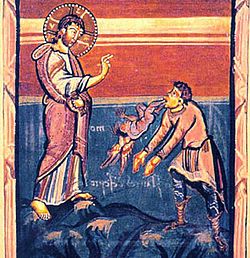
“Haunted” (Luke 17: 11-19)

I’m not sure I believe in ghosts, but I am certain haunting is real. 

I’ve known plenty of people who’ve been haunted.

Maybe it’s the heavy hand or the sharp rebuke of a parent who’s been gone for ages but not really gone…never really gone. 

Or the memory of wartime service.  Over but never really over for those who are home, but never fully home. 

Or all the ways we seem to push people away for all the reasons—the ones we get to leave only to be astonished when it turns out that they’re gone. 

The last few days I’ve thought a lot about all those people returning to their homes in Gaza, grateful for the cease-fire, eager to get back and get on with rebuilding their lives such as they can, and yet: how could you walk through your old neighborhood and not remember what was? Wouldn’t it be wrong not to remember, and yet awful?

How could you not feel the weight of it all?

If that’s what haunting is, I’ve seen it.

And so in this morning’s Gospel story about the ten lepers, I wonder if part of what we’re supposed to imagine is a group of people who aren’t simply sick but also haunted

Because their lives had all begun so differently. 

Because the memory of how quickly it had all changed for each of them would have to have been so painful and so present in their minds – a continuous playback of awful images and unforgettable words. 

There was no place for people in their situation – no home, no harbor.

Just the reality of their condition and the reckoning of all they’d lost. 

So when Jesus shows up, and they call out to him, and he calls back with the good news of a cure, I get why nine of them don’t waste a second before going back to the future.   

Back to the lives they’d once known. 

And I hope that’s exactly what they got, picking it all back up without missing a beat, like the prodigal son. 

But the odd man out, that one who turns back to kneel at the feet of Jesus—he’s in a different category. 

I’m reluctant to say that he’s actually more grateful than the others—that his cup overflows in a way theirs don’t. 

I don’t think it’s that. 

But I think he’s beset by a different sort of haunting. 

Because like the others, he’s seen some stuff. 

The sadness of his exile from home (because that was what happened to lepers); the fear and disgust of those he would have encountered on the road; the suspicion running wild through any town he passed by, certain he would be trying to find his way in wherever he could; the loneliness and boredom of being ill; the occasional kindness of a meal left out, a spare blanket, neatly folded, or a blessing sent his way.  

My guess is that, unlike the others, what suddenly haunts him in his first moments of restoration is the possibility that he might forget the lessons he has learned.

That he might become blinded once again to all the things he’s seen and to all these things he’s learned the hard way. 

When he comes to kneel before Jesus, it’s not just because he’s an ex-leper, a man among a group miraculously cured

He comes to kneel before Jesus because he recognizes he’s a person who has been transformed, a person who won’t unsee what he’s now seen or un-know what he now knows. 

He doesn’t want to. 

It’s too important. 

He turns around to approach Jesus because he’s already been turned around.

He’s a witness to the worst and best that life has to offer, the empty cup and the one that floweth over—and now his charge is to learn to live from that place. 

For me, the man who turns back to say thank you is a model of our faith at its best: clear-eyed about the world, full-hearted with the redemptive purposes of God, and trying to find a way to walk with love in the space between. 

Given what he’s seen and been through, what sort of human brokenness could possibly faze him now? 

And doesn’t that make him an incredible force to be reckoned with?

Not a force in the world’s familiar sense of that term, but according to faith’s vision. 

Because when faith talks about force, it means things like the strength it takes to be gentle, or the stamina it takes to be kind. 

It’s not talking about coercion, but conversion – the invitation to a broader view that can only come from one who has started on the journey toward a different country and hopes that we might find it in ourselves to come along.

And this guy is like that. 

We began by talking about haunting. 

There is so much that people seem haunted by. 

There are so many parts of ourselves and of our stories that loom large – so much that we’d just as soon forget, except that we can’t. 

Some things won’t let themselves be forgotten. 

In this morning’s gospel, I think the nine men who skedaddle are acting out of a fantasy that I’m not sure I have, anymore. 

They’re hoping to rewrite their story – to change the ending and make their time in the wilderness into some sort of brief aside. 

The one who turns back approaches the moment differently. 

He turns back and kneels to mark the beginning of a new chapter – a chapter in which everything he’s been through becomes a way to connect…engage…to get down to business. 

I’d like to be more like that. 

In our tradition, the root of the word “redemption” means “to buy back.”

And isn’t that what Jesus shows us we might do: buy back some of the world’s brokenness and confusion, its despair and unfairness, and not because we’re blissfully above and beyond it, but because we are those who know it all too well, and yet who persist in working for a new day?

In a gospel that speaks so pointedly about the instinct to keep our distance, the question becomes: how close to Jesus are we willing to get?                    

Amen. 

Sermon: “Keeping Up with the Joneses” (Luke 12: 13-21)

A few months ago, I read a not very convincing attempt at a spiritual biography of former president Richard Nixon. 

At the end of the day, the project involved too much reading between the lines to make its points. 

But I understand what sparked the quest. 

It was Henry Kissinger.

In the days after President Nixon’s resignation, Kissinger gave an interview to TIME magazine’s Hugh Sidey, in which he made this devastating observation. 

Kissinger said, “Can you imagine what this man could have been had somebody loved him?  Had somebody in his life cared for him?  I don’t think anybody ever did.  Not his family, not his peers. He would have been a great, great man had somebody loved him.”

I don’t know if that’s really true or not, fair or not, but the spiritual biography I read was an attempt to ponder that statement. 

And even if it wasn’t true for Richard Nixon, specifically, I think it names something accurately about a certain kind of modern life story. 

You know the kind I mean.

I’m talking about the story of a remarkably eventful, remarkably successful life, rich in almost every conceivable way, except for one. 

It’s a life that is cripplingly poor in love. 

And so, after a while, all of the attainments and their trappings start to seem shockingly empty…a desperate chase after the one thing that somehow always seems to slip away. 

Yesterday, along these same lines, I fell into a bit of a rabbit hole on where the phrase “keeping up with the Joneses” comes from. 

And I discovered that it comes from somewhere not too far from here: from Rhinebeck, New York, where in 1853, Elizabeth Schermerhorn Jones built a large Romanesque Revival summer mansion overlooking the Hudson River.

If you’re interested, that’s “Jones,” as in Dow Jones, and also as in the author Edith (Jones) Wharton, who visited as a young girl. 

There were tennis courts, carriage houses, boat houses, gardens, Tiffany skylights. A ballroom.

Apparently, this magnificent new house set off a massive wave of sprucing and renovating and expanding among the other summer families—so much so that they gave us the name we use for doing that, wherever we do.   

But the fashionable world did not stay in Rhinebeck, and by the mid 1880s, after the death of Elizabeth Schermerhorn Jones, the family was quickly off, mostly to Newport.

The house lingered on with a new family through the roaring twenties before settling into a deep quiet, and then finally being abandoned.

All these years later, the house, Wyndyclyffe, is still standing, though only barely.

There’s a chain link fence around it now.  Bricks and other debris all over the place. 

The grounds have been shrunk down to 2.5 acres instead of the original 80. 

Can you imagine what that house would be like now had somebody loved it?

Yet the image of it as an empty ruin seems like a parable in its own right.

So much for “keeping up with the Joneses.” 

I think it also gives us a way into Jesus’ parable in this morning’s gospel. 

Because what are we to make of this man he describes?

Jesus warns us about the guy’s greed, of course, but it’s not just that. 

The man’s lands produce abundantly—so much so that he’s run out of room to store the harvest. 

It’s a gold-medal problem, to be sure. 

But there’s something odd about how he’s inclined to solve his problem.

His idea is to start ripping down his current barns in order to make room for even bigger ones—new barns that will hold what he describes as “all my grain and all my goods.”

And this is where I start thinking about the Joneses.

Because what does this guy really need here? 

Is “need” even the right word? 

Somehow, it isn’t. 

You don’t get the feeling that what he needs is really all this extra food and the extra sense of security that comes with it, although that’s what he seems to tell himself.

Really, though, what I think he needs is something that no amount of food could ever satisfy. 

I think he needs his neighbors to see those new barns going up.

He needs them to see all that hustle and bustle over on his farm, and to see all that grain getting socked away like he’s Joseph preparing the whole land of Egypt for seven years of famine—except (and this is significant) that it’s all for himself.   

He needs farmer Jones across the road to feel jealous.  

Because those are things that tell him he’s worth something.    

Those are the things that tell him he’s alive.

Those are the things that give him hope. 

The man may sound smug and self-satisfied, at least at first, even talking flippantly to his own soul, as Luke suggests with great subtlety. 

Really, though, when you see through the man’s bravado, what you see is how compulsive, desperate, and achingly lonely he must be. 

Imagine what this man could have been had somebody loved him.

Think of what he might have offered. 

Now consider what a ruined soul he’s let himself become.   

It’s an awful picture—awful enough that I have to remind myself that he’s only a made-up person in a parable.

But it gives real urgency to Jesus’ message. 

Because, when you think about it, what are the things that tell us we’re worth something? 

What tells us we’re alive?  

What gives us hope? 

What do our souls need in ample proportion? 

It’s telling, isn’t it, that when the man addresses his soul, he makes it so that he’s the one who does the talking?

He doesn’t give his own soul time and space to speak back to him.

Maybe he doesn’t dare. 

But when we do – when we give our souls that time and space – it shouldn’t surprise us that they talk about very different needs and very different dreams. 

They talk about things that the Joneses almost certainly cannot see, much less keep score on.

They talk about the worries and hopes we have for our families. 

They talk about differences so stark that it seems like they’ll take decades to repair. 

They talk about the exhaustion on the other side of courage, and the pain of carrying blame, no matter how much is or isn’t properly yours to carry.

But they also talk about the gestures of kindness for which we are so grateful. 

They remember the person who found a way to make us laugh, the stranger who stopped to give us a hand, and the friend who found a way to tell us a hard but necessary truth. 

There is the music that never fails to lift us, and that movie that always – always – makes us cry—reminding us how to feel when it seems like we’ve almost started to forget. 

And behind them all, there is the Spirit of the Living God, always in close communion with the soul, speaking of the endlessly creative love that sustains us all. 

Souls don’t need goods.  They need goodness.

Imagine what this man could have been had somebody loved him? 

Imagine what he could have been if he’d been willing to let his soul try.

Not even the Joneses could have kept up with that. 

Amen.

Sermon: The Two Sides of the Door (Luke 11:5-13)

Our gospel this morning is one of Scripture’s greatest affirmations of persistence. 

Now, what Luke wants to emphasize is spiritual persistence, not persistence, in general, but that doesn’t stop people.

Many seem to read these words as God’s particular blessing for pretty much whatever it is we do, no matter what it is, as long as we are willing to stick with it and make it holy by our striving.

Luke is not quite saying that. 

His more particular point is that the spiritual life, a God-oriented, holiness-seeking sort of life, requires persistence. 

I’m going to come back to this in just a moment. 

But first, as I’ve been spending time with this passage over the last few days, I’ve made some curious discoveries about persistence in my own life. 

In fact, I’ll tell you what I did in case you’re moved to do it, too. 

I drew a rectangle with four quadrants on it—can you picture that?

So, along one side, I wrote “Persisted” by one column and “Gave Up” by the other. 

Along the top, I wrote “Glad” over one column and over the other, I wrote “Sorry.”

So I had a little grid, marking my persistence – specifically, when I was glad or sorry for persisting; and then the name for giving up, and when I was glad or sorry for doing that. 

Get it?

And I learned some things. 

First, the two quadrants I could fill instantly were the times I’m sorry I persisted, and its cheery cousin, the times I am actually glad I gave up.   

The things I’m sorry I persisted with turned out to be a list of all the women I dated in college.  This surprised me.   

But then I remembered and was completely sorry all over again. 

The things I’m glad I gave up were all jobs.  Not all my jobs, of course.  But still, jobs. 

I think what this means is that have learned my share of things the hard way. 

The things I’m glad I persisted with were things like really trying to learn French when I was in high school, which has turned out to be a source of joy during many different seasons of my life. 

Same thing with driving stick. 

The things I regret giving up were almost all hobbies. 

It’s unlikely, of course, that I would have gone pro with cribbage or opened a restaurant with my risotto.  

I never even pulled the trigger on beekeeping or learning Klingon.  

From where I am now, that’s probably just as well. 

But in writing these things out, I realized that I didn’t lose interest in them. 

It’s that I had let more “important” things crowd them out. 

They fell away because I have always let my life get out of balance much more easily than it should be, which is something I still grapple with.

So, I found some surprises, and I warmly recommend the exercise to you. 

It will also be obvious that the most immediate answers that came to me were not explicitly religious. 

Two of my most abiding commitments weren’t there—the ones I made by making formal covenants before God and neighbor, as I did when I got married and when I became a pastor. 

My hope is that those are such a part of who I am that it’s like saying I’m glad I persisted with breathing, or something. 

Of course, I never took some sort of oath to become a dad, but the same thing might be said. 

I’m never not one, even if my kids are somewhere else; and I’m never not one, even if I’m dead asleep in the wee hours of the morning after the midnight service on Christmas Eve.

Although this is the deepest sleep possible for a professional Christian, that role persists. 

It’s just part of who I am. 

And it’s with that in mind that I want to take a look at this morning’s Scripture—this affirmation of persistence. 

The overwhelming majority of the story’s hearers identify with the person knocking at midnight, whose knocking Jesus affirms so emphatically. 

He turns it into a firm promise of results with God: “Keep on asking, and you will receive what you ask for,” as one translation has it.  “Keep on seeking, and you will find.  Keep on knocking, and the door will be opened to you.  For everyone who asks, receives. Everyone who seeks, finds.  And to everyone who knocks, the door will be opened.”[1]

“Persist,” he seems to say. “You’ll be glad you did.”

And yet, in a couple of weeks, we’ll hear the story of the foolish bridesmaids, who fall asleep waiting for the bridegroom to arrive and let their lamps run out of oil, then miss him when he arrives unexpectedly, and get explicitly shut out of the party despite all of their knocking. 

I’m mentioning it now just to name that persistence looks more than one way in Luke’s gospel, as it often does in our own lives. 

And so, in our story this morning, I suspect that Luke wants us to note both the persistence of the knocker and the different, but no less important persistence of the “knockee,” (for lack of a better term). 

Because what does it mean to be a Christian when you’re the one on the inside of a locked door?

It means being sound asleep at the end of a long day, with a lot on the docket for tomorrow, but resting for now…everything comfortable, everyone safe and sound.

And then there’s this knock. 

And this is where Luke is so thoughtful.

Because this isn’t the urgent knock of someone whose house is on fire. 

This isn’t someone who just saw creeps taking the catalytic converter out of his wife’s car. 

This isn’t a medical situation. 

As important as hospitality was in the ancient world, you would have to figure that a guest arriving at midnight would be prepared to wait for breakfast. 

Really, this is one of those umpteen small moments in life when the priorities are murky, and our bed is comfy, and our neighbor probably ought to know better. 

And yet, what Jesus wants to know is: will we persist in being Christians then, when for every understandable reason, we don’t feel like it

As Willie Mays once said, “It’s not hard to be good from time to time…What’s hard is being good every day.”[2]

So much is put before us precisely when we don’t feel like it, and it’s then that we must decide how to respond. 

This is what Jesus really means when he tells us to keep asking, seeking, and knocking. 

This is where spiritual persistence really comes in, and when our own faith convicts us as the ones who are constantly and most nakedly in need.

As we’ve said, left to ourselves, our sense of when to persist and when to quit, when to help and when to steer clear are scattershot at best.

They are sources of regret at least as often as they are of satisfaction.

But we are not left to ourselves.

With God’s help, we can become capable of a goodness beyond our own whims, and durable in all weathers. 

This is a moment when the weather seems especially difficult for so many.

A knock at the door comes, and it seems to have a new urgency to it, while the temptation to stay under the covers, safe and warm, holds an even greater appeal.

I’m praying that you and I both hear Jesus’ call to persistence this morning and take it to heart, and may our commitment to kindness and service make glad the very heart of God. 

Amen. 


[1] New Living Translation: 11:9-10

[2] The Book of Positive Quotations, 641. 

The “To Do” List: A Sermon on Martha and Mary (Luke 10:38-42)

I think I’ve spoken before about the early boss I had who expected things done in a certain way. 

And by “a certain way,” I mean pretty much everything. 

As a new teacher in my mid-20s, I learned a lot from her and am the better for her example and her expectations, but not everyone would say the same. 

For example, on Saturday mornings, when school was not in session, it is apparently true that my boss’s husband and adult children would come downstairs for breakfast and find their individualized to-do lists for the day waiting for them at their customary seat. 

Each list would be written out and supplied with its own pen for crossing off items over the course of the day. 

But this wasn’t just a list of assigned tasks, mind you.  My boss would also specify the correct order in which they were to be completed, which she had also calculated. 

Doing them in the right order was important, not only for the sake of form, but because she expected you back by a certain time for other duties – perhaps involving someone else who was assigned that same window of time. 

Apparently, this worked for everyone, although to me, it sounds miserable. 

But in all fairness, I suppose that one person’s nightmarish, Orwellian family hellscape is someone else’s well-oiled, four cylinder engine of love, so there you go. 

It may surprise you to learn that my boss was a very devoted church-goer. 

That said, it probably won’t surprise you to learn that she considered herself a “Martha” of the first order. 

And indeed, somehow, I always seem to think of her whenever I read this particular story. 

Now, in fairness to Martha, there is no indication that her control over her household is as rigid or fully-articulated as my old boss’ was. 

But it doesn’t feel like a major stretch to imagine Martha with her arms folded, clutching Mary’s crumpled up to-do list, which she’d found on the floor.

Watching darkly from the back of the room, she’s only half-listening while Jesus preaches about doing unto others or loving our enemies or suffering the little children to come unto him, or whatever it is this time. 

After all, she’s lived with her sister for way too long not to see it plain as day when Mary’s avoiding eye contact on purpose or keeping a crowd between them so there’s no chance for hissed orders or quick pinches, like their mother used to do. 

This dance is the kind of thing at which Mary excels and always has. 

In fact, the way I see it, and again, in all fairness to Martha, she wouldn’t be bringing up Mary’s behavior to Jesus if her sister was somehow behaving wildly out of character. 

It’s just that now, in front of Jesus, their guest of honor, it seems so flagrant that Martha can only assume he would have thought so, too, and been embarrassed for them. 

I admit, I’ve added some detail to the story here. 

But even if I hadn’t, it wouldn’t take much to imagine both that Martha is being sort of unfair, and also that she may have a point. 

Jesus teaches so clearly that faith should be practical, active, and selfless. 

Its most poignant expressions are generous and sacrificial, from giving up one’s seat on the bus to giving up one’s seat in the last lifeboat. 

In our faith, if some kiss-cam happens to find you, it better catch you busy helping someone, right?

Clearly, yes to all of that. 

And so, in that light, the story seems to take a surprising direction. 

Because what is Martha’s judgy gaze, if not her own personal kiss-cam, catching whoever’s there in whatever their act in the moment may be?

She’s weaponized faith’s call to action, draining it of much of its joy, making her version of what needs doing into some sort of unholy writ. 

By contrast, when Jesus calls us to sacrifice, it’s not because sacrifice is supposed to be some sort of end in itself, but because we’ve learned to love so deeply that giving up other things becomes a small price to pay.

For some, this may even be at the cost of their mortal life. 

Last week, when we read the parable of the Good Samaritan, it was that kind of risky selflessness, his voluntary sacrifice of time, care, and potentially even his own personal safety, that were so commendable. 

I mention only to observe that, by comparison, Martha’s likely version of care seems unlikely to rise to that standard. 

But importantly, the point is not to vilify Martha, or by extension, any of her loyal children, as many of us are—me included, actually. 

Rather, the larger point that I hear in Luke’s story is this (and I’ll refer again to the Good Samaritan to make this one point):

The God who confronts us in the form of an injured stranger by the side of a lonely road is the same God who confronts us in the form of a healthy sibling, sitting by the side of Jesus in the middle of our own living room. 

Both moments, among countless others, challenge us to acts of love and generosity, and even of healing without particular expectation of return. 

We may not like the sound of a God who is so willing to test us, although most Christians throughout history would have had no trouble believing it and would have struggled to believe anything else. 

But whether we see such moments as divine testing, or just as life, Jesus clearly wants us to acknowledge the significance of the choices they put before us. 

He wants us to recognize that the work of loving is everywhere, and often very challenging.

Ironically, the closer it is, the harder it might actually be, stripped as such love is of its fondest illusions.

Yet before it, the mirror of our own mixed motives, weird agendas, and overblown reactions is lifted before us wherever we care to look. 

We truly do not need to travel far. 

It seems like Martha could not quite see it. 

My hope is that, sitting at Jesus’ feet, maybe Mary started to.

I’d love to think that someday soon, in some remote monastery, we’ll find another copy of Luke’s gospel with another verse or two about how Jesus says those words to Martha, then turns his head, and there’s Mary, humming to herself as she heads to the kitchen with a tray full of dishes. 

I’d love to think that when Jesus talks about “choosing the better part,” he means not only choosing Him, but choosing each other, and not in some score-keeping, to do list sort of way, but willingly and with delight. 

May we go wherever God’s love takes us, and learn to do whatever it requires of us.

Amen.

Sermon: “The Luxury of Not Caring, The Pricelessness of Grace” (A sermon on the Good Samaritan)

This morning I’ll begin by telling you about when I first moved back to Connecticut after my first teaching job in Delaware. 

It was a Friday in late June. 

For the first time, I rented a truck – I was driving some things up to my parents’ house, most of which I haven’t thought about since. 

Anyway, the truck they gave me in Delaware was a lemon. 

I also didn’t really know that there are roads in our great nation where you’re not supposed to drive trucks. 

And this turned out to be kind of a pickle. 

Because the truck was about two thirds up the length of  the Garden State Parkway when it decided it was done. 

Somehow, I still managed to make it to the Montvale rest stop (now it’s named after James Gandolfini). 

I went a pay phone and called the emergency breakdown number. 

Eventually, someone came on. 

I explained that the truck was dead, I was at a rest stop, I knew it was 9 o’clock at night on a Friday, but when could someone come help me…etc.

There was a pause.  You could hear the clickety click of a keyboard. 

“I’m sorry, sir,” said the person after a moment.  “We can’t provide service at a Garden State Parkway rest stop.  The truck should not be there.”

“Right,” I said.  “But the truck is here, and it’s not going anywhere else, so someone needs to come help me.”

It went around like this for a bit. 

Not having any new facts to offer into evidence, I kept saying the same thing over and over. 

“I’m sorry, but that’s not possible,” they said definitively.  But then they added, “If a truck is not disabled in the roadway or shoulder then we do not provide service.”

I paused.  “O.k.,” I said. 

And then I had a flash of inspiration. 

“So you’re telling me that if I go into the service area right in front of me and get ten guys to push the truck out into traffic on the Garden State Parkway in New Jersey, and then I call you back, you’ll have to come get me? I mean, like, assuming I live?”

And you know what they said?

“Please hold.”

A minute later they came back on.

“Mr. Grant, we will have tow truck there in 20 minutes.” 

And they did.  And they put me up for the night in a local motel on their dime.

And the next morning they drove me to the truck depot, where a group of guys were on hand to transfer my belongings into a new truck with great care. 

And they mapped the route I was supposed to take with a highlighter and handed it to me. 

It was all very nice. 

Clearly, I must have scared the bejesus out of someone at U-Haul. 

But that’s it.  That’s the end of the story.  I had my adventure in moving and got on with my life.

II.

This morning’s Gospel seems to imagine a different, and certainly a more serious kind of story. 

Now having said that, let’s acknowledge that, for some, it really wasn’t all that serious. 

The priest and the temple functionary each notice a body lying by the side of the road, and their instinct is to keep on walking. 

This may not have been as heartless as it sounds – the road was notorious for the very kind of bandits who had attacked the poor man, and a traveler had to stay alert. 

What if it was a trap? 

And yet, can’t you just hear them back in the office the next morning, talking about their trip?

“How was Jericho?”

“Oh, it was great.  We had really good weather…my mom cooked enough food to feed an army…the kids were splashing around the whole day with their cousins…we actually got to sleep in. 

The only bad part was when I was coming back yesterday afternoon and saw a body on the road. 

Thank God it was just me, and the rest of the gang isn’t coming back until next week. I hope someone will take care of it by then.”

Like so many events in our lives, somebody’s catastrophe is somebody else’s minor detail—an adventure in moving, of sorts, after which they (we) get on with their lives. 

But in a way, that’s a luxury, isn’t it? 

The man left half-dead by the side of the road would say it was. 

His version of that story would certainly be different, wouldn’t it?

Imagine him arriving in Jericho, four days late and without any word to those who’d been waiting for him there. 

What would he have looked like when he walked through the door? 

For him and for anyone who loved him, this would have been a dividing line straight through the story of his life—before the attack or after. 

What was the story when he went back to work?

III.

It’s clear that, thanks to the Samaritan, he escapes with his life. 

As anyone who has been in a bad accident can tell you, making sense of it would have taken far longer.

It would have meant, also, working through the realization that for one dangerous moment, he hadn’t been a person caught in a terrible situation, but just an inert body lying in a ditch. Literally, roadkill. 

Or maybe his body was being used as a prop for the “real” attack.

In any case, he hadn’t been a person to help, but a problem to take care of, particularly before it started to smell and make the road gross for everybody. 

At least, so it was for the first two people who came by. 

Except that God, in His mercy, seeds the world with people who see differently.

God places among us people capable of seeing a person instead of a problem, and who approach the world, not from how it neatly fits into their own story, but in terms of how they might fit into someone else’s. 

In those moments when a life divides between before and after, there are those who are willing to step forward and be the healing hands of God.

As Goethe once observed, “It is the nature of grace always to fill spaces that have been empty.”

In moments of our most significant need, when it seems like the emptiness or uncertainty or pain are about to swallow us whole, there are those who step forward to find and fill such spaces.

They bear the grace of God, the transforming love that always sees us as children to care for, not problems to avoid. 

And Jesus has a name for the people who see like that and respond like that: he calls them neighbors

In our time, there are those who are quick to say how important it is for their neighbors to be Christians. 

This morning reminds us that for Jesus, the far more important thing is for Christians to be neighbors. 

As he tells us, “Go thou and do likewise.”

Amen.  

Sermon: Recipes for the Future(Luke 10:1-11, 16-20)

A few years ago, the New York Times ran a piece about a new trend you may not have heard about. 1

It seems that all across the country, and to some extent, the world, people are choosing to remember their relatives by carving one of their cherished recipes on their gravestone. 

As in: “Mom’s Christmas Cookies: cream one cup sugar, half a cup oleo, add two beaten eggs and one teaspoon vanilla,” …etc. 

It’s not clear that mom’s name or her dates are even on the stone at all – though maybe they’re on the other side?

But according to the Times:

“In cemeteries from Alaska to Israel, families have memorialized their loved ones with the deceased’s most cherished recipes carved in stone. These dishes — mostly desserts — give relatives a way to remember the sweet times and, they hope, bring some joy to visitors who discover them among the more traditional monuments.”

God help us, now we are trying to put our own “spin” on death. 

Of course, there are other issues, too. 

In one case, the gravestone company apparently made an error on a fudge recipe which nobody caught until twenty years later, when the other grandparent died…and so for twenty years, anyone who actually gave the recipe a try had been making runny fudge. 

I don’t know about your grandmother, but mine would have gone bananas about something like that, not that she would have wanted to be remembered in that way.

“Everything I did and said, and you remember me for pumpkin pie? And you don’t even specify that you need to use ‘One Pie Pumpkin’ and only ‘One Pie Pumpkin?!’”

My grandmother was not someone inclined to profanity, but in this case, she might have considered it. 

Still, it is an interesting trend. 

If you were going to be known in perpetuity for just one recipe, what would it be?

Do you know?

And what would keeping it alive mean to you? 

Does it mean the generations will follow it exactly that way forever

Or does “keeping it alive” mean that each generation gets to build on it…introduce variations…go with “an experiment” in some years and put that before the family jury?  

The handing down of recipes is a powerful legacy. 

II.

This seems to be especially worth pondering on a holiday weekend – and all the more so on this particular holiday weekend. 

The Fourth of July is the most important of our civic holidays, and replete with tradition. 

More deeply, July 4th is the day when we remember how the Founders left us a recipe. 

Their own moment was powerfully experimental. 

It had to be.

Their circumstances were chaotic and, at times, terrifying. 

If what they built could not endure, the future would be bleak, indeed. 

So when Thomas Jefferson wrote: “We hold these truths to be self-evident…” it is important to remember how little  actually was self-evident. 

Yet he and the Founders believed that to be human itself was to be endowed with certain rights, among them, as Jefferson notes, “Life, Liberty and the Pursuit of Happiness.”

That particular phrase is closely associated with Jefferson but comes from the English philosopher John Locke. 

The Founders agreed that whatever followed needed to start from those principles. 

Any vision of a workable future needed to begin there. 

And throughout our history, when things have become less than self-evident, we have returned to that recipe. 

We have tested our understanding of the way forward by going back to this particular affirmation. 

We argue over its meanings. 

After all, what is it to “pursue happiness”? 

But we come back to the question because it’s always a good question, though rarely an easy one. 

And it is in our capacity to wrestle with it that we are equipped to move forward.

III.

Similarly, in our Gospel this morning, Luke describes a moment when Jesus sends out 70 of his followers to proclaim the Good News throughout the countryside. 

It is another story of equipping. 

And what comes through so powerfully is how carefully Jesus is trying to prepare them.

He knows it won’t be easy. 

He knows that in the days to come, his followers will be rejected by many and scrutinized by everyone

He even tells them that he’s sending them out as sheep into the midst of wolves—hard words. 

But he knows that he has to start getting them ready. 

He knows that the transformation of the world depends on him, but he also knows that God does not seek to work unilaterally, imposing anything upon a passive Creation. 

God imagines real partnership. 

This means that happiness, or its deeper cousins, joy and purpose, will have to come more gradually, and not by any grand decree from above. 

The full blessings God intends for His world will only happen as the world finds its own way to find Him.

God knows that this will be the work of many hands.

The Bible makes clear that establishing Israel, God’s covenant people, is an ongoing project. 

As someone in the trenches, Jesus knows there will be failures and false starts alongside of the successes—that’s already happened to him, too. 

And so he gives the disciples this recipe—these steps to follow as they go out on the roads in his name. 

What is that recipe?

He’s not all that specific about that part. 

According to Luke, Jesus just says to tell everyone that “the Kingdom of God has drawn near.” 

Maybe that’s a little bit like the idea of the “pursuit of happiness,” which is to say, maybe it’s a more of a touchstone. 

It gives you a way to name something you see—or feel—not once, but continually. 

Like the question, “What would Jesus do?” it can never be answered once and for all. 

This call to recognize the Kingdom of God as it draws near leaves the people in each town with something to debate and discover together, even find new meaning in, well after the missionaries have moved on.

A bit ominously, Jesus continues:

But whenever you enter a town and they do not welcome you, go out into its streets and say,

10:11 ‘Even the dust of your town that clings to our feet, we wipe off in protest against you. Yet know this: the kingdom of God has come near.’

That means, offer people these words, knowing that they may not mean much to them now, but in the hope that someday, they will. 

Ultimately, only God can know when a seed will finally ripen and bear fruit.

That will prove true even for the disciples, themselves, who have worked so hard and given up so much to listen.

Jesus knows that God doesn’t just save us once, but constantly, provided that we learn to listen well and keep listening. 

In our own fraught moment, it is imperative that faithful people try, and that we learn to imagine and describe the Kingdom of God in ways that serve to make us not just great, but also good. 

This is the form of happiness it seems to me that Jesus would have us pursue. 

IV.

Recipes have the power to remind us where we’re from, who we are, and the great legacy of all that has been done for us.

They are alive—growing and changing, as we grow and change, but always seeking to call us back should we stray too far. 

They are a central expression of the love and wisdom of families…the love and wisdom of nations. 

But most of all, they are a central expression of the love and wisdom of Jesus.

May we join the work to which they call us.

May those who follow receive it from our hands with gratitude and joy.                                  

Amen. 

  1. NB: This sermon is a heavy revision of a sermon from July 3, 2022. Section 3 is very different from that earlier version. ↩︎

Sermon: A God Who Won’t Be Appeased (Luke 9:51-62)

At one point in her education, my mom had a particularly mean professor—the kind of guy who criticized your work in front of the whole class, and who relished the chance to do so with a memorable lack of kindness. 

He constructed a terrible environment in which to try and learn. 

At one point, he’d given my mom feedback about something, and a few days later, she decided to go to his office hours to follow up with him about it. 

She knocked on his door. 

“Ah,” he said, “Ms. Grant.  Have you come with a cookie to appease me?” 

If only it had been that simple. 

In Chapter 9 of Luke’s gospel, you get the feeling that the disciples are working harder and harder than ever to try to appease Jesus, who is proving a bit of a taskmaster, though of course, not one like my mom’s old professor. 

Still, appeasing Jesus is not simple, either. 

He’s not being hostile for the fun of it, of course, or using his position to get his digs in.

He knows in a way they don’t that, as they begin to head for Jerusalem, the stakes are changing for him, and for all of them now. 

He’s been trying to tell them.  Trying to explain. 

But they don’t get all this new urgency, the seriousness, and if I may say, the crabbiness. 

It simply unsettles them, and this brings out their worst. 

Trying to regain their footing, they even make a bid to bond with the master by joining him in his feelings and taking them to the next level.

They try fanning the flames of whatever the prevailing mood seems to be, transforming it into fully-fledged righteous anger.

This gets extreme fast, as they propose punishing a town that rejects Jesus by calling down fire from Heaven itself.

That’s some cookie. 

Jesus is not appeased. 

In Genesis 18, Abraham had intervened with God to delay a moment of divine punishment, to give him time to save as many as he could, arguing that there had to be some good people out there—what about them?

But now, all these years later, the disciples don’t seem to remember that story.

Instead of divine mercy teaching them to be merciful and to look for the good people, they’ve let their belief in divine righteousness justify their own self-righteousness at being rejected.   

This is a serious mistake, and one that the church would do well to remember.

The world doesn’t need a church, much less a savior, in order to bless its own attraction to violence, nor its own strongly held conviction that “our” violence is clearly different and fundamentally innocent, unlike “theirs,” whomever they may be.

Scripture says that’s been a fact of human life since the time of the third and fourth humans, Cain and Abel, the sons of Adam and Eve.   

What the world needs is a way to free itself from the magnetic pull, both of that belief, and of the underlying attraction that informs it.

For Luke, this will be a central part of the message of Easter. 

But as he knew, and as we do, too, even in the light of Easter, the pull remains. 

It is an ever-present temptation, though one God would teach us to resist, if we were interested. 

This is one of those challenges that never really goes away.


It was there at the time of the disciples and resurfaces among us in every generation.

You don’t need to be religious to see that we are blessed with remarkable powers, and each generation unlocks capacities that our parents and grandparents could scarcely have imagined, and yet we struggle so mightily to use them for good. 

This is why we need God, and not one we characterize as a distant clockmaker who set everything in motion once and now sits back and just sort of listens to its ticking.

We need the God who comes alongside us in the midst of our struggles and temptations – the One who is not quite so easily appeased, and yet who sees us through.

I think this is why, in Luke’s telling, the story goes on to have these awkward moments of encounter between Jesus and two seemingly well-meaning followers who want to join the work of the Kingdom, but not quite yet.

Because they don’t know the God who sees us through, either.

In their case, the terms are not nearly as dire as calling down fire from heaven in the name of a proper respect for God.  

And yet, Jesus hears in each of them a very subtle, self-persuaded, even self-righteous inclination to put their own personal will ahead of the Father’s will—and again, for ostensibly religious reasons, no less. 

It’s true that the things on their to-do list are ones that in many circumstances might rise to the level of holy obligations: caring for a parent at the end of life (in one case), and in the other, leaving the family on good terms.

Yet while intending no disrespect to fathers or families, Jesus sees this as a dodge, or as steps in the wrong direction. 

We may not entirely agree; however, it’s safe to say that someone who is inclined to lecture Jesus about the importance respecting one’s father has a lot to learn.

What are we supposed to make of all this?

As Dorothee Soelle explains, life “is a series of trials, demands, and possibilities.  And so one life begins to differ from another, depending on how we use our opportunities, offers and temptations.  For what? To allow God to become visible in us.”[1] 

This is what faith is supposed to help us see, and even more importantly, what it is supposed to help us reach for.

To build on her insight, then: when we give into violence, especially when we consider it somehow sanctified by God, what have we allowed to become visible in us?

Are we really prepared to say that it’s God?

When we defer and delay the opportunities and offers of God in the name of more immediate impulses and temptations, what have we allowed to become visible in us?

This is why we need the God who is prepared to forgive us, but not to appease us. 

It is only that God who can transform us.

It is only that God who can make our lives into windows through which His light might shine.

So today, we give thanks for the unappeasable love of God, which expects so much from us, and looks to offer us nothing less than everything. 

Amen.  


[1] Dorothee Soelle, Thinking About God: An Introduction to Theology, 123, 127.

Sermon: “Whole Hog” (Luke 8:26-39)

What is so sad and perplexing for me about this story is that here God arrives unannounced on the seashore and intervenes wonderfully – truly, in a way full of wonder – and nobody so much as stops and says “wow.” 

If you want to, you can chalk this up to a few things. 

This is a community on the other side of the Sea of Galilee—they don’t worship Israel’s God and certainly don’t know Jesus. 

The miracle isn’t some quiet day surgery in some doctor’s office with a little local anesthetic; a horde of demons flies out like a swarm of bats and zooms into a herd of pigs, which summarily jumps off a cliff (the “heights” in the Golan Heights) and drowns. 

The people who see it don’t wait around for an explanation.

By the time the people who hear about it drop what they’re doing and converge back on the scene, the only thing to see is a guy in clean clothes, speaking calmly and casually—you know: “Hey Nat, what’s up?”…”Hey Steve.”

Of course, to put it that way is misleading, because they know who he is, even if nobody seems to remember his actual name. 

He’s been the most troubled guy in this or any other neighborhood for as long as anyone can remember.

Sadly, he’s troubled in a way that can be scary – his demon makes him loud and fast and strong. 

You can imagine how hard it must have been to decide to put his hands in cuffs and put a chain around his neck like he’s some sort of junkyard dog. 

And you can imagine how terrifying it must have been to see him break those chains and rip off his clothes and run for the graveyard. 

Anyone who has cared for or about a troubled person will tell you how relentless and exhausting it is—how part of you is always waiting for that next phone call, always on guard, even in sleep.

This is how it has been for them, pretty much constantly.  

And yet tragically, they’ve allowed this reality to shape them. 

This man and his troubles have become so familiar that instead of his healing, the thing that gets them talking is the pigs who run off the cliff.  

You can almost picture him, sitting on a rock as they all pull up, watching as they run straight past him to peer over the edge of that cliff.

“Wow, that’s a shame to lose so many nice pigs.”

“Wait, now who did you say did this to the pigs?”

“Why did he think it was o.k. just to hocus pocus somebody’s else’s property?”

You could write the script.     

Meanwhile, the man is like: [MG: raise arms, “Helloooo, I’m here.”]

But he’s invisible now. 

The point is: this is a people that has learned to worship predictability, and perhaps a certain vision of security, as ends in themselves.

The only things they notice are threats or challenges—as soon as the disturbed man is healed, they don’t notice him.

They’re already onto what suddenly happened to all those pigs, and their first reaction is that it must be some new threat that’s showed up out of nowhere. 

This is their reality.

Do you know people like this? I do. 

And so when someone finally points to Jesus and says, “He did it…that’s the guy” the mayor clears his throat and straightens his tie and tells Jesus that all things considered, they’d rather he left. 

The thing nobody says is, “Wow.”

Again, it’s not hard to imagine how they got there. 

But they have no idea how seriously this has misshapen each of them. 

It’s blinded them to God and to one another.

In fact, Luke may want us to ask ourselves just who is truly possessed in this place, and by what…

Because what is it that is whispering into people’s ears, teaching them to forget who they are and talking them out of whom they are called to be?  

In their world, the highest form of treason turns out to be disturbing the peace. 

But the thing Luke really wants us to understand about God is that God is determined to disturb any peace that’s not worth having. 

We affirm Jesus as the Prince of Peace only because we understand that he is the enemy of all complacency.

He loves us too much to let us fall for anything like that.

And this is what Jesus is especially contending with in this story, in which the Gerasenes seem to have gone in for complacency, whole hog.

Luke’s fundamental point is that Jesus represents something entirely different—something fundamentally disruptive to the status quo, no matter “quo” your “status” may be. 

What Luke knows is that, when God shows up, He rarely acts in a way just to offer us some form of private consolation—more typically, God stirs things up…He gets things moving

The early church tried to signal this particularly in its baptisms, which were expected to occur in rivers, even at a time when many people could not swim. 

They did baptisms this way because, as they saw it, to become a Christian was to enter living water—water that the God who gets things moving was stirring up. 

If that particularly challenged someone who wasn’t a good swimmer and meant they had to choose between life in God and the whispering demon of their own fears, well…isn’t that really the choice each of us needs to make?

Faith teaches that things happen because God draws near, and those things happen in ways that are utterly beyond human planning, human predicting, or in many instances, human preferring—for which, thanks be to God, who knows far better than we do.    

As some people put it, God isn’t a noun: God is a verb…an action, a state of being that cannot be delimited or confined within what our language offers as a person, place or thing.

This is the God we’re supposed to be talking about and praying to and learning to follow. 

That’s the God who shows up among the Gerasenes, who have no way to imagine such a God. 

It’s also the God who shows up here on our side of the Sea of Galilee.

To be honest, I’m not sure many of us want such a God any more than the Gerasenes did.

When it comes to God, we’ve been putting him on our bumper stickers and billboards, our t-shirts and jewelry for years

For a while in many communities, there was even an unofficial Christian yellow pages so you could be sure to keep your business in the family, as it were. 

I bet if you paged through that book, it could tell you where to buy a car or get a good landscaper—God willing, one with a shiny, new electric leaf blower. 

What it wouldn’t tell you was how to say “wow,” or how to notice what God was stirring up…what God was getting moving. 

In other words, the thing it couldn’t have told you was the only kind of Christian information that anyone actually needs to know.  

Our call is to live as people who know…as those who remember God as the one in whom we live, and move, and have our being. 

May He always surprise us, and may we always great His mercies with thanks and praise.              

Amen.  

From the Newsletter: Visiting Other Churches in Summertime

Dear Friends of 2CC,

For a few years when I was first at our church, we had a member who spent large parts of the year out west—most of the major holidays and, without fail, most of the summer.  

At some point, they would resurface at church on Sunday, but I usually knew they had come back a bit before that because, upon their return, they would swing by the church office and leave a small stack of Sunday bulletins from their other church in California.  

To be honest, this was a little hard to figure out.  

They never wanted to talk about the bulletins — just have me receive them.  

I was heartened, of course, to know that they had kept in the habit of church while they were away.  

Frankly, I also wondered if they were trying to tell me something.  If they were, I was proving too obtuse to recognize it:  “See here, pastor, let me show you how it’s done….”

I never knew.  

This went on for ages, until one day, while I was picking up my latest stack of bulletins and wondering what they were supposed to mean, Gloria said: “Do you think they give their other pastor all of our bulletins whenever they go back to that church?”

Somehow, this seemed entirely possible, and that made the whole thing seem less critical.  

I even considered sending that pastor an email, sort of along the lines of “Hey, it’s me…”, although I never did.  I didn’t need to.  From that moment on, I was never bothered by it again.   

In fact, as time has gone on, I’ve really enjoyed hearing about what people find in worshiping other places.  

Each church has its own ways and responds to God distinctively.  This is a good thing.   It’s obvious to say that preachers have their own particular voice — certain themes they emphasize or ways they deliver a sermon.  

Similarly, churches have their own collective “voice,” which expresses itself in any number or ways, in and out of a formal time of worship.   That’s lovely.  

We tend to boil down our encounters to whether we liked it or not, but there are other questions to ask: who is God to these people?  Where do they see God?  What do they do about it?  What feels most “worshipful” here?  

This has a lot to teach us, if we let it.   It may not lead us to suggest changes once we get back home, but it gives us a sense of the wideness of God’s mercy and the joyful ways that His people respond. 

As you begin to set your own plans for the summer, I hope you’ll find time to worship not only with us here at 2CC, but also somewhere new. 

You can even drop off the bulletin if you want.   

See you in church,

Pentecost Sermon: Activated (Acts 2, Acts 6:1-6)

“But as the believers rapidly multiplied, there were rumblings of discontent. The Greek-speaking believers complained about the Hebrew-speaking believers, saying that their widows were being discriminated against in the daily distribution of food.

So the Twelve called a meeting of all the believers. They said, “We apostles should spend our time teaching the word of God, not running a food program. And so, brothers, select seven men who are well respected and are full of the Spirit and wisdom. We will give them this responsibility. Then we apostles can spend our time in prayer and teaching the word.”

Everyone liked this idea, and they chose the following: Stephen (a man full of faith and the Holy Spirit), Philip, Procorus, Nicanor, Timon, Parmenas, and Nicolas of Antioch (an earlier convert to the Jewish faith). These seven were presented to the apostles, who prayed for them as they laid their hands on them.” (Acts 6:1-16, NLT)

Well, this morning, the church celebrates Pentecost, a holiday that is often considered “the birthday of the church.”

We’ll get to that. 

But first, I want to begin with a wonderful, though maybe apocryphal story attributed to the anthropologist Margaret Mead. 

You may have heard it before. 

But supposedly Mead, late in her career, was asked what she considered the earliest moment, or very first sign of human civilization.[1] 

The possibilities are endless, right? 

Maybe it was forging metal for tools (or, of course, for weapons).  The beginning of agriculture instead of hunting or foraging.

Anyone who still watches “Survivor” might cast their vote for the control of fire. 

But Mead said that, for her, the beginning of civilization was marked by the skeletal remains of a healed thigh bone.

Because, she explained, wounded animals in the wild would not have survived breaking a leg bone. 

They would have been left to fend entirely for themselves, and before very long, they would have been gobbled up by some other hungry creature.

So by that logic, a healed thigh-bone meant that someone got help from somebody else—someone who nursed and cared for them while they got better. 

For Mead, this is where it all began. 

She argued, “Helping someone else through difficulty is where civilization starts.”

So hold on to that idea for just a moment, because I’m going to argue that the true birthday of the church – the very first true sign of “Christianity” – might be at a slightly later moment than the one we’re marking today.

My thought on this is pretty simple. 

Usually, certainly traditionally, we celebrate Pentecost as “the birthday of the church,” as I said. 

We have our reasons. 

Mostly, it’s because on Pentecost, there is this miracle.

All of these folks from different parts of the ancient world suddenly hear the gospel in their own language, and for a moment, it felt like God was personally reaching out his hand for each of them. 

For a moment, people seem to forget their differences and remember that they – we – are all children of God and members of one great human family, that our divisions are false and often end in sin.    

The church has never forgotten what it glimpsed in that moment.

How could it?

But if all the church had was just this momentary glimpse, wonderful and miraculous though it was, I’m not convinced it would have been enough. 

It’s too passive.  It doesn’t show us much of anything being activated beyond amazement. 

This is where Mead comes in for me. 

Because I wonder if she might suggest that a slightly later moment is what shows us the real birthday of the church – the story we’ve heard from Acts 6.

You just heard it: it’s not much of a story. 

Some of the earliest followers approach the disciples to say that their widows, which is to say, their vulnerable ones, aren’t getting their share of the food that gets distributed whenever the church gathers, as was the practice. 

O.k., fine. 

And yet, the names mentioned are worth noticing.

They’re foreign names – Greek names – the names of people whose fundamental claim on the time and attention of the hometown crowd in Jerusalem was a little different, and in some ways, not to be assumed in the same sort of way.

They know that. 

If you’ve ever had the experience of being a person who’s “not from around here,” you know what it can be like. 

For however long, they’ve been putting up with being ever-so-slighted – getting maybe not quite so full a plate or the same broad and ready smile when they come up to the serving table.

They catch a visible impatience when their mothers and grandmothers are moving too slowly or when they plotz down somewhere where all the seats are being saved.

They’ve noticed. 

What I love about this moment is that they push back.

Actually, that’s very important. 

Because it’s the first time since Easter that we hear about something getting activated by the message of the Gospel.

For the first time, people recognize that they are no longer just guests at the feast who should be grateful that they get to be there at all. 

It occurs to them that they are Christians, too.

So: shoulders back, head held high, they step forward and claim the dignity of being children of God.

They’re not making trouble, and, thankfully, it isn’t received that way; but they’re holding the community to its own promises – its own highest ideals. 

It is a crucial moment – maybe even the moment when the church is born. 

Because in so many ways, church should really be our word for what happens after Pentecost…after that first miraculous moment of invitation, when something is activated within us, and we begin to recognize claims on one another, and to live into what it means to say yes to one another, as God teaches us to do.    

This is especially important for us to hear on the day when we confirm our young people and celebrate their entry into full membership in our own community. 

Church, the operative word there is “full.”  

As of today, they are no longer guests in any church, anywhere, and above all, they are not guests in this one

They should not be.

This is what’s so great about Confirmation. 

It begins with inviting young people to become more like us. 

When it ends, if we’ve done it right, we get the opportunity to become more like them. 

By God, I hope we will. 

We could use a strong dose of their passion and compassion, their questions, and their refusal to follow blindly what one of them describes as “the pattern of others,” particularly when that pattern includes “dishonesty, selfishness, intolerance, and apathy.”

Over the course of this year, we have worked very hard to turn them into the most independent-minded, tough-loving, freedom-seeking, fact-checking, inclusive, generous, and, if need be, infuriatingly stubborn Christians in the whole world. 

Which is to say, we’ve tried to turn them into Congregationalists.

Now, because we’ve succeeded, that’s what they’ll do, and that is what they will expect of us.  

They’ll vote and serve and question and urge and give just like we do—though maybe differently than we have—and this, not because they don’t get it somehow, but because, in the most important sense, they do.    

Because now they are part of this thing…this thing that comes together on the other side of inspiration, when something is activated within us, and we begin to say yes to one another and yes to God.  

In a world that remains all too ready to leave behind its wounded, the church shows that Jesus offers another, more civilized and far more holy way.

Today we celebrate as, shoulders back and heads held high, they step forward, and the church is born anew.   

Amen. 


[1] For an argument that the story is, indeed, apocryphal, see Gideon Lasko, “Did Margaret Mead Think A Healed Femur Was the Earliest Sign of Civilization?” (16 June 2022) Sapiens.org.  https://www.sapiens.org/culture/margaret-mead-femur/