
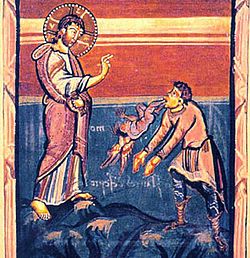
What is so sad and perplexing for me about this story is that here God arrives unannounced on the seashore and intervenes wonderfully – truly, in a way full of wonder – and nobody so much as stops and says “wow.”
If you want to, you can chalk this up to a few things.
This is a community on the other side of the Sea of Galilee—they don’t worship Israel’s God and certainly don’t know Jesus.
The miracle isn’t some quiet day surgery in some doctor’s office with a little local anesthetic; a horde of demons flies out like a swarm of bats and zooms into a herd of pigs, which summarily jumps off a cliff (the “heights” in the Golan Heights) and drowns.
The people who see it don’t wait around for an explanation.
By the time the people who hear about it drop what they’re doing and converge back on the scene, the only thing to see is a guy in clean clothes, speaking calmly and casually—you know: “Hey Nat, what’s up?”…”Hey Steve.”
Of course, to put it that way is misleading, because they know who he is, even if nobody seems to remember his actual name.
He’s been the most troubled guy in this or any other neighborhood for as long as anyone can remember.
Sadly, he’s troubled in a way that can be scary – his demon makes him loud and fast and strong.
You can imagine how hard it must have been to decide to put his hands in cuffs and put a chain around his neck like he’s some sort of junkyard dog.
And you can imagine how terrifying it must have been to see him break those chains and rip off his clothes and run for the graveyard.
Anyone who has cared for or about a troubled person will tell you how relentless and exhausting it is—how part of you is always waiting for that next phone call, always on guard, even in sleep.
This is how it has been for them, pretty much constantly.
And yet tragically, they’ve allowed this reality to shape them.
This man and his troubles have become so familiar that instead of his healing, the thing that gets them talking is the pigs who run off the cliff.
You can almost picture him, sitting on a rock as they all pull up, watching as they run straight past him to peer over the edge of that cliff.
“Wow, that’s a shame to lose so many nice pigs.”
“Wait, now who did you say did this to the pigs?”
“Why did he think it was o.k. just to hocus pocus somebody’s else’s property?”
You could write the script.
Meanwhile, the man is like: [MG: raise arms, “Helloooo, I’m here.”]
But he’s invisible now.
The point is: this is a people that has learned to worship predictability, and perhaps a certain vision of security, as ends in themselves.
The only things they notice are threats or challenges—as soon as the disturbed man is healed, they don’t notice him.
They’re already onto what suddenly happened to all those pigs, and their first reaction is that it must be some new threat that’s showed up out of nowhere.
This is their reality.
Do you know people like this? I do.
And so when someone finally points to Jesus and says, “He did it…that’s the guy” the mayor clears his throat and straightens his tie and tells Jesus that all things considered, they’d rather he left.
The thing nobody says is, “Wow.”
Again, it’s not hard to imagine how they got there.
But they have no idea how seriously this has misshapen each of them.
It’s blinded them to God and to one another.
In fact, Luke may want us to ask ourselves just who is truly possessed in this place, and by what…
Because what is it that is whispering into people’s ears, teaching them to forget who they are and talking them out of whom they are called to be?
In their world, the highest form of treason turns out to be disturbing the peace.
But the thing Luke really wants us to understand about God is that God is determined to disturb any peace that’s not worth having.
We affirm Jesus as the Prince of Peace only because we understand that he is the enemy of all complacency.
He loves us too much to let us fall for anything like that.
And this is what Jesus is especially contending with in this story, in which the Gerasenes seem to have gone in for complacency, whole hog.
Luke’s fundamental point is that Jesus represents something entirely different—something fundamentally disruptive to the status quo, no matter “quo” your “status” may be.
What Luke knows is that, when God shows up, He rarely acts in a way just to offer us some form of private consolation—more typically, God stirs things up…He gets things moving.
The early church tried to signal this particularly in its baptisms, which were expected to occur in rivers, even at a time when many people could not swim.
They did baptisms this way because, as they saw it, to become a Christian was to enter living water—water that the God who gets things moving was stirring up.
If that particularly challenged someone who wasn’t a good swimmer and meant they had to choose between life in God and the whispering demon of their own fears, well…isn’t that really the choice each of us needs to make?
Faith teaches that things happen because God draws near, and those things happen in ways that are utterly beyond human planning, human predicting, or in many instances, human preferring—for which, thanks be to God, who knows far better than we do.
As some people put it, God isn’t a noun: God is a verb…an action, a state of being that cannot be delimited or confined within what our language offers as a person, place or thing.
This is the God we’re supposed to be talking about and praying to and learning to follow.
That’s the God who shows up among the Gerasenes, who have no way to imagine such a God.
It’s also the God who shows up here on our side of the Sea of Galilee.
To be honest, I’m not sure many of us want such a God any more than the Gerasenes did.
When it comes to God, we’ve been putting him on our bumper stickers and billboards, our t-shirts and jewelry for years.
For a while in many communities, there was even an unofficial Christian yellow pages so you could be sure to keep your business in the family, as it were.
I bet if you paged through that book, it could tell you where to buy a car or get a good landscaper—God willing, one with a shiny, new electric leaf blower.
What it wouldn’t tell you was how to say “wow,” or how to notice what God was stirring up…what God was getting moving.
In other words, the thing it couldn’t have told you was the only kind of Christian information that anyone actually needs to know.
Our call is to live as people who know…as those who remember God as the one in whom we live, and move, and have our being.
May He always surprise us, and may we always great His mercies with thanks and praise.
Amen.
 Faith Meets Week