Monthly Archives: June 2025

Sermon: A God Who Won’t Be Appeased (Luke 9:51-62)

At one point in her education, my mom had a particularly mean professor—the kind of guy who criticized your work in front of the whole class, and who relished the chance to do so with a memorable lack of kindness. 

He constructed a terrible environment in which to try and learn. 

At one point, he’d given my mom feedback about something, and a few days later, she decided to go to his office hours to follow up with him about it. 

She knocked on his door. 

“Ah,” he said, “Ms. Grant.  Have you come with a cookie to appease me?” 

If only it had been that simple. 

In Chapter 9 of Luke’s gospel, you get the feeling that the disciples are working harder and harder than ever to try to appease Jesus, who is proving a bit of a taskmaster, though of course, not one like my mom’s old professor. 

Still, appeasing Jesus is not simple, either. 

He’s not being hostile for the fun of it, of course, or using his position to get his digs in.

He knows in a way they don’t that, as they begin to head for Jerusalem, the stakes are changing for him, and for all of them now. 

He’s been trying to tell them.  Trying to explain. 

But they don’t get all this new urgency, the seriousness, and if I may say, the crabbiness. 

It simply unsettles them, and this brings out their worst. 

Trying to regain their footing, they even make a bid to bond with the master by joining him in his feelings and taking them to the next level.

They try fanning the flames of whatever the prevailing mood seems to be, transforming it into fully-fledged righteous anger.

This gets extreme fast, as they propose punishing a town that rejects Jesus by calling down fire from Heaven itself.

That’s some cookie. 

Jesus is not appeased. 

In Genesis 18, Abraham had intervened with God to delay a moment of divine punishment, to give him time to save as many as he could, arguing that there had to be some good people out there—what about them?

But now, all these years later, the disciples don’t seem to remember that story.

Instead of divine mercy teaching them to be merciful and to look for the good people, they’ve let their belief in divine righteousness justify their own self-righteousness at being rejected.   

This is a serious mistake, and one that the church would do well to remember.

The world doesn’t need a church, much less a savior, in order to bless its own attraction to violence, nor its own strongly held conviction that “our” violence is clearly different and fundamentally innocent, unlike “theirs,” whomever they may be.

Scripture says that’s been a fact of human life since the time of the third and fourth humans, Cain and Abel, the sons of Adam and Eve.   

What the world needs is a way to free itself from the magnetic pull, both of that belief, and of the underlying attraction that informs it.

For Luke, this will be a central part of the message of Easter. 

But as he knew, and as we do, too, even in the light of Easter, the pull remains. 

It is an ever-present temptation, though one God would teach us to resist, if we were interested. 

This is one of those challenges that never really goes away.


It was there at the time of the disciples and resurfaces among us in every generation.

You don’t need to be religious to see that we are blessed with remarkable powers, and each generation unlocks capacities that our parents and grandparents could scarcely have imagined, and yet we struggle so mightily to use them for good. 

This is why we need God, and not one we characterize as a distant clockmaker who set everything in motion once and now sits back and just sort of listens to its ticking.

We need the God who comes alongside us in the midst of our struggles and temptations – the One who is not quite so easily appeased, and yet who sees us through.

I think this is why, in Luke’s telling, the story goes on to have these awkward moments of encounter between Jesus and two seemingly well-meaning followers who want to join the work of the Kingdom, but not quite yet.

Because they don’t know the God who sees us through, either.

In their case, the terms are not nearly as dire as calling down fire from heaven in the name of a proper respect for God.  

And yet, Jesus hears in each of them a very subtle, self-persuaded, even self-righteous inclination to put their own personal will ahead of the Father’s will—and again, for ostensibly religious reasons, no less. 

It’s true that the things on their to-do list are ones that in many circumstances might rise to the level of holy obligations: caring for a parent at the end of life (in one case), and in the other, leaving the family on good terms.

Yet while intending no disrespect to fathers or families, Jesus sees this as a dodge, or as steps in the wrong direction. 

We may not entirely agree; however, it’s safe to say that someone who is inclined to lecture Jesus about the importance respecting one’s father has a lot to learn.

What are we supposed to make of all this?

As Dorothee Soelle explains, life “is a series of trials, demands, and possibilities.  And so one life begins to differ from another, depending on how we use our opportunities, offers and temptations.  For what? To allow God to become visible in us.”[1] 

This is what faith is supposed to help us see, and even more importantly, what it is supposed to help us reach for.

To build on her insight, then: when we give into violence, especially when we consider it somehow sanctified by God, what have we allowed to become visible in us?

Are we really prepared to say that it’s God?

When we defer and delay the opportunities and offers of God in the name of more immediate impulses and temptations, what have we allowed to become visible in us?

This is why we need the God who is prepared to forgive us, but not to appease us. 

It is only that God who can transform us.

It is only that God who can make our lives into windows through which His light might shine.

So today, we give thanks for the unappeasable love of God, which expects so much from us, and looks to offer us nothing less than everything. 

Amen.  


[1] Dorothee Soelle, Thinking About God: An Introduction to Theology, 123, 127.
Sermon: “Whole Hog” (Luke 8:26-39)

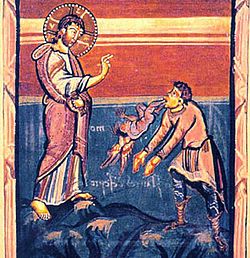
What is so sad and perplexing for me about this story is that here God arrives unannounced on the seashore and intervenes wonderfully – truly, in a way full of wonder – and nobody so much as stops and says “wow.” 

If you want to, you can chalk this up to a few things. 

This is a community on the other side of the Sea of Galilee—they don’t worship Israel’s God and certainly don’t know Jesus. 

The miracle isn’t some quiet day surgery in some doctor’s office with a little local anesthetic; a horde of demons flies out like a swarm of bats and zooms into a herd of pigs, which summarily jumps off a cliff (the “heights” in the Golan Heights) and drowns. 

The people who see it don’t wait around for an explanation.

By the time the people who hear about it drop what they’re doing and converge back on the scene, the only thing to see is a guy in clean clothes, speaking calmly and casually—you know: “Hey Nat, what’s up?”…”Hey Steve.”

Of course, to put it that way is misleading, because they know who he is, even if nobody seems to remember his actual name. 

He’s been the most troubled guy in this or any other neighborhood for as long as anyone can remember.

Sadly, he’s troubled in a way that can be scary – his demon makes him loud and fast and strong. 

You can imagine how hard it must have been to decide to put his hands in cuffs and put a chain around his neck like he’s some sort of junkyard dog. 

And you can imagine how terrifying it must have been to see him break those chains and rip off his clothes and run for the graveyard. 

Anyone who has cared for or about a troubled person will tell you how relentless and exhausting it is—how part of you is always waiting for that next phone call, always on guard, even in sleep.

This is how it has been for them, pretty much constantly.  

And yet tragically, they’ve allowed this reality to shape them. 

This man and his troubles have become so familiar that instead of his healing, the thing that gets them talking is the pigs who run off the cliff.  

You can almost picture him, sitting on a rock as they all pull up, watching as they run straight past him to peer over the edge of that cliff.

“Wow, that’s a shame to lose so many nice pigs.”

“Wait, now who did you say did this to the pigs?”

“Why did he think it was o.k. just to hocus pocus somebody’s else’s property?”

You could write the script.     

Meanwhile, the man is like: [MG: raise arms, “Helloooo, I’m here.”]

But he’s invisible now. 

The point is: this is a people that has learned to worship predictability, and perhaps a certain vision of security, as ends in themselves.

The only things they notice are threats or challenges—as soon as the disturbed man is healed, they don’t notice him.

They’re already onto what suddenly happened to all those pigs, and their first reaction is that it must be some new threat that’s showed up out of nowhere. 

This is their reality.

Do you know people like this? I do. 

And so when someone finally points to Jesus and says, “He did it…that’s the guy” the mayor clears his throat and straightens his tie and tells Jesus that all things considered, they’d rather he left. 

The thing nobody says is, “Wow.”

Again, it’s not hard to imagine how they got there. 

But they have no idea how seriously this has misshapen each of them. 

It’s blinded them to God and to one another.

In fact, Luke may want us to ask ourselves just who is truly possessed in this place, and by what…

Because what is it that is whispering into people’s ears, teaching them to forget who they are and talking them out of whom they are called to be?  

In their world, the highest form of treason turns out to be disturbing the peace. 

But the thing Luke really wants us to understand about God is that God is determined to disturb any peace that’s not worth having. 

We affirm Jesus as the Prince of Peace only because we understand that he is the enemy of all complacency.

He loves us too much to let us fall for anything like that.

And this is what Jesus is especially contending with in this story, in which the Gerasenes seem to have gone in for complacency, whole hog.

Luke’s fundamental point is that Jesus represents something entirely different—something fundamentally disruptive to the status quo, no matter “quo” your “status” may be. 

What Luke knows is that, when God shows up, He rarely acts in a way just to offer us some form of private consolation—more typically, God stirs things up…He gets things moving

The early church tried to signal this particularly in its baptisms, which were expected to occur in rivers, even at a time when many people could not swim. 

They did baptisms this way because, as they saw it, to become a Christian was to enter living water—water that the God who gets things moving was stirring up. 

If that particularly challenged someone who wasn’t a good swimmer and meant they had to choose between life in God and the whispering demon of their own fears, well…isn’t that really the choice each of us needs to make?

Faith teaches that things happen because God draws near, and those things happen in ways that are utterly beyond human planning, human predicting, or in many instances, human preferring—for which, thanks be to God, who knows far better than we do.    

As some people put it, God isn’t a noun: God is a verb…an action, a state of being that cannot be delimited or confined within what our language offers as a person, place or thing.

This is the God we’re supposed to be talking about and praying to and learning to follow. 

That’s the God who shows up among the Gerasenes, who have no way to imagine such a God. 

It’s also the God who shows up here on our side of the Sea of Galilee.

To be honest, I’m not sure many of us want such a God any more than the Gerasenes did.

When it comes to God, we’ve been putting him on our bumper stickers and billboards, our t-shirts and jewelry for years

For a while in many communities, there was even an unofficial Christian yellow pages so you could be sure to keep your business in the family, as it were. 

I bet if you paged through that book, it could tell you where to buy a car or get a good landscaper—God willing, one with a shiny, new electric leaf blower. 

What it wouldn’t tell you was how to say “wow,” or how to notice what God was stirring up…what God was getting moving. 

In other words, the thing it couldn’t have told you was the only kind of Christian information that anyone actually needs to know.  

Our call is to live as people who know…as those who remember God as the one in whom we live, and move, and have our being. 

May He always surprise us, and may we always great His mercies with thanks and praise.              

Amen.  

From the Newsletter: Visiting Other Churches in Summertime

Dear Friends of 2CC,

For a few years when I was first at our church, we had a member who spent large parts of the year out west—most of the major holidays and, without fail, most of the summer.  

At some point, they would resurface at church on Sunday, but I usually knew they had come back a bit before that because, upon their return, they would swing by the church office and leave a small stack of Sunday bulletins from their other church in California.  

To be honest, this was a little hard to figure out.  

They never wanted to talk about the bulletins — just have me receive them.  

I was heartened, of course, to know that they had kept in the habit of church while they were away.  

Frankly, I also wondered if they were trying to tell me something.  If they were, I was proving too obtuse to recognize it:  “See here, pastor, let me show you how it’s done….”

I never knew.  

This went on for ages, until one day, while I was picking up my latest stack of bulletins and wondering what they were supposed to mean, Gloria said: “Do you think they give their other pastor all of our bulletins whenever they go back to that church?”

Somehow, this seemed entirely possible, and that made the whole thing seem less critical.  

I even considered sending that pastor an email, sort of along the lines of “Hey, it’s me…”, although I never did.  I didn’t need to.  From that moment on, I was never bothered by it again.   

In fact, as time has gone on, I’ve really enjoyed hearing about what people find in worshiping other places.  

Each church has its own ways and responds to God distinctively.  This is a good thing.   It’s obvious to say that preachers have their own particular voice — certain themes they emphasize or ways they deliver a sermon.  

Similarly, churches have their own collective “voice,” which expresses itself in any number or ways, in and out of a formal time of worship.   That’s lovely.  

We tend to boil down our encounters to whether we liked it or not, but there are other questions to ask: who is God to these people?  Where do they see God?  What do they do about it?  What feels most “worshipful” here?  

This has a lot to teach us, if we let it.   It may not lead us to suggest changes once we get back home, but it gives us a sense of the wideness of God’s mercy and the joyful ways that His people respond. 

As you begin to set your own plans for the summer, I hope you’ll find time to worship not only with us here at 2CC, but also somewhere new. 

You can even drop off the bulletin if you want.   

See you in church,

Pentecost Sermon: Activated (Acts 2, Acts 6:1-6)

“But as the believers rapidly multiplied, there were rumblings of discontent. The Greek-speaking believers complained about the Hebrew-speaking believers, saying that their widows were being discriminated against in the daily distribution of food.

So the Twelve called a meeting of all the believers. They said, “We apostles should spend our time teaching the word of God, not running a food program. And so, brothers, select seven men who are well respected and are full of the Spirit and wisdom. We will give them this responsibility. Then we apostles can spend our time in prayer and teaching the word.”

Everyone liked this idea, and they chose the following: Stephen (a man full of faith and the Holy Spirit), Philip, Procorus, Nicanor, Timon, Parmenas, and Nicolas of Antioch (an earlier convert to the Jewish faith). These seven were presented to the apostles, who prayed for them as they laid their hands on them.” (Acts 6:1-16, NLT)

Well, this morning, the church celebrates Pentecost, a holiday that is often considered “the birthday of the church.”

We’ll get to that. 

But first, I want to begin with a wonderful, though maybe apocryphal story attributed to the anthropologist Margaret Mead. 

You may have heard it before. 

But supposedly Mead, late in her career, was asked what she considered the earliest moment, or very first sign of human civilization.[1] 

The possibilities are endless, right? 

Maybe it was forging metal for tools (or, of course, for weapons).  The beginning of agriculture instead of hunting or foraging.

Anyone who still watches “Survivor” might cast their vote for the control of fire. 

But Mead said that, for her, the beginning of civilization was marked by the skeletal remains of a healed thigh bone.

Because, she explained, wounded animals in the wild would not have survived breaking a leg bone. 

They would have been left to fend entirely for themselves, and before very long, they would have been gobbled up by some other hungry creature.

So by that logic, a healed thigh-bone meant that someone got help from somebody else—someone who nursed and cared for them while they got better. 

For Mead, this is where it all began. 

She argued, “Helping someone else through difficulty is where civilization starts.”

So hold on to that idea for just a moment, because I’m going to argue that the true birthday of the church – the very first true sign of “Christianity” – might be at a slightly later moment than the one we’re marking today.

My thought on this is pretty simple. 

Usually, certainly traditionally, we celebrate Pentecost as “the birthday of the church,” as I said. 

We have our reasons. 

Mostly, it’s because on Pentecost, there is this miracle.

All of these folks from different parts of the ancient world suddenly hear the gospel in their own language, and for a moment, it felt like God was personally reaching out his hand for each of them. 

For a moment, people seem to forget their differences and remember that they – we – are all children of God and members of one great human family, that our divisions are false and often end in sin.    

The church has never forgotten what it glimpsed in that moment.

How could it?

But if all the church had was just this momentary glimpse, wonderful and miraculous though it was, I’m not convinced it would have been enough. 

It’s too passive.  It doesn’t show us much of anything being activated beyond amazement. 

This is where Mead comes in for me. 

Because I wonder if she might suggest that a slightly later moment is what shows us the real birthday of the church – the story we’ve heard from Acts 6.

You just heard it: it’s not much of a story. 

Some of the earliest followers approach the disciples to say that their widows, which is to say, their vulnerable ones, aren’t getting their share of the food that gets distributed whenever the church gathers, as was the practice. 

O.k., fine. 

And yet, the names mentioned are worth noticing.

They’re foreign names – Greek names – the names of people whose fundamental claim on the time and attention of the hometown crowd in Jerusalem was a little different, and in some ways, not to be assumed in the same sort of way.

They know that. 

If you’ve ever had the experience of being a person who’s “not from around here,” you know what it can be like. 

For however long, they’ve been putting up with being ever-so-slighted – getting maybe not quite so full a plate or the same broad and ready smile when they come up to the serving table.

They catch a visible impatience when their mothers and grandmothers are moving too slowly or when they plotz down somewhere where all the seats are being saved.

They’ve noticed. 

What I love about this moment is that they push back.

Actually, that’s very important. 

Because it’s the first time since Easter that we hear about something getting activated by the message of the Gospel.

For the first time, people recognize that they are no longer just guests at the feast who should be grateful that they get to be there at all. 

It occurs to them that they are Christians, too.

So: shoulders back, head held high, they step forward and claim the dignity of being children of God.

They’re not making trouble, and, thankfully, it isn’t received that way; but they’re holding the community to its own promises – its own highest ideals. 

It is a crucial moment – maybe even the moment when the church is born. 

Because in so many ways, church should really be our word for what happens after Pentecost…after that first miraculous moment of invitation, when something is activated within us, and we begin to recognize claims on one another, and to live into what it means to say yes to one another, as God teaches us to do.    

This is especially important for us to hear on the day when we confirm our young people and celebrate their entry into full membership in our own community. 

Church, the operative word there is “full.”  

As of today, they are no longer guests in any church, anywhere, and above all, they are not guests in this one

They should not be.

This is what’s so great about Confirmation. 

It begins with inviting young people to become more like us. 

When it ends, if we’ve done it right, we get the opportunity to become more like them. 

By God, I hope we will. 

We could use a strong dose of their passion and compassion, their questions, and their refusal to follow blindly what one of them describes as “the pattern of others,” particularly when that pattern includes “dishonesty, selfishness, intolerance, and apathy.”

Over the course of this year, we have worked very hard to turn them into the most independent-minded, tough-loving, freedom-seeking, fact-checking, inclusive, generous, and, if need be, infuriatingly stubborn Christians in the whole world. 

Which is to say, we’ve tried to turn them into Congregationalists.

Now, because we’ve succeeded, that’s what they’ll do, and that is what they will expect of us.  

They’ll vote and serve and question and urge and give just like we do—though maybe differently than we have—and this, not because they don’t get it somehow, but because, in the most important sense, they do.    

Because now they are part of this thing…this thing that comes together on the other side of inspiration, when something is activated within us, and we begin to say yes to one another and yes to God.  

In a world that remains all too ready to leave behind its wounded, the church shows that Jesus offers another, more civilized and far more holy way.

Today we celebrate as, shoulders back and heads held high, they step forward, and the church is born anew.   

Amen. 


[1] For an argument that the story is, indeed, apocryphal, see Gideon Lasko, “Did Margaret Mead Think A Healed Femur Was the Earliest Sign of Civilization?” (16 June 2022) Sapiens.org.  https://www.sapiens.org/culture/margaret-mead-femur/

Sermon: “Beyond Division” (Acts 16: 23-34)

This morning’s Scripture describes an early moment in the church when the Apostle Paul responds to a dire situation, doing so with creativity and love. 

It’s amazing on a lot of levels, but just for starters, I mean it when I say things were dire: the setting is a Roman territorial prison; Paul and his assistant, Silas have been arrested, tried, nearly killed by a mob and badly beaten; then in the middle of the night, there’s a massive earthquake. 

But it turns out to be a funny sort of earthquake.

It’s an earthquake that shakes the foundations of the prison, opens the door of each and every cell, and, as it just so happens, also undoes all of the restraints on each and every prisoner.

That’s the full extent of the damage. 

So maybe it’s not so dire, after all, right?  

Most of the city probably slept right through it.

But for one person, it’s a complete catastrophe. 

That person is the jailer.   

Because the jailer wakes up, sees what has happened, and immediately pulls out his sword, figuring on ending his own life right then and there.

This impulse says a lot, actually. 

What it suggests is that, by his reckoning, suicide is bound to be less awful than whatever punishment his Roman employers will be sure to cook up when they find out.

Back then, when things fell apart, Rome often looked for ways to make an example of you. 

So when it came to a jailer who lost a prison-full of people in the middle of the night after an “earthquake,” it didn’t seem likely that Rome would understand.   

Of course, if you’re Paul or Silas, you actually have a pretty good idea of what had happened.

God was at work. 

But this is where love and creativity come in. 

Because instead of giving each other a high-five and heading off into the night, as they might have done, Paul and Silas stay right where they are. 

What’s more, they convince all the other prisoners to stay right where they are, too.

They could have run, but instead, they choose to stay. 

Nobody says that they’re supposed to save the jailer. 

But Paul and Silas make the choice to respond to this whole sequence of events in a new and unexpected way, and to try loving their enemy and seeing what might happen. 

They try caring when they have every reason not to. 

It isn’t a grand scheme.  It’s just God.

II.

And this is what I want to think about this morning.

Because I read that and I can’t help but think: this is the church that speaks so powerfully to me: the church that stretches to make choices like that. 

So much of the church at its best is to be found when it tries to look beyond our ugly rivalries and sees new possibilities.

It’s the church as we see it in moments like Paul and Silas in Philippi.

It isn’t always like that, of course. 

But let us not forget that there are also moments when the church comes back to itself, hears its own Scriptures anew, feels once again the transforming presence of the Spirit, and sees its work (remembers its work?) with fresh perspective and commitment.

There are moments when we stretch. 

Those moments give us a way to imagine something beyond the same old game—and when they do, it can be amazing to see just how eagerly people step off the merry go round…how grateful they are to step back onto solid ground…more generous and peaceful ground…the kind of world God intended. 

In this morning’s gospel, that’s just what the jailer does.

Acts tells us that he spends the rest of the night bandaging Paul and Silas’ wounds, giving them something to eat, and starting a whole new life right then and there, no longer bound by the rules of the same old game – the very rules it has been his job to enforce. 

He and his whole family become Christians right there under Rome’s nose. 

And maybe they pack up and go do something else…or maybe they just stay and find ways to be Christian in that context. 

Either way, this is Scripture’s first signal that Rome itself will come to be transformed by the love and creativity of God’s people. 

III.

And I have to say, I’m kind of feeling this right now.

I’m ready for the world to be transformed like that again.

I’m ready to be transformed that way, myself. 

I’m hardly one to sing about disruption – to me, most of the time that’s just opening a Pandora’s box.

But I would be thrilled to see the foundations of our old divisions shaken, and what feels like the same old game get disrupted as people reach for something better…as we decide to step off the merry-go round. 

Because I know how earnestly I long. 

I long for a world that’s better than this one sometimes seems as if it even wants to be. 

I long for a world where people can disagree and still keep talking. 

I long for a world where we don’t pretend that all the answers are simple, but where there are also space and grace to figure things out, to not be there yet, to be learning, to have questions, to be stretching. 

It’s something I can scarcely describe and cannot locate, but that my heart knows better than the scent of my mother’s perfume.

You may disagree with me about plenty, but I bet you know exactly how that feels. 

Paul and Silas have come to tell us that it may not be nearly as mysterious and elusive as we think. 

Because as we let God into our lives and let ourselves be drawn into God’s own life, things happen. 

People change. 

We recognize the choices, not that we have to make, but that we get to make between the world as it is and as it might be.

We get our own invitation to live with love and creativity in this moment and make a church that sees beyond one agenda or another, but says everyone needs saving, somehow.

The church is how God embodies the idea that we have it in us to be a force for good, not in some simplistic sense of making everybody Christian – that’s thinking too small – but in the sense of being called to reject any agenda that tries to keep people apart for its own purposes, and to live deeply and joyfully in a very different way. 

This is what I want church to be about now.

This is the work I would love to see us get back to.

In its muddled and most distracted moments, the church can find itself playing the jailer in this story—enforcing someone else’s rules, desperately in need of the very things its gospels try to talk about.

In its greatest moments, the church shows the whole world how to take one big, collective step off the merry go round and back onto solid terrain.  

And the world needs us to do that again. 

The world needs people with this inexplicable call to love even when they have every reason not to…people who see their own cell doors fall open and decide not to leave, but to love right then and there. 

May such people shake the foundations of everything that seems so broken right now, and teach the world to put its swords away, and come live.             

Amen.