
While there have been many great marital partnerships over the course of American history, one of my favorites is the partnership between John and Abigail Adams.
I am pleased to report that they were Congregationalists and that Abigail was a pastor’s daughter, no less.
During John and Abigail’s courtship they apparently wooed each other by reciting favorite sections of Milton’s Paradise Lost.
(He was, more or less, a Congregationalist, too.)
But it is really their letters back and forth during the spring of 1776 that indicate their deep bond.
Mr. Adams, of course, was knee deep in the work of declaring independence—he would come to be a major voice among the framers of the Constitution.
But as the Continental Congress was initially preparing its formal break with Great Britain, Mrs. Adams wrote him a rather pointed letter.
“I long to hear that you have declared an independency,” she wrote, “and by the way in the new code of laws which I suppose it will be necessary for you to make I desire you would remember the ladies, and be more generous and favorable to them than your ancestors. Do not put such unlimited power into the hands of husbands. Remember all Men would be tyrants if they could. If particular care and attention is not paid to the ladies we are determined to foment a rebellion, and will not hold ourselves bound by any laws in which we have no voice, or representation. That your sex are naturally tyrannical is a truth so thoroughly established as to admit of no dispute…”
Mr. Adams responded: “Depend upon it, we know better than to repeal our masculine systems. Although they are in full force, you know they are little more than theory. We dare not exert our power in its full latitude. We are obliged to go fair, and softly, and in practice you know we are the subjects. We have only the name of masters, and rather than give up this, which would completely subject us to the despotism of the petticoat, I hope General Washington and all our brave heroes would fight…”
Mrs. Adams was only somewhat amused. And pressing her point one more time, she wrote:
“I cannot say I think you very generous to the ladies, for whilst you are proclaiming peace and good will to men, emancipating all nations, you insist on retaining an absolute power over wives. But you must remember that arbitrary power is like most other things which are very hard, very liable to be broken – and notwithstanding all your wise laws and maxims we have it in our power not only to free ourselves but to subdue our master, and without violence throw both your natural and legal authority at our feet.”[1]
Am I right that they seem well-matched?
I’m not sure if they were flirting while fighting or fighting while flirting, but so what?
And to me, Abigail Adams’ plea for her husband to “remember the ladies” as independence took legal and political shape is a rallying cry for the ages.
It didn’t happen in 1776.
By the 1840s, the ladies would grow tired of waiting to be remembered and begin to take the cause of suffrage upon themselves—it was almost an 80 year campaign.
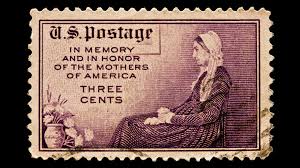
Interestingly, Mother’s Day emerged right at the end of that time, beginning in 1908 and then becoming a federal holiday (although always on a Sunday) in 1914, just six years before women finally won the right to vote.
And I guess I would simply observe that, in its own way, Mother’s Day is also a kind of prompt to “remember the ladies,” or at least, some of the ladies.
For Anna Jarvis, the pioneer of American Mother’s Day, the central idea was for each of us to remember only one: our own mother.
That’s why the apostrophe in Mother’s Day goes where it does.
But even for all that, I’m not sure that we really make it much of a point to try to see our mothers in any kind of complexity today.
I had a relative who always used to mark his birthday by going and putting flowers on his mother’s grave.
It was in some sense to thank her, I am sure.
But clearly, it was also to celebrate what he saw as her greatest achievement.
And there is a part of me that wonders if Mother’s Day might not be a little like that, too.
Just what is it about the ladies, or just our own moms, that we’re remembering?
For its part, Scripture is willing to remember moments that are remarkably raw in the lives of its heroines.
The lives of women are full of cris de coeur, and in one notable moment, even an outright guffaw in the face of a divine promise that sounds just flat out ridiculous to a woman who thinks she’s seen it all —who thinks promises like that are just the kind of thing a man would say.
The story of Ruth is remarkable, not only as a study of resilience in the face of tragedy, but because the real love story, the strongest glue between the characters, is not the marriage at the end (although that’s happy, too), but the unbreakable bond between the beautiful, young, foreign widow, Ruth and her wise but weary mother-in-law, Naomi.
In the opening verses of the story, Naomi urges the newly-widowed Ruth to leave her and find support and a new beginning back among her own family—to remember her fondly, perhaps, but distantly, which is to say, she more or less tells Ruth to move on, to let herself forget.
“See,” she says, “your sister-in-law has gone back to her people and to her gods; return after your sister-in-law.”
But Ruth refuses.
She would rather remain in a dire situation together than find a way to survive alone.
“Entreat me not to leave you or to return from following you,” she replies, “for where you go I will go, and where you lodge I will lodge; your people shall be my people, and your God my God; where you die I will die, and there will I be buried. May the Lord do so to me and more also if even death parts me from you.” (Ruth 1:15-17)
Her words are so beautiful that they are often spoken at weddings, and yet that is exactly not the point.
In fact, she’s giving voice to a very different kind of love.
One for which there are no obvious ceremonies or standard words or clearly defined roles.
And yet, within the messiness of all that, and despite all the chaos that surrounds them, it’s clear that at some point, their love and loyalty for one another start to change things.
At some point, love and loyalty like theirs become holy.
At some point, unlike the mawkish, sentimental emotions and the polite half-truths we so often use to keep one another at arm’s length have fallen away, what comes to exist between this woman and her mother-in-law is raw, real, beautiful, and eternal.
It is a love that transcends and sustains them both.
We can have this, too, if we’re willing to go there.
First, though, it brings me back for one more moment to John and Abigail Adams.
Because for all their wit, their candor, and their obvious affection for one another, their letters back and forth make clear that Mr. Adams, the one who gets to write the rules for a new nation, is mostly just hearing his wife out until she finally lets the matter drop.
Naomi and Ruth suggest a different possibility.
They show us what can happen when we truly heed one another and step into an unknown future together, strengthened by the holy bond that love and solidarity have forged between us.
It’s what life might be when the matter is our lives and dropping it isn’t an option.
It changes and ennobles both people.
The great virtue of Mother’s Day is its reminder that such bonds are not only possible but are part of why we’re standing here today.
If that’s not really what we tend to make of today, it should be.
This is what we’re supposed to remember.
Maybe those bonds are with the woman who gave birth to us.
Maybe it’s with a different kind of mother.
But whoever it was, some good person was able to see us in our complexity.
Someone stood up and stood in and walked beside us, like blessed Naomi did.
Someone was generous and open enough to let their life become entangled with ours, sustaining us with the manna of their care and courage when we needed it most.
Today is for them. And if that was you, it is for you.
May recognizing their own complexity – their own griefs, their own compromises, their own hopes – a little more clearly now make us more even more grateful for all they gave us.
We remember the ladies, our mothers, offering our thanks to them and to God, the one who is both Mother and Father of us all.
Amen.
[1] https://wams.nyhistory.org/building-a-new-nation/navigating-the-new-government/remember-the-ladies/#:~:text=About%20the%20Resources,desires%20in%20the%20Federal%20period.
 Faith Meets Week