
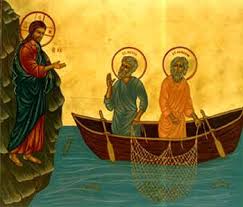
If our Scripture this morning sounds familiar, it may be because it revisits a moment that we looked at earlier this year.
You may remember it from Luke’s gospel, in his account of Jesus calling the disciples to become “fishers of men.”
Once again, there are fishermen. Once again, they’ve been fishing all night. Once again, no luck.
Once again, Jesus appears, tells them to cast their nets on the other side, and suddenly there is a massive haul of fish—enough that the nets almost break.
Peter is central in both stories, too.
But in Luke’s version, Peter takes one look at those full nets and turns to Jesus, saying “Go Lord, leave me, sinner that I am.” (Luke 5:8)
He says this out of immediate respect rather than anything else.
John decides to leave those words unspoken.
When the moment occurs is also interesting.
For Luke, it is almost the very beginning.
For John, it could almost be the end.
Their travels are over. They have snuck back home. They are back in the boat. Nothing seems to have worked out the way they thought it would.
The story is sadder if you remember its arc: they’ve gone from fishermen to fishers of men back to fishermen, and yet, on this night, not even that: tonight, they are fishers of nothing.
This is especially true for Peter, who had been so central to Jesus’ work.
So when I think of Peter having up and left Jerusalem, and now back on his boat in Galilee, back at his nets and staying up all night, fishing, I think of him lost in thought.
I see somebody really wrestling.
“Go Lord, leave me, sinner that I am,” he said in Luke’s version.
In John, Peter seems like someone who’s been left.
It wouldn’t surprise me if nobody was speaking a word out there on the water – that Peter’s friends are there, but trying their best to give him some space.
And yet, I think what Peter feels is not abandonment, but shame.
He’s wrestling with himself.
In some sense, this might even be long overdue.
The gospels describe many situations where Peter acts (or reacts) without thinking.
They also show his tendency toward grand gestures—in one fairly typical example, he hops out of a boat in the middle of a storm to walk with Jesus.
Just as typical is the almost immediate sequel when he suddenly gets scared, starts sinking, and needs rescue.
So much for his grand act of heroism and faith.
Another one is the night when Jesus is arrested.
Peter is all about promises of loyalty, come what may – but he doesn’t end up keeping those promises.
That night, he turns out to be no braver than anyone else.
But the thing of it is, right up until he messes up yet again, that he thinks he is.
His own version of who he is and what he does makes him style himself differently somehow.
Now this is really getting in his way.
The pastoral theologian Lewis Smedes talks about the difference between healthy and unhealthy shame in our lives.
He notes an important difference between hearing a voice that speaks from our true self as opposed to a voice from our false self.[1]
This is very important.
Because there is a voice within us that seeks to call us back when we’ve done wrong or when we’ve somehow acted outside of the person we truly are.
It’s healthy to feel like we have not lived up to ourselves in those moments, and healthy for that to burn.
And there is also a voice within us that shrieks with pain when our superficial identity, a kind of preferred, successful self, undergoes its reversals.
There is the unhealthy shame of our particular set of wounded vanities, whatever they may be.
I was reading this week about a person who was adamant about keeping all her college textbooks on display in a particular room in her house, including the ones from classes she had totally detested and otherwise put behind her.
And then one day, it occurred to her that she needed those books purely as a prop—as a way to prove to herself that she was a smart person.
To her great sadness, she realized that, her life being what it was, the books in her living room had become more or less the only proof she had.
Stories like hers remind us of how much we all contend with healthy and unhealthy shame as our true and false selves contend for our attention.
And this is what Peter is contending with as he sits in that boat, lost in thought.
There’s the unhealthy shame that surrounds him every time he ends up falling on his face or sinking in the waves.
Intertwined with it is the genuine grief of his true self at not standing up for his friend, at seeing his own love and courage falter.
This is when Jesus appears and calls to him, offering Peter the chance to speak words of love and affirmation.
In a replay of the night when Peter had denied Jesus, he gets asked the same question answers three times, even to the point that he finds it annoying…even from Jesus.
He does not recognize that Jesus is offering him a second chance, a way to overwrite his three earlier denials. A chance to start again.
In this, Jesus offers him a way to live, but on somewhat different terms.
Instead of being an impressive, important dispenser of forgiveness and snazzy miracles, the leader of the pack that he had imagined himself to be, Peter is invited to live as someone genuinely forgiven, and therefore truly free.
The moment lets Peter finally shed the unhealthy shame of a false self.
His wrestling comes to an end.
Lord knows, we wrestle, too.
Our hopes and fears, qualities and shortcomings, faith and pessimism, love and betrayal all contend within us, trying to give their distinct versions of the way things are and of how we should respond.
There are plenty of nights when we’re sitting silently in the boat, or we’re driving mile after mile in the car, lost in thought, unsure of what to do or who we are or what we stand for.
Jesus comes to offer us a second chance, or maybe a third or a fourth one, a chance to pay attention to the voice of our true self and follow it to freedom.
We’re sure to find Him there.
Amen.
[1] See Lewis Smedes, Shame and Grace: Healing the Shame We Don’t Deserve.
 Faith Meets Week