
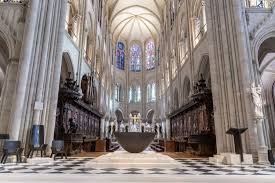
You may have seen that the Cathedral of Notre Dame in Paris is reopening this week, five years after that terrible fire that destroyed so much of it.
With all the loss, it would be easy to overlook the profound relief and gratitude for what remained.
The fire burned for nine hours, yet the relics, the walls, the stained glass windows, and the organ all survived, and there were no fatalities.
In the days after the fire, there was no shortage of ideas for how the reconstruction might offer a chance not only to save Notre Dame, but even improve it.
For example, one person proposed a swimming pool on the roof.
They didn’t end up going in that direction, of course.
If that idea had gotten any traction, I’m sure that the Archbishop of Paris would have had a few thoughts about it.
Still, it is sort of true that Notre Dame doesn’t simply belong to the church alone. Not really.
It might be in a somewhat different way, but the Cathedral also belongs to France itself, and even the world.
If there is any lesson to be learned from the fire, it’s that people, religious or not, love Notre Dame.
They seek and find something there that may be deeper than words.
On Friday, the New York Times quoted Phillipe Joel, head of the restoration task force, who said, “Each day we have twenty difficulties. But it’s different when you work on a building that has a soul. Beauty makes everything easier.”[1]
So many would agree.
And I hope I’m not being picky in saying that it’s not the beauty that reveals the soul so much as it’s the soul that reveals the beauty.
I’m going with soul on this.
When the reporter asked another worker on what the job had meant to her, “she struggled for words, then started to weep.”
To me, that’s about soul.
Let me tell you a little more about the building, and you can tell me if you agree.
Because if you’re rebuilding the cathedral and time is of the essence (money, too), why bother replacing the oak roof beams with each new one specifically chosen to match the one it was replacing, much less then carving it by hand to match the original silhouette, much less putting the original medieval carpenter’s mark back on it?
And all this, for a part of the building that for the next 800 years, only people working on the roof will ever even see?
What is that?
Why bother getting things right rather than simply getting them done?
It’s not just beauty.
It’s soul.
It’s feeling yourself in the presence of something that always was and is and ever will be.
It’s what the opening words of John’s Gospel mean when it says, “In the beginning was the Word, and the word was with God, and the Word was God. He was in the beginning with God, and all things were made through him, and without him was not anything made that was made. In him was life, and the life was the light of men. The light shines in darkness, and the darkness has not overcome it.” (John 1:1-5)
The wording has thrown everybody for ages, and to some extent, it’s slippery on purpose, but at the very least, what John means is that in Jesus, we encounter the promise and the presence of eternity.
For John, this is something (he calls it the Word) that was present at Creation and that has been in every act of making ever since, from great cathedrals and newborn creatures to a turkey someone draws for you by tracing their hand on a piece of construction paper.
For John, God didn’t just make a world and leave it at that.
God gave the world a soul – something in it that points back…that looks up…that sees beyond.
The soul is what knows the initials of the original craftsman, carved into the beams that hold up the universe.
That’s what the disciples knew in Jesus, and not only because Jesus told them about it, but because they saw that soul in him.
Then somewhat more gradually and partially, through his presence and with his help, they saw it in themselves.
So much of the wonder of Christmas is that it helps us to see the soul of the world and the souls of one another now for ourselves.
It may still be gradual and remain all too partial.
But that’s what we’re looking for, and it’s what is so particularly on offer.
Christmas is here to tell us that the soul is there to be found.
Admittedly, Paul’s affectionate words to the church at Philippi were not specific to Christmas, but they come from the same spirit.
“This is my prayer,” he writes, “that your love may overflow more and more with knowledge and full insight to help you determine what really matters, so that in the day of Christ you may be pure and blameless, having produced the harvest of righteousness that comes through Jesus Christ for the glory and praise of God” (Philippians 1:9-11)
These are the days when we collectively seem to reach for what really matters.
At our best, we seek the knowledge and full insight we need to figure out what that might be.
Let’s not make that sound too easy, of course.
As we know, each day may present twenty different difficulties which demand our immediate attention: dressing a toddler, taking a meeting (or the umpteenth zoom), refilling the pill organizer for the coming week, keeping abreast of the news.
Still, as the man said, the beauty that surrounds us makes everything easier.
It points to what we’re really after, the people we really are, and most of all, to a love greater than any cathedral that will not let us go.
Amen.
[1] https://www.nytimes.com/2024/12/05/style/pantone-color-mocha-mousse-2025.html?searchResultPosition=1
 Faith Meets Week