
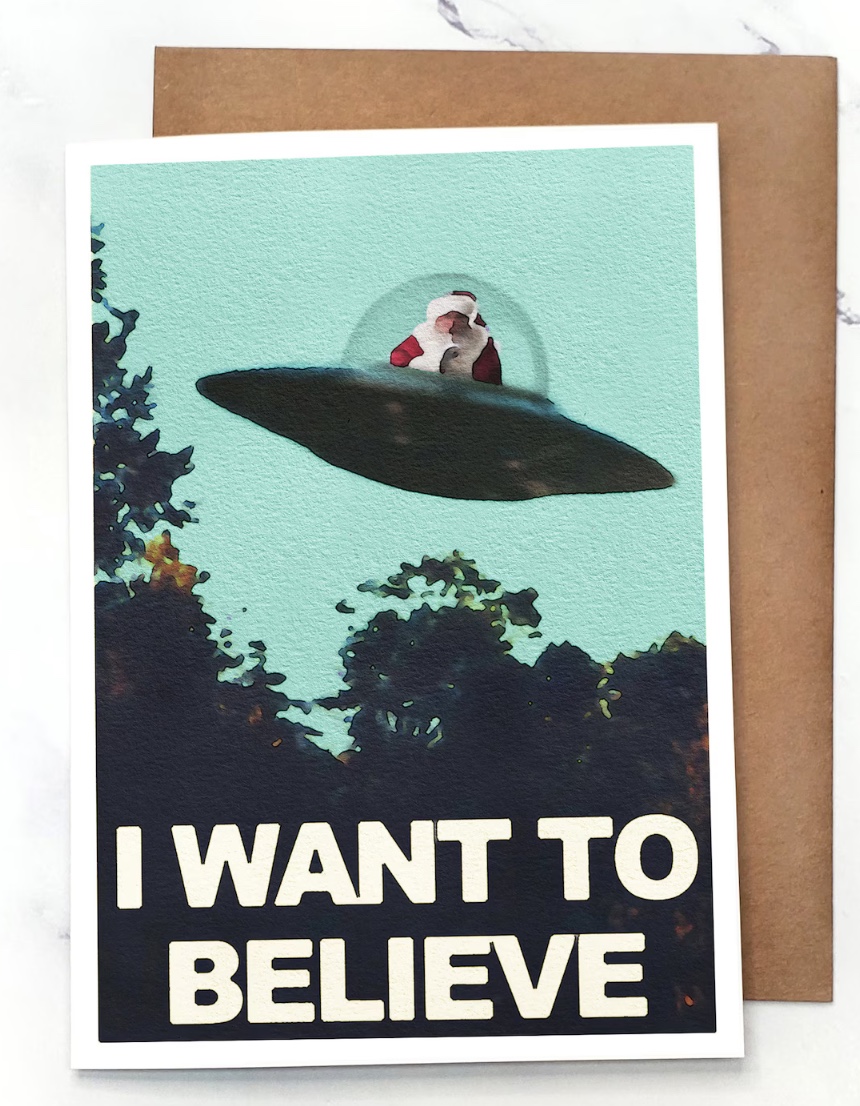
Have you started receiving Christmas cards yet?
We got the first ones yesterday, unless you count that tire shop in Riverside. We got theirs just after Halloween.
If you haven’t gotten many quite yet, you may yet be in store for one of this year’s most surprising Christmas card themes.
I noticed it when I was shopping for our family Christmas card.
Suddenly, it seems, there are all these Christmas cards with UFOs in them.
Don’t believe me?
Oh good—because I brought examples.
So, these two are sort of classic, and have the virtue of being mirror images of one another.
In the one, Santa’s sleigh is a UFO pulled by reindeer.
In the other, the sleigh is being pulled by a line of UFOs.
But we’re not done, friends. Not at all.
Well, the obvious theme is “beaming up”…though the message seems not so cheery, somehow.
Fortunately, Santa is on the case…or, well, maybe he isn’t.
(Is Santa running here?)
Some seem to imagine that the encounter could be a good thing.
Maybe it’s just a variation on what Christmas has always been about.
That’s sort of how it looks here:
(I think the one on the bottom might be an album cover from the 70s.)
And here:
But in the end, maybe the one that sums it up best is this one:
What do you think?
Is anybody rushing out to go order one of these before they’re all gone?
Clearly, if there are so many variations to choose from, this whole concept must be having a moment.
Still, I’ve been trying to put my finger on just what the moment might be.
Maybe for a certain kind of ruthless skeptic, there is amusement to be found in a mash up of seemingly outlandish stories.
Alternatively, it may be that the traditional pastoral, northern European imagery of flying reindeer no longer much speaks to us.
By contrast, space fantasy does.
Those prepared to admit that “Star Wars” is fundamentally a old-style western that just happens to be set in a galaxy far, far away have been saying this, more or less, for years.
Besides, how would Santa challenge the laws of physics as we know them?
Ask the aliens – surely, they’ll know.
Yet at a more basic level, it seems to me that these cards are trying to say something about encounter – close encounter, if you like, but nevertheless: encounter.
Because what is it, after all, to have something utterly beyond us appear out of nowhere?
Does the appearance of something that changes everything represent destruction or salvation…or strangely, maybe both at the same time?
What is it to see with your very eyes that we are not alone…that we have never been alone, and will now forever know that we are not alone?
And if we don’t know how to answer any of those questions, maybe we should ask someone.
In fact, the Bible has some suggestions for whom we might approach with questions such as these.
It might point us to Mary, Jesus’ mother, or the shepherds, Mary Magdalene or the disciples on the road to Emmaus, or Paul out there on the road to Damascus.
Any of them might know.
Because isn’t the strangeness, but also the certainty of encounter precisely what they have come to understand?
Whether it’s Christmas or whether it’s Easter or whether it’s some other time entirely, the story the houses of worship keep telling and retelling is this story of encounter.
It’s a story that runs up against our expectations and our faith in the world as we know it.
Somehow, it always seems to reemerge just when we shake our heads with exhaustion.
We all know those moments when it seems like there is nothing new under the sun, whether we’re speaking about the world or, more specifically, about ourselves.
There are times when we start feeling boxed in, especially by life and its tough choices or, on a grander scale, by fate and its stern decrees.
But are we really prepared to live differently?
Christmas is here to press that question.
Because you can’t encounter God and bumble along, entirely the same as before.
When Nicholas of Myra, whom we know as St. Nicholas, was walking the nighttime streets of his hometown in 4th century Turkey, he heard a poor man praying through an open window that he would not have to sell his children to pay off his debts.
Nicholas took it upon himself to answer that prayer by throwing a small purse with gold coins through the window, where it landed in a shoe.
This was the origin of gift-giving at Christmas.
Its point was not affection, but liberation.
It was a moment of encounter between total hopelessness and new life, not just courtesy of Nicholas (though he was part of it), but through the power of the living God.
The fruits of the spirit that emerge from a life in God remind us of the source from which all good gifts must spring.
This is wonderful, and when it happens, maybe even a little weird.
This is what Christmas is trying to say.
If you ask me, it might not be so different to wake up and find gold in your shoes, or a baby in a manger, than it would be to look up and see a spaceship the size of Manhattan hovering in the sky.
The point is: you can’t go on the way you did before.
And it strikes me as entirely correct to begin the Christmas season by reaffirming that in every way possible.
This morning’s Scripture readings are driving toward this same conclusion.
Luke’s Gospel comes, not from the beginning of his account, but actually from the end, looking to Good Friday.
Jesus talks frankly about disruption and confusion—even a dark hour to come just before God’s new dawn.
“Be alert,” he warns, “praying that you may have the strength to escape all these things that will take place, and to stand before the Son of Man.” (Luke 21:36)
By contrast, the Old Testament prophet Jeremiah offers more hopeful words from God:
“The days are surely coming, says the Lord, when I will fulfill the promise I made to the house of Israel and the house of Judah. In those days and at that time I will cause a righteous branch to spring up for David…and in those days Judah will be saved, and Jerusalem will live in safety. (Jeremiah 33: 14, 16)
The Gospel presents a kind of agony in waiting for deliverance, anticipating a moment when everything would seem in doubt, even for those who followed Jesus.
The earlier words from the prophet were more confident, even though they came very much in the midst of agony, at the moment when God’s ultimate deliverance might have seemed most improbable of all.
But both of them are quite sure that things as they were would not…could not…continue in the same old way.
Strange as it may sound, they saw this ultimately as a source for hope.
Because for those who were (who are) willing to live differently, it was (it is) just the beginning.
So it’s right to hold onto the weirdness of Christmas and to embrace the joy it finds in Godly disruption.
However we can recapture the enormity of its claims is good, because this may be the only way we can reclaim the something of the enormity of the God we know in Jesus – the impossible grandeur God places, paradoxically, in a tiny baby.
Christmas is when we remember God’s promise that the world would never be the same again.
And it’s when we recommit ourselves to making sure it won’t be, starting with ourselves.
Amen.
 Faith Meets Week