
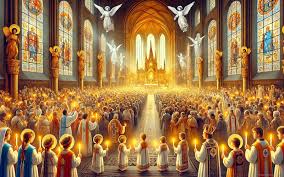
Congregationalism understands “saints” differently than, say, Catholics, Orthodox, and some other Christians do.
In our tradition, when we use the term at all, we look to how the Apostle Paul introduced it in his letters. Following his lead (as we understand it), we see saints in two particular ways: first, not as a way of talking about “super-Christians,” but rather about ordinary folks whose lives have been transformed by God’s extraordinary love; second, we always speak of saints in the plural, collective sense, and not as individuals.
(We also eye with suspicion any notion of praying “to” anything other than God…which is a theological misread that justified a ton of Protestant sanctimony and anti-Catholic bigotry…but that’s a story for a different newsletter.)
Yet, according to us (or, if you prefer, according to Paul as we read him), saints are who we are together, as our church community is genuinely moved to live in the light of God.
Knowing ourselves as well as we do, maybe it’s no wonder that we use the term sparingly, if at all — we’re all too aware of our limitations and hostilities to hazard any claim to sainthood, whatever the definition might be.
For some, saints represent an ideal that can only collapse under the reality of human shortcomings.
But we forget that saints, even by traditional ways of reckoning, don’t need to be perfect (if “perfection” even means never having a grouchy word, or a dark or an impure thought). Certainly, communities can’t claim to be perfect in that way, try as we might.
That misses the point.
Because far from being undone by the reality of imperfection, sainthood is an affirmation of the counter-reality of good.
It names the remarkable fact that, in a world that can be so dark and broken, there are, nevertheless, lives and communities where the light still shines through.
It reminds us that we do not need to be perfect to be kind or for God to use us.
More controversially, perhaps, it goes so far as to suggest that wherever the legacy of the divine presence is remembered and shared, it still offers strength and guidance—God uses it and is present through it once again.
As someone who has never given much thought to saints, I still find that to be true. I find myself remembering people and places where, however improbably, I found light by which to see.
All Saints’ Day reminds me to make sure I find ways to keep passing it on.
I hope you will, too.
See you in church….
 Faith Meets Week