
A couple of weeks ago, I needed a haircut, and the place I ended up going was next to Sophia’s, the Greenwich community’s costume shop.
I know from the pictures of the church’s 300th anniversary that some of you have been to Sophia’s.
If you haven’t, and if you’re in the market for, say, a Victorian-style hoop skirt, it is the place to go.
Anyway, as I walked by Sophia’s en route to my haircut, there in the window was a mannequin.
It was dressed in an elaborate gray silk suit with knee breeches, a vest, and a long coat – the kind of attire I think of people wearing in France just before the Revolution.
It even had a powdered wig.
It seemed quite authentic.
You could just imagine Marie Antoinette standing in Versailles, asking this person why all the people in the city without bread didn’t just eat cake.
The suit was really nice – and you know, if I were 6’4” and 150 pounds, it would be right at the top of my list.
But it also got me thinking.
I feel like most of the people I know are so busy right now, it’s hard to imagine them going to a costume party where your costume “game” has to be at that level.
To be honest, I can’t remember the last time someone told me they went to a costume party, at all. Even a more basic one.
Are regular costume parties a feature of your lives that nobody’s telling me about?
What’s harder to admit, of course, is that, even without parties, our daily lives have a certain amount of costume to them.
Sociologists have long argued that, actually, it goes way beyond that, if you think about it.
They’d say that, in some ways, we’re all playing characters…that we are assuming the role of ourselves in whatever scenes we happen to wander into, or perhaps create by our arriving.
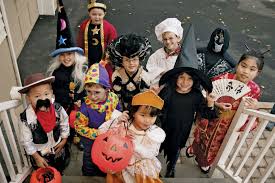
This is what makes Halloween so interesting.
Because it’s the day when our young people have the freedom to think about what side of themselves they want to put on display.
It’s the day when they script something different for their arrivals and can notice and appreciate the difference between that and the everyday.
I don’t think you can really enter into it without claiming and proclaiming something you know is inside you.
Especially for the young, the power of both their dreams and their fears, the shape of their heroes and their villains is on full display.
If you wanted to, you could even call it “apocalyptic,” in a way – going back to the original meaning of the word “apocalypse,” which does not point to destruction, but actually, to revelation – to a moment when hidden things will be finally uncovered and the truth will reign.
Satan is the one described by tradition as the “father of lies.”
The Christian view is that the truth is never something to be afraid of.
To tell the truth is to stand in the very presence of God, which we know because God makes such a point of using truth to bring healing and liberation.
As Jesus said to his home synagogue at Nazareth, “The Lord has sent me to proclaim release for the captives, and recovering of sight to the blind, to set at liberty those who are oppressed” (Luke 4:18).
And whatever our captivity, whatever our blindness, whatever our oppression, the church has known the presence of Jesus and the power of truth wherever the shackles finally fall.
Apocalypse – revelation – is happening.
And yet, if you went to Sophia’s Costume Shop and watched one of our neighbors pick out the right costume, I wonder if that’s what you’d see.
Children find a joy in getting ready for Halloween, in facing their fears or presenting their ideals.
Often, we don’t enjoy it all that much.
For us, the trick with finding the right costume is making sure that it doesn’tsurprise anyone or put anything new out there – that whatever it is remains solidly “on brand” for us and keeps our secrets safe with us.
We’re determined to manage our own revelations, thank you, even when it means muting much of our truth.
Except that, on Halloween, we are invited to image what it might look like if we didn’t.
In this respect, Halloween might accomplish more in one night than many churches do in the course of 52 Sundays.
Because on Halloween, we’re willing to accept the gift of release and the joy of truth which the church faithfully and forever proclaims, but which we may hear only dimly.
It says two things: first, that lurking beneath our saintly demeanor is a sinner squarely in need of redemption; second, and by contrast, it says that even a monster might yet be a hero, and is, first, foremost and forever, a creature that God loves.
Halloween leaves us to consider which of those might be the word we most need to hear on any given day.
Maybe it also makes us think more carefully about the roles we play and the subtle forms of costume we put on to play them, all the better to convince whatever audiences we’re most hoping will believe our performance (so often, an audience of one).
It is a great sadness to me that in some Christian circles, there can be so much focus on the pagan roots of Halloween, and so little recognition of its faith in the power of the truth to make us free.
As I see it, the Christian thing is to champion and cherish that truth whenever we see it, and all the more so when the speaker and their truth are tender.
That is not celebrating the darkness. It’s letting in the light.
And right now the world stands in dire need of more light, not to mention the truth which is its fundamental source.
But that’s a sermon for another time.
For this morning, may we find in God’s presence the courage to be ourselves, and in God’s love, the understanding of how fearfully and wonderfully each one of us is made.
And may we learn to live in such a way that no matter what our costume may be, the joy of our truth and the truth our joy will always shine through.
Amen.
 Faith Meets Week