
For the youngest among us (not to mention all our teachers), the new school year is either already under way or just about to be.
On Labor Day, summer solemnly lowers its flag and marches off, never mind that the warm days aren’t quite over and, astronomically speaking, we’re a few weeks short of the equinox.
Our neighbors and many of us are gearing up for what’s next.
Our presidential candidates are busy and seem to be appearing at every state fair and professional convention happening anywhere, even as they gear up for the debate, which is coming in a little over a week.
In our own church family, in addition to our students and teachers, we have people gearing up lots of things – big moves, helping a parent begin medical treatment, a new job.
Of course, how you gear up for a new season can look very different, depending on how new it is.
I think I’ve talked about when I was getting ready for ninth grade and my father took me to the Boys’ department at Brooks Brothers to get all my stuff, now that I was going to a school with a dress code.
Once I actually got to school, of course, I quickly realized that when it came to dress code, the name of the game was actually about flirting with the edge of documentable non-compliance. The louder and rattier, the better.
The freshman who only brought one necktie on purpose and wore it every day for the whole year was considered a hero to the whole student body.
Needless to say, at the end of the next summer, when I was getting ready to go back as a tenth grader, I was on the lookout for very different gear.
In any case, whether in such a literal sense or a larger one, as summer ends, here many of us are, once again gearing up for a new season.
And yet, it’s interesting to consider how we do that.
We spend a tremendous amount of time procuring all the items we’ll need to take or locking down the calendar this next season will follow.
Those are important things to do.
But left to our devices, as we enter a new season, I’m not sure we give much thought to the kind of people we will seek to be.
A million years ago, there was that book, The Seven Habits of Highly Effective People.
It was a good book.
And yet, it can’t help us much with the reality that effective or not, successful or not, having friends and influencing people or not, life needs to be lived, and the measure of a good one isn’t just a matter of getting and staying organized, or what have you.
At any moment, who we are is the most fundamental element that we bring into it.
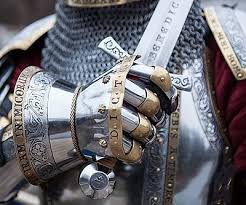
I think this is what the Apostle Paul is driving at in his famous words to the Ephesians about “putting on the whole armor of God.”
Clearly, he understands the importance of gearing up for a new season, with all its challenges.
Being Christian was politically risky then in a way we modern people may struggle to imagine.
For the first three hundred years of the church’s life, Rome’s distaste for and suspicion of Christians were served by a state apparatus of remarkable efficiency and violence.
Danger was predictable. What might bring it down upon anyone could be the smallest thing, said to the right person at the right time…perhaps with the right incentive.
How can anyone live under such conditions?
For Paul, this isn’t something you can buy your way out of or plan your way around.
It comes down to who you are.
He is scathing when it comes to the ways of the world around them all, but his letter takes a playful turn when he invites his audience – the Ephesians first, and now us – to imagine girding themselves for battle.
I guess he could have said to go get a really big sword and a really mean dog.
That’s not what he says.
Instead he says something far gentler and, frankly, much harder.
“Though you once were in darkness, now as Christians you are light. Prove yourselves at home in the light, for where light is, there is a harvest of goodness, righteousness, and truth. Learn to judge for yourselves what is pleasing to the Lord; take no part in the barren deeds of darkness, but show them up for what they are.” (6:8-11)
And then he talks about armor.
“Therefore take up the whole armor of God,” he says, “so that you may be able to withstand on the evil day and, having prevailed against everything, to stand firm. Stand, therefore, and belt your waist with truth and put on the breastplate of righteousness and lace up your sandals in preparation for the gospel of peace. With all of these, take the shield of faith, with which you will be able to quench all the flaming arrows of the evil one. Take the helmet of salvation and the sword of the Spirit, which is the word of God. Pray in the Spirit at all times in every prayer and supplication. To that end, keep alert and always persevere in supplication for all the saints.” (6:13-18)
Our belt of what now? Our breastplate of huh?
Paul’s point is not that we can slash our way to safety – he’s seen enough to know that never works.
More importantly, he knows the power of someone truly committed to being a force for good.
He knows that, for a God-breathed life, there’s just not much they can throw at you, no matter how desperately they may try.
And so, as the church at Ephesus gears up for a new season, they may not be feeling quite that strong yet, or quite that confident in the people that faith is showing them how to be.
Nevertheless, Paul tells them, it is time to try. God needs them to try. The example of Jesus is clear.
“Prove yourselves at home in the light,” he says.
Don’t just check the box of being Christians. Live out what you believe.
Whatever you may be facing, bring yourself into that moment, remembering that you are loved by God and that your heart is held by God, and then look for what good you might do, just as Jesus remembered, looked, and did.
This is what Paul understands as “gearing up.”
It may not sound like much at all.
But to those with eyes to see, it is the transformative presence of God in the world.
Just ask the person who needs a little kindness just then, or a little patience, or a steadfast voice for fairness.
Just ask the widow, the orphan, or the stranger—or their more modern equivalents, the unloved, the loner, or the person who’s not supposed to be there.
Just ask because, to them, you being there and you being you are everything.
So we enter a new season, with all that we have to do, and whatever familiar or unfamiliar roles we are being asked to play.
Who will we actually be? How are we trying to gear up for that?
“Take up the whole armor of God,” is what Paul counsels.
What a world it would be if we Christians decided we would.
Amen.
 Faith Meets Week