
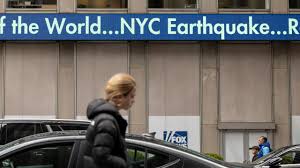
If you ask me, lately nature has become decidedly unnatural.
We’ve been gearing up for the eclipse tomorrow (Monday). I don’t know how much of it we’ll see here, but my understanding is that people from Texas to Maine will be able to see the whole thing, weather-permitting.
Of course, if you were inclined to wonder just what the weather may or may not be inclined to permit right now, you would have cause to do so.
In addition to the eclipse, I understand that there is snow in the forecast, and maybe a lot, for this coming week.
Also, here in April, apparently 1 trillion cicadas are expected to hatch.
That’s about 999.999 billion more cicadas than I need, myself.
And on Friday, you’ll recall, we had that earthquake.
Of course, for all the things that seem unnatural – suddenly unpredictable and foreboding – there are the consolations of other things which do not change.
For example, I was troubled by the earthquake, especially when I thought it wasn’t an earthquake, but was the church boilers somehow all exploding at once.
To be honest, when you put it that way, I was relieved that it was only an earthquake.
But I was more relieved when I read that by midafternoon yesterday, a New York City store was already selling t-shirts that said, “I Survived The NYC Earthquake, April 5, 2024.”
Don’t go changin’, oh my city. Don’t go changin’.
In Scripture, of course, there are descriptions of earthquakes and eclipses and, for that matter, plagues of insects.
Matthew and Luke’s Gospels talk about Good Friday with some references along those lines.
When Jesus dies, Matthew reports that “the curtain of the Temple split from top to bottom. And the earth shook, and rocks split, and tombs opened,” (27:51-52).
According to Luke, as Jesus dies, “darkness fell on the whole earth…the sun’s light failed, and [again] the curtain of the temple’s inner shrine split in half,” (23:44-45).
All Creation seems to be proclaiming the Creator’s anguish and displeasure at the death of the Son, although soon enough, the weather conditions appear to have returned to their regularly scheduled program.
Life went on.
Most of the people were probably looking at one another, grinning a little sheepishly.
“It was only an earthquake…”.
“You know, for a second there, I thought it was…”
“Yeah. Me too. Me too.”
Just what had changed and what had not were questions preempted by the return of nature’s regularly scheduled program.
For us, too, it will not take long before a t-shirt may be the only memory we still have of all this unsettled and unsettling weather, and we’ll be able to shirk its questions just as seems the people on Good Friday did.
What did you think was happening? What seemed suddenly more precarious—less trustworthy—than you’d ever actually paused to consider before?
What are the “’unsinkable’ Titanics” of our lives: those truths we hold that are just one iceberg away from a painful revelation that seems like it could send us to the bottom of the sea?
All that aside, whom did you call first when it was over—who called you?
There are many things we might ask and try to wrap our heads around.
It’s all good now, and we don’t have to. (Shrug.)
What if we didn’t shirk the questions?
This is why I love The Gospel of John’s story about Thomas, the guy who is so famous for his doubting.
John always sets his really good stories about doubts and questions at night, as if darkness could not help but make us yearn for light and clarity.
At the beginning of his gospel, the story about Nicodemus is like that.
So here, close to the end, night falls again, and with it, the questions return.
We’ve learned to berate Thomas for his doubting—John suggests that even Jesus does.
Personally, though, I see it as a blessing.
It’s a blessing for anyone who decides that they cannot, will not shirk life’s questions, or simply swallow even faith’s most pious answers.
Thomas is not resisting the good news because faith is unimportant to him, but precisely because it is.
…Because it’s not enough to want something to be true, no matter how much you want it, or why, even if it’s for the best of reasons.
Following the path that winds along through our fondest illusions is exceedingly hard to do; pretending that we don’t have to may be the fondest illusion of all.
But not for Thomas, and God willing, not for us.
The wonderful Irish Catholic theologian, Enda McDonagh, warns: “All believers are open to the temptation to domesticate God.”[1]
Yet, as he adds, “The unbelief which shatters our easy grip on a reduced God is the beginning of growth…Breakdown will occur. But breakthrough is on offer.”
What is Easter, if not a story that begins with breakdown but continues along to breakthrough?
The story of Thomas offers us this powerful example of someone earnestly seeking to live an Easter kind of life for themselves, even if doing so means risking both the power of his enemies and the displeasure of his friends.
But the power of God – the lure of God – is just that strong.
Thomas goes to a place where what is obvious and what is not come before him in a way that nobody else can really speak to, and it’s there that Jesus comes to meet him.
Honesty says that we shouldn’t shirk life’s questions.
Easter replies that we never have to, because even if it seems as if breakdown may loom, with God, it’s breakthrough that’s on offer.
The earth may shake, the darkness may descend, there may be enough cicadas about to hatch so that each person on the face of earth can have their very own.
But the shattering of our illusions and our idols is the shattering of our shackles.
And the One that Thomas teaches us to call Our Lord and Our God is there to greet us, finally free.
Amen.
[1] Enda McDonagh, “Gospel and Culture,” in Between Chaos and New Creation, 28.
 Faith Meets Week