
A lot of people come to church on Christmas Eve only because somebody else makes them.
So if that’s you, and you’re here because somebody else insisted, welcome!
And if you’re here because you’re the somebody who did the insisting, thumbs up.
(I’m on your side.)
Among the prayers tonight for peace on earth and good will toward all, I’ll add my own prayer that you and I will end up vindicated for getting people here.
Whether or not you choose to bring it up again later is up to you.
For its part, the Christmas story doesn’t succumb to any gloating.
In fact, just the opposite is true.
It’s a story that is powerfully shaped by God’s capacity for surprise and by humanity’s capacity for wonder.
Gloating really isn’t a part of it – there was just too much joy in being able to share all these things that God was doing.
Stars blazing across the sky.
Angels belting out a heavenly chorus.
Of course, the arrival of a baby is always a tender reminder of the power of new life and a call to the future, even in hard circumstances.
But while there is no reported gloating, in its own way, the story does have its own version of “I told you so.”
Because for all the wonders of that first Christmas Eve, the fact was that much of it had long been foretold.
For centuries, the prophets had described what truly faithful lives were supposed to look like.
They’d given account of the grand project that it was to join God’s creative work across creation.
They gave account, too, of the power of the chaos inside us to challenge that work.
They knew about these things because God had told them so.
Now in the gospels, Luke is the one who tells us about the presence of the shepherds around the manger.
You’ve got to love the shepherds.
They’re just about the only ones who would have walked into a stable after midnight and considered it an upgrade.
Luke doesn’t say if these particular shepherds were uniquely hopeful, or especially qualified to be there.
He doesn’t introduce any of them by name or report any specific words they might have said.
Their own paths to get there aren’t his focus.
But in words that recall what the prophets had foretold, an angel comes out to call them in.
This isn’t the version of the story with people arriving at the stable with gifts for the newborn king.
For Luke, the central gift the various characters bring with them is more internal—it’s more akin to a capacity for recognition.
The shepherds would have recognized the warmth and shelter of this place of last resort where Mary has given birth, not its discomforts.
For their part, Jesus’ parents would have recognized that lowly shepherds could also be ennobled pilgrims, witnesses of a deeply holy joy.
Luke says that everyone is “amazed” at what the shepherds have to report—they recognize the wonder of it.
There’s also Mary.
In the phrasing of one recent translation, Mary “kept all these things safe in her memory, considering in her heart what they might mean.” (Sara Ruden)
I love that her memory is already at work even before her understanding has managed to catch up.
She’s no stranger to angels, herself, and yet what it all means is still very much sinking in.
And yet, somehow, everyone gathered would have recognized that while any baby is a wonder and a miracle, this baby – or more remarkably still, this baby – came to lead the world out of its violence and captivity and into the arms of God.
It makes me think of that wonderfully theological lyric in the hymn, “Hark the Herald Angels Sing.”
“Veiled in flesh the godhead see,” it says.
Really, though, what Luke wants us to picture is more of an unveiling.
That’s what the people gathered around the manger recognized.
At Christmas, the definitive presence of love and eternity are unveiled for us.
The definitive guidance we need to overcome whatever separates us from God, one another, and from our true selves has been unveiled for us.
The stable’s vision of peace, new life, and a holy vulnerability have unveiled God’s fondest hopes for all people.
That’s what the story is most eager to say.
The psychiatrist Erich Fromm once observed that “Hope is not a prediction of the future. It is the vision of the present in a state of pregnancy.”
Hope is about recognition. Anticipation. A sense of the proximity of what is soon to come.
Isn’t that just what we mean when we talk about incarnation: God coming to join us, taking on the life we know?
Because if God is close at hand, then everything poised to blossom under His presence is never far away.
I think that’s why we hold onto this story. It’s why we keep keeping Christmas.
Christmas makes those promises easier to remember.
It’s the time when so much around us seems to blossom, including us.
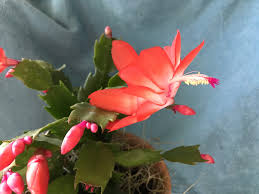
This week, I read about a family that has managed to keep its Christmas cactus going for no fewer than 145 years.
That’s not so easy, particularly with a Christmas cactus, which people tell me is a kind of plant that apparently gets mad at you for moving it.
(Any gardeners here? Have you heard of this?)
Apparently, some Christmas cacti can be so sensitive that if you move them even just the littlest bit, they will refuse to flower for a year or two.
Yet with understanding and a little tenderness, at Christmas, this cactus will blossom.
The same goes for the picky, prickly cacti known as you and me.
Whatever we may be like for so much of the year, no matter how sensitive or stoic we may style ourselves to be, Christmas calls forth some of the beauty within us.
It brings out something that we might otherwise keep hidden or, God forbid, come to forget.
It reminds us how we might still be shaped by God’s capacity for surprise and by our own capacity for wonder.
It still has the power to call us in.
May all creation repeat the sounding joy.
 Faith Meets Week