
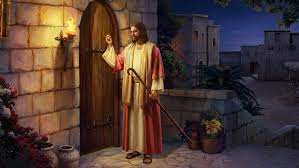
“Behold, I stand at the door and knock,” says our gospel this morning.
The fundamental hope of our faith is that, in Jesus, a different kind of life is possible.
Where you’re counting on seeing that different life with your own eyes may vary.
For some of us, the change we’re focusing on is a change for the whole world. Or maybe it’s a change for someone who important to you, or – big breath – change for yourself.
Isn’t it surprising how the more local it is, the bigger climbing that mountain can start to feel?
It’s odd that saving the world can seem to offer a way to avoid working on ourselves, isn’t it?
Not that it’s always that.
In any case, whatever in our purview stands in particular need of saving, the hope that looks to Jesus is a hope that he will open up something new – that, with God, change will come at last…because that’s who God is.
That’s what God makes possible.
As you know, in Scripture, the Book of Revelation comes at the very end.
Yet the gospel accounts of the first Christmas are offered as revelations every bit as dramatic as anything imagined to come at the end.
What those accounts want us to understand is focused on that hope—once again, that with God, change will come at last…because that’s who God is.
“Behold, I stand at the door and knock,” Jesus says.
“Boy, I sure hope so,” is so often our reply.
II.
For a while on t.v. there was a cooking show – I don’t remember its name – but the premise was that a celebrity chef and his sidekick zany presenter Brit guy would wander in a random neighborhood somewhere in America, right around five p.m., and start ringing doorbells to see who might be home.
And if you answered the door, they’d offer to come in and cook dinner for your family, with one condition. Well, two.
They got to film the whole thing.
More importantly, though, they would only use the food you already had.
In the fridge: the eggs. The mayo. The celery. The bologna and the yellow mustard for school lunches.
Whatever the glop was in the Tupperware all the way in the back.
The cooking involved a lot more sniffing than you see on Emeril, I’ll tell you that.
Fearlessly, they’d scrape the olives off a random slice of pizza, repurpose half a jar of salsa, turn the half and half into artisanal butter if need be.
They’d throw in the Bailey’s Irish Cream from last year’s Christmas party.
Any spices in the spice drawer, be they limited to nutmeg or Mrs. Dash.
Whatever you had, they’d try to get it in there.
Each dish was something hitherto unimaginable, quite possibly unrepeatable, and (almost always) wonderful.
And so, in some random place, at some random door, on a random night that seemed petty much like yesterday warmed over, the unexpected would happen—the doorbell would ring, and shortly thereafter, there would be a feast.
III.
To hear Luke tell it, the first Christmas was a little like that – full of surprises and new possibilities.
Breaking into lives that seem destined to offer little more than yesterday warmed over, the unexpected happens.
God’s son comes to offer something very different: a new way of living, and ultimately, a new world.
Time and time again, the gospels go on to show us that Jesus takes whomever he can gather and invites them (…us…) to a feast.
To some extent, the improbability of who’s invited and what gets served is offered as part of the delight.
But from the very beginning, from the manger itself, Jesus’ kind of party was always one where unexpected things went together and turned out to bring out the best in each other.
All these years later, that’s still his kind of party.
IV.
Truth be told, this can ask a lot of us.
We may not always acknowledge the courage such moments require, although Luke the gospel writer keeps pointing that out all along the way.
Surely, it’s not for nothing that when the shepherds out there in the fields, watching their flocks by night, the angel’s first words to them are: “Fear not.”
Way before that, the story offers us a catalogue of things rightly to be feared: everything from personal embarrassment and likely social stigma for Mary and Joseph, to the threat of political power at its most lethal (as we see in Herod and soon enough again with the Romans).
There is the somewhat more predictable, but very real danger of childbirth itself – that’s Mary again, of course.
Soon after their encounter with the angel, the shepherds will have to overcome the danger of straying a little too far away from the safety of their group as they venture into town—a place where they would have been seen as a nuisance, at best.
For each of the figures whom we find around the manger, that gathering comes at a moment when attention is something they’ve been hoping to avoid, for any number of good reasons.
For people trying to fly below the radar, the darkness offers a certain amount of cover.
The point, though, is that they step out of that darkness and step into the infinite possibility of love to remake our lives and to remake the world.
That infinite possibility is the essence of Christmas.
It says that each of us already has so much to offer.
The ingredients are already there.
Each of us is poised to offer something hitherto unimaginable, quite possibly unrepeatable, and (almost always) wonderful – provided love is there to bring it out…
…provided we are there, joining with God to nurture that love, (and) to bring out the best in one another and in our world.
Admittedly, it takes some courage to open the door when God rings the doorbell.
But the darkness cannot save us, friends.
In the end, only the light can do that.
Only opening our hearts can do that.
Only God can do that.
Whenever we gather, we remember with joy and gratitude that God already has.
Amen.
 Faith Meets Week