
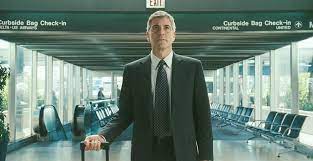
Those of you who travel frequently for business tell me that it isn’t long before any allure that it had initially begins to fade.
My parents both had to do a fair bit of travel in their careers, and they say that, too.
I gather there usually isn’t time for much sightseeing when you’re traveling on the company’s dime and time.
The job is the focus, and the place, wherever it may be, can become sort of a blur.
Wherever you are, it’s always the Hilton.
Taken to an extreme, there was that movie with George Clooney where he flew all over the country on a business trip that more or less never ended, going from place to place to fire people on behalf of companies who had outsourced that task.
In many ways, he’s the right man for the job. We come to understand that he really has no ties to anyone or anywhere—that in lieu of grounding commitments, he prides himself on things like being a savvy traveler who travels light (which is, of course, a metaphor) and an accruer of airline miles—and this is more or less what gets him through the day.
Until of course, it doesn’t. But that’s another story.
Yet we sympathize, because as so many of us know first-hand, in such a job, the airports are all alike, the hotel restaurants and rooms are all alike, the professional interactions are all alike, and so on.
What makes him different is that, in his case, this isn’t a kind of price to be paid for the good things in life—it’s all there is.
So in this morning’s gospel, when Zechariah goes up to Jerusalem for another business trip, which history suggests he would have done twice a year for two weeks at a time, I wonder if he is another one haunted a bit by the sameness of it all.
I wonder if he arrives for duty without much expectation, prepared just to go through the motions once again.
He is different and infinitely richer than George Clooney because he does have a home to go to, and a wife he loves who’s waiting for him there – but there’s a sadness to him, too.
He has no son to bring along and introduce around, no pictures to share on his iPhone with the other guys in his cohort.
To some, that may sound awfully shallow, and it’s true that the Bible has a strong bias in favor of families that we may not share.
But alongside that bias, the Bible uses the image of children as a way to talk about the future – and to emphasize, in particular, that what will be soon is significantly connected to what is now.
In fact, the Bible is a lot less interested in any vague notion of “someday” than we may realize.
Its focus is on getting us to respond to God’s invitation to build what is to come.
So Zechariah comes dutifully to offer his service to the Temple once again, arriving to perform faithfully the rituals of his people’s faithfulness, and all the while, nobody seems to notice that this asks an even further kind of faithfulness of him, as he works on behalf of promises that, for himself, he’s long since given up on.
He’s like a crewman on the Titanic, with the world a kind of doomed vessel, and him quietly and efficiently assisting everybody else into lifeboats where nobody will be holding a place for him.
And yet somebody has to help the others.
If you think about it, it’s kind of a weird way to begin getting us ready for Christmas.
In point of fact, the creators of our cycle of readings, the Revised Common Lectionary, don’t assign the story at all, whether at this time or at any other, so those who engage the Bible primarily through Sunday worship will not know the story well, if at all.
Somewhere along the line, somebody decided that we can get to Christmas without it.
With all the usual stuff to talk about, that may well be true.
Plus also, the way we’ve read it this morning didn’t get into the connection between John’s mother, Elizabeth, and her younger cousin, Mary, who will become pregnant just a few months later.
Their pregnancies are intertwined, just as the ministries of John the Baptist and Jesus will be intertwined.
But I’m going to argue there’s a reasonable logic to beginning the season by acknowledging emptiness. By naming the challenge of going through the motions. By saying some journeys don’t seem likely to lead us home.
Even Hermey the elf would tell you that Christmas itself can be like that.
Yet the story of Zechariah and Elizabeth is the story of how Christmas begins way before that star came to rest over the manger in Bethlehem.
It begins way before the magi first noticed it in the skies and traveled across the ancient world to see it up close.
It begins way before Mary and Joseph.
It begins even before John the Baptist.
Maybe we can’t even quite say when it begins—John’s Gospel will suggest that from the beginning, Christmas kind of always was.
But Luke says that Christmas begins with this old couple, Zechariah and Elizabeth, and in how the angel makes it clear that with God, all things are possible.
It begins when he is selected, seemingly by a roll of the dice, to be the one who goes deep inside the Temple to light the incense near the holy of holies—a seemingly random opportunity to go far into restricted territory.
The restrictions were real.
The only one who got much closer to God’s particular point of contact in and with Creation was the High Priest himself, and that only on one day a year.
But Zechariah is chosen—and so, when an angel is there to greet him and share with him the wonderful news of his own child yet to come—a second and more importance instance of being chosen—we can understand why he would be frozen for a moment in disbelief.
Struck dumb.
It’s such an important moment, I think, because it names how so much of what God does, even a flat-out blessing, can be so hard to get your head around.
But it reminds us of something profoundly important about Christmas, namely, that even in our disbelief, even in our exhaustion, even in our disappointment and our skepticism and our loneliness…even in the brokenness of so much of the world around us, even as we are just going through the motions…with God, all things are possible.
The Christmas hymn “O Holy Night” describes it in words that Zechariah would well have understood.
Long lay the world in sin and error pining
‘Til He appears and the soul felt its worth
A thrill of hope the weary world rejoices
For yonder breaks a new and glorious morn
Fall on your knees; O hear the Angel voices!
These words would have pointed to so many hopes and to the lifting of so much weariness.
They still do.
They tell us that more is going on than we realize – and more is yet to come.
A hopeful future and a redeemed present are utterly intertwined and closer at hand than we know.
And if that seems impossible to believe from where we’re standing, Luke is here to tell us that these things have been in motion far afield from where we are, but into which the love and purposes of God are already beginning to sweep us.
Like Zechariah, we will find that God is already well at work, and in that working, sadness will be transformed into joy, fatigue will be transformed into new life, and we go from numb to dumb to bursting into song.
Amen.
 Faith Meets Week