
Jesus begins this morning’s parable by saying, “For it is as if a man, going on a journey, summoned his servants and entrusted his property to them.”
Of course, even if his disciples don’t know it, we know that his words point straight back at himself, as he prepares to leave them and must entrust his work – the proclamation of the coming kingdom of God – to their care.
What they are poised to do with it is very much on his mind, and it seems as if what he wants is to see that it is on their minds, too.
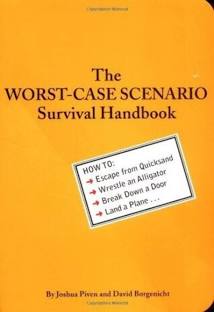
It reminds me a bit of that book you used to see right by the cash register at places like Barnes and Noble – I think it was called something like “The Worst Case Scenario Survival Handbook.”
It was supposed to be a joke, of course, but there it was, a little handy dandy guide with quick tips on things like how to escape from quicksand, or wrestle an alligator, or survive jumping out of a plane without a parachute.
There was one part I read that I still have nightmares about, which is what to do if you wake up and you’re in a coffin and they’ve already buried you six feet deep.
I never did buy the book, and as I said, it didn’t style itself as an actual emergency manual for anyone.
I would hate to imagine that there were people who sincerely relied on it, even refused to leave home without it…just in case.
But in all seriousness, it did get you to look at the world a little differently…
…To ask yourself, “what if?”
“What if it something unthinkable happened, and thinking about how making it through was all up to me?”
In some sense, this is what’s lurking just below the surface as Jesus shares this parable—his knowledge that something unthinkable was about to happen.
However, what “survival” would look like was an open question.
II.
The parable talks about being entrusted with the master’s property – in some versions, all that he had.
It also helps to recall that a “talent” of silver was an astronomical sum: perhaps as much as twenty years’ wages for a typical day laborer.
I remember writing a check for Liz’s engagement ring.
The amount was, I admit, somewhat shy of twenty years’ wages, but it was still the largest single check I had ever written up to that point—it felt like an astronomical sum, at least for me.
So imagine being called into the head office, up there on the campus of the old American Can Company off King Street, the holy of holies in one of those enormous office parks from fifty years ago, and there on the chairman’s desk are a hundred years’ wages…or forty years’ wages…or just twenty.
The chairman stands up and says, “I’m going away. I need you to look after this for me until I get back.”
No explanations. No further instructions or suggestions or anything. Not even a thumbs up. The meeting is over.
Two guys in jump suits step forward with a hand-truck to wheel those talents of silver out to your car.
And seven minutes later, you’re driving down King Street, heading home, your car sagging just a few inches above the road, while you’re trying to get your head around what just happened and what in heaven’s name is going to happen now.
Because it’s then that the full weight of this responsibility starts to become clear.
It’s a scenario that nobody’s quite prepared you for.
It seems outlandish. It’s supposed to be.
Yet if we compared notes, I’m sure it would not take us long to recognize that even in the normal course of our lives, there are any number of tasks we take on that nobody has quite prepared us for…or ever quite could.
In the world of ministry, for example, I remember how challenging seminary was and how proud I was to have made it through – and I remember the day when I realized that what it taught me was only just enough for me to get started.
It’s the difference between sitting in a locker room while a coach stands at a blackboard with a piece of chalk, making a picture of all these x’s and o’s and arrows and stuff…and then finding yourself out on the twenty yard line. (The analogy, in an entirely different context, is from JKA Smith.)
There are plenty of experiences in our lives that are like that.
Work is like that. Parenthood is like that. Marriages are like that. Serving our community is like that.
There’s no shame in not knowing what to do.
But recognizing the responsibility that’s fallen to you means that it’s on you to figure it out.
III.
And this is Jesus’ point in the parable.
The first servant goes home with 100 years of wages – more money than he, his son, and maybe even his grandson would be likely to acquire over three generations without a single day off.
He figures it out.
The second servant goes home with 40 years of wages, which is every nickel you would have earned since James Watt was Secretary of the Interior.
He figures it out.
But the third servant doesn’t figure it out.
Or maybe it’s more accurate to say that what enters into his figuring is a rejection of the responsibility that’s been placed on him.
The First Nations Version, a translation of the Gospel by and for Native Americans, substitutes herds of horses instead of talents of silver.
It reads: “The man with five herds of horses went to work right away, traded well, and earned five more herds. In same way the one with two hers used them to gain two more. But the one who had only one kept the herd well-hidden and safe from thieves.” (FNV 25: 16-18)
Strictly speaking, it’s not nothing.
It’s also far too short of something.
Because it isn’t enough to be a security guard. He’s called to be a caregiver. A cultivator.
The results actually matter.
We’ve talked about the sheer weight of what he has been handed.
And yes, it’s a lot. Fair enough.
The point is that he never even tries to bear that weight.
He doesn’t hold himself responsible, much less live up to the trust that the master has placed in him.
This means that, when the master finally returns to settle accounts, the third servant has nothing to show for it.
IV.
The master’s ensuing judgment and rejection are painful to read.
We are so accustomed to the mercy of God, the patience of God, and the balm of forgiveness that we may find it hard to have our Jesus speak in such a way.
But the results actually matter to God.
What we do actually matters.
Maybe we just have one person we’re asked to care for – or two or five…one phone call, email or text we should send…or two or five.
Maybe there’s just one community meeting where our voice would make a difference. Or two. Or five.
Maybe we can make time to pray or to listen to our conscience just once this week. Or twice. Or…well, I’m sure you get it.
Jesus isn’t asking us to be super-human. He’s just asking us to be Christian. To be responsible enough to show up and to be faithful in following as things go where they go…as needs evolve and relationships unfold.
If you think about it, the truly scandalous thing about our faith is not how much is required of us, but really how little.
But Jesus pushes us to own our part of the work fully, whatever our part may be, remembering that lives depend on it – including our own.
V.
I don’t remember how to survive if I fall out of a plane without a parachute.
I don’t remember how to recognize actual quicksand, much less escape from it.
But with God’s help, I am learning to ask “what if…”
Not the “what if” of calamity, but the “what if” of possibility.
The “what if” of hope and new life.
The “what if” that imagines what would become possible if the churches truly committed to bearing the weight of God’s love for the world.
What if we lived each day, mindful that showing and sharing that love actually matters?
What if we already have everything we need to make God’s dreams for us come true? AMEN.
 Faith Meets Week