
A couple of weeks ago, there was an article in the New York Times about Americans visiting Europe this summer.
It’s an article I feel like I’ve read a thousand times before – I mean, truly, no summer would be complete without Europeans remembering just how much we Americans get on their nerves.
So in this summer’s version of the same old story, remember that it’s been uncharacteristically hot in Europe.
For the first time since the pandemic, it’s also been quite crowded.
And it seems the Americans are spoiling it for everyone (this time) by doing things like asking for the air conditioning to get turned up when there isn’t any, by wearing flip flops and crop tops in the presence of great art, and what have you.
“Here in Italy, people dress up just to take their garbage down the street,” explained one hotel manager in Florence. “You wouldn’t dare put on flip flops.”
Along those same lines, it seems that asking for an iced coffee at a caffe in Italy is like going into a restaurant and asking the maître d if their marinara tastes like “Ragu” or if it’s closer to, say, “Prego.”
Even for the best-intentioned of visitors, it turns out that visiting Rome is full of pitfalls.
When it comes to living in heat, we and the Romans begin from fundamentally different places.
II.
So when I tell you that for the next three weeks, we’re going to be looking at some key moments in the Apostle “Paul’s Letter to the Romans,” you may want to begin by settling back and lifting a word of thanks for our air-conditioned chapel.
If you want to bring in an iced coffee, show up in your flip flops, go right ahead.
No pitfalls here.
That said, Paul’s letter itself can be tricky.
It has a lot of purposes.
One careful scholar of Paul, Michael Bird, identifies six distinct tasks at work: he says that the letter is a theological treatise, a summary of Paul’s teaching, a letter of self-introduction to the notably multicultural churches of Rome.
It’s also a fundraising letter, an attempt to pull a specific church community together internally, and then even suggest some ways to work with the larger Jewish community in Rome, which really wasn’t sure what to make of this strange new sect that had started to give them a bad name with the locals.
A lot is going on with this letter, most of which we’ll have to take up another time.
But in the section we’ve heard this morning, Paul is trying to tell this congregation what the good news means for them.
And the central point he wants to make is that, as you really start to be drawn to the Good News…as God’s way really begins to shape your imagination: the more you begin to realize that more and more, you and the world around you just seem to be starting from fundamentally different places.
III.
For Paul, a holy life for a Christian meant seeing that again and again.
For Paul, it meant that, for starters, a holy life for a Christian was a constant process of unlearning the false promises of a broken world and then relearningwhat it was to find genuine hope in a more durable vision of life. (The terms are Michael Gorman’s.)
And that strikes me as so important, and not entirely obvious.
For starters: what is it that we have to unlearn about a broken world?
Doesn’t so much of our most important learning involve unlearning?
A few weeks ago, Rev. Cydney Van Dyke was with us, and she preached wonderfully about “The Barbie Movie,” which has been a notable feature of the culture this summer, complete with people – gosh, even guys! – dressing in pink to attend each screening, as a form of homage.
I feel like “The Barbie Movie” could launch a hundred different sermons, each one of them important.
All I want to say this morning is that it is a movie that is thinking very deeply about the relationship between unlearning and learning.
As one cultural reporter (James Dusterberg at the website, The Point) puts it:
Barbie’s premise is as wonderfully simple as the doll herself. Barbie, played by Margot Robbie, lives in Barbieland, a utopian world where everything is made of plastic and every day is like the previous one and the next one: “perfect.” But one day, inexplicably, things start to go wrong. Barbie trips, has a bad hair day, discovers cellulite on her thigh. The invisible water in her shower is the wrong temperature; in the middle of a slumber party in her Dreamhouse, she even has “thoughts of death.”
Pause there.
Barbie is in the middle of her umpteenth slumber/dance party with all her friends, another day in the life, somewhere between ad nauseam and ad infinitum, and she blurts out, “Do you guys ever think about dying?”
The record scratches, the dancing stops, and the room falls totally silent.
Of course, they haven’t.
A little after that, her feet, which are permanently shaped for stiletto heels, fall completely flat.
In the next days, Barbie discovers that more and more “errors” (the word is from Brittany Schultz in the National Catholic Reporter) are creeping into Barbieland.
It’s happening because (here’s Schultz again) “the girl who is playing with her in the real world is sad, and her sadness is bleeding into Barbie, causing her imperfections and making her question the world she knows.”
And thus begins Barbie’s quest.
To set her world right, she needs to unlearn some of her unrecognized assumptions about that world – she needs to come to see how things “bleed into” that world.
She needs to recognize a much bigger world.
IV.
This is what Paul is trying to talk about in this morning’s Scripture.
He’s saying: what happens?
What happens when the music stops, when our feet fall flat, when we can’t ignore the errors that seem to be creeping in, and we have to unlearn however the world seems to explain or ignore these things and relearn a more durable vision of life?
Paul says this is what happens when faithful people encounter the Good News.
It’s God’s invitation to recognize a far bigger world.
…A world in which so much seems to bleed into our lives: situations and people and ideas and hopes that are, it seems, so far away.
Except that they’re not.
They’re right there. Right there. That’s part of what we come to recognize.
And Paul’s point is that, when that happens to you, you might tell someone.
And a certain person might say, “Yuck.”
And another person might say, “Whatever.”
And a third kind of person might say, “Huh?”
But for Paul, a Christian person will say, “Yeah.” And then they’ll say, “Welcome.”
They’ll say “welcome” because, like them, now we are on our way to recognizing a bigger world.
Now we are learning to live with a more durable vision.
We are re-learning how to live.
V.
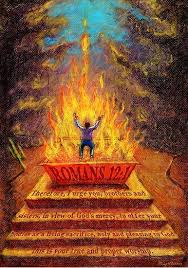
This is what Paul means when he calls the members of that early church in Rome, and when he calls us now, saying “Present your bodies as a livingsacrifice.”
He means, live with a willingness to die to the old and rise to the new, unlearning and relearning as you go, with an open mind and an open heart.
From that first inkling…that first clue that the world and you might be starting from different places in some way…all along the course of that red thread that weaves in and out of view, leading us into the unfamiliar—that place where the answers aren’t so clear—provided we are willing to follow.
He wants us to follow.
He sees a Christian as someone whose mind is constantly transforming, constantly renewed and whose life is now pointed toward a very different understanding of who God actually is, and of what God actually wants.
And again, his emphasis is on the living…on the notion of offering ourselves day by day…moment by moment…interaction by interaction…following that red thread.
The gift in that is a life where we get to be ourselves, not “someone else,” not some person that we’re told the world expects us to be.
For Paul, this is one of the great gifts that God offers in the Good News.
And he even dreams of what it would look like if we all got to be ourselves together – a world in which we connect across all our specificity…all our personality…all our unfamiliarity to the world into a larger vision of people together.
He imagines us as a body. A body with different parts but comprising a larger whole.
He does that in other places throughout his letters, but here, again.
With the idea that, with God’s help, we might relearn how to balance our own immediate needs and our own immediate gifts — the world of our own immediate circle — with the needs of a larger world, and the gifts that others might offer if we manage to make some room.
God calls us to belong to one another, just as surely as we do to ourselves, and to Him.
VI.
Along the way, there are always things we will need to unlearn in order to relearn how to live.
There is a rhythm of letting go and taking hold, a pattern of dying and rising again to new life.
Time and time again, we find ourselves like those Americans in Italy this summer – or like those Italians faced with the expectations of all these visiting Americans.
We find that we are just beginning in a different place than the people before us.
Maybe that starts as something very small, like expecting a pitcher of ice water for the table in a restaurant on a blazing hot day.
Or maybe it’s already something much more important, like the discovery that you no longer fit the expectations and easy assumptions of those around you.
But the new life beckons, if we learn to watch for it.
Paul’s hope for us this morning is that we will learn to claim that life each day with renewed joy.
Amen.
 Faith Meets Week