
There have been a couple of times when I’ve been caught in a storm that came out of nowhere.
Has that ever happened to you?
Let me be clear: I’m not talking about moments when you’re like, “whoops, guess I should have brought an umbrella” – those times when you get caught in a downpour while walking the dog, and the dog looks up at you like, “You jerk. How could you let this happen?”
No, I mean storms.
Like the time there was a small tornado in downtown New Haven one summer day while I was coming back from getting an ice cream.
If you’re a New Haven person, I was going up York Street right near where the JPress and the Wawa used to be, and it suddenly occurred to me that it was oddly—actually oppressively quiet for a midafternoon in July.
No birds, no buzzing critters, no nothing. Strange.
Then, looking up, I saw that the sky had turned the electric yellow-green of a jar of pickle juice. I’d never seen that before. Again: strange.
Maybe if you know about tornadoes, there were other strange and alarming signs, but I didn’t know about tornadoes, and so if there were any, I didn’t pick up on them.
Truth be told, I was in a kind of “whoops, guess I should have brought an umbrella” place.
And then there was this enormous boom.
It sounded like someone had just blown off the top of the Chemistry building, and all of the sudden, I realized that I was being pelted by hail.
And by “pelted by hail,” I mean pelted like someone was emptying a dump truck of golf balls on my head.
The wind went from zero to sixty faster than a Porsche.
But it was not until the next moment, when I saw the metal street sign go zinging down the street past the post office and on toward the New Haven Green, that I actually remembered to be scared.
I ran across Broadway and pounded on the door of the pizza place that used to be on the corner, but the guy in the apron just put up his hands like “I’m not opening it,” and I just ran on, making a little hat with my hands in case one of those hailstones turned out to be more of a baseball than a golf ball.
I am sorry to say I forget who took me in – someone did, but only for a few minutes.
Suddenly, the storm was over. The rain had stopped.
By the time I was halfway back to my dorm, the store owners along Broadway were already out with their enormous push brooms, sweeping the hail off the sidewalk.
There were a couple of dueling car alarms. Some gnarled uprooted trees. And the birds were back.
That was it.
But…that was a storm.
I don’t know if they’d be willing to tell you their story, sometime, but Dorothy and Gerry Mayfield were young parents when they lived in that part of the country they call “Tornado Alley,” which goes from the top of South Dakota to the middle of Texas.
Let’s just say Dorothy and Gerry know very well why somebody decided to name it that.
In his book The Perfect Storm, Sebastian Junger notes that, “There are houses in Gloucester (Massachusetts) where grooves have been worn into the floorboards by women pacing past an upstairs window, looking out to sea.”
If you asked them, they could tell you about storms, too.
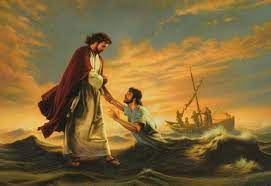
I say that because, when Jesus fishes Peter out of the sea in the middle of the storm, and he holds Peter up by the collar and says, “You of little faith, why did you doubt?” – I’ve got to admit that I’m pretty much on Peter’s side.
Or what I think of as his side, anyway.
Not everybody is.
Sometimes, preachers act as if Peter’s doubt is just silly.
It’s kind of the “Well, duh” school of preachers.
As in, “Well duh, Peter! He’s Jesus! He’s out there on the water! Who wouldn’t be out there with him?”
That seems like Monday morning quarterbacking, though.
Like a guy sweeping hailstones off the sidewalk when the tornado is over, who says, “I don’t think it was really all that bad.”
Well, ok, if you say so.
The King James version always gives Jesus’ words that slightly formal touch: “O thou of little faith,” it says, “wherefore didst thou doubt?”
Or as a more current translation of this same moment, by Sarah Ruden, Jesus puts it: “…You with hardly any trust! Why did you waver?”
But honestly: who wouldn’t waver?
It’s dark, and the waves are as tall as houses, and the wind is screaming, and it’s raining sideways, and somehow it turns out that you’re out in it.
Don’t pooh-pooh the power of a storm.
II.
By and large, Scripture doesn’t.
However, it does put some space between the violence of storms and the presence of God.
Probably the most famous example focuses on the Prophet Elijah.
He has a particular grievance against God, or thinks he does – that’s not our focus here.
Elijah’s words to God have a kind of “are we there yet?” quality that parents of young children will recognize right away.
Abruptly, God decides to demonstrate the divine presence, probably to show Elijah that God has been with him all along.
God says: “Go out and stand on the mountain before the Lord, for the Lord is about to pass by.”
The story continues: “Now there was a great wind, so strong that it was splitting mountains and breaking rocks in pieces before the Lord, but the Lord was not in the wind;
and after the wind an earthquake, but the Lord was not in the earthquake;
and after the earthquake a fire, but the Lord was not in the fire; and after the fire, the sound of sheer silence.
When Elijah heard it, he wrapped his face in his mantle and went out and stood at the entrance of the cave. Then a voice came to him that said, ‘What are you doing here, Elijah?’” (1 Kings 19:11-13)
For Elijah, despite the power of the storm, it is the sheer silence that tells him that he has stepped onto holy ground—and it seems to remind him that God’s silence is not the same thing as God’s absence.
If anything, that profound quiet is a particular sign of God’s attending presence.
III.
For a while, when Emily was very small, she would have trouble falling asleep at night.
Like me when I was small, she was also an early enthusiast when it came to conversation.
So it took a while for her to settle, even after umpteen stories, talk about her day, and a trip to the bathroom for a small sip of water.
Even with the lights out, she would often announce that one of her stuffed animals wanted her to sing them a song.
It took her awhile to enter into that particular silence that was a comforting presence and finally made rest possible.
IV.
For me, this is what the “Well, duh” school of preaching tends to overlook – the sense of God’s comforting presence as something it takes a certain kind of quiet in order to reach…a particular kind of stillness, or as Elijah encountered it, “a sound of sheer silence.”
Scripture seems to admit quite willingly that, in the moment, that sound can be quite hard for us to hear, even for the most faithful of us.
V.
With all this in mind, then, I wonder if there isn’t a deeper point to this morning’s Gospel.
You know by now that we Christians aren’t supposed to pooh-pooh the storm.
You’ve got that, right?
Well, while we’re at it, let’s not pooh-pooh that Peter, caught in the storm, still hops out of the boat and takes a few steps toward Jesus.
He doesn’t get enough credit for that, if you ask me.
The point shouldn’t be that he didn’t make it all the way that time.
The Gospels make it clear that there would be many, many other times when he wouldn’t make it again.
But all along the way, there would be moments when he knew he had stepped onto holy ground and felt God’s presence.
The point isn’t that he started to sink, and that, well duh, he shouldn’t have.
The point is that he took those steps.
Just like dropping his nets to follow Jesus had been just a first step.
Just like passing around the water turned to wine at the wedding feast at Cana was another step.
Just like following Jesus in the rooms where sick people lay suffering and witnessing their healing were other steps.
There were a lot of steps.
So now, in the heart of the storm, having taken those earlier steps, he hops over the side of the boat in the thick of the storm to take his next few steps.
And, God bless him, it takes him quite a few until the waves loom large again, and he remembers to be scared.
VI.
What do you and I need to do so that we can take our own next step toward Jesus?
Better yet, whose storm might we resolve to step into, in the name of love, hoping to offer some of God’s own peace, so that someone else might find shelter?
And when someone tries to tell us about a storm in their life that’s come out of nowhere, how can we make sure we don’t somehow pooh-pooh what they’re trying to tell us?
As we go along, there are times when even the bravest of us remembers to be scared.
But one step at a time, we learn to live into God’s love.
And as the waves subside, and we are surrounded by the sound of sheer silence, we’ll remember something else: that God’s love has been with us all along, teaching us to walk through the valley of every shadow.
The sound of sheer silence will be joined with the peace in our hearts.
Amen.
 Faith Meets Week