Monthly Archives: October 2017

From the Newsletter: “A Reformation Faith”

luther

Dear Friends of Second Church,

This coming Sunday, we will mark Reformation Sunday at our 10:30 Worship Service — which will include a musical celebration with harpsichord, brass, strings, a boy soloist…in short, the works.

It is sure to be a great tribute on a day close to the 500th anniversary of when it is said that Martin Luther nailed the 95 Theses to the cathedral door in Wittenberg, Saxony (the actual day is October 31st).

There are those who wonder if it happened exactly that way, with all the drama of Spielberg movie, and I admit that I don’t know.

But it’s clear that a very different way of “being the Church” emerged as a result.

Luther focused and then broadened a conversation about how we encounter God, how we understand God’s will for us, and what the world should look like in light of our faith.

Over the last 500 years, that conversation has continued, and what’s proven to be its most enduring feature are its perennial questions, rather than many of its specific answers. Those often turn out to be the testimonies of a particular place and time, with much to teach us, but also much we must respectfully, but courageously reinterpret.

To do as Luther did has proven more important for us than to think precisely as Luther thought.

The composer Gustav Mahler once said, “Tradition is not guarding the ashes, but fanning the flames.”

Along those lines, the thing about a Reformation faith is that each generation — and in a very real sense each person — is challenged to remake it anew. We have to fan those flames once again. We have to look for God in our midst and ask what God is doing now, in this place.

What are the urgent concerns of this moment, and how is it that the light of the Gospel and the love of God in Jesus Christ can transform them? What does God need the Church to see, which the world, in its brokenness, cannot? And what does that ask of us in the Church, and of all of us as the Church?

There is not one simple answer. How could there be?

Truly, it is no surprise that passionate debate has always been a part of Reformation faith.

Yet clearly, it’s not a passive way of being faithful. It never has been.

Moreover, it must not be.

That’s one of the Reformation’s most important and enduring insights.

Passivity creeps in all too easily.

The great sociologist Max Weber talked about “the routinization of charisma,” his phrase for how the great energy and insight of a movement’s founder gets translated into (and slowly depleted by) the often mundane work of maintaining an institution.

Even the Church.  Even the Reformers’ churches.

The Reformers and those who came afterwards loved building institutions.

Indeed, those institutions have given us a lot to be thankful for.

The challenge of wrestling with God’s Word demanded that the first Reformers push for Bibles that people could read in their own languages. Then they saw the need to push for the broad, basic literacy that ensured the people could read for themselves. In this country, you can trace the migration of the Puritans and their descendants by following the founding of colleges across the American West.

But at a deeper level, those achievements came back to that fundamental commitment to wrestling.

Much has changed over the last 500 years. Some even say that we are at the very beginning of the next Great Reformation in Christian history, as the institution of the Church changes yet again to meet life circumstances and new social expectations that have shifted dramatically, especially in the last 50 years.

That commitment to wrestling has not changed.

From where I sit, the most vibrantly faithful, joyful, and committed of our own members today are those who live out that commitment, and the people who visit us and end up staying are those who are seeking a nurturing place to do that, too.

This tells me that, whatever the next 500 years will bring, the women and men whose lives are shaped by a Reformation faith across the generations will always share something much more fundamental than anything that might divide them.

I hope you’ll join us this Sunday to celebrate the last 500 years, and the next 500 years, and to engage for yourself in the deep wrestling that is the enduring heart of our faith.


See you in church,

From the Newsletter: “#MeToo and our Faithful Response”

For the last week or so, my Facebook feed has offered testimony after testimony from women under the hashtag #metoo, sharing their experiences of unwanted sexual advances from men with positions of power in their lives — elite music camp “star teachers,” coaches, dissertation advisors, bosses, pastors — men of all kinds, sometimes drawing on even the slenderest forms of “leverage” to coerce women into doing what they wanted.

For the first couple of days, I was truly shocked.

Then I got embarrassed that I was so shocked.

In so many cases, the stories were not accounts of a single time, or a single creep.

They were matter-of-fact lists of men named only by role, encountered through the years and in many different places.

Part of the point is that the details of any given one scarcely matter, because in some sense, of course, they are all the same story, told over and over again by women of all backgrounds, and often multiple times within the life of even one woman.

The details don’t matter because we might be too easily tempted to use them as a way to parse these stories, to identify some sort of behavior in the teller, some sort of mixed signal, some part of the context that meant that it was “all an unfortunate misunderstanding.”

We’d like so much to think so.

There are mixed signals and unfortunate misunderstandings, to be sure.

We can always look for those if we so choose.

Or we can seek to learn from the vast experience of all those for whom these are not isolated incidents, but rather all-too-predictable patterns of living and working alongside men.

Maybe an isolated story has the power to shock us.

But a fact of life that stands in plain view, testified to by countless family members, friends and coworkers, can only reveal how willful our blindness and astonishment truly are.

That should embarrass us — and challenge us, too.

The Church at its best has always been grounded in the understanding that all people are created in the image of God, and are precious to God.

That means they are never to be seen as objects for someone’s particular use or purposes, or as the means to an end. All are worthy in themselves, and always to be seen in light of the fact that God did not consider Creation complete without each of us — and not for some to serve as “helpmeets” for others, but for all to serve together as coworkers in the vineyard.

This is never to be taken lightly. Particularly by those in a position to give particular help or hindrance, to do good or harm, to enact justice or injustice for others, or to act on behalf of neighbor or of self.

Sin should not shock us. But it must motivate us.

Jesus believed there was joy to be found in working together in service to the Kingdom.

May we work for a day when it is the stories of such joy that speak of our common lot, and not the heartbreak and shame of bearing someone else’s inhumanity.


See you in church,

From the Newsletter: “Wildfire and Memory”

wildfire

Dear Friends at Second Church,

The wildfires ranging through Napa and Sonoma counties in California became more personal for me yesterday, as I saw pictures of a community being evacuated where my great-uncle David has a home.

As it happened, a little later I got an email from a vineyard where I once ordered wine for Christmas, letting me know that they were safe, at least for now, and even though I haven’t purchased anything from them in years, I was glad to know they were still there.

They’re in my prayers now, for sure.

Then this morning, I saw a picture posted by a clergy colleague who has retired to a farm near Santa Rosa, that showed firemen resting for a few minutes on their firetrucks, which were temporarily parked in my friend’s front yard.

What days these are.

Another friend who lives in Florida commented, “When the hurricane came, we had three days to get ready. With the wildfires, you get a call to evacuate within the next twenty minutes.”

It’s an awful thought.

Of course, that doesn’t make a wildfire somehow “worse” than a hurricane. We should resist the impulse to compare worry and suffering. So many places are hurting — and so many are still drying out, digging out, and trying to salvage what remains, which is such melancholy work.

Loss is loss — parsing it is beside the point.

But I do wonder about what I’d carry if I only had twenty minutes to pull it together.

It’s remarkably easy to picture how our girls would be pleading for every beloved stuffed animal while Liz and I were taking down pictures of our grandparents from the downstairs hallway. How the church’s Senior Deacon and I would be frantically over here at the church, too, trying to get the fireproof safe open to stash in a few more things.

How long would I let myself wonder if it made sense to take my diplomas or the hard copies of my sermons?

If you only have twenty minutes, how much of your time do you spend gathering the tools you’ll need for the coming days — the clothes, medicines, contact lens solution, dog food, phones, laptops, etc. — and how much time do you use for securing the irreplaceable items of your own history?

It’s hard to say for certain, of course, and yet I know that my own instincts would lean toward securing the history.

The most precious things are often the least valuable to anyone else — I probably wouldn’t even think to grab the jewelry (a lapse for which my grandmother would never forgive me), but would have the full run of Grace and Emily’s pre-school art work. Does a smurf matter more than a set of china? Who can say? And yet if you had to say, what would you?

Maybe the deeper lesson is not to underestimate how important such things actually are for the future.

Without a sense of where we’ve been, we struggle that much harder to remember who we are.  As we face a future that remains as yet unwritten, we find strength in those reminders of the road we’ve been traveling. The blessings we’ve encountered along the way remind us that there will be other blessings yet to come. We also learn that in so many ways, and even without knowing it, we have even been preparing for this current moment, whatever it may hold.

I concede that this might be a lot to ask of a childhood smurf, grabbed off the shelf before I flee with my family from a wildfire.

Yet the Lord works in a mysterious way, his wonders to perform.

Faith teaches us that our history fits within a larger story of God’s love for the world, and of God’s calling a people into being for love and service. We are those people. That is our story. This is our moment.

Whatever we need to keep close by in order to remember who we are in God and what God calls us to be, may we keep it close, indeed.


See you in church,

On Love and Bakeries: A Reflection

granola

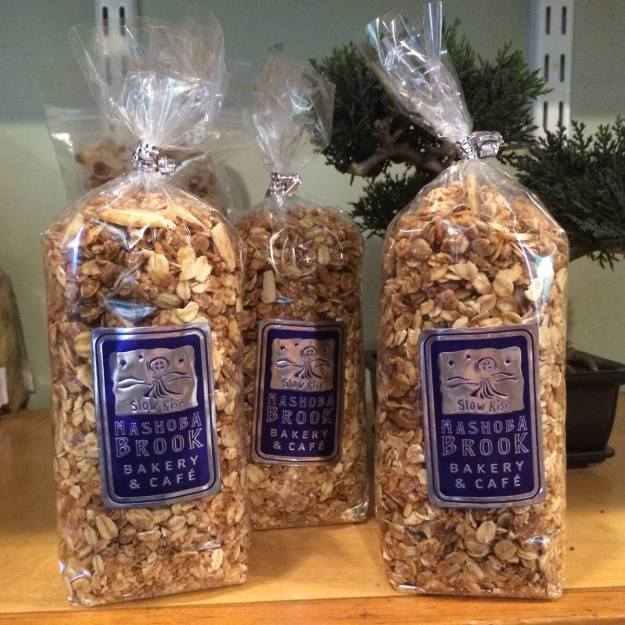
Today’s Washington Post reports that last Tuesday, the Food and Drug Administration sent a formal letter of warning to a Massachusetts bakery, regarding a series of violations, one of which was with regard to the labeling of the bakery’s famous granola.

It seems that the Nashoba Brook Bakery in Concord is proud of its granola.

I’m glad.

It’s one of those artisanal bakeries where they aren’t just in the bread and cookie business, but understand themselves as part of the community in a deep way, as a place that takes care of its people, etc., all of which is also surely commendable.

People love the bakery. It has a following, and a bit of a sense of humor.

Keep that in mind, because apparently, if you look at the ingredients listed in their granola, in addition to oats and almonds and brown sugar and stuff, the folks at the bakery have also listed “love” as an ingredient.

According to the Post, “the ‘ingredient’ was a nod to the passion bakers put into their product and a wink to the fans of the snack.”

Well, that was all a little to cute to the FDA, which has regulations about such things, and so on Tuesday, they warned the bakery that “love” was considered “intervening material” on a list of ingredients, and needs to go.

From now on, if “love” is going to be an ingredient, it’s going to have to be a secret one.

What is it with love and bakeries, right now?

You’ve probably heard that in its current term, the US Supreme Court has agreed to hear Masterpiece Cakeshop v. Colorado Civil Rights Commission, a case that is also, in its own way, about love–specifically, the right of a bakery to deny a customer service for religious reasons, namely, the baker’s faith-based objections to same-sex marriage.

The baker argues that his cakes are a form of expression, and that therefore he cannot be forced to use his creativity for something in which he does not believe. (See Robert Barnes, “In Major Supreme Court Case, Justice Department Sides With Baker…”, Washington Post 7 September 2017.)

In some sense, he’s claiming that the couple’s love represents a challenge and an affront to his own–his love of craft and right to self-expression through that craft, which is such that he feels it must be desecrated by being placed in service to an unworthy recipient, namely, a same-sex couple getting married.

Notionally, I wonder how far he takes this.

When former clients end up divorcing, does he go after some sort of marriage-means-forever security deposit? Make people return any uneaten portions of the cake they might still have in the back of the freezer?

What does the cake actually mean?

Kind of a lot. For everybody.

For many same-sex couples, there is the abiding awareness of having to keep their love secret — the all-too-familiar-reality that love as they felt and lived it was a “secret ingredient” in so many lives, almost everywhere, and among almost everyone.

That this is no longer the case in more communities (though even now, far from all) is very recent history — which explains some of the power of being able to proclaim it openly at this particular moment — as if love and the liberation of loving and being loved were not already worthy of being proclaimed and celebrated all by themselves. Which for almost everyone else, they are.

People claiming their right to love and be loved are making a powerful public act.

So is refusing to make them a cake when they do.

But it’s a fundamentally despicable one.

The Book of Leviticus declares: “No man among your descendants for all time who has any physical defect is to come and present the food of his God” for sacrifice.

“No man with a defect is to come,” it says, “whether a blind man, or a lame man, a man stunted or overgrown, a man deformed in foot or hand, or with misshapen brows or a film over his eye or a discharge from it….” (Leviticus 21:21).

The list goes on, a sobering reminder that the Bible is, indeed, often entirely comfortable with notions of second-class citizenship.

Even today, a baker who considered it essentially “un-Biblical” to bake for a blind person or someone in a wheelchair could claim solid Scriptural footing.

But the Bible also tells us about heroines like Ruth and Esther, who loved across boundaries and, in so doing, both saved themselves and became foremothers of the entire people.

In the Bible, love liberates.

The strength of the faithful and their success as a people waxes and wanes as they learn forget, and remember that central idea.

It’s the key ingredient in everything.

On that, everyone involved in the court case surely ought to agree.

That only some do tells you just about everything you need to know.

From the Newsletter: “Thoughts and Prayers”

thoughtsprayers

Dear Friends of Second Church,

The reports out of Las Vegas earlier this week have sent us reeling once again, the most recent heartbreak in a long season of devastation.

I’m sure you’ve also seen the pushback against one traditional form of public condolence, the promise that the victims and their families “are in our thoughts and prayers.”

I can understand the pushback — condolences are easily spoken, but not necessarily deeply felt. Pious assurances of sadness and good will, all by themselves, fall well short of God’s call to bring healing to a broken world in the name of Jesus, which is the clear mandate of all Christians.

But I’m also convinced that prayer does matter — it matters deeply.

It matters in large part because, when prayers are deeply felt, they quickly express themselves in actions, like the many citizens of Las Vegas who stood in line for hours to donate blood just hours after the shooting, to name just one obvious example.

For some of us, such gestures are almost instinctive—maybe even more so than kneeling or lifting our hands or speaking particular words to God.  For some of us, the gesture is the prayer.

Either way, prayer is our reminder in word and practice that we are connected to God and neighbor in ways beyond distance, difference, and even time itself.

Eternity is alive in prayer.

In part this means that prayer expresses itself in other concrete steps to offer comfort or, at a more official level, to learn lessons from tragedy, as we seek to show that we are engaged beyond the moment—to live out the truth that we are, in the end, one.

It is in such moments that the full power of human creativity and generosity, both central gifts from God and vital channels of divine grace, start getting to work.

When that happens, I start to feel a little more hopeful about humanity’s chances, despite the many challenges that we face—so many of them, sadly, challenges we have brought upon ourselves.

So I am not one to say that the time for “thoughts and prayers” is over.

I think the world is aching for it begin.


See you in church,