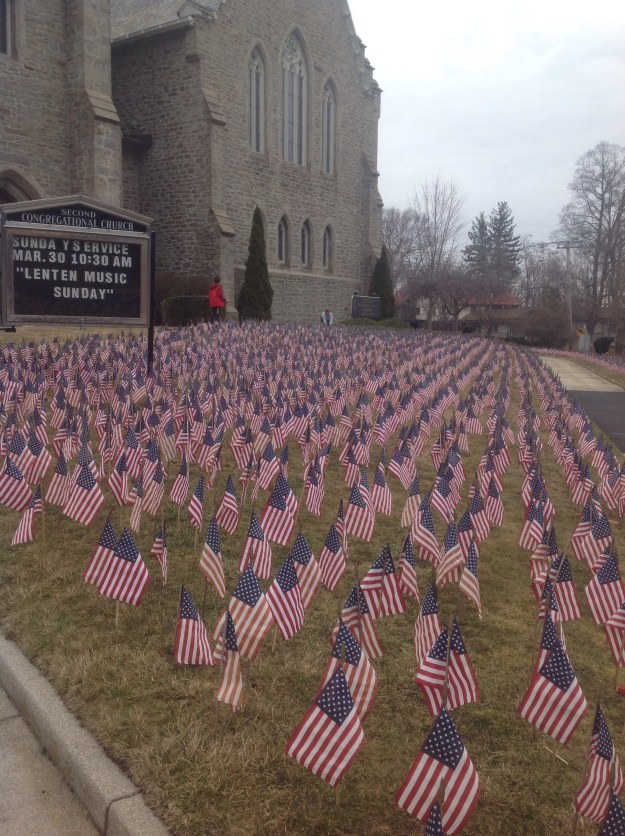
Every year around Fourth of July, my father gets out the kitchen step ladder to hang the American flag from the eaves of their front porch.
If that conjures a kind of Norman Rockwell image for you, then you’re picturing it correctly. Old house, white picket fence, yard, dog, just down from the post office in a pretty Connecticut shoreline town…the kind of place where the hardware store is as close as they come to a men’s club.
My dad hangs the flag vertically, which is a subtle form of showing off because there are rules about where the blue field with stars should be, which he has looked up, and while has never said so, I suspect that he keeps hoping that someone will challenge his placement and allow him to show them the relevant pages on flag ettiquette in our family copy of Chapman’s Piloting.
That nobody has, in fact, ever challenged this is, for him, a sign of national decay.
The fact that in their particular town it is not unreasonable to imagine that each and every family might well have its own copy of Chapman’s Piloting, and therefore know that he is following the directives of the Department of the Navy and the U.S. Power Squadron…well, that has not really occurred to Dad.
You see my dad is not just a member of the Old School. He is like the Headmaster of the Old School.
I meant that.
And so the things about that flag on their front porch that is remarkable is not simply that it’s hung according to regulations. That’s basic.
The thing that’s actually worth noticing about it is that the stars seem off–their rows are staggered in a funny way, almost zigzagging back and forth along the left edge, as if Betsy Ross needed new glasses.
But that’s not it. Or I should say, you come realize that that’s not it when you actually make the effort to count the stars. Because it’s them that you realize: it’s a 49 star flag.
I told you he was old school. It may be the only piece of Eisenhower memorabilia my family owns. Certainly, it is the only one our family displays.
And let me just say, flying an older version of “Old Glory” is not some form of protest on my father’s part. Let me affirm, especially with our friend Jeffrey Mead back in town for a visit, that we Grants love Hawaii as much as anyone.
So part of it is nostalgia. But only part. There’s more to it than that. Because if I’ve learned anything from my father, it’s that like that flag, America is unfinished. The work of securing a more perfect union is unfinished. The responsibility of this country to stand for liberty and justice for all is unfinished.
So many have done so much as a part of that work. Yet it continues, even now. As recent events have reminded us all, I’m sure. we’re not at the end of that work. We’re very much in the middle of that work.
And as the last two weeks have shown, that work is not easy.
Our congregation is like so many, in that there are a wide range of experiences and perspectives that come together here. I can’t say with any certainty where many of you may be on the symbolism of flags, the proper role of government, or how to define marriage.
But I’m reminded of two things Benjamin Franklin said in the days when the Founding Fathers were meeting in Philadelphia.
The first was early on, when the outcome of the Revolution was by no means assured.
Speaking to members of the Continental Congress, Franklin observed, “We must all hang together…or most assuredly, gentlemen, we will all hang separately.”
The second moment was just after the Constitution Convention finished drafting the Constitution. One evening, as he returned home, a woman leaned her window and said, “Well Mr. Franklin, what kind of government is it to be?” And he tipped his hat to her and said, “Madam, a republic…if we can keep it.”
The challenges of hanging together, and of keeping what was imagined for us remain hard work.
Wherever you are today, however it seems personally to you that things are going right now, I hope you’ll decide to remain committed to that work.
In whatever ways you feel called upon to do it…whatever it seems to you the work we need is, even if it’s just talking to a neighbor or telling a grandchild about what it is to serve our country, I hope you’ll do it.
Seeking and serving the greater good needs all of us.
In this morning’s gospel, we get a brief look at a community that seems as if it has forgotten that.
It is Jesus’ own home community of Nazareth, to which he has returned. His ministry has begun–it is beginning to hit its stride. The disciples have appeared. The healings have begun. He’s been baptized in the Jordan, tempted in the desert, started to talk in parables, and even the wind and sea obey him….and in Mark’s gospel, that’s just the first five chapters.
And then he comes home.
Is it nostalgia for the small town ways he’d known and lived so long that brings him back? Was it like driving by your old exit on 95 when you’re headed somewhere else, and deciding to take the Post Road through town just for old time’s sake?
When he sees all the familiar cars parked in front of the synagogue, does he look at his watch and say, “well…why not?”
He slips in just after the first hymn. Bob Willett hands him a bulletin and points to his family’s pew, which maybe one of his sisters or their kids is holding down solo, and there he is, back.
And we don’t know how long he’s been gone, but you know that you don’t need to be away from home long to come back and see it with new eyes, the way you do when you come home for Christmas after your first semester in college…the way you do when you’ve finished Basic and you’re home before shipping out…the way you do your first Sunday back after the baby’s been born or your divorce becomes final or you met with the doctor to go over your results.
And your world is bigger. Bigger and a whole lot more complicated than it was the last time you were here. It’s all changing and you’re just like…whoa.
Do you ever have Sundays when you kind of dread coffee hour after church because you know that someone’s going to ask you what’s up, what’s new, or how you’re doing…and you don’t want to lay something heavy on them but…big things are happening?
I wonder if that’s how it was for Jesus.
And so maybe by getting up to read the Torah, maybe by getting up to do this impromptu sermon, Jesus wasn’t exactly meaning to proclaim the coming Kingdom of God to them.
Maybe he was just trying to head off all the questions by talking about how the Kingdom of God had come to him. Because they always tell you to start that kind of thing with an “I” statement, right? Maybe that’s what’s going on here.
But he sees the whispering. The frowning. The people sitting in the pew texting the others who aren’t…OMG Jesus back. Not good. Ttyl.
Or whatever it is they wrote.
Standing there in the pulpit, Jesus sees all that.
He sees it and he knows that in some fundamental way, he is “of Nazareth” no longer. That these people — his people — are no longer the ones with a claim on him.
You see, they can’t imagine that unfamiliar truths might come from a familiar face. They can’t imagine that their world could be called to stretch, and their minds could be called to change, and their hearts to grow. They can’t imagine that God might have anything new to say.
What they see instead, or what they think they see, is the impertinence of Jesus, rather than his radical invitation to join him and become part of the Kingdom of God.
Whatever the reason, they are willing to listen, but they are not ready to hear.
What he says is just too different, and it frightens them.
“This is Nazareth, Jesus. Remember your place. This is heritage, son. Not hate.”
Like so many communities, Nazareth seems to see its very survival on people knowing their place and staying in it.
And Jesus returns to invite them into a world where we’re forever changing places, giving up our seats for others and finding ways to make more places available.
He’s saying that in the Kingdom of God, everyone has a place…and until we’re all together, the work remains unfinished.
If we are honest with ourselves, we know that they’re right to be afraid. Because living the way that Jesus was inviting them to live was an invitation change everything–starting with themselves, starting with the very security and comfort that they had worked so hard to achieve and were so understandably jealous to preserve.
They were right to be afraid.
So should we. Because all these years later, this is still true. He still asks the same thing.
On July 4th weekend, we remember that as Americans. we are called to “form a more perfect union.”
As Christians, we are called to remember that there is only one union that is truly, finally perfect, and that is a world united in God through Jesus Christ.
There is much to do on both fronts.
The good people of Nazareth–and I don’t for a minute doubt that they were good people–could not see their way clear to God’s glorious future.
And it is so hard when our children return from out there in the world with a message about yet some other change that we are supposed to embrace, or be called a throwback or a dinosaur or part of the problem.
That’s why listening–hearing–seeking to understand is so important…such an act of faith.
God is not simply a force for change. If you read your Bible, you’ll know that God is not One who seeks changes for change’s sake.
But time and time again, the force of goodness, and the force of justice, and the force of love are harnessed in the force of change, and God’s hand is in it.
We know that about God. And so we are called to listen, and hear, and to seek to understand where God is in the world as it changes. And we are especially called to do that in times like these, when the world seems to change before our very eyes.
In gratitude for the many who sacrificed their lives for our freedom, and in gratitude for the one who sacrificed his life that all might be free, may we rededicate our lives to a more perfect world for all people. .
The people of Nazareth chose to stay put. But we must not. That’s not the Jesus way. And our neighbors and our souls need us to move forward, however it is that we can.
We’re still very much in the middle of the work.
May there always be room for another voice, another point of view, another friend, and another star.
AMEN.



 Faith Meets Week